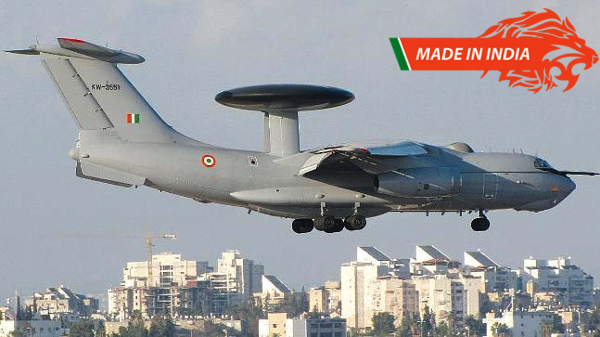
The Indian Air Force is preparing for a major expansion of its airborne surveillance network, with an active requirement for six new Airborne Early Warning and Control aircraft capable of full 360-degree surveillance. The move comes as DRDO simultaneously advances the indigenous Netra family, including the six-aircraft AEW&C Mk-II programme, signalling a long-term effort to build a much larger and more capable fleet of airborne command-and-control platforms.
The IAF formally issued a Request for Information on January 5, 2026, for the procurement of Airborne Early Warning and Control aircraft along with associated ground systems.
The RFI seeks six aircraft, according to the document details reported from the requirement. More importantly, the specifications call for a mission suite capable of maintaining full 360-degree surveillance, giving India another layer of airborne radar coverage beyond its existing fleet.
New Aircraft Must Watch the Entire Battlespace
An AEW&C aircraft is much more than a radar mounted on an airliner.
The IAF describes the proposed platform as a “system of systems” combining long-range radar, Identification Friend or Foe equipment, electronic surveillance measures, communication-support systems, command-and-control facilities, battle-management software and secure data links.
The aircraft is expected to have either at least ten hours of endurance or aerial-refuelling capability, operate at altitudes up to approximately 45,000 feet and use airfields situated at elevations approaching 10,000 feet.
That last requirement is particularly relevant to operations along India’s mountainous northern frontier.
The mission system is expected to provide full 360-degree coverage and detect a wide spectrum of aerial threats, ranging from small and slow-moving targets to very high-speed and hypersonic threats.
Such capabilities would allow the aircraft to monitor fighters, bombers, cruise missiles and unmanned systems while simultaneously directing friendly combat aircraft and feeding information into India’s wider air-defence network.
Why 360-Degree Coverage Is Important
India’s original indigenous Netra AEW&C uses an electronically scanned radar mounted over the Embraer ERJ-145 platform.
It represented a major technological achievement for DRDO and established India’s ability to design and integrate a sophisticated airborne surveillance and battle-management system domestically.
However, the original Netra’s radar architecture does not provide the continuous all-round coverage associated with a full 360-degree AWACS configuration.
For future high-intensity air warfare, complete coverage provides an important advantage.
An AWACS orbiting hundreds of kilometres from the front can continuously watch airspace in every direction without having to orient the aircraft towards a particular threat axis. This allows it to manage multiple engagements simultaneously and maintain awareness of threats approaching from unexpected directions.
That capability becomes particularly valuable when dealing with cruise missiles, drones and long-range aircraft operating across a wide battlespace.
Netra Reaches Final Operational Clearance
The new requirement comes at an important moment for India’s indigenous airborne surveillance programme.
On June 25, 2026, DRDO formally handed the Final Operational Clearance certificate for the indigenous Netra AEW&C system to the Indian Air Force.
The Ministry of Defence described Netra as an indigenous system developed through collaboration between DRDO, the IAF and Indian industry to improve airborne surveillance, situational awareness and battle-management capability. Its Initial Operational Clearance had been granted in 2017.
The achievement is significant because Netra created an indigenous technological foundation covering airborne radar, electronic systems, mission computers, communications and command-and-control integration.
India can now build on that knowledge rather than beginning every future AWACS programme with an entirely foreign mission system.
Six Larger Netra Mk-II Aircraft Move Ahead
The next major step is already underway.
On July 22, 2026, DRDO’s Centre for Air Borne Systems signed two important contracts for the AEW&C Mk-II programme.
The first was with AI Engineering Services Limited for conversion of six Airbus A321 aircraft from commercial configuration. A second contract appointed Adani Defence Systems and Technologies Limited as the Development-cum-Production Partner for the Mk-II mission systems.
DRDO’s Centre for Air Borne Systems will remain responsible for integrating the mission equipment onto the modified aircraft.
DRDO, Adani Defence and the IAF will then conduct flight testing before the aircraft receives certification from India’s military airworthiness and quality-assurance authorities.
The Ministry of Defence says Mk-II will offer greater endurance, advanced airborne surveillance, secure communications, improved situational awareness and enhanced command-and-control capabilities.
This makes the A321-based Mk-II significantly more ambitious than the original Embraer-based Netra.
Mk-II and a Full 360° AWACS Serve Different Requirements
It is important not to confuse the A321-based AEW&C Mk-II with the new six-aircraft 360-degree requirement.
The Mk-II programme was formally approved earlier. Government records show that Acceptance of Necessity for six AEW&C Mk-II aircraft was granted in December 2020 under the Buy (Indian-IDDM) category.
Available reporting on the configuration indicates that Mk-II is expected to provide substantially wider coverage than the original Netra, but it is not the same architecture as a conventional full-circle AWACS.
The January 2026 IAF requirement specifically raises the ambition to a mission suite with 360-degree scanning capability.
India could therefore eventually operate a layered airborne surveillance fleet: smaller indigenous Netra aircraft, larger A321-based Netra Mk-IIs and another class optimised for persistent all-round AWACS coverage.
India Has Pursued a 360° Indigenous AWACS for Years
The Ministry of Defence confirmed in 2019 that the Defence Acquisition Council had revalidated the requirement for additional AWACS India aircraft, whose mission systems and subsystems were to be indigenously designed, developed and integrated by DRDO.
Earlier concepts examined wide-body aircraft carrying large indigenous radar systems capable of all-round surveillance.
DRDO-hosted defence documentation has also recorded previous studies involving Airbus A330-class aircraft and indigenous 360-degree radar systems, showing that a large AWACS has been part of India’s long-term technological planning for years.
What has changed is the operational environment and urgency.
The IAF’s latest RFI sets demanding endurance, altitude and radar requirements and explicitly seeks a system able to detect threats ranging from small targets to hypersonic vehicles.
An Airborne Command Centre
AWACS aircraft become especially valuable when air battles extend across hundreds of kilometres.
Ground radars are constrained by terrain and the curvature of the Earth. Low-flying aircraft and cruise missiles can exploit these limitations.
Placing the radar thousands of metres above the ground dramatically increases the sensor horizon.
But detection is only the first part of the mission.
An AWACS can identify tracks, prioritise threats, direct fighters towards targets and distribute the resulting information through secure data links. It can also coordinate aircraft without requiring fighters to constantly operate their own powerful radars.
That improves situational awareness while allowing combat aircraft to operate more efficiently as part of a networked force.
During a complex confrontation involving fighters, drones, missiles and ground-based air-defence systems, that airborne command function can become as important as the radar itself.
Indigenous Content Becomes Strategically Important
Developing the mission system domestically also provides benefits that go beyond industrial self-reliance.
An indigenous radar and battle-management architecture gives India greater control over software, electronic warfare integration, threat libraries and future upgrades.
New Indian missiles, fighters, unmanned aircraft and ground-based air-defence systems can be incorporated into the network without relying completely on a foreign supplier for every modification.
The Mk-II programme already demonstrates this approach.
Airbus will support modification of the aircraft platform, while DRDO and Indian industry will develop and integrate the mission systems that give the aircraft its military capability.
That distinction is important: the airframe may originate overseas, but the radar, electronic systems and command-and-control architecture can increasingly come from India’s own defence ecosystem.
From Netra to a Larger Airborne Surveillance Fleet
India’s airborne surveillance effort is now progressing along several tracks simultaneously.
The original Netra has achieved Final Operational Clearance.
Six larger A321-based AEW&C Mk-II aircraft have moved into the industrial conversion and mission-system phase.
At the same time, the IAF has placed a new requirement before industry for another six AEW&C aircraft with full 360-degree surveillance capability.
The final platform and industrial structure for that newest requirement have not yet been announced. Nor has DRDO or the Ministry of Defence formally designated it “AWACS Mk3.”
Claims that an Airbus A330 has already been selected for a new Mk3 programme therefore go beyond what official sources currently establish.
What is official is already substantial.
The IAF wants a new generation of long-endurance airborne surveillance aircraft capable of watching the entire battlespace, while DRDO is steadily building the domestic technologies needed to reduce India’s dependence on imported airborne radar systems.
If these programmes proceed as planned, the coming decade could see India move from a small fleet of scarce “eyes in the sky” towards a much broader network of indigenous and indigenously integrated airborne command centres capable of supporting continuous operations across multiple fronts.
For the IAF, that expansion would represent more than an increase in aircraft numbers. It would strengthen the information network that allows fighters, missiles and air-defence systems to see farther, react sooner and fight as one integrated force.
Sources
Indian Air Force / Government e-Procurement Portal — January 5, 2026: Active RFI for procurement of Airborne Early Warning and Control aircraft with associated ground segment.
Ministry of Defence / PIB — July 22, 2026: Contracts for conversion of six A321 aircraft and development/production of mission systems for the indigenous AEW&C Mk-II programme.
Ministry of Defence / PIB — June 25, 2026: Final Operational Clearance of DRDO’s indigenous Netra AEW&C system.
Ministry of Defence / PIB: Official record of Acceptance of Necessity for six AEW&C Mk-II aircraft under Buy (Indian-IDDM).
You may also like
-
India Moves Towards Five-Year Assured Orders for Defence Startups Under New Procurement Reforms
-
BHEL–Coal India Joint Venture Begins Construction of ₹25,016 Crore Indigenous Coal Gasification Project in Odisha
-
Zen Technologies Introduces Indigenous Hyper-Strike Falcon AI-Guided Counter-Drone Interceptor
-
L&T and Germany’s SCHOTTEL Expand Partnership for Controllable Pitch Propeller Systems in Indian Shipbuilding
-
India to Train 60,000 Civil Defence Volunteers Across 12 States and UTs with Indian Army Support
