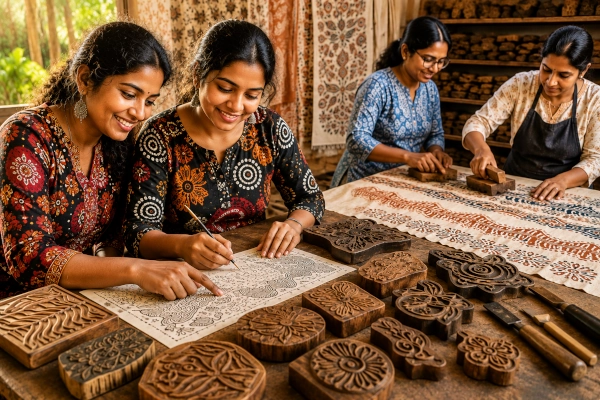
A remarkable collaboration between Indigenous Australian artists and traditional Indian craftspeople has transformed dozens of culturally significant textile designs into durable hand-carved woodblocks, creating a new way to preserve artistic traditions that have been passed through generations.
The project connects the Bábbarra Women’s Centre in Maningrida, Northern Territory, with Bengaluru’s Tharangini Studio, bringing together two women-led organisations with distinct but deeply rooted textile traditions.
At the heart of the initiative are designs created by Indigenous women artists from West Arnhem Land. Bábbarra artists have long used lino printing and screen printing to place ancestral stories, traditional foods, spiritual beings and aspects of community life onto textiles.
However, the tropical conditions of Arnhem Land presented a practical problem. Heat and humidity were gradually degrading some of the lino blocks used to reproduce the designs. The search for a more durable medium eventually brought the Australian artists together with Tharangini Studio and India’s centuries-old tradition of woodblock printing.
More Than 70 Designs Recreated in Teak
The collaboration resulted in more than 70 designs from Bábbarra’s archives being translated into hand-carved wooden printing blocks.
The process involved considerably more than simply copying the original designs. Individual works were traced onto paper and returned to the relevant artists and cultural custodians for approval before carving began.
Artisans at Tharangini then recreated the approved designs in seasoned teak, giving the artworks a physical medium capable of surviving repeated use over long periods.
Tharangini’s experience made the Bengaluru studio particularly suited to the project. Its artisans have worked with traditional hand-block printing for more than half a century, while the studio retains wooden blocks more than a century old that can still be used for printing today.
Two Textile Traditions Meet in Bengaluru
The collaboration was developed with support from the Centre for Australia–India Relations’ Maitri program, which promotes cultural and people-to-people links between the two countries.
Australia’s Department of Foreign Affairs and Trade has also highlighted the project as an example of First Nations engagement with India. The partnership enabled artists to share techniques while creating textiles that combine Bábbarra’s Indigenous Australian visual traditions with Indian woodblock-printing skills.
The project was named Karri-djarrk-durrkmirri, meaning “we work together” in Kuninjku. Its name captures an unusual creative relationship in which differences in language became less important than the shared practical vocabulary of drawing, carving, printing, fabric and colour.
Senior Bábbarra artists Deborah Wurrkidj and Janet Marawarr travelled to India in 2023. A larger delegation followed in 2024, while Tharangini director Padmini Govind also travelled to Maningrida as the exchange developed in both directions.
21 Textiles Displayed in Bengaluru
The partnership moved beyond preservation into the creation of an entirely new body of textile work.
In October 2024, the Bangalore International Centre hosted the Karri-Djarrk-Durrkmirri (We-Together-Work) exhibition. It presented 21 unique hand-printed textiles created from 77 individual woodblocks, with designs developed by Bábbarra artists across approximately two decades.
The exhibition combined Indigenous Australian imagery with South Indian printing traditions. Natural dyes and sustainably sourced fabrics formed an important part of the production process, while some works also incorporated embroidery by women artisans from the Porgai Artisan Association in Tamil Nadu.
The exhibition therefore became more than a presentation of preserved designs. It demonstrated how traditional crafts from different parts of the Indo-Pacific could interact while allowing the original cultural stories and artistic ownership behind the designs to remain central.
The exhibition subsequently travelled to Australia’s Northern Territory in 2025, taking the collaboratively produced textiles back to the region from which the original designs emerged.
Preserving Art for Another Generation
An important legacy of the project will remain in Maningrida itself. Some of the woodblocks and original lino material are intended for preservation in the community’s museum collection, giving future generations an opportunity to study and reconnect with the designs.
The collaboration has also received wider recognition. Creative Australia named the Bábbarra Women’s Centre and Tharangini Studio as recipients of an Asia Pacific Arts Innovation Award, recognising the project as an innovative approach to building creative connections across Asia and the Pacific.
What began as a practical effort to protect vulnerable lino designs has consequently developed into a broader Australia–India cultural partnership.
By combining Indigenous Australian knowledge with Bengaluru’s traditional wood-carving and textile-printing skills, Karri-djarrk-durrkmirri demonstrates how heritage crafts can serve not simply as reminders of the past, but as practical tools for carrying cultural memory into the future.
You may also like
-
Yavana in the Mahabharata: Greek Connections, Pandava Campaigns and the Warriors of Kurukshetra
-
India and Sri Lanka Launch SAMHiTA Manuscript Digitisation Project to Preserve Ancient Buddhist Heritage
-
ASI Uses Ground-Penetrating Radar to Investigate Ancient Buddhist Stupa at Ujjain After Nearly 90 Years
-
Pahlava: The Parthian World Beyond India’s Northwestern Frontiers in the Mahabharata
-
Namami Gange in 2026: 368 Projects Completed, 4,339 MLD Sewage Treatment Capacity Created as Ganga Rejuvenation Advances
