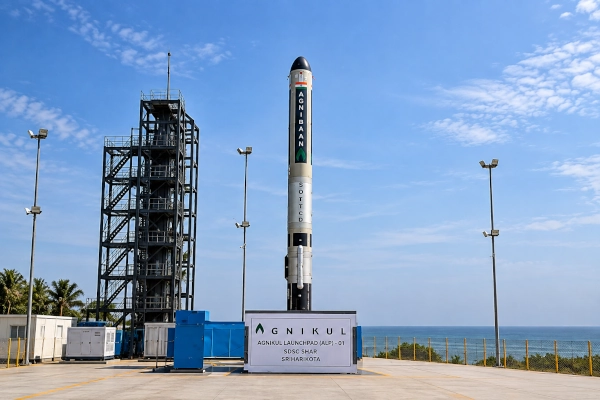
Indian space startup Agnikul Cosmos has completed a fresh firing of its Agnite semi-cryogenic rocket engine, carrying out multiple thrust sweeps and an extended-duration run as work progresses towards Mission-02 of the Agnibaan programme.
Agnikul said the latest test was designed to study throttling behaviour by varying thrust during operation. The company also allowed the engine to run for a duration beyond the maximum burn time required by some of its ascent-phase engines, generating additional endurance data before flight.
Agnite Is the Booster-Stage Engine for Agnibaan
Agnite is Agnikul’s one-metre-tall semi-cryogenic engine designed for the booster stage of the Agnibaan launch vehicle.
The engine uses electric motor-driven pumps to deliver propellants to the combustion chamber. Agnikul’s official product documentation says the same Agnite architecture can also be used in a vacuum-optimised configuration for the second stage.
This electric-pump approach allows the company to vary propellant flow through motor control, which supports finer thrust management and a highly configurable engine-clustering architecture.
Entire Combustion Section Is 3D-Printed as One Piece
Agnikul has built its propulsion strategy around additive manufacturing.
According to the company, the entire combustion section of Agnite is manufactured as a single-piece assembly using 3D printing. This reduces the number of individual parts and joints that would normally require separate manufacturing and assembly.
The design philosophy is central to Agnikul’s approach to launch-vehicle production. Instead of relying on a large number of individually fabricated combustion components, the company integrates much of the engine geometry into a single manufactured structure.
Agnikul has previously emphasised that the innovation lies not simply in using additive manufacturing, but in producing an entire rocket-engine assembly as a single piece of hardware.
Latest Test Focused on Throttling
The October 6 firing concentrated on one of the more important capabilities of an electric-pump-fed engine: thrust modulation.
Agnikul said engineers completed several thrust sweeps to understand how Agnite behaves as engine output changes. Throttling is valuable because it allows a launch vehicle to adjust thrust during different stages of ascent rather than operating only at one fixed output level.
The company had already demonstrated deep throttling of an electric motor-driven semi-cryogenic engine by varying motor speed. It said this architecture provides high accuracy and rapid response, both of which are useful when a launch vehicle must follow a demanding trajectory.
The latest firing extends that work by combining thrust variation with a longer operating period.
Engine Ran Beyond Required Burn Duration
Agnikul also said Agnite was operated for a period well beyond the maximum burn time of some of its ascent-phase engines.
Running an engine beyond a nominal mission requirement helps engineers gather additional data on thermal behaviour, combustion stability and component endurance.
A longer ground firing also provides margin before flight. Rocket propulsion systems must remain stable as temperatures rise and structural loads accumulate, so extended tests can reveal behaviour that may not become apparent during shorter firings.
The company has not disclosed the exact duration of this latest test in its public update.
Agnite Has Already Passed a Series of Ground Tests
The October firing builds on a sequence of propulsion milestones completed by Agnikul during 2026.
In March, the company test-fired its one-metre single-piece Agnite booster engine. In April, it demonstrated a 77-second repeatability test, followed by additional engine-cluster and quick-start demonstrations in May and June.
Earlier in February, Agnikul successfully test-fired three semi-cryogenic engines simultaneously, while a four-engine firing followed in May.
These tests indicate that the programme has progressed from individual engine validation towards the clustered propulsion architecture required for the Agnibaan launch vehicle.
Agnibaan Uses a Clustered Engine Architecture
Agnibaan is designed around modularity rather than a single fixed propulsion configuration.
Agnikul says its launch vehicle can use different engine clusters depending on payload and mission requirements. The company describes this as a way of tailoring the launcher more closely to individual missions rather than forcing every satellite into the same vehicle configuration.
The Agnite engine is central to that approach because multiple identical engines can be clustered to produce the required thrust.
Using the same basic engine architecture across stages and configurations can also simplify manufacturing and provide greater commonality across the launch system.
Mission-01 Demonstrated the Technology in Flight
Agnikul completed Mission-01 in May 2024 with the flight of the Agnibaan SOrTeD suborbital technology demonstrator from its private launchpad at Satish Dhawan Space Centre, Sriharikota.
The mission achieved a 66-second powered flight with controlled ascent and demonstrated Agnikul’s autopilot, launch operations and propulsion architecture.
According to the company, Mission-01 included several firsts. It was the world’s first flight using a single-piece 3D-printed rocket engine, India’s first flight powered by a semi-cryogenic engine and the first launch from a private launchpad in the country.
The vehicle also used aviation-grade fuel with liquid oxygen and incorporated a Linux-based computing architecture connected through Ethernet.
Mission-02 Moves Towards a More Ambitious Configuration
Agnikul has repeatedly described Mission-02 as the next major step in the development of Agnibaan.
In July 2026, the company announced that Mission-02 would incorporate a reusable booster recovery concept along with a convertible upper-stage architecture. This points to a programme that is moving beyond technology demonstration towards a more flexible launch system.
Agnikul has not announced a final launch date for Mission-02 in its latest engine-firing update.
The company has instead said that the mission is getting progressively closer as propulsion testing, vehicle development and supporting infrastructure mature.
New Test Facilities Support Faster Development
Agnikul has also expanded its ground infrastructure during 2026.
In September, the company inaugurated new STIF and PROOF facilities in Chennai, adding more dedicated infrastructure for engine and propulsion-system testing.
The company has also announced plans for a ₹400 crore expansion in Thoothukudi, Tamil Nadu, as it builds additional manufacturing and testing capacity.
These facilities are important because private launch companies require repeated ground testing before flight. Having dedicated infrastructure can shorten development cycles and allow greater control over qualification schedules.
Public Funding Is Supporting Further Development
Agnikul’s development programme has also received government-backed financial support.
In September 2026, the Technology Development Board signed an agreement with the company for ₹200 crore under the Research, Development and Innovation Fund.
The support is intended to strengthen indigenous launch-vehicle development and commercial space capabilities.
Agnikul has also received backing from Tamil Nadu institutions and has worked with ISRO, IN-SPACe, IIT Madras and the Technology Development Board during different stages of its development.
From Engine Innovation to Launch-System Maturity
The significance of the latest Agnite firing lies in the transition from proving individual engine technologies to demonstrating repeatable propulsion performance across a wider operating envelope.
A single-piece 3D-printed engine, electric motor-driven pumps and clusterable propulsion represent a distinctive technical approach, but their value ultimately depends on reliable operation across repeated tests and full flight profiles.
The latest thrust sweeps and extended-duration firing provide additional data on how Agnite behaves when pushed beyond nominal operating conditions.
As Mission-02 approaches, Agnikul is steadily converting its propulsion architecture from a technology demonstration into the foundation of a practical Indian commercial launch system.
References
- Agnikul Cosmos — Official update on Agnite engine firing and Mission-02 progress, October 6, 2026.
- Agnikul Cosmos — Official product documentation for Agnibaan, Agnite and SOrTeD.
- Agnikul Cosmos — Official Media Hub, propulsion-test announcements, 2026.
- Agnikul Cosmos — Mission-02 Reusable Booster Recovery and Convertible Upper-Stage Concept, July 15, 2026.
- Agnikul Cosmos — Official Mission-01 and Agnibaan SOrTeD mission documentation.
You may also like
-
Sagar Defence Unveils Autonomous Vessel at SWAVLAMBAN 2026, Expands Manufacturing
-
Rajnath Singh Calls for Aatmanirbharta 2.0 in Defence at SWAVLAMBAN 2026
-
Defence Acquisition Council Clears ₹2.12 Lakh Crore Proposals, 82% Earmarked for Indian Industry
-
Manastu Space Secures ₹116 Crore Government Support to Develop Indigenous Green Propulsion Systems
-
GeM’s AABHAR Collection Showcases 294 Indigenous Products, Strengthens Market Access for Indian Artisans
