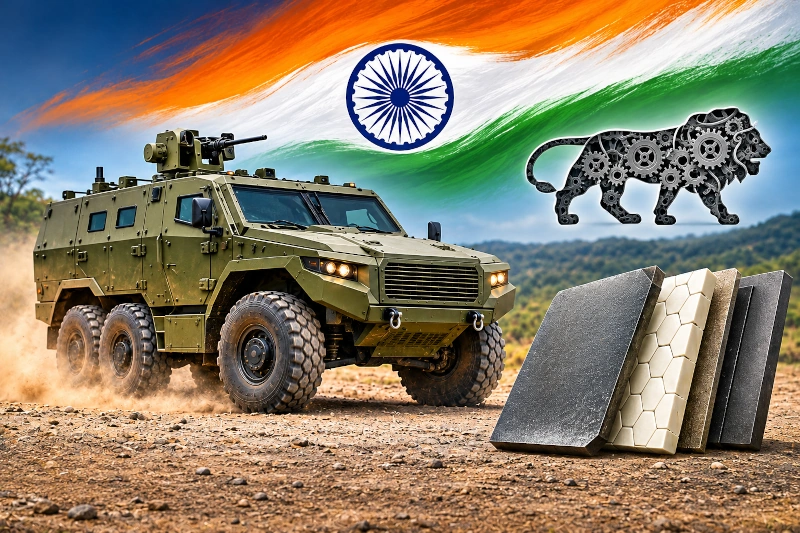
Carborundum Universal Limited (CUMI), a materials science and engineering company belonging to the Murugappa Group, has achieved NATO STANAG 4569 Level 4 qualification for its indigenously developed ceramic composite armour system designed for military vehicles. The qualification establishes that the company’s armour solution meets an internationally recognised standard for protection against high-velocity ballistic threats.
The Chennai-headquartered company has developed an integrated manufacturing capability extending from advanced ceramic powders and material processing to the production of ready-to-fit composite armour panels. Its technology is intended for armoured personnel carriers, military vehicles and other platforms requiring ballistic protection while maintaining vehicle mobility.
CUMI highlighted its latest protection capabilities in an announcement circulated on November 11, 2026. The company had previously confirmed its STANAG Level 4 qualification during its financial results conference in May 2026.
STANAG 4569 Level 4 Protection Against Armour-Piercing Ammunition
STANAG 4569 is a NATO standard that establishes protection requirements for occupants of military vehicles against ballistic threats, artillery fragments and explosive devices.
The standard defines different protection levels according to the type of threat, projectile characteristics and testing conditions.
STANAG 4569 Level 4 ballistic protection includes resistance against 14.5 × 114 mm armour-piercing incendiary ammunition, representing a substantially higher protection requirement than the lower ballistic levels.
According to CUMI’s technical documentation, its independently developed ceramic composite armour panels have qualified for STANAG 4569 Level 3 and Level 4 protection.
The company has also developed armour panels in collaboration with the Defence Research and Development Organisation’s Defence Metallurgical Research Laboratory (DMRL), which have achieved STANAG 4569 Levels 2 and 3.
These qualifications cover different threat categories and demonstrate the company’s ability to manufacture protection systems for varying operational requirements.
Indigenous Powder-to-Panel Manufacturing Technology
A distinguishing feature of CUMI’s armour technology is its integrated manufacturing process, which the company describes as a powder-to-panel capability.
The process encompasses the development of ceramic materials, powder preparation, processing, component engineering and the manufacture of finished composite armour panels.
Unlike conventional armour systems relying entirely on metallic protection, advanced ceramic composite armour combines hard ceramic materials with supporting structural layers.
The ceramic component provides resistance to projectile penetration, while the supporting layers contribute to absorbing and distributing the energy generated during impact.
CUMI’s product portfolio includes advanced materials such as Reaction Bonded Silicon Carbide (RBSiC) and Zirconia Toughened Alumina (ZTA).
These materials are used in composite armour systems designed to balance ballistic protection, structural requirements and weight.
Weight optimisation is particularly important for wheeled armoured vehicles because additional armour mass influences mobility, payload capacity, fuel consumption and mechanical performance.
The company’s integrated manufacturing capability allows it to develop and produce ceramic components and composite panels within its domestic manufacturing operations.
Protection Against Improvised Explosive Devices
In addition to ballistic protection, CUMI has developed composite armour panels intended to protect military vehicles against side-blast threats from improvised explosive devices.
According to the company’s technical documentation, these systems have achieved STANAG 4569 Levels 3 and 4 qualification for IED side-blast protection.
Such protection is relevant to military vehicles operating in environments where explosive devices may be positioned along roadsides or other routes.
The company has also been working on ceramic composite armour systems for vehicle underbody protection against explosive threats.
CUMI’s November announcement confirmed that qualification activities for underbody blast protection were continuing.
The underbody protection programme is separate from the company’s already qualified ballistic and IED side-blast protection systems.
Testing at DRDO and International Ballistic Laboratories
CUMI’s armour products have undergone testing and qualification at specialised Indian and international facilities.
These include the Defence Research and Development Organisation’s Terminal Ballistics Research Laboratory (TBRL) in Chandigarh and IABG in Germany.
The company’s technical documentation also identifies the Ballistics Research and Testing Centre at the National Forensic Sciences University in Ahmedabad among the facilities involved in testing its armour ceramics.
Ballistic qualification requires materials and assembled protection systems to withstand prescribed impact conditions under controlled testing procedures.
Such evaluations examine the behaviour of armour panels against specified ammunition and other threats, with successful qualification depending on compliance with the applicable standards.
CUMI states that its products have received 10 Indian and international qualifications covering armour ceramics and composite panels for personal and vehicle protection.
The qualifications span NATO STANAG 4569 requirements and standards associated with India’s Bureau of Indian Standards and the United States National Institute of Justice.
Collaboration with DRDO’s Defence Metallurgical Research Laboratory
CUMI’s indigenous armour development has also involved technological cooperation with DRDO’s Defence Metallurgical Research Laboratory.
Through a Transfer of Technology arrangement, the company developed lightweight add-on composite armour panels using advanced ceramic materials for wheeled military vehicles.
CUMI’s FY2024–25 Annual Report confirmed that these panels had been certified by Germany’s IABG laboratory in accordance with STANAG 4569 Levels 2 and 3.
The collaboration provided a technological foundation for the development and manufacture of indigenous ceramic composite armour systems.
The company’s subsequent expansion into independently qualified Level 4 protection represents an extension of its capabilities in advanced defence materials.
The development demonstrates the progression from technology collaboration and materials engineering to the manufacture of higher-protection indigenous armour systems.
Advanced Ceramic Protection for Military Personnel
CUMI’s defence materials portfolio also includes ceramic components for personal ballistic protection.
The company manufactures advanced armour ceramics intended for bullet-resistant jackets and protective equipment, including helmets and other specialised body protection systems.
Its technical documentation identifies qualifications corresponding to National Institute of Justice Levels III+ and IV and Bureau of Indian Standards Levels V and VI.
The materials are designed for incorporation into protective systems intended to resist specified ballistic threats.
Personal armour applications require materials that provide suitable protection while limiting weight and maintaining the mobility of personnel.
CUMI’s ceramic materials engineering capabilities therefore extend beyond vehicle armour into products used in protective equipment for security and defence applications.
₹49 Crore Manufacturing Facility for Advanced Defence Ceramics
CUMI has strengthened its domestic manufacturing capabilities through investments in specialised facilities for advanced ceramic components.
During its May 15, 2026, earnings conference, the company’s management confirmed the commissioning of a new facility with an investment of approximately ₹49 crore for manufacturing advanced ceramics used in ballistic protection for vehicles and personnel.
The facility forms part of the company’s expansion into higher-value engineering ceramics and specialised defence materials.
CUMI’s integrated operations cover the development and processing of ceramic materials and the manufacture of engineered components for industrial, aerospace and defence applications.
The investment adds domestic production capacity for advanced protection materials at a time when indigenous manufacturing has become an important component of India’s defence industrial development.
Importance for India’s Defence Manufacturing Industry
The availability of domestically manufactured, internationally qualified armour materials is relevant to Indian companies developing armoured vehicles and military protection systems.
Vehicle manufacturers must integrate ballistic protection into platforms while meeting requirements relating to weight, structural strength, mobility and operational performance.
Pre-qualified armour materials and composite panels can provide manufacturers with components that have already undergone testing against specified standards.
This can reduce the extent of material-level development and qualification work required when designing protection systems for new vehicle platforms.
CUMI’s capabilities are particularly relevant to manufacturers of armoured personnel carriers, protected mobility vehicles and other military platforms requiring varying levels of ballistic and blast protection.
The company’s indigenous ceramic production, composite armour engineering, DRDO collaboration and international qualifications establish a domestic source for specialised defence protection materials.
The STANAG Level 4 achievement confirms CUMI’s technical capability in manufacturing advanced ballistic protection solutions. The company has not announced a specific new military procurement contract or vehicle induction associated with the qualification.
You may also like
-
Hathor Rockets Plans ₹250 Crore Rocket Engine Manufacturing and Testing Facility in Andhra Pradesh
-
Alembic Pharmaceuticals Secures USFDA Approval for Generic Cancer Drug, Eligible for 180-Day Exclusivity
-
Escorts Kubota Plans New Tractor Manufacturing Plant in Uttar Pradesh with Initial Capacity of 60,000 Units
-
DISA India Inaugurates New Manufacturing Facility in Karnataka, Expands Industrial Equipment Production
-
Bharat Electronics Secures ₹619 Crore in New Orders for Drones, Electro-Optics and Defence Systems
