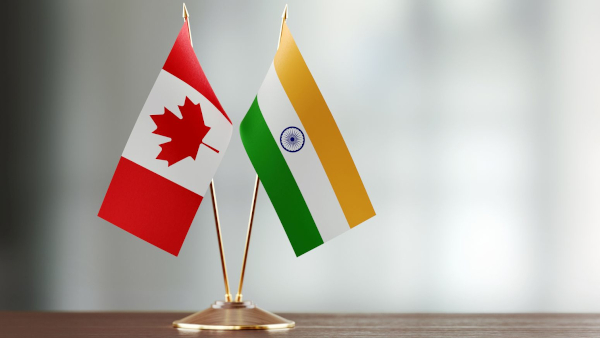
India and Canada have reviewed progress in bilateral security and law-enforcement cooperation, as both countries continue efforts to rebuild institutional engagement across national security, counter-terrorism and transnational crime.
National Security Adviser Ajit Doval met David Morrison, Senior Diplomatic and International Affairs Advisor to Canadian Prime Minister Mark Carney and Canada’s G7 and G20 Sherpa, in New Delhi on October 6, 2026. The meeting formed part of the regular bilateral security dialogue between the two countries.
Security Dialogue Builds on February Workplan
India and Canada had already agreed earlier this year to a shared workplan on national security and law enforcement, following Ajit Doval’s visit to Canada in February 2026.
That framework covers cooperation against violent extremism, terrorism, organised crime, narcotics trafficking, cybercrime, extortion, financial fraud and trafficking networks. It also calls for stronger information-sharing and more direct coordination between relevant agencies.
The October 6 meeting reviewed the state of this cooperation and explored additional areas where the two sides could work together.
Liaison Mechanisms Aim to Improve Information Sharing
A significant component of the bilateral security framework is the establishment of security and law-enforcement liaison mechanisms.
India and Canada have agreed that closer institutional links can help streamline communication between agencies and enable faster exchange of information on issues of mutual concern.
These mechanisms are particularly relevant for transnational organised crime, narcotics networks and other criminal activities that operate across jurisdictions and require cooperation between multiple enforcement agencies.
Counter-Terrorism Remains a Core Area
Counter-terrorism has long been part of the India-Canada security relationship.
The two countries established a Joint Working Group on Counter Terrorism in 1997 and later signed a Framework for Cooperation on Countering Terrorism and Violent Extremism in 2018.
The renewed security dialogue builds on these earlier mechanisms while expanding cooperation into areas such as cybercrime, organised criminal networks and financial offences.
Cybersecurity Cooperation Is Expanding
India and Canada have also agreed to formalise cooperation on cybersecurity policy and information sharing.
As digital infrastructure becomes more important to both economies, cyber threats increasingly overlap with organised crime, fraud and national security concerns.
Greater cooperation can allow agencies to exchange experience on cyber policy, threat assessment and enforcement while remaining within their respective domestic legal frameworks.
Bilateral Relations Enter a More Structured Phase
The security dialogue forms part of a broader effort to rebuild India-Canada relations through institutional mechanisms rather than relying only on political-level engagement.
During Prime Minister Mark Carney’s visit to India in early 2026, both governments welcomed progress under the NSA-level security dialogue and agreed to deepen cooperation across law enforcement and national security.
That joint framework placed security alongside defence, trade, energy, critical minerals and technology as one of the foundations of the renewed bilateral partnership.
From Diplomatic Reset to Practical Cooperation
The significance of the latest Doval-Morrison meeting lies in the gradual return of regular working-level engagement between security institutions.
Rather than focusing only on past political disagreements, both countries are now building practical mechanisms around information exchange, organised crime, cybersecurity, narcotics and counter-terrorism.
The October 6 talks therefore represent another step in converting the broader India-Canada diplomatic reset into structured cooperation between agencies responsible for national security and law enforcement.
References
- Prime Minister’s Office, Government of India, India-Canada Joint Leaders’ Statement, March 2026.
- Ministry of External Affairs, Government of India, India-Canada Bilateral Relations, 2026.
- Privy Council Office, Government of Canada, Meeting between Minister of Public Safety, Canada’s Deputy Clerk and National Security and Intelligence Advisor to the Prime Minister and India’s National Security Adviser, February 8, 2026.
- Government of Canada, official material on the India-Canada shared national security and law-enforcement workplan, 2026.
You may also like
-
India Strengthens Trade Ties with Netherlands as Piyush Goyal Visits Port of Rotterdam
-
India to Train 600 Nigerian Army Soldiers in Specialised Jungle and Mountain Warfare
-
India and Russia Strengthen Parliamentary Diplomacy as Om Birla Meets State Duma Chairman Vyacheslav Volodin
-
India Seeks South Korean Shipbuilding Partnerships as Sarbananda Sonowal Begins Four-Day Visit to Busan
-
India and Italy Hold First Maritime Security Dialogue in Rome, Strengthen Strategic Maritime Cooperation
