The alliance between Rāma and Sugrīva, described in the Kiṣkindhā Kāṇḍa of the Vālmīki Rāmāyaṇa, provides a compelling example of diplomacy founded upon mutual interests, clearly defined commitments and the recognition of complementary capabilities. Formed during a period of personal adversity for both leaders, the partnership brought together the exiled prince of Ayodhyā and the dispossessed ruler of the vānaras. What began as an agreement to address two seemingly separate crises developed into a strategic relationship that fundamentally altered the course of the struggle against Rāvaṇa.
Rāma required assistance in locating Sītā, who had been abducted during their exile in the Dandaka forest. Sugrīva, meanwhile, had been driven from his kingdom by his elder brother Vāli and was living under the protection of the Ṛṣyamūka mountain. Neither possessed, independently, all the resources necessary to accomplish his immediate objective. Their alliance demonstrated how political cooperation could emerge when two parties recognised that their respective strengths could address each other’s vulnerabilities.
The circumstances of their meeting, the negotiations conducted through Hanumān, the solemnisation of their friendship and the fulfilment of their commitments provide valuable material for examining the principles of alliance-building in ancient Indian statecraft. The narrative also demonstrates that a successful alliance requires more than agreement at the negotiating stage. Its durability depends upon trust, timely action, political judgment and the willingness of each partner to honour obligations even after achieving immediate personal objectives.
Two Leaders Confronting Different Strategic Challenges
Following Sītā’s abduction, Rāma and Lakṣmaṇa travelled through the forests searching for information about her whereabouts. Their journey eventually brought them to the region surrounding Pampā, where Sugrīva had taken refuge after losing control of Kiṣkindhā. The meeting occurred at a moment when both sides possessed significant capabilities but faced limitations that prevented them from achieving their objectives independently.
Rāma possessed extraordinary martial strength, courage and determination, but he lacked the information and organised search network necessary to locate Sītā across distant territories. His immediate challenge was not simply to defeat an adversary but to discover the identity, location and capabilities of the individual responsible for her abduction. Without reliable intelligence, even overwhelming military power offered no immediate solution.
Sugrīva faced a different problem. Although he retained the loyalty of Hanumān and several trusted vānaras, he had lost his kingdom and lived in constant fear of Vāli. His knowledge of the surrounding regions and his connections within the vānara community offered considerable potential, but he lacked the military strength required to challenge his brother successfully.
These complementary circumstances created the foundation for cooperation. Rāma could provide the decisive military assistance Sugrīva required, while Sugrīva could mobilise the intelligence-gathering and search capabilities needed to find Sītā. Their shared interests did not arise from identical circumstances but from the recognition that cooperation could achieve results that neither side could readily accomplish alone.
Hanumān’s Diplomacy: Establishing Trust Before Negotiation
The first significant diplomatic intervention came from Hanumān, who approached Rāma and Lakṣmaṇa on Sugrīva’s behalf. The encounter, described in Kiṣkindhā Kāṇḍa, Sargas 3–4, established the conditions under which the later alliance became possible. Hanumān approached the two princes carefully, assessed their identities and intentions, and opened a conversation designed to determine whether they represented a threat or a potential opportunity.
Hanumān’s conduct reveals the importance of communication in diplomacy. Rather than making an immediate demand or offering an unconditional commitment, he began by understanding the circumstances of the individuals before him. His manner of speaking impressed Rāma, who recognised the discipline, knowledge and clarity reflected in his words. The exchange established confidence in Hanumān’s judgment and prepared the ground for direct negotiations with Sugrīva.
Lakṣmaṇa subsequently explained the circumstances of Rāma’s exile and Sītā’s abduction. He also made clear that the brothers were seeking Sugrīva’s assistance. Hanumān recognised that the proposed relationship could benefit both parties, since Rāma possessed the strength to help Sugrīva recover his kingdom and Sugrīva possessed the means to organise a search for Sītā.
This recognition was the decisive achievement of Hanumān’s initial mission. He transformed a potentially suspicious encounter between strangers into an opportunity for cooperation, identifying common interests before bringing the prospective partners together. His role demonstrates the importance of capable envoys who can assess intentions, communicate accurately and recognise strategic possibilities beyond the immediate concerns of their rulers.
The Agreement at Ṛṣyamūka: Friendship Becomes a Formal Commitment
The alliance was established in Kiṣkindhā Kāṇḍa, Sarga 5, when Hanumān brought Rāma and Lakṣmaṇa into Sugrīva’s presence. After introducing the princes and explaining their circumstances, he created an opportunity for the two leaders to establish a direct relationship.
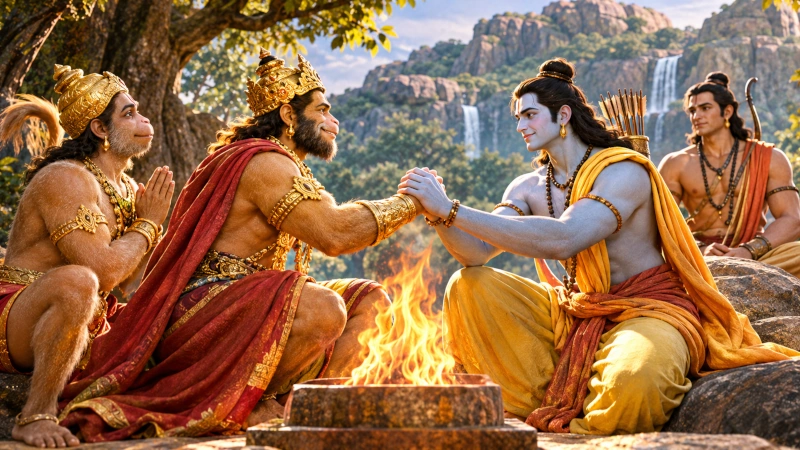
Sugrīva welcomed the prospect of friendship and extended his hand to Rāma. Rāma accepted the gesture, clasped Sugrīva’s hand and embraced him. The exchange established personal trust, but the narrative proceeded to give the relationship a more solemn foundation through a ceremony conducted before sacred fire.
Hanumān kindled the fire and placed it between the two leaders. Rāma and Sugrīva then circumambulated it, formally entering into friendship. The ceremony transformed their mutual understanding into a commitment witnessed by a sacred presence, emphasising that the agreement carried moral obligations extending beyond immediate convenience.
The Sanskrit passage describes this moment:
ततोऽग्निं दीप्यमानं तौ चक्रतुश्च प्रदक्षिणम्।
सुग्रीवो राघवश्चैव वयस्यत्वमुपागतौ॥
Kiṣkindhā Kāṇḍa, 4.5.16
The verse states that Rāma and Sugrīva circumambulated the blazing fire and entered into friendship. Its significance lies in the deliberate establishment of a relationship understood to involve lasting obligations rather than a temporary exchange of assistance.
Sugrīva subsequently declared that their happiness and suffering would henceforth be shared. This commitment introduced a deeper dimension to the alliance. Each partner was expected to recognise the other’s difficulties as matters of common concern, creating a foundation for mutual assistance.
Clearly Defined Objectives Strengthened the Partnership
The strength of the Rāma–Sugrīva alliance rested partly upon the clarity of its objectives. Rāma required information about Sītā’s abduction, assistance in locating her and support in recovering her from captivity. Sugrīva required protection from Vāli, restoration of his political position and the return of his wife, Rumā, whom Vāli had taken from him.
These objectives were not abstract expressions of goodwill. They involved specific outcomes that each party could identify and pursue. The agreement therefore created a relationship in which assistance could be measured through concrete action.
In Sarga 6, Sugrīva provided information relating to Sītā’s abduction. He explained that he and his companions had witnessed a woman being carried through the sky by a powerful rākṣasa. As she was taken away, she had dropped a bundle containing her ornaments, which Sugrīva subsequently produced before Rāma.
This information was an early demonstration of Sugrīva’s value as an ally. Before receiving assistance in recovering his kingdom, he provided material evidence potentially connected with Sītā’s whereabouts. Lakṣmaṇa recognised the anklets among the ornaments, while Rāma was overcome with emotion on seeing the possessions associated with Sītā.
The incident illustrates an important feature of effective alliances: confidence grows when parties begin contributing towards shared objectives rather than merely repeating assurances. Sugrīva’s evidence demonstrated that his knowledge and resources could assist Rāma’s search.
Intelligence Sharing as the Foundation of Strategic Cooperation
The information provided by Sugrīva was significant because Rāma’s search initially suffered from uncertainty. Although he knew that Sītā had been abducted, he had not yet established the complete circumstances of her captivity or the location to which she had been taken.
Sugrīva’s account contributed to the developing understanding of the abduction. His willingness to share what he knew also established an intelligence relationship that would eventually become one of the alliance’s greatest strengths.
In Sarga 7, Sugrīva acknowledged that he did not know the precise residence, strength or lineage of the abductor. This admission is important because it distinguishes verified knowledge from information that still required investigation. Rather than claiming certainty he did not possess, Sugrīva promised to undertake the search necessary to establish the missing facts.
The distinction reflects a principle that remains important in strategic decision-making. Reliable intelligence depends not only upon the information available but also upon an accurate understanding of what remains unknown. An ally who recognises the limits of existing knowledge may contribute more effectively than one who offers unsupported assurances.
Sugrīva’s subsequent ability to mobilise search parties across distant territories transformed this initial intelligence cooperation into a coordinated operation. The geographical instructions later recorded in Kiṣkindhā Kāṇḍa, Sargas 40–43, demonstrate the breadth of the search network that the alliance eventually brought into operation.
Rāma’s Commitment to Sugrīva: Military Support and Political Restoration
Sugrīva’s principal objective was to recover his kingdom from Vāli. In Sarga 8, he explained the circumstances of his displacement, describing how his elder brother had deprived him of political authority, taken his wife and forced him into exile.
Rāma responded by affirming that assistance was an essential obligation of friendship. He promised to act against Vāli and relieve Sugrīva of the danger that had forced him to seek refuge at Ṛṣyamūka.
However, the narrative also records an important element of deliberation. When Sugrīva described his suffering, Rāma asked him to explain the origins of the hostility between the two brothers. He wished to understand the circumstances and assess the situation before undertaking decisive action.
This request introduces political judgment into what might otherwise appear to be a straightforward commitment of military assistance. Rāma recognised that intervention in an existing conflict required knowledge of its causes. Sugrīva’s grievances created the basis for assistance, but the circumstances surrounding the dispute still required examination.
The subsequent confrontation with Vāli, including the ethical questions raised by Rāma’s intervention, forms a separate and substantial subject within the Kiṣkindhā Kāṇḍa. For the study of diplomacy, the essential point is that the alliance connected military assistance with the restoration of Sugrīva’s political position.
The eventual defeat of Vāli and Sugrīva’s accession to the throne fulfilled the first major objective of their partnership. It also changed the balance of obligations between them, placing greater emphasis upon Sugrīva’s responsibility to assist Rāma.
The Restoration of Sugrīva and the Question of Political Legitimacy
Following Vāli’s death, Sugrīva became ruler of Kiṣkindhā, while Aṅgada, Vāli’s son, was recognised as an important figure within the restored political order. This arrangement helped preserve continuity within the vānara kingdom while establishing the leadership required to fulfil the alliance’s remaining commitments.
Rāma did not seek the throne of Kiṣkindhā for himself. His objective was to assist Sugrīva in recovering his position and then obtain the cooperation necessary to rescue Sītā. The arrangement therefore differed from conquest intended to establish direct control over another kingdom.
This distinction is important for understanding the diplomatic character of the partnership. Rāma’s intervention supported the authority of an allied ruler whose interests were compatible with his own. Sugrīva’s restoration, in turn, created the political and organisational conditions necessary for the mobilisation of the vānara forces.
The alliance demonstrates how military assistance and political legitimacy can become interconnected. Restoring a partner’s authority can generate the stability required for further cooperation, provided that the restored leadership remains committed to the purposes for which the partnership was formed.
The Monsoon Delay: When Alliance Commitments Were Tested
The partnership encountered a significant difficulty after Sugrīva recovered his kingdom. During the rainy season, he remained in Kiṣkindhā and became absorbed in royal life, while Rāma continued waiting for assistance in locating Sītā.
The delay introduced tension into the relationship because one partner had achieved his immediate objective while the other’s principal concern remained unresolved. What had originally been a mutually beneficial arrangement now required Sugrīva to demonstrate that his commitments remained binding after his political restoration.
In Kiṣkindhā Kāṇḍa, Sarga 29, Hanumān intervened again, this time as an adviser reminding Sugrīva of his obligations. He emphasised the importance of timely assistance, the preservation of friendship and the necessity of fulfilling commitments made to those who had provided support.
Hanumān’s intervention is significant because it shows that diplomacy does not conclude when an agreement is signed. Relationships require continued attention, practical implementation and the willingness of advisers to address failures before they become irreparable disputes.
Sugrīva responded by initiating preparations to assemble the vānara forces. However, the delay and inadequate communication contributed to further tension, eventually leading Lakṣmaṇa to visit Kiṣkindhā. The crisis required additional diplomatic intervention, including Tārā’s efforts to calm the confrontation and restore cooperation.
The episode demonstrates the importance of alliance management after the initial political objectives have been achieved. Agreements can lose their effectiveness when obligations are delayed, communication deteriorates or one partner assumes that earlier assistance no longer requires a response.
Hanumān’s Role in Sustaining the Alliance
Hanumān’s contribution extended far beyond arranging the first meeting. He functioned as an envoy, intelligence assessor, political adviser and eventually the principal operative in the search for Sītā.
During the initial negotiations, he identified the complementary interests of Rāma and Sugrīva. After the agreement, he contributed to maintaining confidence between the partners and helped translate their commitments into organised action. When Sugrīva delayed fulfilling his promise, Hanumān reminded him that political authority and lasting friendship required responsible conduct.
This continuity of service reveals the importance of trusted advisers in diplomatic relationships. Agreements between leaders depend upon individuals capable of communicating intentions, understanding strategic requirements and addressing emerging difficulties.
Hanumān’s later mission to Lanka further illustrates this principle. His successful discovery of Sītā demonstrated the operational value of the alliance and provided Rāma with the information necessary to prepare the campaign against Rāvaṇa.
His progression from diplomatic representative to intelligence operative and strategic messenger shows how a capable envoy can influence events at several stages of an international or inter-kingdom relationship.
The Alliance as an Example of Ancient Indian Statecraft
The Rāma–Sugrīva partnership offers several insights into the strategic thinking represented in the Vālmīki Rāmāyaṇa. Its formation depended upon the identification of shared interests, but its success required trust, a clear understanding of responsibilities and the availability of complementary capabilities.
The alliance also demonstrates that partners do not need to possess equal resources or identical political standing to cooperate effectively. Rāma’s military strength and Sugrīva’s organisational resources served different purposes. Their partnership became effective precisely because the contribution of one addressed a limitation faced by the other.
The solemnisation of friendship before sacred fire emphasised the moral character of the agreement. The relationship was not presented merely as a calculation of immediate advantage but as a commitment involving honour, truthfulness and responsibility towards an ally.
At the same time, the events following Sugrīva’s restoration reveal that moral commitments require institutional and practical expression. Military forces must be mobilised, information must be communicated and promised assistance must be delivered within an appropriate period.
These features allow the alliance to be examined alongside modern concepts of strategic partnerships, mutual assistance and alliance management. The comparison is analytical rather than a claim that the epic describes modern treaty structures. The Rāmāyaṇa presents its own political and ethical framework, within which friendship, royal duty and the fulfilment of promises occupy central positions.
From a Regional Alliance to the Campaign Against Lanka
The immediate objectives of Rāma and Sugrīva eventually became part of a much larger undertaking. The restoration of Sugrīva’s kingdom enabled the mobilisation of vānara forces, whose geographical knowledge and operational capabilities supported the search for Sītā.
The search brought Hanumān to Lanka, where he located Sītā and returned with crucial information concerning her captivity. This achievement gave Rāma the knowledge required to proceed towards the southern ocean and prepare for the confrontation with Rāvaṇa.
Sugrīva and the vānaras subsequently participated in the military campaign, demonstrating that their alliance had developed beyond the original exchange of assistance. What began as cooperation between two individuals confronting separate crises had become a sustained political and military partnership.
The sequence is important because it shows the cumulative effects of strategic cooperation. The initial agreement established trust, the restoration of Sugrīva created political capacity, the search operations produced intelligence, and the subsequent campaign brought together the resources required to achieve the alliance’s remaining objective.
The Rāma–Sugrīva alliance therefore occupies a central position in the diplomatic and military narrative of the epic. Without this partnership, the course of the search for Sītā and the campaign against Lanka would have been fundamentally different.
Modern-Day Parallel: Strategic Partnerships Built on Mutual Interests
The Rāma–Sugrīva alliance finds a compelling parallel in modern international relations, where nations establish strategic partnerships by combining complementary strengths to achieve shared objectives. India’s contemporary diplomatic relationships illustrate this principle, particularly its cooperation with countries such as France, Japan and the United States in defence, technology, maritime security and economic development. Each partnership is shaped by mutual interests, with India contributing its growing technological capabilities, industrial potential, strategic geographical position and economic opportunities, while its partners bring specialised expertise, advanced technologies, investment and access to wider international networks. Much like Rāma and Sugrīva, whose alliance enabled each to overcome challenges that neither could readily resolve independently, modern strategic partners recognise that cooperation can deliver outcomes beyond their individual capabilities. The enduring lesson of the Rāmāyaṇa is that successful diplomacy does not require identical interests or equal strengths; it requires clearly defined objectives, mutual respect, complementary capabilities and, above all, the consistent fulfilment of commitments. In contemporary geopolitics, where partnerships are frequently tested by changing circumstances and competing priorities, the Rāma–Sugrīva alliance remains a powerful illustration of how trust and reciprocal obligations transform shared interests into enduring strategic cooperation.
Conclusion: Mutual Interests, Trust and the Fulfilment of Commitments
The alliance between Rāma and Sugrīva demonstrates how effective partnerships can emerge from a clear recognition of mutual interests. Each leader faced a challenge that could be addressed through the other’s capabilities, creating the foundation for an agreement supported by solemn commitments and practical cooperation.
Hanumān’s diplomatic judgment made the relationship possible, while the ceremony before sacred fire established its moral foundation. Sugrīva’s intelligence concerning Sītā demonstrated his immediate value as an ally, and Rāma’s assistance in restoring Sugrīva’s kingdom fulfilled the first major obligation of the partnership.
The subsequent delay in organising the search for Sītā revealed the difficulties of maintaining an alliance once one partner had achieved his principal objective. Hanumān’s intervention and the restoration of active cooperation demonstrated that successful diplomacy requires continued attention to commitments and the management of disagreements.
The partnership ultimately became one of the decisive relationships in the Vālmīki Rāmāyaṇa, enabling the mobilisation of resources, the collection of intelligence and the campaign against Lanka.
Its enduring relevance lies in the relationship it establishes between mutual interest and moral responsibility. Strategic partnerships may originate in necessity, but their strength depends upon trust, timely assistance and a willingness to honour commitments even when circumstances change.
References
1. Vālmīki Rāmāyaṇa — Kiṣkindhā Kāṇḍa, Sarga 3
Hanumān’s first meeting with Rāma and Lakṣmaṇa.
https://sanskritdocuments.org/sites/valmikiramayan/kish/sarga3/kishkindharoman3.htm
2. Vālmīki Rāmāyaṇa — Kiṣkindhā Kāṇḍa, Sarga 4
Hanumān recognises the complementary interests of Rāma and Sugrīva.
https://sanskritdocuments.org/sites/valmikiramayan/kish/sarga4/kishkindharoman4.htm
3. Vālmīki Rāmāyaṇa — Kiṣkindhā Kāṇḍa, Sarga 5
The establishment of friendship between Rāma and Sugrīva before sacred fire.
https://sanskritdocuments.org/sites/valmikiramayan/kish/sarga5/kishkindharoman5.htm
4. Vālmīki Rāmāyaṇa — Kiṣkindhā Kāṇḍa, Sarga 6
Sugrīva provides information about Sītā’s abduction and produces her ornaments.
https://sanskritdocuments.org/sites/valmikiramayan/kish/sarga6/kishkindharoman6.htm
5. Vālmīki Rāmāyaṇa — Kiṣkindhā Kāṇḍa, Sarga 7
Sugrīva consoles Rāma and promises assistance in the search for Sītā.
https://sanskritdocuments.org/sites/valmikiramayan/kish/sarga7/kishkindharoman7.htm
6. Vālmīki Rāmāyaṇa — Kiṣkindhā Kāṇḍa, Sarga 8
Sugrīva explains his conflict with Vāli and Rāma promises assistance.
https://sanskritdocuments.org/sites/valmikiramayan/kish/sarga8/kishkindharoman8.htm
7. Vālmīki Rāmāyaṇa — Kiṣkindhā Kāṇḍa, Sarga 29
Hanumān reminds Sugrīva of his obligations and the importance of timely assistance.
https://sanskritdocuments.org/sites/valmikiramayan/kish/sarga29/kishkindharoman29.htm
You may also like
-
India Hosts First BIMSTEC Maritime Security Exercise in Andaman and Nicobar Islands, Strengthening Bay of Bengal Cooperation
-
UNESCO Recognises Mahabharata, Arthashastra and Rajatarangini Manuscripts, Taking India’s Asia-Pacific Heritage
-
India and Guatemala Explore Expanded Trade and Investment Cooperation Across Key Industrial Sectors
-
India-Led International Solar Alliance Expands to 116 Members as Bahamas Joins
-
India and Italy Explore Expanded Textile Manufacturing, Technology and Investment Partnerships
