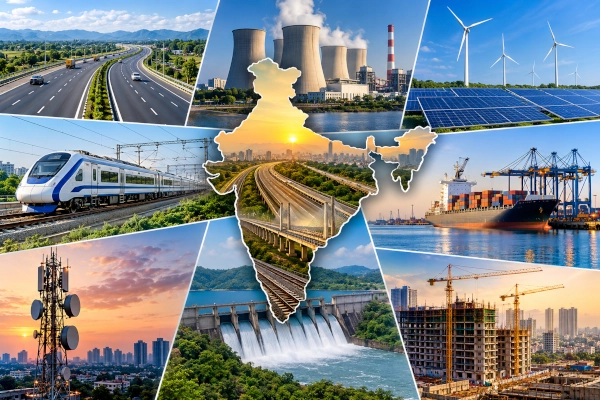
India is monitoring 1,853 Central Sector infrastructure projects with a combined latest estimated cost of ₹37.56 lakh crore, reflecting the scale of investment underway across the country’s transport, energy, water, telecommunications and social infrastructure sectors. According to the Ministry of Statistics and Programme Implementation (MoSPI), cumulative expenditure on these projects reached ₹17.73 lakh crore by September 2026, representing approximately 47.21% of their combined estimated cost.
The findings were published on 26 October 2026 in MoSPI’s Monthly Flash Report on Central Sector Infrastructure Projects. The report draws on information submitted by 17 Central Ministries and Departments and uses the PAIMANA monitoring framework to track implementation progress, expenditure and project-level developments.
Transport and logistics account for the largest share of monitored projects, followed by the energy sector. Together, these two categories represent 1,545 projects, or 83.4% of the total, underscoring the importance of connectivity and energy infrastructure in India’s ongoing development programme.
Infrastructure Investment Reaches ₹37.56 Lakh Crore Across 17 Ministries
The September 2026 monitoring report covers Central Sector infrastructure projects with an estimated cost of ₹150 crore or more. Of the 1,853 projects under observation, 780 are classified as mega projects, each involving an estimated investment of ₹1,000 crore or more. The remaining 1,073 are categorised as major projects with costs below ₹1,000 crore.
The combined expenditure of ₹17.73 lakh crore represents a substantial commitment of public investment towards infrastructure development. However, the expenditure-to-cost ratio should not be interpreted as the overall physical completion percentage, since project costs, payment schedules and construction milestones do not necessarily progress at identical rates.
MoSPI reported that 654 projects, representing approximately 35% of the monitored portfolio, had achieved more than 80% physical progress. Meanwhile, 338 projects, or around 18%, had crossed the 80% threshold in financial completion.
These figures indicate that a significant number of projects have entered advanced stages of construction and implementation. At the same time, the monitoring system continues to track projects in their initial stages, reflecting a pipeline extending from newly initiated works to infrastructure approaching commissioning.
Transport and Logistics Dominate India’s Infrastructure Pipeline
Transport and logistics constitute the largest category in the report, with 1,320 projects involving an estimated investment of ₹20.07 lakh crore. The category accounts for 71.2% of all monitored projects and approximately 53.4% of their combined estimated cost.
The sector encompasses roads and highways, railways, urban public transport, aviation infrastructure, shipping and logistics facilities. These investments support the expansion of national connectivity, reduce transport constraints and improve the movement of passengers and goods across the country.
Roads and highways account for 974 projects, making them the largest component of the transport portfolio. Railways follow with 286 projects under the report’s sector-based classification.
Urban public transport represents another important investment segment, with 29 projects valued at approximately ₹3.02 lakh crore. Aviation and aviation infrastructure account for 25 projects, while shipping and logistics infrastructure contribute a smaller number of projects.
Cumulative expenditure in the transport and logistics category reached approximately ₹10.24 lakh crore, equivalent to 51.03% of its estimated project cost.
Within this category, 504 projects had reached the 81–100% physical-progress range by September 2026. Another 280 projects remained in the initial 0–20% range, illustrating the simultaneous progression of mature infrastructure works and newer investments.
Energy Projects Represent ₹11.04 Lakh Crore in Investment
India’s energy infrastructure forms the second-largest category by investment value, comprising 225 projects with an estimated cost of ₹11.04 lakh crore.
The portfolio includes oil and gas infrastructure, electricity generation, transmission and distribution networks, and energy storage facilities. Together, these investments address requirements associated with growing electricity demand, industrial expansion, energy transportation and the integration of new generating capacity.
Oil and gas infrastructure accounts for the largest number of energy projects, with 102 under monitoring. Electricity generation represents the largest investment component, covering 38 projects valued at approximately ₹4.27 lakh crore.
Transmission and distribution infrastructure comprises 72 projects valued at ₹2.47 lakh crore. These projects are particularly important for strengthening power evacuation networks, expanding grid capacity and connecting electricity generation facilities with demand centres.
The energy storage subsector includes 13 projects involving approximately ₹28,874 crore. Cumulative expenditure in this subsector had reached 81.79% of its estimated cost, the highest ratio among the energy subsectors.
Across the entire energy category, expenditure stood at approximately ₹4.37 lakh crore, representing 39.58% of the combined project cost.
The figures demonstrate the considerable scale of investment required to expand and modernise India’s energy infrastructure while supporting a more diversified electricity system.
Roads and Railways Lead Ministry-Wise Infrastructure Development
The Ministry of Road Transport and Highways accounts for the highest number of monitored projects among Central Ministries and Departments.
With 974 projects valued at approximately ₹9.46 lakh crore, the ministry represents nearly 53% of the total project count and approximately one-quarter of the monitored investment portfolio.
The Ministry of Railways follows with 284 ongoing projects involving an estimated cost of ₹7.21 lakh crore. These projects reflect continued investment in railway capacity, network improvements and associated infrastructure.
The Ministry of Power is implementing 106 projects with an estimated cost of ₹6.40 lakh crore, while the Ministry of Petroleum and Natural Gas accounts for 115 projects worth approximately ₹4.30 lakh crore.
The Ministry of Housing and Urban Affairs is responsible for 49 projects valued at ₹3.41 lakh crore. The Department of Water Resources, River Development and Ganga Rejuvenation accounts for another 35 projects with an estimated cost of ₹1.95 lakh crore.
The Ministry of Coal is monitoring 121 projects involving approximately ₹2.22 lakh crore.
Other ministries and departments contribute investments in telecommunications, higher education, healthcare, civil aviation, steel, ports, mining and sports infrastructure.
The ministry-wise distribution highlights the importance of road and railway development while demonstrating how infrastructure investment extends across several sectors of the economy.
Buxar Thermal Power Project Among Major Infrastructure Milestones
The September 2026 report highlighted several major infrastructure projects that had reached commissioning milestones.
Among them was the 1,320 MW Buxar Thermal Power Project, with a reported project cost of ₹13,756.56 crore. The Ministry of Power project was commissioned on 12 September 2026 and inaugurated on 14 September 2026.
The project represents a significant investment in electricity generation infrastructure and contributes to the development of India’s power sector.
Another major milestone involved Phase I of the NMDC Slurry Pipeline Project, with a reported cost of ₹5,427 crore. The Ministry of Steel project was commissioned on 26 September 2026 and inaugurated the following day.
The pipeline project forms part of the industrial infrastructure required to support the movement of mineral resources and strengthen connectivity between production and processing facilities.
MoSPI also highlighted Package I of Phase I of the Delhi–Amritsar–Katra Expressway, covering a section from the Jussur Kheri area on the NH-KMP Expressway to a junction near Rukhi Paani village.
The package, valued at ₹2,429.9 crore, was commissioned on 4 November 2025 and inaugurated on 17 July 2026. Although included among the report’s prominent infrastructure milestones, its commissioning predates the September 2026 reporting period.
These projects illustrate the range of infrastructure developments covered by the monitoring framework, from electricity generation and industrial transportation to major expressway construction.
PAIMANA Adds 83 Infrastructure Projects to Monitoring System
During September 2026, 83 additional projects were brought under the PAIMANA monitoring system, expanding the ministry’s coverage of infrastructure implementation.
The Ministry of Railways accounted for 57 of these projects, while the Ministry of Road Transport and Highways contributed another 16. The Ministry of Power added seven projects, followed by two from the Ministry of Ports, Shipping and Waterways and one from the Ministry of Coal.
The newly onboarded portfolio includes several substantial infrastructure investments.
One such project involves upgrading the Dholavira–Mauvana–Vauva–Santalpur section of National Highway 754K in Gujarat to a two-lane road with paved shoulders. The package carries an estimated cost of ₹575.07 crore.
In the power sector, a transmission system for integrating the Krishnagiri Renewable Energy Zone Phase I carries an estimated cost of ₹7,627 crore. The newly monitored projects also include the installation of two synchronous condenser units at the Fatehgarh-II pooling station, valued at ₹1,157 crore.
Another project, valued at ₹1,015 crore, involves augmentation works at Bhadla-III, Ramgarh and Kanpur power-system facilities.
The Ministry of Ports, Shipping and Waterways has also brought a ₹630.67 crore multipurpose berth mechanisation project into the monitoring system.
Additionally, the report identifies the Hosur–Omalur railway umbrella work, valued at ₹1,839.32 crore, among the projects newly incorporated into PAIMANA.
The addition of these projects improves the monitoring coverage of infrastructure investments. However, inclusion in PAIMANA should not automatically be interpreted as evidence that every project began construction during September.
Water and Sanitation Projects Record Highest Expenditure Ratio
Water and sanitation infrastructure accounts for 50 monitored projects with an estimated cost of ₹1,98,837 crore.
Cumulative expenditure in this category reached ₹1,40,791 crore, representing 70.81% of the reported project cost. This was the highest expenditure-to-cost ratio among the principal infrastructure categories covered by the report.
Water resources projects form the largest component of this category, with 27 projects involving approximately ₹1,90,927 crore.
The remaining 23 projects fall under waste and water infrastructure, with a combined estimated cost of ₹7,910 crore.
The relatively high expenditure ratio indicates that a substantial portion of the planned investment has already been incurred. MoSPI also observed that many projects in this category were concentrated in advanced physical and financial progress ranges.
Investment in water infrastructure plays an important role in supporting irrigation, water management, urban services and environmental infrastructure.
Telecommunications, Education and Healthcare Infrastructure Also Progress
The report also examines infrastructure investments beyond transport and energy.
The communication category comprises 31 telecommunications projects with an estimated cost of ₹1,33,708 crore. Cumulative expenditure stood at ₹65,064 crore, equivalent to 48.66% of the estimated investment.
These projects contribute to the expansion and strengthening of India’s telecommunications networks and digital connectivity infrastructure.
Social and commercial infrastructure includes 79 projects worth approximately ₹95,348 crore. The category covers education, healthcare, real estate, tourism, hospitality and wellness infrastructure.
Education accounts for 32 projects and records an expenditure ratio of 61.24%. Healthcare comprises 31 projects, with expenditure equivalent to 41.29% of their estimated cost.
Real estate infrastructure accounts for 15 projects, while one project falls within tourism, hospitality and wellness.
Together, these investments illustrate the broader role of infrastructure development in expanding public services, educational capacity and healthcare facilities.
PAIMANA Strengthens Digital Monitoring of Infrastructure Projects
MoSPI is strengthening infrastructure monitoring through its PAIMANA platform, which supports project tracking, inter-ministerial reviews and data-driven assessments of implementation progress.
The ministry has renamed the project-monitoring interface PAIMANA-PROJ, while PAIMANA-CRIP serves as the underlying Central Repository of Infrastructure Projects.
Launched in July 2026, PAIMANA-CRIP functions as a national repository intended to improve the standardisation, availability and reporting of infrastructure project information.
According to MoSPI, nearly 80% of the data in the repository is updated through application programming interfaces, allowing participating institutions to submit project information through connected digital systems.
This approach can help reduce dependence on fragmented reporting arrangements and support more consistent monitoring across ministries.
The platform records expenditure, physical progress and project information, enabling authorities to identify implementation patterns and examine projects requiring closer attention.
The September report draws on data supplied by the concerned ministries and departments. Its coverage is limited to specified categories and subsectors and therefore does not represent every infrastructure project undertaken across India.
Infrastructure Monitoring Supports India’s Long-Term Development
The September 2026 report provides a detailed assessment of India’s Central Sector infrastructure investment programme at a time when transport connectivity, energy security and industrial development remain important national priorities.
With 1,853 projects representing ₹37.56 lakh crore in estimated investment, the monitored portfolio demonstrates the considerable scale of infrastructure development underway across the country.
The expenditure of ₹17.73 lakh crore and the large number of projects in advanced implementation stages indicate substantial progress, although individual projects remain at different levels of completion.
The addition of 83 projects to the monitoring system also reflects the continuing expansion of the infrastructure pipeline.
As PAIMANA-PROJ and PAIMANA-CRIP develop further, improved digital reporting and coordinated project reviews can strengthen implementation oversight, support more informed decisions and help translate infrastructure investment into operational assets that serve India’s economy and public infrastructure requirements.
References
- Press Information Bureau, Ministry of Statistics and Programme Implementation, 26 October 2026. Monthly Flash Report on Central Sector Infrastructure Projects tracks 1,853 Infrastructure Projects worth ₹37.56 lakh crore as of September 2026. Release ID: 2328472.
https://www.pib.gov.in/PressReleaseDetail.aspx?PRID=2328472®=48&lang=1 - Ministry of Statistics and Programme Implementation, PAIMANA-PROJ — Central Sector Infrastructure Project Monitoring.
https://paimana-proj.mospi.gov.in/
You may also like
-
Indian Semiconductor Companies Propose New Manufacturing and Chip Design Investments in Madhya Pradesh
-
Paras Semiconductors Secures 43 Acres in Madhya Pradesh for Proposed ₹6,200 Crore Advanced Chip Packaging Facility
-
Petronet LNG Plans ₹1,200 Crore Joint Venture for Ten Compressed Biogas Plants Across India
-
PM Modi to Inaugurate RBI’s Tier IV Data Centre and Cybersecurity Training Institute in Bhubaneswar
-
Rosatom Completes Supply of Nuclear Safety Control Systems for Kudankulam Units 3 and 4
