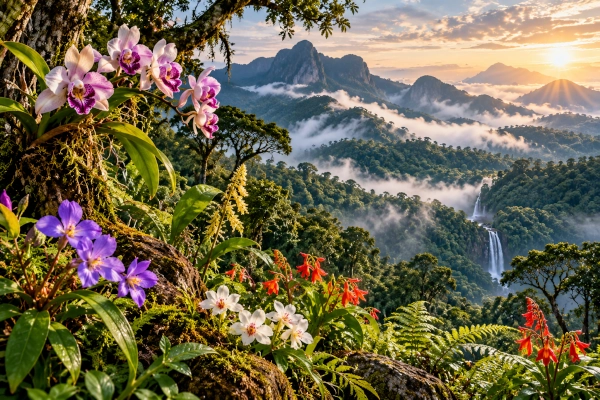
Scientists from the Jawaharlal Nehru Tropical Botanic Garden and Research Institute (JNTBGRI) in Kerala have documented 3,261 flowering plant species in the Agasthyamalai Biosphere Reserve, revealing the extraordinary botanical richness of one of India’s most important biodiversity landscapes. The comprehensive research also identified 1,018 taxa endemic to India, accounting for approximately 31.2% of the recorded flowering plant diversity. The findings reinforce the significance of the southern Western Ghats as a major centre of plant diversity, endemism and ecological specialisation.
The botanical checklist, published in the scientific journal Plant Science Today in 2026, covers the Agasthyamalai Biosphere Reserve across Kerala and Tamil Nadu. Researchers documented 3,261 species, along with 26 subspecies and 28 varieties, representing 1,139 genera belonging to 190 botanical families. The study provides an updated scientific foundation for understanding the geographical distribution of flowering plants, identifying rare species and developing conservation strategies for the southern Western Ghats.
Kerala Scientists Prepare Comprehensive Botanical Checklist of Agasthyamalai
The research was conducted by a team comprising E. S. Santhosh Kumar, S. M. Shareef, P. P. Anusha, K. A. Rashmi and Rejitha Joseph of JNTBGRI, Palode, Thiruvananthapuram. Their study, titled Comprehensive Checklist of the Flowering Plants of the Agasthyamalai Biosphere Reserve, South India, consolidates botanical knowledge accumulated through more than a century of scientific exploration. The researchers examined historical botanical literature, original species descriptions, modern taxonomic publications and internationally recognised plant classification databases to produce an updated inventory of the region’s flowering plants.
Earlier botanical investigations had documented numerous species across different parts of Agasthyamalai. However, much of the available information remained scattered among regional floras, scientific reports, taxonomic publications and other botanical records. Changes in plant names and classification systems had also created inconsistencies in the available information. To address these issues, the researchers organised the checklist according to the Angiosperm Phylogeny Group IV classification system, which groups flowering plants according to their evolutionary relationships. The resulting inventory provides a consolidated scientific reference for future botanical investigations and conservation assessments.
Agasthyamalai Contains 3,261 Flowering Plant Species Across 190 Families
The research documents an exceptional concentration of flowering plants within the approximately 3,500-square-kilometre Agasthyamalai landscape. The recorded diversity includes trees, shrubs, climbers, herbs, grasses, orchids and numerous other flowering plants adapted to different ecological conditions. The biosphere reserve contains tropical evergreen forests, moist deciduous forests, montane shola vegetation, grasslands and specialised habitats associated with streams, rocky slopes and high-altitude environments. These contrasting ecosystems support plants with different requirements for moisture, temperature, sunlight and soil conditions.
The mountainous terrain creates considerable ecological variation over relatively short geographical distances. Plants growing in humid valleys experience different environmental conditions from those inhabiting exposed ridges, rocky slopes and higher-elevation grasslands. Changes in rainfall, temperature and soil characteristics further influence the distribution of vegetation across the landscape. This combination of climatic variation, geographical isolation and habitat diversity helps explain the remarkable concentration of flowering plants documented in the study. The updated checklist reinforces the importance of the southern Western Ghats as a major reservoir of India’s tropical and montane botanical diversity.
Fabaceae Emerges as the Most Species-Rich Plant Family
The researchers identified Fabaceae, commonly known as the legume family, as the most diverse flowering plant family recorded within the Agasthyamalai Biosphere Reserve. The family accounts for 349 taxa, making it the largest botanical group represented in the checklist. Fabaceae includes trees, shrubs, climbers and herbaceous plants that occupy a wide range of ecological environments. Many members of this family maintain important relationships with soil microorganisms, including nitrogen-fixing bacteria associated with their roots. These ecological interactions contribute to nutrient cycling and help maintain soil fertility in different habitats.
Rubiaceae, a family that includes coffee and numerous tropical forest shrubs, ranks second with 194 taxa, while Poaceae, the grass family, follows with 193 taxa. Grasses form important components of open habitats, forest clearings and high-altitude grassland ecosystems, providing food and shelter for various animal species. Orchidaceae ranks fourth with 168 taxa, highlighting the diversity of orchids inhabiting the reserve’s forests and montane environments. Many orchids depend on specialised combinations of humidity, light, host vegetation and fungal associations. The substantial representation of these botanical families demonstrates the ecological complexity of the Agasthyamalai landscape and its ability to support diverse plant communities.
More Than 1,000 Plant Taxa Are Endemic to India
One of the most important findings of the study is the exceptionally high proportion of endemic plants recorded within the biosphere reserve. Researchers identified 1,018 taxa endemic to India, representing approximately 31.2% of the documented flowering plant diversity. Endemic plants are naturally restricted to particular geographical regions, often because of specialised habitat requirements, climatic conditions or evolutionary processes that have separated populations over long periods. The concentration of such plants in Agasthyamalai demonstrates the region’s significance in the evolutionary history of India’s flowering plants.
The Western Ghats are internationally recognised for their remarkable levels of endemism, particularly among flowering plants, amphibians and other organisms associated with specialised tropical environments. Many endemic species occupy relatively restricted geographical areas and depend on specific environmental conditions for their survival. Unlike widely distributed plants, these species may have limited opportunities to establish populations elsewhere when their habitats undergo substantial changes. The findings therefore reinforce the importance of protecting natural forest ecosystems, maintaining ecological connectivity and preserving the environmental conditions that support India’s distinctive botanical heritage.
Scientists Identify 245 Plants with Extremely Restricted Distribution
Within the endemic flora, the researchers identified 245 steno-endemic taxa, a category describing plants with particularly narrow geographical distributions. These plants may occur only within limited mountain ranges, specialised forest environments or narrow elevational zones. Some are associated with particular soil conditions, exposed rock surfaces, shaded forest habitats or moisture-dependent environments. Their restricted distribution makes them especially important for conservation planning because disturbances affecting a relatively small habitat can influence a substantial proportion of the species’ known population.
The presence of such a large number of narrowly distributed plants highlights the need for conservation strategies tailored to the ecological characteristics of individual habitats. A species confined to a rocky mountain slope may face different environmental pressures from one growing in a humid evergreen forest or high-altitude grassland. Protecting specialised environments, maintaining natural forest connectivity and monitoring rare plant populations can help conserve this distinctive flora. The checklist provides valuable information for identifying sensitive habitats and developing targeted conservation programmes across the Kerala–Tamil Nadu landscape.
Rare Orchids Highlight Agasthyamalai’s Botanical Uniqueness
Agasthyamalai is particularly important for its specialised orchid flora, including species associated with the southern Western Ghats. One notable example is Paphiopedilum druryi, an orchid endemic to the Agasthyamalai region. The species belongs to the slipper orchid group, whose flowers possess a distinctive pouch-shaped structure. Its restricted geographical distribution makes it an important component of the region’s botanical heritage and highlights the evolutionary specialisation found among plants inhabiting the southern Western Ghats.
Orchids frequently depend on complex ecological relationships involving specialised fungi, pollinating insects and suitable environmental conditions. Their growth and reproduction may be influenced by changes in humidity, forest structure, host vegetation and the availability of associated organisms. Consequently, conserving orchid diversity requires the protection of entire ecological communities rather than individual plants alone. The documentation of 168 orchid taxa in the biosphere reserve demonstrates the importance of Agasthyamalai’s forests and montane habitats for these remarkable flowering plants. Continued botanical monitoring can help improve understanding of their distribution, reproductive ecology and conservation requirements.
Agasthyamalai Flora Shows Strong Biogeographical Connections with Sri Lanka
The study also identified important geographical relationships between the flowering plants of Agasthyamalai and those found in Sri Lanka. Researchers recorded 347 taxa shared between Agasthyamalai and Sri Lanka, indicating a substantial biogeographical relationship between the two regions. Southern India and Sri Lanka possess similarities in geological history, tropical climate and certain forest ecosystems. Historical changes in sea levels also altered geographical connections between the Indian subcontinent and Sri Lanka, influencing opportunities for the movement and distribution of organisms.
These historical processes, together with long-term climatic relationships and plant dispersal, have contributed to similarities between the botanical communities of southern India and Sri Lanka. The researchers identified the southern Western Ghats–Sri Lanka region as an important floristic province, reflecting its distinctive combination of plant diversity and evolutionary relationships. The study also recorded 102 taxa showing biogeographical affinities with tropical American flora, highlighting broader patterns of botanical distribution. Such findings contribute to scientific understanding of how plant populations developed, diversified and spread across different geographical regions over evolutionary timescales.
Agasthyamalai Biosphere Reserve Extends Across Kerala and Tamil Nadu
The Agasthyamalai Biosphere Reserve occupies approximately 3,500 square kilometres at the southern end of the Western Ghats, extending across parts of Thiruvananthapuram and Kollam districts in Kerala and Tirunelveli and Kanniyakumari districts in Tamil Nadu. The mountainous landscape includes Agasthyarkoodam, also known as Agasthyamala, which rises to approximately 1,868 metres above sea level. The region contains extensive tropical forests, steep mountain slopes, river catchments and high-altitude ecosystems that support numerous plant and animal communities.
Several major protected areas form part of the biosphere reserve, including Shendurney Wildlife Sanctuary, Peppara Wildlife Sanctuary and Neyyar Wildlife Sanctuary in Kerala. The Kalakad Mundanthurai Tiger Reserve in Tamil Nadu forms another important component of the wider protected landscape. Together, these areas conserve a substantial range of forest ecosystems, wildlife habitats and freshwater catchments. The geographical continuity of the reserve allows forests and mountain environments to support diverse ecological communities across the Kerala–Tamil Nadu boundary. These connected habitats are particularly important for species that depend on relatively undisturbed forest environments and specialised climatic conditions.
UNESCO Recognition Reflects Global Conservation Importance
UNESCO included the Agasthyamala Biosphere Reserve in its World Network of Biosphere Reserves in 2016 under the Man and the Biosphere Programme. The designation recognises landscapes that combine important biodiversity values with opportunities for scientific research, environmental education and sustainable development. Biosphere reserves seek to balance ecosystem conservation with the needs of communities living within or around them. Agasthyamalai is especially important because of its tropical forests, endemic wildlife, specialised plant communities and genetic diversity of cultivated and wild plant relatives.
UNESCO has highlighted the region’s importance as a genetic reservoir for plants associated with cardamom, jamun, nutmeg, pepper and plantain. These botanical resources contribute to the region’s ecological, agricultural and scientific significance. The updated checklist provides a more comprehensive account of flowering plant diversity than earlier descriptive profiles of the biosphere reserve. This additional information can support future assessments of conservation priorities, ecological conditions and the distribution of important plant resources. It also reinforces the significance of maintaining the region’s natural ecosystems through coordinated scientific and conservation initiatives.
Kani Communities and the Region’s Traditional Botanical Knowledge
The Agasthyamalai landscape is also home to Kani communities whose traditional knowledge reflects generations of interaction with the forests of the southern Western Ghats. These communities possess knowledge of local plant resources, forest environments and traditional practices associated with the region’s biodiversity. Agasthyamalai is widely recognised for its connection with ethnobotanical research involving Trichopus zeylanicus subsp. travancoricus, commonly associated with the traditional name Arogyapacha. Research into this plant and its traditional uses contributed to important discussions concerning biological resources, traditional knowledge and benefit-sharing arrangements in India.
The relationship between scientific botanical research and community knowledge demonstrates the importance of recognising different forms of expertise in biodiversity conservation. Local communities possess valuable knowledge of forest environments, seasonal changes and traditional plant uses, while scientific institutions contribute systematic documentation, taxonomy and ecological research. Responsible conservation programmes can benefit from cooperation among research institutions, forest departments and local communities while respecting traditional knowledge and applicable access and benefit-sharing provisions. The updated Agasthyamalai checklist provides an additional scientific resource for understanding the botanical environment in which these communities have maintained longstanding cultural and ecological relationships.
Botanical Checklist Provides Foundation for Future Conservation Research
A comprehensive inventory of flowering plants provides an essential scientific baseline for biodiversity monitoring and conservation planning. Without accurate information about the species present within a landscape, researchers and conservation authorities face difficulties assessing population changes, habitat degradation and the possible disappearance of rare plants. The Agasthyamalai checklist addresses this need by consolidating taxonomic information and documenting the recorded diversity of flowering plants across the biosphere reserve. The updated data can support future botanical surveys, habitat assessments and studies examining changes in vegetation over time.
Researchers can also use the checklist to identify botanical groups requiring more detailed investigation, particularly rare plants and species confined to narrow geographical ranges. Changes in vegetation caused by invasive species, habitat disturbance or climatic variation may become easier to assess when reliable historical and contemporary botanical records are available. The inventory can also support the identification of ecologically sensitive areas and guide restoration activities in degraded habitats. By bringing together historical botanical knowledge and modern taxonomic methods, the study provides a valuable foundation for long-term research rather than functioning solely as a catalogue of plant names.
Conservation Strategies Must Protect Specialised Mountain Habitats
The researchers emphasised the ecological fragility of the Agasthyamalai landscape and the importance of developing conservation approaches suited to its distinctive habitats. Although the biosphere reserve contains extensive protected forests, its rare plants occupy environments with different ecological requirements. High-altitude grasslands, wet evergreen forests, shaded valleys and rocky mountain slopes may each support plant communities that cannot readily survive in other habitats. Protecting these environments requires an understanding of the relationships between plant distribution, local climate, soil characteristics and forest structure.
The conservation of narrow-range endemic plants is particularly important because their populations may depend on small geographical areas with specialised environmental conditions. Habitat disturbance, fragmentation and changes in moisture availability can place additional pressure on species with restricted distributions. Botanical research can help identify sensitive environments, guide restoration programmes and establish priorities for long-term monitoring. Coordinated conservation planning between Kerala and Tamil Nadu will remain important for maintaining the ecological integrity of this extensive mountain landscape. The updated checklist provides valuable scientific information that can support such efforts while improving understanding of the reserve’s exceptional botanical diversity.
Kerala’s Botanical Research Strengthens Knowledge of Western Ghats Biodiversity
The study represents an important contribution by Kerala’s scientific research institutions to the documentation of India’s natural heritage. JNTBGRI has a longstanding role in botanical exploration, plant taxonomy, conservation research and the study of tropical plant resources. By compiling and updating the flowering plant records of Agasthyamalai, its researchers have produced a substantial reference for scientists working on Western Ghats biodiversity. The inventory also demonstrates the importance of sustained institutional research in documenting species diversity across ecologically complex landscapes.
The research highlights the continuing relevance of taxonomy, a foundational scientific discipline concerned with identifying, describing, naming and classifying organisms. Accurate taxonomy supports biodiversity conservation by helping researchers distinguish species, identify endemic populations and understand relationships among different plant groups. It also provides the scientific basis for assessing geographical distribution and recognising plants that require particular conservation attention. By integrating historical botanical records with modern classification systems, the Agasthyamalai study strengthens scientific understanding of one of India’s richest mountain ecosystems and creates opportunities for further exploration.
Agasthyamalai Emerges as a Major Centre of India’s Botanical Heritage
The documentation of 3,261 flowering plant species in the Agasthyamalai Biosphere Reserve reinforces the remarkable biological wealth of the southern Western Ghats. With 1,018 taxa endemic to India and 245 possessing exceptionally narrow geographical distributions, the reserve represents an important centre of plant diversity, ecological specialisation and evolutionary history. The findings also reveal important botanical relationships linking southern India with Sri Lanka and other tropical regions. Together, these discoveries deepen scientific understanding of the natural processes that have shaped one of India’s most distinctive biodiversity landscapes.
Beyond establishing updated species records, the research provides essential information for identifying conservation priorities, protecting specialised habitats and strengthening long-term biodiversity monitoring. The work of JNTBGRI scientists demonstrates the importance of systematic botanical exploration in understanding and safeguarding India’s natural ecosystems. As scientific investigations continue across the Western Ghats, the Agasthyamalai checklist will serve as a valuable foundation for future research, habitat conservation and the protection of rare and endemic plants. The study stands as an important contribution to India’s growing scientific knowledge of its extraordinary flowering plant heritage.
References
- E. S. Santhosh Kumar, S. M. Shareef, P. P. Anusha, K. A. Rashmi and Rejitha Joseph. Comprehensive Checklist of the Flowering Plants of the Agasthyamalai Biosphere Reserve, South India. Plant Science Today, Volume 13, Issue 3, 2026.
https://horizonepublishing.com/journals/index.php/PST/article/view/15465 - UNESCO – Man and the Biosphere Programme. Agasthyamala Biosphere Reserve. Official profile, geographical information, biodiversity and World Network of Biosphere Reserves designation.
https://www.unesco.org/en/mab/agasthyamala - UNESCO Biodiversity Resource Hub. Agasthyamala Biosphere Reserve. Official biosphere reserve data and conservation profile.
https://biodiversity.unesco.org/profile/site/INAg2016
You may also like
-
Zoological Survey of India Discovers Three New Centipede Species in Western Ghats of Kerala and Karnataka
-
Scientists Discover Two Rare Blind Fish Species in Assam’s Underground Waters, Revealing Hidden Biodiversity
-
India Begins National Red List Assessment of 1,211 Bird Species to Strengthen Wildlife Conservation
-
Wild Water Buffaloes Return to Madhya Pradesh’s Kanha Landscape After Nearly 100 Years
-
Indian Scientists Discover New Seahorse Species in Indian Ocean, Resolve 150-Year-Old Scientific Mystery
