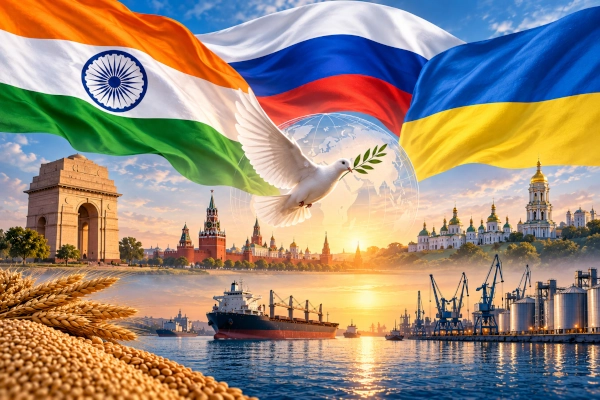
India has intensified its diplomatic engagement with Russia and Ukraine by advancing a reported three-part peace initiative aimed at reducing attacks on critical civilian infrastructure, protecting commercial shipping and restoring the uninterrupted movement of essential commodities through the Black Sea. The proposal represents an important development in New Delhi’s efforts to encourage a negotiated settlement to the conflict, which has continued since February 2022 and has affected international energy markets, agricultural trade, maritime security and global economic stability.
Unlike comprehensive peace proposals that seek to resolve territorial disputes, security guarantees and political disagreements simultaneously, India’s reported framework concentrates on practical areas where Russia and Ukraine have overlapping economic, humanitarian and security interests. It seeks to establish limited agreements that could reduce immediate threats to civilian populations, commercial vessels and essential infrastructure without requiring either country to abandon its broader negotiating position.
Ukraine’s Foreign Minister Andrii Sybiha acknowledged India’s diplomatic initiative on 2 October 2026, describing it as the most comprehensive among several proposals received from international partners. Russian President Vladimir Putin has also acknowledged Prime Minister Narendra Modi’s constructive ideas concerning possible solutions to the conflict. External Affairs Minister S. Jaishankar subsequently indicated on 4 October that India had moved beyond general appeals for peace and was engaging directly with Moscow and Kyiv on specific measures concerning maritime transportation, agricultural exports and energy infrastructure.
The initiative has attracted attention because it seeks to address the immediate economic and humanitarian consequences of the conflict while creating conditions for wider diplomatic negotiations. Although the Indian government has not publicly released the complete proposal, reporting between 7 and 12 October 2026 has identified three principal components: restrictions on attacks against energy infrastructure, protection of agricultural and energy exports, and improved security for commercial shipping in the Black Sea.
India Moves from Appeals for Peace to Practical Diplomatic Engagement
India has consistently maintained that dialogue and diplomacy offer the most sustainable means of ending the Russia–Ukraine conflict. Since the beginning of the war, Prime Minister Narendra Modi has communicated with Russian President Vladimir Putin and Ukrainian President Volodymyr Zelenskyy, emphasising the humanitarian consequences of continued fighting and the need for negotiations. New Delhi has also expressed concern about the impact of the conflict on countries that are not directly involved, particularly developing economies facing higher food prices, energy costs and disruptions to international trade.
India’s diplomatic engagement has developed gradually through high-level meetings, official visits and direct communication with both governments. Prime Minister Modi’s visit to Ukraine in August 2024, the first by an Indian prime minister since Ukraine became independent, demonstrated India’s willingness to engage Kyiv while maintaining its longstanding strategic relationship with Moscow. These parallel relationships provide New Delhi with established diplomatic channels to both countries, although maintaining communication does not automatically guarantee influence over their negotiating positions.
The latest initiative marks a more specific phase of India’s engagement. Speaking at the Munich Leaders Meeting in New Delhi on 4 October 2026, External Affairs Minister S. Jaishankar indicated that India was discussing practical measures with Russia and Ukraine rather than limiting itself to general expressions of support for peace. The discussions reportedly concentrated on protecting Black Sea shipping, facilitating essential exports and reducing attacks on energy infrastructure. These areas directly affect civilian populations, international commerce and countries dependent on agricultural and petroleum imports.
The proposed framework reflects India’s assessment that limited cooperation on economically important issues may be possible even when the larger political disagreements remain unresolved. By identifying specific activities that both countries have reasons to protect, New Delhi seeks to encourage reciprocal commitments that could provide immediate benefits and gradually create opportunities for broader negotiations.
India’s Three-Part Peace Proposal Focuses on Immediate Humanitarian and Economic Priorities
The reported Indian initiative consists of three interconnected components intended to protect essential economic activities from the effects of military operations. Although each component addresses a different problem, all three concern the movement of vital commodities, the safety of civilian infrastructure and the protection of international commerce. Their combined objective is to reduce the economic damage caused by the conflict while establishing a practical framework for limited cooperation between Russia and Ukraine.
The proposal differs from a comprehensive military ceasefire because it does not seek an immediate suspension of all hostilities along the extensive front line. Instead, it concentrates on identifiable categories of infrastructure and commercial activity where reciprocal restrictions could produce measurable results. The approach recognises that the two countries continue to hold sharply different positions on territorial control, national security and the conditions for a permanent settlement.
A limited agreement would still require detailed negotiations concerning geographical coverage, prohibited activities, monitoring arrangements and responses to violations. Nevertheless, by concentrating on specific areas of mutual interest, the Indian proposal seeks to reduce the number of issues that must be resolved before an initial understanding becomes possible.
First Component: Ending Attacks on Energy Infrastructure
The first component of India’s reported proposal focuses on establishing reciprocal restrictions against attacks on energy facilities and other designated infrastructure essential to civilian life and economic activity. Throughout the conflict, electricity generation facilities, transmission networks, petroleum installations, fuel storage depots and related infrastructure have faced repeated attacks, disrupting industrial production and essential services. These attacks have also contributed to uncertainty in regional energy markets and increased the financial burden of repairing damaged facilities.
Ukraine’s electricity infrastructure has been particularly vulnerable to missile and drone attacks. Damage to power stations and transmission networks can interrupt electricity supplies to residential areas, hospitals, water-treatment facilities, transport systems and industrial establishments. Such disruptions become especially serious during winter, when households depend on electricity and heating systems to withstand severe temperatures. Repeated attacks can also require expensive emergency repairs and divert financial resources away from other civilian requirements.
Russia has faced attacks against oil refineries, fuel depots and other energy-related installations. Damage to these facilities can affect petroleum processing, domestic fuel distribution and industrial operations. Such attacks may also disrupt commercial activity and create uncertainty for companies involved in energy production and transportation. Consequently, both countries have economic reasons to consider arrangements that reduce the vulnerability of selected energy infrastructure.
Under the reported Indian framework, Moscow and Kyiv would undertake reciprocal commitments to refrain from attacking agreed categories of energy facilities. The arrangement could protect infrastructure considered particularly important for civilian welfare and economic continuity while allowing the parties to continue discussing the wider military conflict separately. Its effectiveness would depend on clearly identifying protected facilities, establishing procedures for investigating alleged violations and ensuring that both governments consider the restrictions acceptable.
The practical advantage of this component is that it seeks to protect infrastructure on both sides rather than requiring a unilateral concession. Ukraine could benefit from more reliable electricity generation and distribution, while Russia could reduce the risk of damage to specified petroleum and energy installations. Such reciprocal benefits could provide an incentive for negotiation, although the precise facilities and restrictions proposed by India have not been publicly disclosed.
Second Component: Restoring Grain and Energy Exports Through the Black Sea
The second component of India’s initiative seeks to protect the movement of agricultural commodities and energy supplies through Black Sea ports. The region plays a major role in international grain and vegetable oil trade, with Russia and Ukraine among the world’s leading agricultural exporters. Commercial activity in the Black Sea also supports the transportation of petroleum and other strategically important commodities to international markets.
Ukraine’s ports at Odesa, Chornomorsk and Pivdennyi have historically handled substantial quantities of agricultural exports. Their operations depend on functioning cargo terminals, storage facilities, transport connections, loading equipment and secure access to maritime routes. Military attacks affecting these facilities can interrupt exports even when agricultural products remain available for shipment. Damage to port infrastructure also increases operating costs and creates delays that affect farmers, exporters and international buyers.
Russia similarly depends on Black Sea and adjoining maritime routes for the transportation of agricultural products and energy commodities. Interruptions to shipping, restrictions on port operations and increased transportation costs can affect export revenues and commercial planning. The economic importance of these routes creates an area of shared interest despite the broader conflict between the two countries.
India’s reported proposal seeks to establish arrangements under which essential agricultural and energy shipments could move through designated maritime routes without attacks on the facilities and vessels supporting their transportation. The objective would be to provide greater predictability for exporters, shipowners and international buyers while reducing the risk of disruptions to global commodity supplies. The arrangement would not necessarily remove international sanctions or other commercial restrictions, but it could reduce security-related obstacles affecting legitimate shipping operations.
The importance of this component extends well beyond Russia and Ukraine. Countries in Africa, West Asia and Asia rely on internationally traded wheat, maize, sunflower oil and other agricultural commodities. Interruptions to major export routes can increase procurement costs, create uncertainty in supply contracts and place pressure on domestic food markets. Restoring greater reliability to Black Sea agricultural trade would therefore have economic and humanitarian benefits for many countries not directly involved in the conflict.
Third Component: Protecting Commercial Shipping and Civilian Seafarers
The third component concentrates on the protection of merchant vessels and civilian maritime personnel operating in the Black Sea. Commercial ships face serious risks when military operations extend into major transportation corridors. Missile strikes, unmanned aerial systems, naval mines and attacks affecting port facilities can threaten vessels carrying agricultural products, petroleum and other non-military cargo. These dangers also increase insurance costs and can discourage shipping companies from operating in affected areas.
India has a particular interest in this issue because Indian nationals form a substantial part of the international maritime workforce. Indian officers, engineers and other seafarers work aboard merchant vessels registered in numerous countries and transport cargo across international trade routes. Their employment aboard foreign-flagged ships means they may face direct risks from conflicts in which India is not a military participant.
Reports of Indian seafarers being killed or injured in incidents involving commercial shipping during July 2026 brought the issue into sharper focus. The reported deaths of five Indian maritime personnel during the second half of July prompted diplomatic concern in New Delhi and highlighted the vulnerability of civilian crews operating near conflict zones. These incidents strengthened India’s interest in securing explicit protections for merchant vessels and maritime workers.
The proposed maritime arrangement would seek reciprocal commitments against attacks on eligible commercial ships operating within agreed conditions. Such commitments could include clearly identified routes, procedures for registering vessel movements and mechanisms for communicating information between the parties. The objective would be to distinguish legitimate commercial transportation from military operations and reduce the danger faced by civilian crews.
For India, this provision combines the responsibility to protect its citizens with its wider interest in maintaining safe international shipping routes. A functioning maritime safety agreement would benefit Indian seafarers and commercial operators from many other countries, while reducing uncertainty for international freight companies and insurers.
Why the Black Sea Is Central to India’s Peace Initiative
The Black Sea occupies a strategically important position in international commerce because it connects major agricultural and energy-producing regions with global markets through the Turkish Straits and the Mediterranean Sea. Ports along its coastline support the movement of grain, vegetable oils, petroleum, manufactured goods and industrial materials. Disruptions in this region can therefore affect commodity prices and transportation costs far beyond Eastern Europe.
For agricultural exporters, functioning maritime transportation is essential because large quantities of grain and oilseeds must reach international markets within commercially viable periods. When shipping routes become unsafe or ports suspend operations, exporters may face storage constraints, higher freight charges and additional financing costs. Agricultural producers can also suffer when transportation problems reduce access to buyers or delay payments.
The Black Sea’s importance is equally evident in energy transportation. Petroleum and petroleum products move through regional ports and maritime routes that connect producers with international customers. Security threats affecting these routes can increase war-risk insurance premiums, alter shipping schedules and influence commercial decisions by energy companies.
The impact of maritime disruption was highlighted by reports of sharply reduced cargo handling at major Ukrainian ports during July and August 2026. Figures attributed to Ukrainian transport authorities indicated that average daily cargo volumes at three major ports around Odesa fell substantially during an extended period of attacks and disruption. Such developments demonstrate how the loss of secure port access can affect an entire export economy without necessarily damaging every individual cargo shipment.
India’s proposal therefore focuses on an economic corridor whose stability matters to numerous countries. By seeking to protect both port infrastructure and maritime transportation, the framework attempts to address the practical requirements for restoring commercial activity rather than concentrating on individual security incidents.
The Black Sea Grain Initiative of 2022 Provides an Important Precedent
India’s reported approach has an important precedent in the Black Sea Grain Initiative established in July 2022 through negotiations involving Türkiye, the United Nations, Russia and Ukraine. The arrangement was designed to facilitate the safe movement of food and agricultural commodities from designated Ukrainian ports despite the continuing conflict. It demonstrated that limited agreements addressing specific commercial activities could operate without a comprehensive military ceasefire.
Under the initiative, a Joint Coordination Centre was established in Istanbul to facilitate vessel movements, coordinate inspections and support agreed maritime procedures. Commercial ships used a designated maritime humanitarian corridor, allowing agricultural commodities to reach international markets under a framework accepted by the participating parties.
According to the United Nations, the initiative enabled the export of nearly 33 million tonnes of grain and other food products between July 2022 and July 2023. These shipments reached 45 countries across three continents and contributed to the availability of agricultural commodities in global markets. The United Nations World Food Programme also used the arrangement to facilitate food assistance for vulnerable populations.
The initiative’s achievements demonstrated the value of concentrating negotiations on clearly defined humanitarian and economic objectives. Russia and Ukraine continued to disagree on major political and military issues, yet the arrangement provided a mechanism for coordinating essential commercial activity. Its operation showed that practical cooperation could produce tangible benefits without requiring an immediate settlement of the wider conflict.
However, the initiative also revealed important weaknesses. Russia declined to extend its participation in July 2023, citing unresolved concerns related to agricultural exports and associated commercial restrictions. The collapse demonstrated that limited agreements remain vulnerable when participants believe their interests are not being adequately protected or when wider political disputes undermine cooperation.
India’s current proposal could draw lessons from this experience. A renewed arrangement would need to address the concerns of both parties, establish dependable operational procedures and provide mechanisms for resolving disagreements before they lead to a suspension of cooperation. The earlier agreement provides evidence that maritime arrangements are possible, but its termination also shows why implementation and long-term political commitment are essential.
Why India’s Limited Ceasefire Approach May Be More Practical
The principal advantage of India’s reported framework is its attempt to separate achievable humanitarian and economic objectives from the larger political disputes that have prevented a comprehensive settlement. Russia and Ukraine remain deeply divided over territorial control, sovereignty, security guarantees, military deployments and the conditions for ending the war. These disagreements involve fundamental national interests and have repeatedly complicated negotiations.
A comprehensive peace agreement would require both governments to reach understandings on several issues that remain politically sensitive and militarily consequential. Even if progress were achieved on one question, disagreement over another could prevent the entire settlement from moving forward. This creates a difficult negotiating environment in which partial agreements may be rejected because broader disputes remain unresolved.
India’s approach seeks to avoid making immediate humanitarian relief dependent on solving every political problem. Moscow and Kyiv could, in principle, agree to protect selected energy facilities, agricultural exports and civilian shipping without accepting each other’s territorial claims or abandoning existing security positions. The proposed restrictions would concern specific activities rather than the final political status of contested territories.
Another advantage is the possibility of reciprocal economic benefits. Ukraine would gain from reduced damage to electricity infrastructure, more reliable port operations and safer agricultural exports. Russia could benefit from restrictions on attacks against designated energy facilities and improved conditions for legitimate commercial shipping. Both countries would have reasons to consider arrangements that protect important economic assets.
The proposal also concentrates on activities that can potentially be monitored through existing technical and administrative systems. Port authorities maintain records of commercial cargo movements, shipping companies document vessel routes, and maritime identification systems provide information about many commercial ships. Satellite imagery, infrastructure inspections and other monitoring methods can assist in investigating damage to protected facilities.
These capabilities would not eliminate disputes over responsibility for attacks, particularly where military and civilian activities overlap. Nevertheless, they could provide a more manageable basis for verification than an agreement requiring comprehensive monitoring of every military operation along an extensive front line.
A limited arrangement could also create opportunities for confidence-building. If Russia and Ukraine successfully implemented reciprocal restrictions in specific areas, they could establish communication procedures and negotiating practices that might support future discussions. Such progress would not guarantee a wider peace agreement, but it could reduce immediate suffering and demonstrate that practical cooperation remains possible.
India’s Proposal Addresses Several Interconnected Problems Together
One feature distinguishing India’s reported initiative from narrower proposals is its attempt to connect maritime security, infrastructure protection and commodity transportation within a single framework. These issues are closely related because the movement of agricultural and energy cargo depends on functioning ports, safe shipping routes and reliable supporting infrastructure.
Protecting commercial ships would provide limited economic benefits if the ports where they load and unload cargo remained vulnerable to attack. Similarly, protecting port facilities would not guarantee uninterrupted trade if vessels faced unacceptable risks while travelling through nearby waters. A meaningful restoration of commercial transportation therefore requires attention to both the infrastructure used for trade and the maritime routes connecting producers with international markets.
Energy infrastructure presents another interconnected challenge. Attacks on electricity facilities can disrupt port operations, industrial production and transportation systems. Damage to petroleum installations can affect fuel supplies and energy exports, while maritime insecurity can complicate the movement of essential energy commodities. By addressing these issues together, the Indian framework seeks to improve the conditions necessary for essential economic activity.
The wider scope could also create opportunities for reciprocal concessions. A government reluctant to accept restrictions in one area might consider them more seriously when an agreement also addresses another issue of particular importance. Negotiations involving several mutually beneficial commitments can sometimes provide greater flexibility than discussions confined to a single subject.
However, broader coverage can introduce additional complications. Each component requires agreement on definitions, operating procedures, geographical limits and mechanisms for handling alleged violations. The framework would therefore need careful negotiation to ensure that its different provisions reinforce one another rather than create additional disputes.
How India’s Initiative Compares with Other Ceasefire Proposals
India’s proposal has emerged alongside diplomatic efforts involving Türkiye, Egypt and the United States. These countries have different relationships with Russia and Ukraine and have concentrated on areas where their diplomatic influence, economic interests or security concerns may contribute to negotiations.
Türkiye has played an important role in Black Sea diplomacy because of its geographical position, its control of the Turkish Straits under the Montreux Convention and its established diplomatic relationships with both Moscow and Kyiv. Ankara previously helped negotiate the Black Sea Grain Initiative and participated in arrangements designed to facilitate agricultural exports. Its experience demonstrates the value of regional maritime expertise and practical coordination mechanisms.
Egypt has a major interest in the reliable movement of agricultural commodities because it is an important grain-importing country. Disruptions to Black Sea exports can influence procurement costs and food security planning for economies that depend heavily on imported wheat. Diplomatic initiatives focusing on agricultural trade therefore address an immediate economic concern for Cairo and other food-importing countries.
The United States has pursued diplomatic engagement concerning restrictions on attacks against energy infrastructure. Such proposals seek to reduce damage to economically important facilities while broader discussions continue. Their scope and implementation depend on the positions adopted by Russia and Ukraine.
Ukraine’s Foreign Minister Andrii Sybiha acknowledged these international initiatives on 2 October 2026 and described the Indian proposal as the most comprehensive among those received. This assessment reflected the reported inclusion of several connected economic and security issues within India’s framework.
The complete texts of the proposals have not been publicly released, making a detailed comparison of their legal and operational provisions impossible. Nevertheless, the available descriptions indicate that India’s approach seeks to combine the protection of energy infrastructure, agricultural trade and commercial shipping rather than concentrating exclusively on one of these concerns.
Ukraine’s Response Shows Interest in Practical Ceasefire Arrangements
Ukraine’s acknowledgment of India’s initiative represents an important development in New Delhi’s diplomatic engagement with Kyiv. Foreign Minister Andrii Sybiha’s remarks on 2 October confirmed that Ukraine had received proposals from several international partners and was considering different approaches to reducing hostilities.
Ukraine has consistently emphasised the need to protect its energy system, commercial ports and civilian population from attacks. The destruction of electricity infrastructure creates widespread humanitarian consequences, while damage to ports and transportation facilities can undermine export revenues and economic stability. These concerns explain why proposals addressing infrastructure and maritime security have received attention from Kyiv.
At the same time, Ukraine continues to maintain that any settlement must respect its sovereignty and address its long-term security requirements. Its willingness to examine limited arrangements does not amount to acceptance of territorial concessions or other political conditions it considers unacceptable.
The reported Indian framework offers a possible means of addressing immediate civilian and economic needs while leaving those broader questions for separate negotiations. However, Ukraine’s positive acknowledgment should not be interpreted as acceptance of a final agreement. The publicly available information does not establish that Kyiv has approved the complete text or agreed to specific implementation arrangements.
Russia’s Position and India’s Established Diplomatic Channels
Russia’s relationship with India provides New Delhi with longstanding diplomatic channels through which to discuss the conflict. The two countries maintain substantial cooperation in defence, energy, trade, nuclear technology and other strategic sectors. Regular high-level engagement has continued despite the deterioration of relations between Russia and several Western countries.
President Vladimir Putin has publicly acknowledged Prime Minister Narendra Modi’s ideas concerning possible solutions to the conflict. Such remarks demonstrate Russia’s willingness to recognise India’s diplomatic engagement, although they do not establish acceptance of the reported three-part framework.
Moscow continues to argue that a lasting peace settlement must address what it describes as the underlying causes of the conflict. Its position includes broader political and security demands that remain contested by Ukraine. These disagreements complicate efforts to negotiate a comprehensive ceasefire or final peace agreement.
On 12 October 2026, the Kremlin rejected a Ukrainian proposal for a 60-day ceasefire connected with the possibility of holding presidential elections, reiterating its preference for negotiations addressing a wider settlement. This response illustrated the continuing distance between the parties on major political questions.
India’s initiative seeks to identify areas where practical cooperation might remain possible despite these differences. Rather than requiring an immediate agreement on the future political and military settlement, the proposal concentrates on protecting specified infrastructure and commercial activities whose disruption imposes costs on both countries.
India’s Balanced Diplomatic Engagement Supports Its Role as a Facilitator
India maintains important relationships with Russia and Ukraine while pursuing an independent foreign policy based on its national interests and commitment to dialogue. This position has allowed New Delhi to communicate directly with both governments and express concern about the humanitarian and economic consequences of the conflict.
Prime Minister Modi’s engagements with Presidents Putin and Zelenskyy have provided opportunities to convey India’s views at the highest political level. External Affairs Minister Jaishankar has also maintained regular contact with international counterparts, including discussions concerning maritime security, trade and the wider consequences of the conflict.
India’s diplomatic position differs from that of countries directly involved in providing military support to one side or participating in regional security arrangements connected with the conflict. New Delhi has maintained relations with Moscow while expanding its engagement with Kyiv and other European partners. This combination gives India an opportunity to communicate across diplomatic divisions, although the effectiveness of any mediation effort ultimately depends on the willingness of the parties to negotiate.
The reported three-part proposal demonstrates an effort to translate these relationships into practical diplomatic engagement. Instead of presenting India as the principal decision-maker in the conflict, the initiative seeks to identify mutually beneficial measures that Russia and Ukraine themselves could negotiate and implement.
Protecting Indian Seafarers Is an Important National Interest
India’s focus on commercial shipping reflects a direct national responsibility to protect citizens working in international maritime operations. Indian seafarers serve aboard merchant vessels carrying petroleum, grain, chemicals, containers and other cargo across global trade routes. Their work supports international commerce and contributes to India’s maritime economy.
When military operations threaten commercial shipping, these personnel can face serious dangers even when their vessels are registered outside India. Attacks on civilian ships may cause injuries, fatalities, cargo losses and environmental damage. They can also leave crews stranded in unsafe ports or force vessels to navigate through areas affected by mines and other military hazards.
The reported deaths and injuries involving Indian seafarers during July 2026 reinforced the importance of maritime safety in India’s diplomatic discussions. By seeking restrictions on attacks against commercial ships, New Delhi is addressing a concern directly connected with the welfare of Indian nationals.
A maritime safety arrangement could also improve working conditions for seafarers from numerous other countries. Greater security along designated routes would reduce exposure to military attacks and provide more predictable operating conditions for the international shipping industry.
The inclusion of civilian maritime protection gives India’s initiative a humanitarian dimension that extends beyond strategic relations with Russia and Ukraine.
India’s Energy Security Gives the Proposal Additional Economic Importance
India’s dependence on imported petroleum makes the stability of international energy markets an important economic priority. Developments affecting Russian energy production, refining and exports can influence global supply conditions, freight costs and commercial decisions by energy companies.
The Russia–Ukraine conflict has contributed to volatility in energy markets through direct damage to infrastructure, sanctions, transportation disruptions and changing trade patterns. Even when alternative supplies remain available, uncertainty can increase operating costs for importers and refiners.
A limited agreement protecting selected energy facilities and commercial maritime transportation could reduce some of these risks. Fewer attacks on designated installations may support greater continuity in production and processing, while safer shipping routes could improve the reliability of commodity deliveries.
Such an agreement would not eliminate sanctions, geopolitical risks or normal market fluctuations. Petroleum prices would continue to respond to global supply, demand and other economic developments. Nevertheless, reducing the threat of military disruption would provide additional predictability for commercial planning.
For India, stable energy transportation supports refineries, industrial production, electricity generation and other economic activities that depend directly or indirectly on petroleum products. The energy component of the peace proposal therefore aligns with the country’s broader interest in maintaining reliable international supply chains.
Restoring Agricultural Trade Could Help Stabilise Food Markets
Agricultural trade represents another major economic consideration behind India’s initiative. Russia and Ukraine play important roles in supplying wheat, maize, sunflower oil and related commodities to international markets. Interruptions to their exports can affect food prices and procurement decisions across importing countries.
India imports substantial quantities of edible oils and remains exposed to international market conditions affecting sunflower oil and other vegetable oils. When Black Sea shipping becomes unreliable, importers may need to seek alternative suppliers, adjust delivery schedules or pay higher transportation costs. These changes can influence wholesale prices and increase uncertainty for domestic food-processing businesses.
Developing countries with high dependence on imported grain are particularly vulnerable to prolonged disruptions. Their governments may face additional financial pressure when international commodity prices rise or shipping costs increase unexpectedly.
The earlier Black Sea Grain Initiative demonstrated that restoring commercial shipments could improve the availability of agricultural commodities even while the conflict continued. India’s reported proposal seeks to pursue similar practical benefits through renewed protection of ports, maritime routes and essential cargo movements.
More predictable agricultural trade would benefit producers, exporters, shipping companies and importing countries. It could also reduce uncertainty for humanitarian organisations purchasing food supplies for vulnerable populations.
Why a Limited Agreement Could Be Easier to Verify Than a Comprehensive Ceasefire
One practical advantage of a narrowly defined ceasefire is the possibility of establishing specific monitoring arrangements for clearly identified activities. A comprehensive cessation of hostilities across the entire Russia–Ukraine front would require extensive military monitoring and agreement on numerous disputed situations. Violations could be difficult to investigate, particularly in areas where military forces remain in close proximity.
By comparison, arrangements protecting named ports, commercial vessels and designated energy facilities could rely on existing records and technical monitoring systems. Port authorities document cargo movements, maritime operators maintain vessel records, and satellite observations can help identify damage to infrastructure.
These sources could assist an agreed monitoring body in examining alleged violations. Commercial vessel tracking systems may also help establish the movements of eligible ships, although such systems have limitations and cannot independently determine responsibility for attacks.
The earlier Black Sea Grain Initiative provides an example of how administrative procedures and international coordination can support maritime agreements. Its Joint Coordination Centre helped organise vessel movements and inspections through arrangements accepted by the participating parties.
A future agreement would still require clear rules for identifying protected activities, investigating incidents and addressing disagreements. Neither the existence of monitoring technology nor the limited scope of an agreement guarantees compliance. Nevertheless, concentrating on specific facilities and commercial operations could make verification more manageable than attempting to supervise the entire conflict simultaneously.
Major Challenges Remain Before India’s Proposal Can Become an Agreement
Despite its practical objectives, India’s initiative faces substantial diplomatic and operational obstacles. Russia and Ukraine would first need to agree on precisely which facilities, ships and commercial activities would receive protection. They would also have to determine whether restrictions apply across the entire Black Sea region or only to designated routes and installations.
Another difficulty concerns infrastructure that may serve both civilian and military purposes. Ports, transportation networks and energy facilities can support civilian economic activity while also having military significance. Disputes over their use could complicate efforts to establish mutually acceptable protections.
Reciprocal compliance presents a further challenge. If either government believes that the other has violated an agreement, it may suspend its own commitments or undertake retaliatory action. Without reliable procedures for examining incidents and resolving disagreements, isolated violations could undermine the entire arrangement.
The earlier Black Sea Grain Initiative demonstrated that commercial benefits alone cannot guarantee the survival of an agreement. Russia’s withdrawal in July 2023 showed how unresolved concerns and wider political disputes can weaken cooperation even when an arrangement supports international trade.
The latest diplomatic developments also reveal continuing difficulties in establishing restrictions on attacks against energy infrastructure. On 11 and 12 October 2026, reports concerning a possible energy ceasefire were accompanied by disagreements over its terms and implementation. Ukraine indicated its willingness to consider reciprocal restrictions, while questions remained concerning Russia’s position and the continuation of attacks.
These developments reinforce the importance of distinguishing diplomatic announcements from operational agreements. India’s proposal can provide a framework for negotiations, but its effectiveness will depend on detailed commitments, credible monitoring and sustained cooperation from both parties.
A Successful Limited Ceasefire Could Create Opportunities for Wider Negotiations
The broader diplomatic significance of India’s initiative lies in its potential to establish practical cooperation before a comprehensive political settlement becomes possible. Russia and Ukraine remain divided over issues that cannot be resolved simply by improving maritime security or protecting energy infrastructure. Nevertheless, reducing attacks in specific areas could create a more constructive environment for further dialogue.
Successful implementation would require the governments to maintain communication, exchange operational information and address alleged violations through agreed procedures. These activities could provide experience in managing limited commitments during an ongoing conflict.
If such arrangements proved durable, they might encourage discussions on additional humanitarian questions. Protection of civilian infrastructure, humanitarian access and other confidence-building measures could become subjects for future negotiations, although they are not established components of the reported Indian framework.
Progress would remain dependent on the political decisions of Moscow and Kyiv. A maritime or energy ceasefire would not automatically produce agreement on territorial disputes or long-term security arrangements.
Nevertheless, limited cooperation could reduce immediate economic and humanitarian damage while preserving opportunities for diplomatic engagement. This represents the central logic of pursuing manageable agreements rather than requiring a complete settlement as the first step.
India’s Initiative Could Strengthen International Cooperation on Conflict Resolution
India’s reported proposal reflects the growing importance of addressing the international consequences of armed conflict through focused diplomatic engagement. The war has affected countries far beyond Russia and Ukraine by disrupting agricultural exports, increasing energy uncertainty and creating risks for international maritime transportation.
New Delhi’s approach identifies areas where the interests of the conflicting parties overlap with those of the wider international community. Protecting commercial shipping serves both exporters and importing countries. Maintaining grain transportation supports agricultural producers and food security. Reducing attacks on energy infrastructure benefits civilian populations and can improve economic stability.
These objectives provide a foundation for cooperation that does not depend on immediate agreement over the conflict’s most difficult political questions.
India’s diplomatic relationships with both Moscow and Kyiv allow it to participate in discussions concerning these practical measures. Its experience as a major trading economy, energy importer and supplier of international maritime personnel also gives it direct interests in the outcome.
The proposal therefore combines India’s commitment to dialogue with its concern for international economic stability and the safety of civilians, including Indian nationals working aboard commercial vessels.
India’s Three-Part Proposal Offers a Practical Starting Point Towards Peace
India’s reported three-part Russia–Ukraine peace initiative represents an effort to advance negotiations through achievable humanitarian and economic objectives. By concentrating on the protection of energy infrastructure, the restoration of essential commodity exports and the safety of commercial shipping, the framework addresses areas where both countries could benefit from reciprocal commitments.
Its practical strength lies in separating immediate cooperation from the difficult territorial and security questions that continue to prevent a comprehensive settlement. The approach does not eliminate those disagreements, but it offers a possible means of reducing civilian suffering and economic disruption while broader negotiations remain unresolved.
The earlier Black Sea Grain Initiative demonstrates that limited agreements can function during active hostilities when participating governments establish clear procedures and maintain cooperation. Its eventual collapse also underlines the importance of addressing disputes, maintaining reciprocal confidence and developing credible implementation arrangements.
As of 12 October 2026, India has not publicly announced a final agreement based on the reported three-part framework, and neither Russia nor Ukraine has confirmed acceptance of a complete settlement under its terms. The initiative remains a diplomatic proposal whose success will depend on negotiations and the willingness of both governments to undertake enforceable commitments.
Nevertheless, the approach offers a constructive alternative to diplomatic efforts that depend entirely on securing an immediate comprehensive peace agreement. Protecting civilian infrastructure and commercial transportation could deliver important benefits while creating opportunities for further engagement.
By pursuing practical cooperation on Black Sea security, agricultural trade and energy infrastructure, India is contributing to international efforts to reduce the humanitarian and economic consequences of the conflict while encouraging the dialogue necessary for a durable and negotiated peace.
References
- Ministry of External Affairs, Government of India – Official Statements and Media Briefings, October 2026. Statements concerning India’s diplomatic engagement with Russia and Ukraine, Black Sea maritime security and essential commodity transportation.
www.mea.gov.in - The Indian Express – 5 October 2026. We Are in Talks with Both Russia and Ukraine: Jaishankar. Reporting on External Affairs Minister S. Jaishankar’s remarks at the Munich Leaders Meeting in New Delhi on 4 October.
indianexpress.com/article/india/russia-ukraine-war-jaishankar-10906499/ - Hindustan Times – 7 October 2026. India Proposes 3-Part Truce Amid Russia-Ukraine War to Keep Grain, Energy Flowing. Reporting on the proposed framework covering energy infrastructure, commodity shipments and maritime security.
hindustantimes.com/india-news/india-proposes-3-part-truce-amid-russia-ukraine-war-to-keep-grain-energy-flowing-putin-zelesnkyy-modi-jaishankar-101791330931883.html - Hindustan Times – 8 October 2026. India Engaged in Talks with Russia, Ukraine on Truce Proposal: MEA. Reporting on India’s official diplomatic engagement with both governments.
hindustantimes.com/india-news/india-engaged-in-talks-with-russia-ukraine-on-truce-proposal-mea-101791400618558.html - The Indian Express – 11 October 2026. Behind India’s Russia-Ukraine Peace Proposal: Grain, Crude Oil — and Trump. Analysis of the proposed arrangement, maritime security and the economic interests of the parties.
indianexpress.com/article/explained/explained-global/india-russia-ukraine-peace-proposal-black-sea-ceasefire-explained-10915906/ - Ministry of Foreign Affairs of Ukraine – October 2026. Statements by Foreign Minister Andrii Sybiha concerning international ceasefire proposals and Ukraine’s diplomatic position.
mfa.gov.ua/en - Al Jazeera – 8 October 2026. India to Türkiye, Can New Proposals to Broker Russia-Ukraine Truce Succeed? Comparative reporting on international ceasefire initiatives.
aljazeera.com/news/2026/10/8/india-to-turkiye-can-new-proposals-to-broker-russia-ukraine-truce-succeed - United Nations – Black Sea Grain Initiative. Official information concerning the July 2022 agreement, Joint Coordination Centre, commercial shipping arrangements and agricultural exports.
www.un.org/en/black-sea-grain-initiative - United Nations – Black Sea Grain Initiative Achievements, 14 November 2023. Official assessment of agricultural shipments and international food security benefits.
un.org/en/black-sea-grain-initiative/achievements - Reuters – 11 October 2026. Ukraine Awaits Details of Ceasefire Proposals from US, Russia Maintains Attacks, Zelenskiy Says.
reuters.com/world/europe/ukraine-awaits-details-ceasefire-proposals-us-russia-maintains-attacks-zelenskiy-2026-10-11/ - Reuters – 12 October 2026. Kremlin Rejects Ukrainian Leader’s Idea of a 60-Day Ceasefire, Says It Wants an Overall Peace Deal.
reuters.com/world/europe/kremlin-rejects-ukrainian-leaders-idea-60-day-ceasefire-says-it-wants-an-overall-2026-10-12/
You may also like
-
India and Canada Move to Strengthen Trade, Energy and Defence Cooperation as Foreign Minister Anita Anand Announces Visit
-
India and UK Strengthen Cooperation in Space, Nuclear Energy and Emerging Technologies
-
India and UK Target Doubling Bilateral Trade by 2030 as CETA Opens New Opportunities
-
Exercise Tarang Shakti 2026 Concludes in Jodhpur, Showcasing India’s Air Power, Indigenous Defence Technology
-
US Double Standards in Foreign Policy: 16 Recent Cases Involving India, Russia, China and Global Trade
