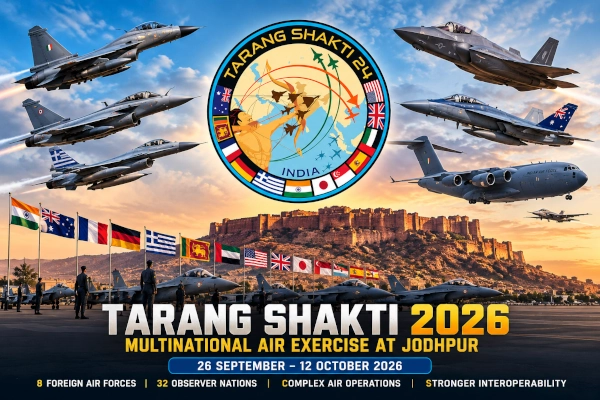
The Indian Air Force (IAF) successfully concluded the second edition of Exercise Tarang Shakti 2026 at Air Force Station Jodhpur on October 12, 2026, marking a significant milestone in India’s expanding military cooperation with international partners. The multinational air exercise brought together seven friendly foreign countries and 32 observer nations, highlighting India’s growing role in international defence engagement and aerospace cooperation.
Conducted from September 26 to October 12 under the theme “Power in Partnership,” the exercise featured advanced combat aircraft, transport platforms, aerial refuelling systems and complex multinational flying operations. It provided participating air forces with opportunities to improve operational coordination, exchange professional expertise and strengthen their ability to undertake joint missions.
The participation of India’s indigenous Light Combat Aircraft (LCA) Tejas and Light Combat Helicopter (LCH) Prachand also demonstrated the country’s expanding capabilities in aerospace design, development and manufacturing.
Held during the Indian Air Force’s 94th anniversary celebrations, Tarang Shakti 2026 combined military preparedness, international cooperation, defence self-reliance and public engagement.
Seven Foreign Air Forces and 32 Observer Nations Participate in Tarang Shakti 2026
Exercise Tarang Shakti 2026 brought together air forces from seven friendly foreign countries, reflecting the Indian Air Force’s growing engagement with international military partners.
The participating countries were:
- Australia
- Bangladesh
- France
- Germany
- Sri Lanka
- United Arab Emirates
- United States of America
In addition to these participating nations, representatives from 32 countries attended as observers.
The presence of such a large international contingent provided opportunities for military professionals to understand different operational procedures, aircraft capabilities and approaches to modern air warfare.
For the Indian Air Force, the exercise offered an opportunity to strengthen existing defence relationships while developing professional connections with additional countries.
The participation of observer nations also demonstrated international interest in India’s military aviation capabilities and its expanding aerospace and defence manufacturing ecosystem.
F-35, Rafale, F-16 and Other Advanced Aircraft Join Multinational Flying Operations
Tarang Shakti 2026 featured a diverse range of modern military aircraft representing combat aviation, strategic and tactical air transport, and air-to-air refuelling capabilities.
According to the Ministry of Defence’s announcement at the commencement of the operational phase, foreign aircraft participating in the exercise included the F-35 Lightning II, Rafale, F-16, Airbus A400M, Multi-Role Tanker Transport (MRTT), C-130, C-130J and KC-30A.
The presence of these platforms enabled participating air forces to exchange operational knowledge across several areas of military aviation.
Modern combat aircraft offer different combinations of sensors, weapons, avionics and mission capabilities. Operating in a multinational environment provides valuable experience in coordinating aircraft with varying performance characteristics and operational procedures.
Transport aircraft contribute capabilities related to tactical and strategic airlift, while aerial refuelling platforms support extended flying operations and greater operational reach.
By bringing these capabilities together, Tarang Shakti provided a setting for complex mission planning and coordinated flying activities involving multiple air forces.
The exercise also allowed pilots, mission planners, ground crews and support personnel to understand the procedures followed by their international counterparts.
Multinational Missions Strengthen Operational Interoperability
A major objective of Exercise Tarang Shakti 2026 was to strengthen interoperability among participating air forces.
Interoperability refers to the ability of military forces from different countries to coordinate their equipment, personnel, communications and operational procedures during joint activities.
Multinational flying exercises help participating air forces develop a common understanding of mission planning, operational coordination and flight safety requirements.
Tarang Shakti 2026 provided opportunities for aircrew and mission planners to exchange experiences relating to complex flying operations and the employment of different aircraft capabilities.
The exercise also enabled participants to study one another’s operational philosophies, training practices and mission execution procedures.
Such professional exchanges contribute to improved coordination during future multinational exercises and other mutually agreed military engagements.
The experience gained through these activities is particularly relevant as modern air operations increasingly depend on coordinated planning, information exchange and the effective integration of multiple aviation capabilities.
Operation Sindoor Highlights Importance of Combat Readiness and Integrated Air Power
The Ministry of Defence highlighted the relevance of Exercise Tarang Shakti 2026 in the context of the Indian Air Force’s operational experience during Operation Sindoor.
According to the Ministry, the operation demonstrated the IAF’s ability to undertake precise and calibrated military action in support of India’s national security objectives.
It also highlighted the importance of operational preparedness, integrated planning, credible deterrence and the effective application of air power.
Modern military aviation requires coordination between aircraft, surveillance capabilities, mission planning systems and operational support infrastructure.
Experience gained during actual operations helps military organisations assess their readiness and improve the procedures required for complex missions.
Multinational exercises provide a complementary opportunity to exchange professional knowledge and examine different approaches to operational challenges.
Tarang Shakti 2026 therefore combined international military cooperation with the Indian Air Force’s continuing emphasis on combat readiness and operational effectiveness.
Indigenous Tejas Fighter and Prachand Helicopter Showcase India’s Defence Self-Reliance
One of the important features of Tarang Shakti 2026 was the participation of indigenous Indian military aviation platforms.
The Light Combat Aircraft Tejas and Light Combat Helicopter Prachand represented India’s expanding technological capabilities in designing, developing and manufacturing advanced aerospace systems.
Their presence alongside international aircraft provided an opportunity to showcase Indian aerospace engineering and defence manufacturing achievements.
LCA Tejas Demonstrates India’s Indigenous Fighter Aircraft Capability
The LCA Tejas represents a major achievement in India’s indigenous combat aircraft development programme.
Developed through India’s aeronautical research and aerospace manufacturing ecosystem, Tejas is a lightweight, multirole fighter aircraft designed for modern combat operations.
The aircraft incorporates advanced avionics, digital flight-control systems and an integrated mission architecture.
Its development has contributed to the growth of domestic expertise in combat aircraft design, aerodynamics, systems integration and aerospace manufacturing.
The participation of Tejas in multinational exercises also provides opportunities to demonstrate the capabilities of an Indian-developed fighter aircraft in an international operational environment.
LCH Prachand Highlights Indigenous Combat Helicopter Development
The Light Combat Helicopter Prachand represents another important milestone in India’s defence aviation capabilities.
Designed and manufactured by Hindustan Aeronautics Limited, Prachand is an indigenous combat helicopter developed to meet the operational requirements of the Indian Armed Forces.
The helicopter is designed for operations across varied terrain and environmental conditions, including high-altitude areas.
Its development reflects India’s growing expertise in helicopter engineering, lightweight structures, avionics integration and specialised military aviation systems.
The participation of Prachand in Tarang Shakti 2026 placed India’s indigenous rotary-wing combat capability before an international military audience.
Together, Tejas and Prachand highlighted the contribution of Indian research institutions, public-sector aerospace organisations and domestic defence industries to the country’s goal of achieving greater technological self-reliance.
Tarang Shakti 2026 Promotes India’s Aerospace and Defence Manufacturing Industry
Beyond operational flying activities, Exercise Tarang Shakti 2026 also provided opportunities to showcase India’s developing aerospace and defence industrial ecosystem.
Industrial visits formed part of the exercise programme, allowing participating contingents to gain exposure to Indian defence manufacturing facilities and technological capabilities.
These engagements highlighted the importance of domestic research, industrial production and technological development in strengthening national defence preparedness.
India’s defence self-reliance initiative, Aatmanirbhar Bharat, places particular emphasis on expanding indigenous design capabilities, increasing domestic manufacturing and strengthening the defence industrial base.
The development of aircraft such as Tejas and Prachand demonstrates the progress of this approach in the aerospace sector.
International military exercises also provide an opportunity for foreign defence professionals to observe Indian platforms and understand the capabilities of the country’s aerospace industry.
Such exposure can support professional engagement and create opportunities for future cooperation in areas of mutual interest.
Military Cooperation Extends Beyond Flying Operations
The programme at Jodhpur extended beyond aircraft operations to include professional discussions, cultural interactions and visits to defence-related institutions.
Participating personnel engaged in activities designed to encourage mutual understanding and strengthen professional relationships.
Industrial visits provided insights into India’s technological and manufacturing capabilities, while other engagements allowed military personnel to exchange experiences from their respective air forces.
These interactions are important because sustained defence partnerships depend not only on equipment and operational procedures but also on trust and familiarity among military professionals.
Tarang Shakti 2026 provided an environment in which participants could develop such relationships while gaining a better understanding of India’s defence and technological ecosystem.
Yoga, Heritage Visits and International Night Strengthen Cultural Ties
Cultural engagement formed another important part of Exercise Tarang Shakti 2026.
The exercise programme included yoga sessions, heritage visits and informal interactions that introduced international participants to India’s traditions and cultural heritage.
Yoga activities provided an opportunity for personnel from different countries to experience a practice closely associated with India’s cultural identity.
Heritage visits allowed participants to explore aspects of the country’s history and architectural traditions.
The International Night brought together representatives of participating nations to celebrate their distinct cultural identities and traditions.
These activities encouraged interaction outside the operational environment and helped strengthen camaraderie among personnel from different countries.
Cultural exchanges complement military cooperation by developing mutual respect and creating lasting personal and professional connections.
More Than 20,000 Visitors Attend Indian Air Force Open Day
Public engagement emerged as a notable feature of Tarang Shakti 2026, with more than 20,000 visitors attending the Open Day organised during the exercise.
The event provided members of the public with an opportunity to observe the Indian Air Force’s aircraft and gain a closer understanding of military aviation.
Visitors also received exposure to the capabilities and professional activities of IAF personnel.
Such initiatives help strengthen connections between the Armed Forces and the communities they serve.
For students and younger visitors, the Open Day offered an opportunity to develop an interest in aviation, aerospace engineering, defence technology and careers in the Armed Forces.
Public outreach also contributes to greater awareness of the technological complexity and professional standards involved in military aviation.
The large turnout demonstrated public interest in the Indian Air Force and its operational capabilities.
Exercise Builds on Success of Tarang Shakti 2024
The 2026 edition built on the experience gained during the inaugural Exercise Tarang Shakti held in 2024.
The first edition established a platform for bringing multiple international air forces together in India for professional exchanges and coordinated flying activities.
Tarang Shakti 2026 continued this approach while strengthening engagement with participating countries and a larger international observer community.
The exercise’s emphasis on interoperability, complex mission planning and operational knowledge-sharing reflected the Indian Air Force’s intention to develop sustained relationships with partner nations.
Repeated multinational engagements allow participating forces to build familiarity with one another’s procedures and improve the effectiveness of future cooperation.
For India, the continuation of Tarang Shakti reinforces its ability to organise international air exercises and provide facilities for complex multinational military aviation activities.
Indian Air Force Marks 94 Years of Service and Technological Progress
Exercise Tarang Shakti 2026 concluded during a significant period for the Indian Air Force, which celebrated its 94th anniversary on October 8, 2026.
Established on October 8, 1932, the Indian Air Force has developed from a relatively small aviation organisation into a modern military force with extensive operational responsibilities.
Over nine decades, the IAF has expanded its combat aviation, air transport, surveillance, helicopter and aerial refuelling capabilities.
Technological developments have transformed the nature of air warfare, increasing the importance of advanced aircraft systems, networked operations, precision capabilities and integrated mission planning.
The Indian Air Force continues to pursue modernisation while strengthening domestic aerospace capabilities.
Indigenous aircraft programmes, technological innovation and international military exercises form important components of this ongoing development.
Tarang Shakti 2026 reflected these priorities by combining operational training, international cooperation and the participation of Indian-developed aircraft.
Tarang Shakti Strengthens India’s Defence Diplomacy and International Partnerships
The participation of seven foreign air forces and representatives from 32 observer nations demonstrated the growing scale of India’s international military engagement.
Air exercises provide an important mechanism for defence diplomacy because they allow military personnel to develop professional relationships through practical cooperation.
They also support the exchange of operational experiences, strengthen communication and encourage understanding of different military practices.
India’s expanding defence engagement includes cooperation with countries possessing diverse military technologies, operational doctrines and strategic perspectives.
Tarang Shakti offers a common platform for such interactions while maintaining a focus on professional military cooperation.
The exercise also strengthens India’s profile as a host of major international defence activities and highlights the Indian Air Force’s organisational capabilities.
Exercise Tarang Shakti 2026 Reinforces India’s Air Power and Defence Self-Reliance
The successful conclusion of Exercise Tarang Shakti 2026 represents another important milestone in the Indian Air Force’s development as a modern, technologically capable and internationally engaged military organisation.
The participation of advanced international aircraft, multinational flying operations and professional exchanges strengthened opportunities for operational learning and cooperation.
At the same time, the presence of indigenous platforms such as Tejas and Prachand demonstrated India’s expanding ability to develop sophisticated military aviation systems.
Industrial engagements highlighted the contribution of India’s aerospace and defence manufacturing sector, while cultural activities and public outreach strengthened relationships beyond the operational environment.
As the Indian Air Force enters its 95th year of service, the experience gained through Tarang Shakti 2026 will contribute to its continuing emphasis on operational preparedness, technological development and international cooperation.
Through the combination of advanced air power, indigenous innovation and trusted defence partnerships, Exercise Tarang Shakti 2026 reflects India’s commitment to building a capable, self-reliant Indian Air Force that contributes to national security and international stability.
References
1. Press Information Bureau, Government of India
Ministry of Defence
Exercise Tarang Shakti 2026: Power in Partnership, Strength in Self-Reliance
Published: October 12, 2026, 5:42 PM
PIB Release ID: 2322365
https://www.pib.gov.in/PressReleseDetailm.aspx?PRID=2322365
2. Press Information Bureau, Government of India
Ministry of Defence
Exercise Tarang Shakti 2026: “Power in Partnership” — IAF Commences Operational Phase at Jodhpur
Published: September 27, 2026, 4:45 PM
PIB Release ID: 2315563
https://www.pib.gov.in/PressReleaseIframePage.aspx?PRID=2315563
3. Indian Air Force
Ministry of Defence, Government of India
Official Information on Indian Air Force Exercises, Aircraft and Operational Capabilities
https://indianairforce.nic.in
You may also like
-
US Double Standards in Foreign Policy: 16 Recent Cases Involving India, Russia, China and Global Trade
-
Indian Navy Vice Chief Inspects Japan’s Mogami-Class Stealth Frigate as India-Japan Shipbuilding Cooperation Expands
-
Philippine Marine Wargames Reportedly Show BrahMos Can Penetrate Chinese Destroyer Air Defences
-
Safran Signs 18 Agreements with Indian Aerospace Suppliers, Expanding Make in India Manufacturing Partnerships
-
Indian Army’s Vajra Corps Certifies First Batch of Drone Operators, Strengthens Battlefield Surveillance
