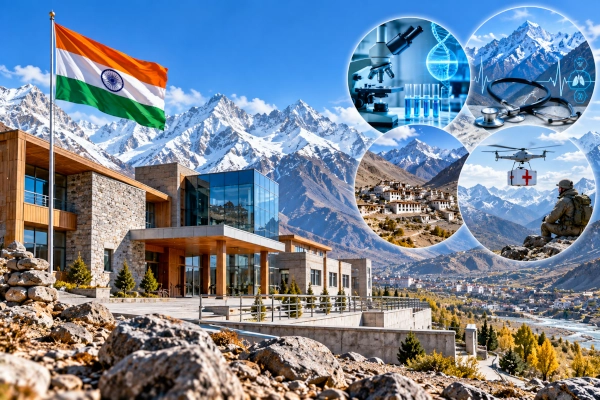
India has taken a major step towards strengthening medical research in the Himalayan region with the establishment of its first dedicated Centre for High Altitude Medicine and Public Health Research at Keylong in Lahaul and Spiti district, Himachal Pradesh. Union Minister for Health and Family Welfare Jagat Prakash Nadda laid the foundation stone of the facility on 12 October 2026, marking the beginning of an initiative to study the health challenges faced by Himalayan communities and military personnel deployed in extreme-altitude environments.
The new institution, officially named the ICMR Centre for High Altitude Medicine and Public Health Research (ICMR-CHAMP), is being established by the Indian Council of Medical Research under the Department of Health Research, Ministry of Health and Family Welfare. It will bring together medical scientists, public health specialists and military healthcare professionals to develop scientific evidence and practical healthcare solutions for people living and working in mountainous regions.
The initiative involves collaboration between ICMR, the Armed Forces Medical Services (AFMS), AIIMS Bilaspur and other research institutions. Its research programmes will investigate the effects of reduced oxygen availability, extreme cold, changing climatic conditions, geographical isolation and distinctive environmental factors on human health.
The centre will also explore emerging technologies such as drone-based medicine delivery, telemedicine, digital healthcare platforms and artificial intelligence to improve access to medical services in remote Himalayan settlements.
India’s First Dedicated High-Altitude Health Research Centre Established at Keylong
Union Health Minister J. P. Nadda performed the traditional Bhumi Pujan and laid the foundation stone of ICMR-CHAMP at Keylong on 12 October 2026. The ceremony marked the formal establishment of a permanent research institution dedicated to understanding the relationship between high-altitude environments and human health.
Speaking at the event, Nadda emphasised the importance of systematic scientific studies to understand the effects of low oxygen levels, severe cold and changing climatic conditions on people living in mountainous regions. He highlighted the need to develop region-specific preventive healthcare strategies rather than depending entirely on medical approaches designed for populations living at lower altitudes.
The Union Minister said that scientific research must address the distinctive health requirements of Himalayan communities, particularly tribal populations living in remote and geographically isolated areas. He also highlighted the importance of developing medical interventions that support the health and operational preparedness of Armed Forces personnel serving in high-altitude locations.
The new institution builds upon an ICMR field station established at Keylong nearly a decade ago. That earlier presence created a foundation for scientific engagement with local communities and provided experience in conducting research under Himalayan environmental conditions.
ICMR-CHAMP will expand this work through a permanent, year-round institution equipped with modern laboratories and specialised scientific personnel. Its broader mandate will encompass biomedical research, environmental health, public health surveillance and the development of healthcare solutions suited to mountainous regions.
Why Keylong Was Selected for High-Altitude Medical Research
Keylong, the administrative headquarters of Lahaul and Spiti district, lies in a mountainous region of Himachal Pradesh where residents experience prolonged winters, low temperatures and difficult geographical conditions.
The district’s high-altitude settlements provide an important setting for studying the effects of reduced atmospheric oxygen and extreme environmental conditions on human health. Unlike short-term mountaineers or visitors, local communities live in these environments throughout the year, creating opportunities to investigate both immediate physiological responses and long-term health patterns.
The Himalayan environment also presents distinctive challenges for healthcare delivery. Mountainous terrain, seasonal snowfall, unpredictable weather and long distances between settlements can complicate access to hospitals, specialist doctors, diagnostic facilities and emergency medical services.
Climate variability adds another dimension to these difficulties. Changes in temperature, precipitation and environmental conditions may influence disease patterns, occupational risks and the availability of essential services.
By establishing a permanent research centre in Keylong, ICMR intends to undertake sustained field investigations involving high-altitude and tribal populations. Such studies can help researchers understand how environmental conditions, lifestyle, nutrition and healthcare access influence health outcomes over time.
The institution’s location will also allow researchers to work closely with local communities, enabling medical investigations to reflect the actual living conditions of Himalayan populations.
Understanding How Low Oxygen Levels Affect the Human Body
One of the centre’s principal research priorities will be the physiological effects of high altitude.
As elevation increases, atmospheric pressure decreases, reducing the partial pressure of oxygen available for breathing. Although oxygen continues to account for approximately 21% of the atmosphere, the lower pressure means that less oxygen is available to enter the bloodstream with each breath.
The human body responds through several physiological adjustments. Breathing generally becomes faster and deeper, heart rate may increase, and the kidneys participate in longer-term changes that support oxygen transport and acid-base balance.
Over time, the body can also increase red blood cell production, improving its capacity to transport oxygen. These adjustments form part of acclimatisation, the process through which the body adapts to reduced oxygen availability.
However, acclimatisation varies between individuals. Rapid ascent, physical exertion, dehydration, underlying illnesses and individual susceptibility can influence the body’s response.
Some people develop acute mountain sickness, which may cause headaches, nausea, fatigue, dizziness and disturbed sleep. Severe altitude-related illnesses can involve fluid accumulation in the lungs or brain and require urgent medical attention.
ICMR-CHAMP will study high-altitude physiology and acclimatisation with the objective of improving medical understanding and informing preventive and clinical approaches.
Research involving permanent Himalayan residents could also provide insights into how long-term exposure to reduced oxygen differs from the short-term experiences of visitors and military personnel arriving from lower elevations.
ICMR and Armed Forces Medical Services to Conduct Joint Research
A major feature of the Keylong centre is its collaboration with the Armed Forces Medical Services, which possesses extensive experience in providing healthcare to military personnel stationed in mountainous and high-altitude environments.
The Indian Armed Forces operate in some of the world’s most demanding terrain, where personnel may encounter severe cold, reduced oxygen availability and significant physical exertion.
Medical teams serving in these regions must address altitude-related illness, cold injuries, respiratory problems, fatigue and other health concerns associated with harsh environmental conditions.
The collaboration will combine ICMR’s biomedical research capabilities with the practical clinical experience accumulated by military medical professionals.
Union Minister of State for Defence Sanjay Seth, who attended the foundation-stone ceremony as Guest of Honour, highlighted the significance of this partnership. He said the research initiative would strengthen scientific understanding of extreme-altitude health challenges and contribute to the development of effective medical solutions.
Air Marshal Sandeep Thareja, Director General of Armed Forces Medical Services, explained that research conducted at Keylong could support better healthcare for soldiers deployed in challenging mountainous environments.
He emphasised that combining military medical experience with ICMR’s scientific expertise would help translate research findings into practical protocols for acclimatisation, early detection of illness and treatment.
The collaboration is expected to support both military personnel and civilian communities because many of the environmental health challenges affecting soldiers also occur among residents of Himalayan settlements.
Research to Improve Acclimatisation and Medical Preparedness of Soldiers
Acclimatisation remains an important consideration for military personnel deployed at high altitude.
Service members arriving from lower elevations generally require time to adjust to reduced oxygen availability before undertaking demanding physical activities. Inadequate acclimatisation can increase the risk of altitude-related illness and affect physical performance.
The Armed Forces already possess established medical procedures for deployment in high-altitude environments. Research at Keylong will provide an opportunity to strengthen these practices through additional scientific evidence.
Studies may help researchers understand individual differences in physiological adaptation, identify early indicators of altitude-related health problems and improve the assessment of medical risks.
The centre’s research could also contribute to healthcare strategies for personnel who spend extended periods in extreme-altitude environments.
Cold exposure presents additional challenges because prolonged contact with low temperatures can increase the risk of hypothermia and cold-related injuries. These risks become more significant when combined with inadequate shelter, fatigue or difficult emergency evacuation conditions.
By studying these factors alongside altitude physiology, researchers can develop a more comprehensive understanding of environmental health risks faced by military personnel.
The knowledge generated will also be relevant to mountain rescue teams, high-altitude workers and other professionals operating in difficult Himalayan terrain.
Special Focus on Tribal Communities and Long-Term Himalayan Health
ICMR-CHAMP will not limit its research to short-term altitude-related illness. The institution will also investigate broader public health concerns affecting communities that live permanently in the Himalayan region.
Many Himalayan settlements have distinctive dietary practices, occupational patterns, cultural traditions and environmental exposures. These factors may influence health outcomes and require locally appropriate research approaches.
The centre will study the relationship between environmental conditions and patterns of infectious and non-communicable diseases. Researchers will also examine the effects of geographical isolation, changing climatic conditions and access to healthcare services.
The institution’s research framework includes environmental and occupational health, recognising that livelihoods in mountainous regions can involve physically demanding activities under difficult weather conditions.
Long-term studies involving local populations can help scientists distinguish health concerns associated with altitude from those influenced by nutrition, occupation, age and other factors.
Such investigations will support the development of healthcare strategies that reflect the needs of Himalayan communities rather than relying exclusively on findings from urban or low-altitude populations.
Dr Rajiv Bahl, Secretary of the Department of Health Research and Director General of ICMR, emphasised the importance of involving local communities directly in the research process.
He explained that Keylong should become a place where laboratory research and community experience come together, with residents participating in investigations intended to improve their health.
This approach places community involvement at the centre of the institution’s scientific mission.
Maternal Health, Newborn Care and Child Nutrition Among Research Priorities
The Keylong centre will undertake research into maternal and newborn health, child growth and nutrition in high-altitude communities.
Pregnancy and early childhood require particular attention because adequate nutrition, oxygen availability and timely medical care are important for healthy development.
Women living in remote Himalayan settlements may face difficulties accessing specialist obstetric services, diagnostic facilities and emergency transportation. Severe weather and geographical isolation can further complicate healthcare delivery.
Research into maternal health will help scientists understand how environmental conditions interact with established medical and social determinants of pregnancy outcomes.
The institution will also examine child growth and nutrition, including the relationship between dietary practices, environmental exposure and access to healthcare.
These investigations could provide evidence to guide maternal and child health programmes in mountainous districts.
The centre’s findings may also help healthcare authorities identify gaps in service delivery and develop approaches suited to communities with limited access to conventional hospital infrastructure.
By including maternal and child health within its mandate, ICMR-CHAMP will address the needs of entire communities rather than concentrating exclusively on altitude-related physiological conditions.
Climate Change and Emerging Diseases to Form Part of Research Programme
The Himalayan region is experiencing environmental changes that can affect public health, livelihoods and access to essential services.
Variations in temperature, snowfall, precipitation and extreme weather events may influence disease patterns and create new challenges for healthcare systems.
The Ministry of Health and Family Welfare has identified climate-sensitive and emerging diseases as important research priorities for the Keylong institution.
Researchers will investigate how environmental conditions influence infectious diseases, non-communicable diseases and other health risks.
Changing climatic conditions may also affect water availability, sanitation, food production and occupational exposure. These factors can influence community health even when they are not directly connected with altitude-related illness.
The centre will examine disaster medicine and emergency preparedness because mountainous regions face distinctive difficulties during landslides, avalanches, extreme weather and other emergencies.
Such events can interrupt transportation routes and delay medical assistance, making local preparedness and effective coordination particularly important.
The research programme will contribute to the development of climate-resilient healthcare systems capable of responding to environmental changes while maintaining access to essential services.
Drone-Based Medicine Delivery Could Transform Himalayan Healthcare
One of the institution’s most technologically significant research areas will involve the possible use of drones to transport medicines and other medical supplies to remote settlements.
Conventional healthcare logistics in mountainous regions can be difficult because roads may become inaccessible during snowfall, landslides or severe weather.
Drones offer a potential alternative for transporting lightweight medical supplies between designated locations, particularly where difficult terrain makes road transportation slow or unreliable.
ICMR-CHAMP will examine the integration of drone-enabled healthcare logistics as part of its wider research into improving medical access.
Potential applications include the movement of essential medicines, selected diagnostic materials and emergency healthcare supplies, subject to technical feasibility, aviation regulations and medical transport requirements.
However, operating drones in high-altitude environments introduces challenges associated with reduced air density, cold temperatures, battery performance and unpredictable mountain winds.
Successful deployment will require reliable aircraft systems, safe flight planning and appropriate procedures for handling temperature-sensitive medical products.
The centre’s research can help evaluate where drone transportation offers practical advantages and how it can complement conventional healthcare delivery.
The government’s announcement identifies drone-based medicine delivery as a proposed research area rather than an already operational service established at Keylong.
Artificial Intelligence and Digital Health to Support Remote Medical Services
The centre will also explore digital health technologies, telemedicine and artificial intelligence to improve healthcare delivery in difficult-to-reach Himalayan regions.
Telemedicine allows patients and local healthcare providers to consult specialists remotely, potentially reducing the need for long-distance travel for certain medical consultations.
Digital health platforms can support the management of medical records, communication between healthcare institutions and coordination of patient care.
Artificial intelligence may assist researchers in analysing health data, identifying patterns and developing tools that support clinical assessment and public health surveillance.
However, any clinical use of AI-based systems requires appropriate validation, protection of patient information and oversight by qualified healthcare professionals.
The Keylong research programme will examine how these technologies can be adapted to the realities of mountainous environments, where connectivity, electricity availability and access to specialised personnel may vary considerably.
Digital solutions will be particularly relevant when used alongside local healthcare services rather than as substitutes for essential clinical facilities.
The integration of emerging technologies could help researchers develop scalable approaches for improving healthcare access across remote Himalayan districts.
AIIMS Bilaspur to Participate in High-Altitude Medical Studies
The All India Institute of Medical Sciences at Bilaspur will participate in the research initiative, adding clinical expertise to the collaboration between ICMR and the Armed Forces Medical Services.
Union Health Minister Nadda acknowledged AIIMS Bilaspur’s contribution during the foundation-stone ceremony and highlighted its role in studying health challenges associated with high-altitude conditions.
The involvement of a major medical institution creates opportunities to connect field observations with hospital-based clinical research.
Patients requiring specialist medical attention often travel from remote mountainous regions to larger healthcare institutions. Their medical histories and clinical assessments can provide useful information for studying diseases and conditions associated with Himalayan environments.
Cooperation between field researchers and hospital specialists can help develop research questions that address practical healthcare needs.
The institutional partnership will also support scientific exchange, training and the development of evidence-based medical approaches.
By combining laboratory investigations, community studies and clinical experience, the centre aims to create a broader research framework for high-altitude medicine.
Research Findings to Benefit Himalayan States and Border Regions
Although ICMR-CHAMP will operate from Keylong, its research mandate extends beyond Lahaul and Spiti.
The Ministry of Health and Family Welfare expects the findings to support healthcare improvements across several Himalayan and border regions, including Himachal Pradesh, Ladakh, Jammu and Kashmir, Uttarakhand, Sikkim and Arunachal Pradesh.
These regions share certain environmental characteristics but differ in altitude, climate, terrain, population distribution and healthcare infrastructure.
Research conducted at Keylong can provide scientific evidence that healthcare authorities may adapt to the needs of different communities.
The centre will also contribute to national priorities involving tribal health, disaster preparedness, public health surveillance and climate-resilient healthcare systems.
Its research findings may inform preventive healthcare programmes, clinical protocols and policy decisions concerning medical services in remote areas.
The government’s longer-term objective is to strengthen India’s own scientific evidence base for healthcare in Himalayan environments rather than depending exclusively on studies conducted in other mountain regions of the world.
Permanent Research Institution Builds on Nearly a Decade of ICMR Field Experience
The establishment of ICMR-CHAMP represents the expansion of research activities already undertaken by the Indian Council of Medical Research at Keylong.
The earlier field station provided a local institutional presence and experience in conducting scientific activities in a challenging mountainous environment.
The new centre will transform this foundation into a permanent research institution with modern laboratories, specialised scientific personnel and the ability to undertake year-round investigations.
A permanent facility will allow researchers to conduct studies across different seasons and observe changes that may not be apparent during short field visits.
Such continuity is particularly important for research into environmental health, disease patterns, nutrition and the long-term effects of living at high altitude.
The institution will also support capacity building by bringing together medical scientists, public health specialists, clinical professionals and researchers working in related disciplines.
The Ministry of Health and Family Welfare has identified multidisciplinary cooperation as an important feature of the centre’s development.
Through partnerships with the Armed Forces, medical institutions, the Himachal Pradesh government and local communities, ICMR-CHAMP aims to connect scientific research with practical healthcare needs.
Green ICMR Campus Initiative Marks Foundation-Stone Ceremony
The foundation-stone ceremony also included activities intended to highlight environmental responsibility and scientific awareness.
Union Health Minister Nadda and other dignitaries planted native Himalayan saplings under the Green ICMR Campus Initiative.
The programme reflects an effort to incorporate environmental considerations into the development of the research institution.
Nadda also inaugurated a scientific exhibition for school students, launched the centre’s website and institutional video, and released a commemorative postal special cover.
These activities marked the beginning of the institution’s public engagement and highlighted the importance of encouraging scientific awareness among young people in Himalayan communities.
Senior officers from the Armed Forces Medical Services and Indian Air Force, scientists, government representatives, Panchayati Raj members and local residents participated in the ceremony.
The involvement of local representatives reflects the centre’s emphasis on conducting research in cooperation with the communities whose healthcare challenges it seeks to understand.
India’s High-Altitude Medical Research Capabilities Enter a New Phase
The establishment of ICMR-CHAMP represents an important investment in India’s ability to understand and address health challenges associated with the Himalayan environment.
For civilian communities, the centre will provide a research foundation for improving preventive healthcare, maternal and child health, nutrition, disease surveillance and access to medical services.
For the Armed Forces, the collaboration with military medical specialists will support scientific investigations into acclimatisation, high-altitude illness and healthcare requirements in extreme operational environments.
The inclusion of drone-enabled logistics, artificial intelligence and digital health will also create opportunities to evaluate technologies that could improve medical access in geographically isolated regions.
By bringing together biomedical research, public health and military medical expertise, the centre will strengthen India’s capacity to develop healthcare approaches informed by conditions experienced within the country.
The permanent research facility will also provide opportunities for long-term scientific investigations involving Himalayan communities and contribute to wider understanding of high-altitude physiology and environmental health.
With ICMR-CHAMP taking shape at Keylong, India is laying the foundation for a specialised research ecosystem that will advance Himalayan medicine, strengthen healthcare for border communities and Armed Forces personnel, and support the development of resilient medical services across the country’s mountainous regions.
References
- Ministry of Health and Family Welfare, Government of India – Press Information Bureau, 12 October 2026.
Union Health Minister Shri Jagat Prakash Nadda Lays Foundation Stone of ICMR Centre for High Altitude Medicine and Public Health Research at Keylong.
Release ID: 2322248.
www.pib.gov.in/PressReleseDetailm.aspx?PRID=2322248 - Ministry of Health and Family Welfare – Press Information Bureau, 11 October 2026.
Union Health Minister Shri Jagat Prakash Nadda to Lay Foundation Stone of ICMR Centre for High Altitude Medicine and Public Health Research at Keylong on 12 October.
Release ID: 2321924.
www.pib.gov.in/PressReleasePage.aspx?PRID=2321924 - Indian Council of Medical Research – Government of India.
Official institutional information, biomedical research programmes and public health research initiatives.
www.icmr.gov.in - Department of Health Research – Ministry of Health and Family Welfare, Government of India.
National health research priorities, institutional research programmes and scientific capacity-building initiatives.
dhr.gov.in
You may also like
-
Centre Caps Cancer Drug Trade Margins at 30%, Patients Expected to Save ₹2,500 Crore Annually
-
Women Make Up 43% of India’s Ayush Workforce as Sector Grows to ₹3.12 Lakh Crore
-
Bengaluru Startup Astrome Wins Indian Army iDEX Challenge to Develop Indigenous Portable Electronic Intelligence System
-
DRDO’s Shakti Electronic Warfare System: India’s Indigenous Shield Against Radar and Missile Threats at Sea
-
DRDO Develops Generative AI Framework to Improve Military Object Recognition with Limited Training Data
