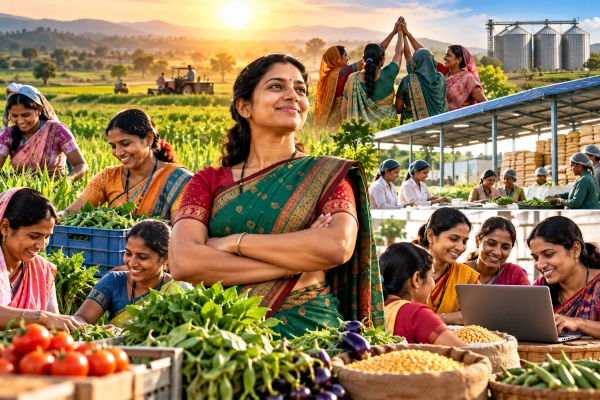
Women-led Farmer Producer Organisations (FPOs) are emerging as an important force in India’s agricultural economy, demonstrating stronger institutional survival, expanding membership and growing participation in organised agricultural enterprises. According to the sixth edition of the State of the FPO Sector Report 2026, released on October 12, 2026, nearly 80% of women-led Farmer Producer Companies have more than 600 members, highlighting their ability to mobilise farming communities and build collective agricultural institutions.
The report, released by the National Association for Farmer Producer Organisations (NAFPO) in partnership with the National Bank for Agriculture and Rural Development (NABARD), examines the development, financial health, institutional sustainability and performance of Farmer Producer Organisations across India. The assessment also highlights the growing importance of women’s participation in agricultural leadership, collective marketing and rural entrepreneurship.
India’s FPO ecosystem has expanded to more than 49,800 registered organisations, reflecting efforts to strengthen farmers’ bargaining power, improve market access and promote collective agricultural enterprises. However, the report identifies continuing challenges involving access to finance, limited land ownership among women and the need for stronger governance and business capabilities.
The findings were reported by Akashvani News on October 12, 2026, highlighting the potential of women-led agricultural organisations to strengthen rural livelihoods while creating new opportunities for women to become owners, entrepreneurs and decision-makers within India’s agricultural economy.
Women-Led FPOs Demonstrate Stronger Institutional Survival
One of the significant findings of the State of the FPO Sector Report 2026 concerns the institutional resilience of women-led Farmer Producer Organisations. The assessment indicates that these organisations have demonstrated stronger survival after incorporation, suggesting that women’s collective participation can contribute to maintaining agricultural institutions over time.
Establishing an FPO involves bringing farmers together under a formal organisation capable of undertaking business activities on behalf of its members. However, registration alone does not guarantee that an organisation will remain active, generate adequate revenue or provide sustained benefits to participating farmers. Long-term institutional survival depends on membership participation, financial management, business operations and the ability to respond to changing agricultural markets.
The report identifies women-led organisations as an important component of the FPO movement because they have demonstrated the capacity to mobilise members and sustain collective participation. In several cases, these organisations have also reported improvements in income and market access, indicating that collective enterprise structures can support broader economic opportunities.
The findings do not mean that every women-led FPO is financially successful or that female leadership alone determines institutional survival. Organisational age, access to finance, governance practices and business conditions also influence performance. Nevertheless, the reported results provide an important basis for examining how women’s participation contributes to the development of sustainable agricultural enterprises.
Nearly 80% of Women-Led Farmer Producer Companies Have More Than 600 Members
The report identifies membership mobilisation as a notable strength of women-led Farmer Producer Companies. According to the findings highlighted by Akashvani News, nearly 80% of women-led FPCs have membership exceeding 600 farmers, demonstrating the scale at which these organisations can bring agricultural producers together.
A substantial membership base can provide several advantages for collective agricultural enterprises. By combining their produce and purchasing requirements, farmers may achieve greater bargaining power when dealing with buyers, traders, agricultural input suppliers and service providers. Larger organisations can also distribute certain administrative and operational costs across more participating members.
Collective membership creates opportunities for farmers to coordinate agricultural activities that would otherwise be difficult to undertake individually. These may include purchasing seeds and fertilisers, arranging transport, accessing storage facilities and negotiating with buyers for larger quantities of produce.
However, membership size must be distinguished from business performance. An organisation with hundreds of registered members may still face challenges involving active participation, financial resources and commercial operations. The long-term value of a large membership base depends on whether the organisation can translate collective participation into reliable services, improved market access and sustainable economic benefits.
India’s FPO Ecosystem Crosses 49,800 Registered Organisations
The sixth edition of the State of the FPO Sector Report records the expansion of India’s Farmer Producer Organisation ecosystem to more than 49,800 registered entities. This development reflects the growing use of collective enterprise structures to address challenges faced by small and marginal farmers.
Farmer Producer Organisations allow agricultural producers to undertake certain economic activities collectively while maintaining their individual farming operations. Depending on their legal structure, these organisations may operate as producer companies or cooperative institutions, with members participating in their governance and economic activities.
FPOs can support the aggregation of agricultural produce, procurement of inputs, development of market relationships and establishment of value-addition activities. Their collective structure provides a mechanism through which smaller producers can participate in larger commercial transactions and develop relationships with institutional buyers.
The rapid expansion of the sector has also increased the importance of evaluating organisational quality rather than relying exclusively on registration numbers. Financial viability, governance standards, member participation and sustained business operations are essential for determining whether an FPO delivers meaningful benefits.
The NAFPO report contributes to this assessment by examining institutional performance and identifying areas where organisations require stronger support to become sustainable agricultural enterprises.
Government’s 10,000 FPO Scheme Expands Women’s Participation in Agriculture
The Government of India’s Central Sector Scheme for the Formation and Promotion of 10,000 Farmer Producer Organisations has contributed to the expansion of collective agricultural enterprises across the country.
In an official parliamentary reply issued on August 7, 2026, the Ministry of Agriculture and Farmers Welfare confirmed that 10,000 FPOs had been formed under the scheme, including 1,175 organisations with 100% women members. Women also accounted for approximately 40% of shareholders across the FPOs established under the programme.
The scheme requires every participating FPO to include at least one woman on its Board of Directors or Governing Body. This provision seeks to strengthen female participation in institutional governance and ensure that women’s perspectives are represented within agricultural organisations.
The Government also provides professional support to participating FPOs for five years after registration through designated implementing agencies and Cluster-Based Business Organisations. This assistance covers capacity building, business development, institutional strengthening and market linkage activities.
As of July 31, 2026, FPOs formed under the scheme had reported cumulative turnover of ₹20,358 crore. The Ministry also confirmed that thousands of organisations had accessed equity grants, management support and credit guarantee assistance.
These official figures relate specifically to the Central Government’s 10,000 FPO scheme and should be distinguished from the larger national FPO population examined in the NAFPO report.
Women Farmers Continue to Face Limited Agricultural Land Ownership
Despite improvements in collective participation, the report identifies land ownership as a major structural challenge affecting women farmers.
According to the findings highlighted in the October 12 report, women’s agricultural land ownership remains limited, with estimates placing their share at approximately 13% to 14%. The report identifies this situation as an important barrier to financial access and enterprise development.
Agricultural land frequently serves as an important economic asset when farmers seek formal credit or provide security for certain financial transactions. Women who participate extensively in cultivation but lack legal ownership of land may therefore face difficulties establishing their financial credentials or accessing credit products.
This challenge also affects their ability to make independent investment decisions, expand agricultural enterprises and participate fully in formal financial arrangements.
Farmer Producer Organisations can help address some of these disadvantages by creating collective institutional structures through which women participate in agricultural business activities. Nevertheless, membership in an FPO does not automatically resolve the underlying problems associated with limited asset ownership.
The report highlights the importance of recognising women as agricultural producers and strengthening their access to the financial and institutional resources required for economic participation.
Access to Institutional Credit Remains a Major Challenge
Limited access to capital continues to restrict the growth of many Farmer Producer Organisations, including women-led enterprises.
Agricultural producer companies require working capital to purchase produce from members, maintain inventories, arrange transport and undertake marketing activities. Organisations seeking to establish storage, processing or value-addition facilities may also require longer-term investment.
Without adequate financing, FPOs can struggle to expand their commercial operations even when they possess substantial membership bases and established relationships with farmers.
The report identifies access to formal credit as a particularly important challenge for women-led institutions. Limited land ownership and other asset-related constraints can make conventional collateral-based lending difficult, while smaller organisations may lack the financial records required by lenders.
The Government’s FPO promotion scheme provides mechanisms intended to address some of these barriers, including equity grant assistance and credit guarantee support for eligible organisations.
Improving access to financial services remains essential for helping FPOs move beyond their initial formation stage and establish sustainable business activities.
Women-Led FPOs Can Improve Agricultural Market Access
The NAFPO assessment reports improvements in income and market access among women-led FPOs in several cases, highlighting the potential benefits of collective agricultural enterprise development.
Individual small-scale farmers often sell relatively limited quantities of produce and may have restricted access to information about prices, buyers and marketing opportunities. Collective organisations can help address these limitations by aggregating produce and negotiating transactions on behalf of their members.
Through an FPO, farmers may be able to coordinate grading, sorting, storage and transport while exploring relationships with institutional buyers. Such arrangements can improve the organisation of agricultural marketing and create opportunities to reduce avoidable transaction costs.
Collective enterprises can also support the development of value-added agricultural products, allowing farmers to participate in activities beyond the initial sale of raw produce.
For women farmers, access to organised marketing channels can provide greater visibility within agricultural value chains and opportunities to participate in commercial decisions.
However, improvements in income depend on actual business performance, operating costs and market conditions. The report’s findings support the potential value of collective organisation without establishing that every participating member has experienced the same economic gains.
Transition from Self-Help Groups to Farmer Producer Companies Gains Importance
One of the recommendations highlighted in the State of the FPO Sector Report 2026 concerns strengthening the transition from women’s Self-Help Groups to formal Farmer Producer Companies.
Self-Help Groups have played an important role in organising women around savings, financial inclusion and community-based economic activities. These groups can provide a foundation of collective experience, mutual trust and basic financial practices that may support the development of larger enterprises.
Farmer Producer Companies operate within a more formal agricultural business structure, enabling participating producers to undertake activities related to procurement, aggregation, processing and marketing.
The report recommends formalising the transition between these institutional models to help women’s collectives develop greater commercial capabilities.
Such a transition requires attention to legal registration, governance, accounting, business planning and access to finance. Not every Self-Help Group will necessarily possess the membership profile or commercial requirements needed to become a Farmer Producer Company.
Where appropriate, however, stronger institutional pathways could enable established women’s groups to participate more extensively in agricultural markets and enterprise development.
Women’s Participation in FPO Governance Must Extend Beyond Membership
The report places particular emphasis on strengthening women’s participation in governance and financial decision-making.
Membership provides farmers with a formal connection to an agricultural organisation, but meaningful participation also depends on their ability to influence its activities, priorities and management.
Important governance responsibilities include approving business plans, reviewing financial information, selecting organisational leadership and evaluating commercial decisions. Greater involvement in these processes can help women develop practical experience in managing agricultural enterprises.
The NAFPO assessment recommends ensuring that women participate directly in financial and governance decisions rather than remaining passive members of producer organisations.
NAFPO Steering Committee Chairperson Pravesh Sharma emphasised that women should move beyond being beneficiaries of the FPO movement and become owners, decision-makers and entrepreneurs.
This approach reflects the importance of institutional empowerment alongside membership growth. Sustainable women’s participation requires opportunities to develop leadership capabilities and exercise meaningful authority within the organisations they help establish.
Financial Management and Professional Training Are Essential for FPO Sustainability
As Farmer Producer Organisations expand, stronger financial management and professional capabilities become increasingly important.
Collective agricultural enterprises must maintain accurate records of membership, transactions, income, expenditure and financial obligations. These requirements become more complex as organisations expand into larger procurement activities, processing operations and multiple marketing channels.
Professional training can help directors and management personnel understand organisational governance, statutory compliance, business planning and financial decision-making.
Women-led organisations may benefit from training programmes designed around their operational needs and the challenges affecting their access to formal agricultural markets.
NAFPO has identified institutional capacity building as an important part of its work, including training resources for FPO directors and management personnel. Its digital initiatives also seek to improve organisational visibility and access to business-related information.
Strengthening these capabilities can help producer organisations establish reliable systems and reduce their dependence on external assistance as they mature.
Women-Led Agricultural Enterprises Support Rural Economic Participation
The expansion of women-led FPOs represents an important development in India’s wider efforts to strengthen rural livelihoods and agricultural entrepreneurship.
Women contribute substantially to agricultural production and related activities, yet their participation in formal enterprise ownership and decision-making has historically faced institutional and economic barriers.
Farmer Producer Organisations offer a structure through which women can participate collectively in commercial agricultural activities while developing organisational and management experience.
Such institutions can create opportunities for participation in procurement, marketing, processing and other activities that connect agricultural production with wider markets.
Their contribution also extends to the development of local leadership and professional capabilities within rural communities.
The report’s findings suggest that strengthening women’s collective institutions can become an important part of agricultural development strategies aimed at expanding participation and improving access to economic opportunities.
NABARD and NAFPO Emphasise Stronger Agricultural Institutions
The partnership between NABARD and NAFPO in releasing the sixth edition of the State of the FPO Sector Report reflects the importance of institutional research and financial development in India’s FPO ecosystem.
NABARD plays a major role in supporting agriculture and rural development, including initiatives associated with Farmer Producer Organisations, rural credit and institutional capacity building.
NAFPO works to strengthen producer organisations through research, representation, collaboration, training and market linkages.
The 2026 report brings attention to the challenges faced by agricultural collectives after registration, particularly their ability to remain active, access finance and establish sustainable business operations.
Its emphasis on women-led organisations provides additional evidence for understanding how collective membership, leadership and institutional support contribute to rural enterprise development.
The findings can assist policymakers, financing institutions and agricultural development organisations in identifying support mechanisms suited to the requirements of women-led FPOs.
Women-Led FPOs Strengthen the Foundation for Inclusive Agricultural Growth
The State of the FPO Sector Report 2026 highlights the growing contribution of women-led Farmer Producer Organisations to India’s agricultural economy.
With nearly 80% of women-led Farmer Producer Companies reportedly having more than 600 members, these institutions demonstrate considerable capacity for collective mobilisation. The report also identifies stronger institutional survival and examples of improved income and market access.
At the same time, limited agricultural land ownership, restricted access to institutional credit and the need for greater participation in financial decision-making remain important challenges.
The Government’s formation of 1,175 entirely women-member FPOs under its 10,000 FPO scheme provides an additional foundation for expanding women’s participation in organised agricultural enterprises.
Further progress will depend on strengthening business capabilities, professional training, governance standards, market relationships and access to finance.
By supporting women as agricultural producers, enterprise owners and institutional leaders, India’s expanding FPO movement can contribute to stronger rural livelihoods, more resilient farmer organisations and greater economic opportunities for women across the agricultural sector.
References
1. Akashvani News — News on AIR
Women-Led FPOs Show Stronger Survival After Incorporation, Says NABARD Report
Published: October 12, 2026, 9:33 PM
https://newsonair.gov.in/women-led-fpos-show-stronger-survival-after-incorporation-says-nabard-report/
2. National Association for Farmer Producer Organisations (NAFPO)
State of the FPO Sector Report 2026
Sixth Edition, released October 12, 2026, in partnership with NABARD.
https://www.nafpo.in/sofpo-reports
3. National Association for Farmer Producer Organisations
Women Farmer Producer Organisations — Institutional Development and Economic Participation
https://www.nafpo.in/all-women-fpos
4. Press Information Bureau, Government of India
Ministry of Agriculture & Farmers Welfare
Formation of Farmer Producer Organizations (FPOs)
Published: August 7, 2026
Release ID: 2296208
https://www.pib.gov.in/PressReleasePage.aspx?PRID=2296208
5. Press Information Bureau, Government of India
Ministry of Cooperation
FPO in Cooperative Sector
Published: December 19, 2023
Release ID: 1988377
https://www.pib.gov.in/PressReleasePage.aspx?PRID=1988377
6. National Bank for Agriculture and Rural Development (NABARD)
Farmer Producer Organisations and Rural Institutional Development
https://www.nabard.org
You may also like
-
Indian Banks Expected to Record 25.4% Profit Growth in Q2 FY27 as Lending Expands and Margins Prepare for Recovery
-
India Targets 1 Billion 5G Users by 2030 as Telecom Sector Prepares for Global 6G Leadership
-
GHCL Begins Production at 2,800-Tonne Bromine Manufacturing Facility in Gujarat
-
BHEL Awards ₹52.68 Crore Indigenous Gas Turbine Component Contract to Azad Engineering
-
India Tightens Scrutiny of Satellite Internet Security as Government Clarifies Starlink Licensing Rules
