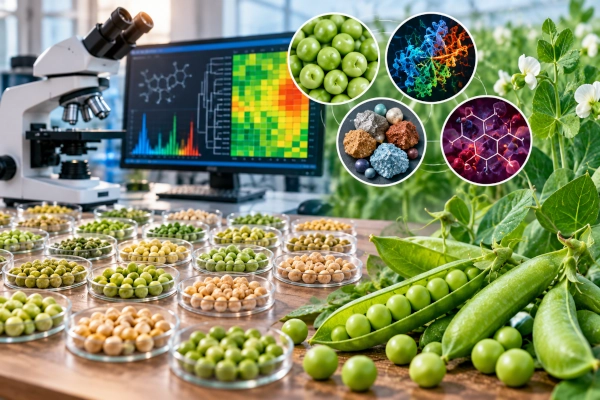
Indian agricultural researchers have identified substantial nutritional diversity across 94 garden pea genotypes, revealing several lines with strong concentrations of protein, minerals, phenolic compounds and antioxidant activity. The study, carried out by scientists associated with ICAR-Indian Agricultural Research Institute, ICAR-National Bureau of Plant Genetic Resources, ICAR-Indian Agricultural Statistics Research Institute and Rani Lakshmi Bai Central Agricultural University, provides a useful genetic resource for future pea-breeding programmes focused on nutritional quality.
The work was conducted during the 2022–23 Rabi season at the research farm of IARI’s Division of Vegetable Science in New Delhi. Researchers evaluated 94 garden pea genotypes, including four check varieties, for agronomic and biochemical traits such as protein, sugars, calcium, magnesium, iron, zinc, total phenolics and antioxidant activity. The wide variation recorded across these traits showed that existing pea germplasm contains significant scope for improving nutritional quality through selective breeding.
GP 1102 Emerges as a Strong High-Protein Line
Protein content varied considerably across the genotypes, ranging from 3.54 per cent to 9.09 per cent on a fresh-weight basis. The genotype GP 1102 recorded the highest protein level in the trial at 9.09 per cent, making it one of the strongest candidates for future nutrition-oriented breeding.
GP 1102 also stood out for its mineral profile. It recorded the highest calcium and magnesium concentrations among the tested lines, combining strong protein performance with high levels of two important nutrients. Calcium content across the collection ranged from 8.04 to 33.49 mg per 100 grams, while magnesium ranged from 24.41 to 60.59 mg per 100 grams.
This combination is particularly useful from a breeding perspective because it offers the possibility of improving several nutritional traits together rather than selecting for only one parameter.
Iron and Zinc Diversity Could Support Biofortification
The study also identified considerable variation in micronutrients associated with human nutrition. Iron content ranged from 0.76 to 3.05 mg per 100 grams, with 2021/PMVAR-6 recording the highest iron concentration. Zinc ranged from 0.52 to 3.12 mg per 100 grams, with GP 1801 emerging as the strongest zinc accumulator.
These differences are important because iron and zinc deficiencies remain persistent nutritional concerns in many populations. Genotypes that naturally accumulate higher concentrations of these minerals could serve as donor parents in future breeding programmes aimed at developing biofortified pea varieties.
Rather than introducing completely new traits, breeders may be able to use the natural variation already present within conserved germplasm to improve micronutrient density.
Phenolic Compounds and Antioxidant Activity Show Wide Variation
The researchers found even greater diversity in phenolic content. Total phenolic concentration ranged from 29.18 to 185.58 mg of gallic acid equivalents per 100 grams, representing more than a six-fold difference between genotypes.
The line IPFD-16-13 recorded the highest phenolic concentration in the trial, while antioxidant performance was strongest in JP625. The researchers assessed antioxidant capacity using DPPH radical-scavenging and FRAP assays, and JP625 produced the highest values in both tests.
The analysis also found a strong positive relationship between phenolic concentration and antioxidant activity. This indicates that phenolic compounds were an important contributor to the antioxidant performance measured in the pea seeds and could become another target for quality-focused breeding.
Sweetness Remains an Important Breeding Trait
Sugar content also varied significantly, ranging from 1.80 to 9.80 per cent. The check variety Pusa Prabal recorded the highest sugar concentration at 9.80 per cent, while GP 1104 showed the lowest.
This variation matters because consumer acceptance of garden peas depends not only on nutritional density but also on sweetness, texture and overall eating quality. A nutritionally superior genotype may not be commercially useful if it performs poorly for yield or taste.
The study therefore highlights the need to balance nutritional improvement with traits valued by farmers, processors and consumers.
Researchers Identify Important Trade-Offs Between Traits
The correlation analysis showed that several desirable traits were positively linked, while others involved trade-offs. Protein content was positively associated with calcium, magnesium, iron, zinc and FRAP antioxidant activity, suggesting that some nutrient-rich genotypes may offer multiple advantages at once.
At the same time, protein content showed a negative relationship with sugar content and pod yield. Sugar concentration, in contrast, was positively associated with pod yield and iron.
These relationships illustrate the complexity of nutrition-focused crop improvement. Breeders will need to select combinations that improve nutrient density without significantly reducing sweetness, yield or other commercially important characteristics.
Protein and Magnesium Show Particularly Strong Association
One of the strongest relationships identified in the study was between protein and magnesium, with a correlation coefficient of 0.808.
The researchers noted that this relationship is biologically plausible because magnesium plays an important role in nitrogen metabolism and protein synthesis. Genotypes that accumulate more magnesium may therefore also have physiological characteristics that favour higher protein concentration.
For breeding programmes, this relationship could be useful because selection for one trait may help improve the other at the same time.
Statistical Analysis Separates Genotypes Into Nutritional Groups
To understand the overall pattern of variation, the researchers used principal component analysis and hierarchical clustering.
The first principal component largely represented a nutritional-density axis, with strong contributions from protein, magnesium, phenolics and antioxidant activity. Hierarchical clustering divided the 94 genotypes into six distinct groups, helping identify nutritionally contrasting material that could be useful for future crosses.
One cluster containing GP 1102 showed the highest average protein, calcium and magnesium levels, while another cluster containing JP625 showed particularly strong phenolic and antioxidant characteristics.
These statistical groupings help breeders move beyond single-trait selection and identify parents that differ meaningfully across several nutritional attributes.
Promising Crosses Could Combine Different Nutritional Strengths
The study points to several possible breeding combinations based on the strengths of individual genotypes. A cross between GP 1102 and JP625 or IPFD-16-13 could potentially combine high protein and mineral density with stronger antioxidant characteristics.
Similarly, crossing GP 1102 with GP 1801 could combine high protein with improved zinc concentration, while a cross with 2021/PMVAR-6 could bring together stronger protein and iron traits.
These combinations are breeding possibilities rather than finished varieties. Each would require several generations of crossing, selection, field evaluation and stability testing before a new cultivar could be considered for release.
Existing Germplasm Offers a Strong Base for Nutritional Improvement
One of the broader conclusions from the study is that substantial nutritional improvement may be possible using genetic diversity already present within pea germplasm.
The researchers did not need to create new characteristics through genetic engineering. Instead, they identified naturally occurring variation across existing lines and varieties.
This strengthens the value of national germplasm collections, which are not merely repositories of agricultural biodiversity but active resources for crop improvement, nutrition security and future breeding.
Further Multi-Location Testing Will Be Necessary
The study was conducted during a single season and at one location, so the strongest-performing genotypes will need further validation.
Nutritional traits can be influenced by soil conditions, temperature, moisture, management practices and other environmental factors. A genotype that performs exceptionally well in one location may not produce identical results elsewhere.
Future multi-year and multi-location trials will therefore be important for determining whether the observed nutritional advantages remain stable across different growing environments.
Strong Foundation for Nutrition-Focused Pea Breeding
The screening of 94 garden pea genotypes has identified several promising lines with complementary nutritional strengths. GP 1102 stood out for protein, calcium and magnesium, GP 1801 for zinc, 2021/PMVAR-6 for iron, IPFD-16-13 for phenolic content and JP625 for antioxidant activity.
Together, these genotypes provide Indian plant breeders with a valuable set of donor parents for developing future pea varieties that combine nutritional quality with agronomic performance and consumer preference.
The study also reinforces the strategic importance of conserving and evaluating crop genetic resources. By converting naturally occurring diversity into improved cultivars, Indian agricultural research can strengthen both crop productivity and nutritional security through conventional breeding.
References
Discover Plants — Nutritional and biochemical analysis in vegetable pea germplasm for quality breeding, 2026.
https://doi.org/10.1007/s44372-026-00912-6
ICAR-Indian Agricultural Research Institute — Division of Vegetable Science, New Delhi.
ICAR-National Bureau of Plant Genetic Resources — Germplasm conservation and crop genetic resources.
ICAR-Indian Agricultural Statistics Research Institute — Statistical support for agricultural research.
Rani Lakshmi Bai Central Agricultural University — Agricultural research and crop improvement programmes.
You may also like
-
Indian Researchers Combine AI and Infrared Spectroscopy to Detect Parkinson’s-Linked Biochemical Changes in Fruit Flies
-
IIT Hyderabad Develops Lung-Derived Bioink for 3D Bioprinting and Regenerative Medicine
-
Indian Scientists Discover Molecular Switch That Can Regulate Cellular Autophagy
-
Scientists Map Earliest Glow of Hydrogen, Opening A New Window to the Universe
-
Indian Researchers Study RAD51 DNA-Repair Gene Variant in Prostate Cancer
