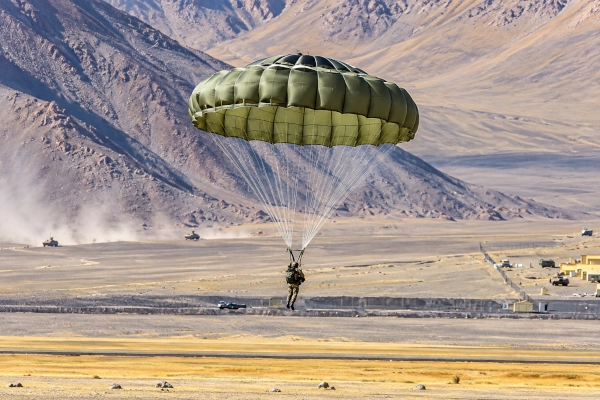
The Defence Research and Development Organisation has successfully conducted the maiden live jump of its Advanced High-Altitude Parachute, or AHAP, at Nyoma in Ladakh, demonstrating the system’s suitability for troop deployment in some of India’s most demanding high-altitude conditions.
The test was carried out at the Mudh Drop Zone in Nyoma, one of the country’s highest-altitude drop zones. The jump took place from 16,000 feet above mean sea level, with parachute deployment at around 15,500 feet and landing at a drop zone located at approximately 13,700 feet.
AHAP Designed for High-Altitude Paratrooper Operations
The Advanced High-Altitude Parachute has been designed and developed by the Aerial Delivery Research and Development Establishment, Agra, a DRDO laboratory specialising in aerial delivery and parachute systems.
AHAP is a static-line parachute system intended for the mass deployment of paratroopers. In a static-line jump, the parachute is automatically deployed shortly after the soldier exits the aircraft, making the system particularly suitable for coordinated troop insertions.
The successful Nyoma trial demonstrated the parachute’s tactical employability in terrain where reduced air density, strong winds, low temperatures and difficult landing conditions can significantly complicate airborne operations.
Operational Range Extends Up to 18,000 Feet
According to DRDO, the system has a wide operational altitude range extending up to 18,000 feet and supports multiple deployment modes.
One of the principal design priorities is maintaining a safe rate of descent at high altitude. Static-line jumps become more demanding as altitude increases because lower atmospheric density can produce higher descent speeds, while the opening of the parachute can expose the jumper to significant shock loads.
The AHAP has therefore been developed specifically around the tactical requirements of Indian defence forces operating in mountainous and high-altitude regions.
Indigenous Development and Certification Ecosystem
The parachute system represents a coordinated indigenous development effort involving several defence organisations.
While ADRDE designed and developed the AHAP, the system has been manufactured by the Ordnance Parachute Factory, Kanpur. Quality inspection was undertaken by the Directorate General of Aeronautical Quality Assurance, while certification was carried out by CEMILAC through RCMA Kanpur.
The programme demonstrates how design, production, quality assurance and certification capabilities within India’s defence ecosystem are being brought together to field specialised equipment for operational requirements.
Why the Nyoma Test Is Significant
Nyoma lies in a strategically important high-altitude region where military operations place unusual demands on personnel, aircraft and equipment. Testing a parachute system in such conditions provides a more realistic assessment than trials conducted at lower elevations.
A successful live jump also goes beyond laboratory validation. It demonstrates that the parachute can function under actual operational stresses involving high-altitude exit, deployment, descent and landing.
For airborne formations, such systems can enhance the ability to insert personnel rapidly into remote areas where conventional ground movement may be constrained by terrain.
Defence Leadership Hails Indigenous Capability
Defence Minister Rajnath Singh congratulated DRDO, the armed forces, defence public sector units and industry involved in the successful trial. He described the achievement as another important step towards Aatmanirbhar Bharat in defence technology.
Defence Secretary and DRDO Chairman Rajesh Kumar Singh also congratulated the teams associated with the development and testing of the system.
Expanding India’s High-Altitude Airborne Capability
The maiden live jump of AHAP marks an important milestone in India’s indigenous parachute-development programme. Its combination of a wide operating envelope, controlled descent characteristics and suitability for mass static-line deployment addresses a specialised requirement that becomes increasingly important in mountainous theatres.
With successful demonstration at Nyoma, the programme strengthens India’s ability to develop and field equipment tailored to its own high-altitude operational environment while reducing dependence on imported systems.
References
- Press Information Bureau, Ministry of Defence, Government of India, “DRDO Conducts Maiden Live Jump of Advanced High-Altitude Parachute”, October 6, 2026.
You may also like
-
Sigma Advanced Systems Secures Fresh ₹973 Crore NATO Artillery Ammunition Order
-
India Advances Indigenous Defence and Space Technologies Through Naval Innovation, Drones and Advanced Electronics
-
Thales Seeks Indian Partnerships for Next-Generation Missiles, Radars and Electronic Warfare Systems
-
Indian and Australian Armies Conduct Jungle and Coastal Warfare Drills in AUSTRAHIND 2026
-
Sagar Defence Unveils Autonomous Vessel at SWAVLAMBAN 2026, Expands Manufacturing
