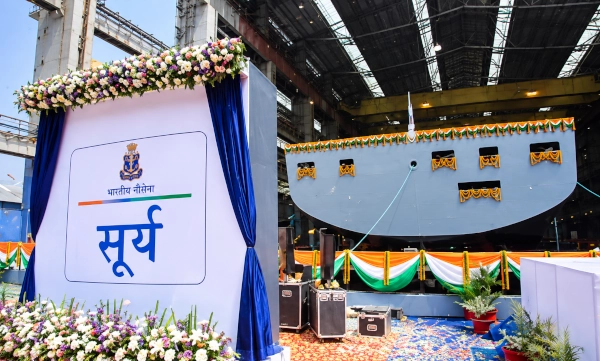
Hindustan Shipyard Limited has launched Surya, the first of five indigenous Fleet Support Ships being built for the Indian Navy, marking a major step in India’s effort to expand naval logistics capacity and strengthen domestic shipbuilding.
Defence Minister Rajnath Singh launched the first Fleet Support Ship, laid the keel of the fifth vessel in the series and inaugurated an upgraded slipway and a new 300-tonne Goliath Crane at HSL in Visakhapatnam on October 6, 2026.
Together, the three developments expand HSL’s ability to construct larger and more complex naval vessels while strengthening India’s capacity to sustain maritime operations far from the coast.
Surya Becomes First Ship in Five-Vessel Fleet Support Programme
The first Fleet Support Ship, designated FSS-1 and named Surya, was launched into the Bay of Bengal following traditional honours performed by Laila Swaminathan, President of the Navy Wives Welfare Association.
The vessel has been designed and built indigenously by Hindustan Shipyard Limited. The programme covers five large support ships intended to provide the Indian Navy with greater endurance during prolonged deployments.
The keel of FSS-5, the fifth ship in the programme, was also laid during the event, demonstrating that construction is progressing across multiple vessels rather than sequentially around a single prototype.
Why Fleet Support Ships Matter to the Indian Navy
Fleet Support Ships are designed to replenish warships at sea with fuel, water, stores and other essential supplies. This allows combat ships to remain deployed for longer periods without repeatedly returning to harbour.
For a navy operating across the Indian Ocean Region, such vessels are crucial to maintaining sustained presence over long distances. They increase the endurance of carrier groups, destroyers, frigates and other surface combatants by extending the time these ships can remain operationally available.
The new vessels will also carry first-line maintenance workshops, enabling limited repairs and technical support while deployed. A helicopter deck will support multi-role helicopter operations, adding flexibility for personnel transfer, logistics and other maritime missions.
Self-defence systems will further allow the ships to operate as part of naval formations in contested environments.
Larger Cargo and Fluid Capacity for Extended Deployments
The Fleet Support Ships are being designed with enhanced capacity for both solid cargo and liquid stores.
That capability is particularly important during long-range operations, when a naval task force may need repeated replenishment without access to nearby friendly ports. Fuel transfer, fresh water, food, ammunition and technical stores can all become limiting factors during extended deployments.
A dedicated replenishment fleet therefore functions as the logistical backbone of a blue-water navy. The addition of large indigenous support ships will reduce operational dependence on shore-based infrastructure and give the Indian Navy greater flexibility across the wider Indian Ocean.
HSL Expands Infrastructure for Larger Ships
The launch of Surya was accompanied by a significant expansion of Hindustan Shipyard’s physical infrastructure.
Slipway-4 has been extended and strengthened to handle ships of up to 45,000 deadweight tonnes, allowing HSL to undertake substantially larger shipbuilding programmes.
A new 300-tonne Goliath Crane, spanning Slipways 3 and 4, has also been commissioned. The crane was designed and manufactured by L&T Geostructure with Konecranes under the Make in India framework.
It incorporates programmable logic controls, variable-frequency drives, tandem lifting capability, remote diagnostics and condition monitoring. These features will allow larger prefabricated ship blocks to be moved with greater precision, supporting modern modular construction techniques.
Modern Block Construction Can Speed Up Shipbuilding
Large modern ships are increasingly built through block construction, in which major sections are fabricated separately and later assembled.
The new Goliath Crane gives Hindustan Shipyard greater capacity to handle these heavy modules, reducing dependence on smaller sequential construction processes. In practical terms, this can improve productivity while allowing more work to proceed in parallel.
Combined with the upgraded slipway, the new infrastructure increases HSL’s ability to undertake both large naval programmes and more complex commercial or specialised shipbuilding projects in the future.
Visakhapatnam Emerging as a Maritime Industrial Cluster
The Defence Minister also called for Visakhapatnam to develop into a major maritime industrial hub, drawing on the concentration of naval, shipbuilding and port infrastructure already present in the city.
Visakhapatnam hosts the Eastern Naval Command, Naval Dockyard, Hindustan Shipyard and Visakhapatnam Port, creating the foundations for an integrated maritime ecosystem.
Closer links between HSL, local MSMEs, universities, technology companies and startups could expand this ecosystem further. Smaller companies can contribute specialised components, while academic institutions can support research, skill development and advanced engineering.
Digital shipbuilding, maritime electronics, automation, maintenance technologies and advanced materials represent additional areas where local industry and startups can participate.
From Self-Reliance to Global Competitiveness
Rajnath Singh said Indian shipyards must move beyond self-reliance and compete internationally on quality, productivity, cost, technology, reliability and delivery schedules.
He called for timely delivery to become an organisational priority at HSL, alongside stronger indigenous design capabilities, resilient supply chains, skilled manpower and closer cooperation with MSMEs and startups.
Lifecycle support will also become increasingly important as Indian shipyards take greater responsibility not only for constructing vessels but also for their maintenance, repair and modernisation throughout decades of service.
Hindustan Shipyard’s Growing Role in Naval Construction
HSL has been associated with Indian shipbuilding for more than eight decades. The shipyard also holds historical significance because Jala Usha, the first ship built in independent India, was launched at Visakhapatnam in 1948.
Its elevation to Miniratna Category-I status in 2025 reflected a broader transformation after coming under the Ministry of Defence.
The Fleet Support Ship programme now places HSL at the centre of one of the Indian Navy’s most important logistics modernisation projects.
The launch of Surya, keel laying of the fifth vessel and commissioning of new heavy shipbuilding infrastructure together show how naval procurement and industrial capacity are advancing in parallel. As the programme progresses, the five indigenous Fleet Support Ships will strengthen the Indian Navy’s ability to sustain operations at greater distances while expanding India’s domestic capability to design, build and support large naval vessels.
References
- Press Information Bureau, Ministry of Defence, Government of India, “Raksha Mantri launches first indigenous Fleet Support Ship ‘Surya’ at Hindustan Shipyard Ltd in Visakhapatnam”, October 6, 2026.
You may also like
-
Bengaluru Startup Paar Autonomy Develops AI-Powered Drone Systems for GPS-Denied Environments
-
Sigma Advanced Systems Secures Fresh ₹973 Crore NATO Artillery Ammunition Order
-
India Advances Indigenous Defence and Space Technologies Through Naval Innovation, Drones and Advanced Electronics
-
Thales Seeks Indian Partnerships for Next-Generation Missiles, Radars and Electronic Warfare Systems
-
Indian and Australian Armies Conduct Jungle and Coastal Warfare Drills in AUSTRAHIND 2026
