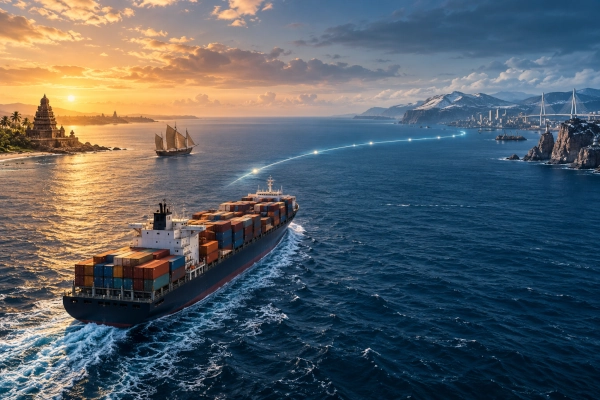
India and Russia are steadily developing one of the most geographically significant trade corridors in Eurasia: a maritime connection between India’s eastern seaboard and the Russian Far East. Known as the Chennai–Vladivostok Eastern Maritime Corridor, or EMC, the route is designed to connect ports on India’s east coast with Vladivostok and other Russian Pacific ports, creating a shorter and more direct transport link between the two countries.
The corridor is no longer merely a proposal. Cargo has already begun moving through the route, and both India and Russia are seeking to expand its commercial utilisation as bilateral trade grows towards the target of more than $100 billion by 2030. The route has particular relevance for bulk commodities such as coking coal and crude oil, while its longer-term potential extends to fertilisers, LNG, timber, industrial goods, pharmaceuticals and containerised cargo.
At the same time, the corridor raises a fascinating historical question. India’s southeastern coast has been sending ships eastward for nearly two millennia. Tamil merchants sailed across the Bay of Bengal, South Indian commercial guilds established themselves throughout Southeast Asia, Chola fleets crossed into the Malay world, and ships connected ports such as Nagapattinam with Chinese maritime centres including Quanzhou and Guangzhou.
This has led to occasional claims that the Chennai–Vladivostok route is simply the revival of a sea lane that was active during the period of India’s ancient or medieval kings. The historical reality is more complex. The modern corridor does follow the same broad eastward maritime orientation used by Indian sailors for centuries, but there is presently no firm archaeological or textual evidence establishing a regular direct Chola-era shipping route between Tamil India and the coastline around present-day Vladivostok.
What can be demonstrated with much greater confidence is the existence of a vast maritime continuum stretching from the Coromandel Coast through Sri Lanka, Southeast Asia and the South China Sea to the ports of China. The final extension northwards towards the Russian Far East belonged to a different regional maritime environment. Understanding that distinction allows the modern corridor to be placed within a remarkable historical context without exaggerating the evidence.
A Maritime Corridor Connecting Two Ends of Asia
The Eastern Maritime Corridor links India’s eastern seaboard with Russia’s Pacific territories. Chennai and Vladivostok serve as its principal reference points, although the concept is broader than a simple port-to-port shipping service. Other Indian east coast ports and Russian Far Eastern ports, including Vostochny, Nakhodka and Kozmino, can potentially participate in the larger logistics network.
The distance between Chennai and Vladivostok is approximately 5,647 nautical miles, or about 10,458 kilometres. This gives the route a significant advantage over longer maritime connections between India and European Russia. India’s Ministry of Ports, Shipping and Waterways has estimated that cargo moving between India and the Russian Far East through the EMC can potentially complete the journey in roughly 24 days, compared with more than 40 days through longer routes reaching European Russia.
The corridor therefore changes the geographical logic of India–Russia commerce. Traditionally, much of the relationship was viewed through western India, the Arabian Sea, Europe and the western regions of Russia. The EMC instead turns eastward through the Bay of Bengal, Southeast Asian waters and the Western Pacific before reaching Russia’s Pacific coastline. It creates an alternative gateway into Russia and places the Russian Far East more directly within India’s wider Indo-Pacific economic geography.
The Corridor Begins on One of India’s Oldest Maritime Coasts
Although Chennai itself developed much later as a major port city, the coastline around present-day Tamil Nadu possesses one of the oldest and richest maritime traditions in India. Ancient and medieval ports including Kaveripattinam, also known as Puhar, Mamallapuram, Nagapattinam, Korkai and Alagankulam connected southern India with Sri Lanka, Southeast Asia and wider Indian Ocean trading networks.
Marine archaeological investigations and historical research show that ports along the Tamil coast played an important role in overseas commerce from the early centuries of the Common Era. Goods, merchants, religious ideas and cultural traditions moved along these routes, establishing the Coromandel Coast as one of the principal eastern maritime gateways of the subcontinent.
The modern Eastern Maritime Corridor therefore begins in a region whose commercial relationship with the sea predates the contemporary Indian state by many centuries. While the modern port infrastructure is new, the basic geographical advantage of the Tamil coast remains familiar: it provides direct access across the Bay of Bengal towards Southeast Asia and the wider Pacific maritime world.
The Coromandel Coast Looked East Long Before Modern Shipping
Indian maritime history is often discussed through trade across the Arabian Sea with Rome, Arabia, Persia and East Africa. The eastern coast, however, supported an equally important system of maritime exchange. Sailors operating from the Bay of Bengal understood seasonal monsoon winds and used them to navigate between India, Sri Lanka and Southeast Asia.
Archaeological evidence including ceramics, beads, inscriptions, coins and port settlements demonstrates sustained interaction across these waters. Indian merchants did not merely wait for foreign vessels to arrive on the subcontinent. They participated actively in overseas trade and established commercial communities beyond India.
From the Tamil coast, the maritime road led towards Sri Lanka, the Nicobar and Andaman region, the Malay Peninsula, Sumatra, Java and the South China Sea. These waters connected South Asia with some of the most important commercial centres of Southeast and East Asia.
The Cholas Turned the Eastern Sea Into a Strategic Space
The maritime orientation of southern India reached one of its greatest expressions under the imperial Cholas. By the tenth and eleventh centuries, the Chola state controlled much of the Coromandel Coast and possessed access to important ports including Nagapattinam.
The Chola economy benefited extensively from overseas commerce. Textiles, spices, aromatics, precious materials and manufactured goods moved through ports associated with the kingdom, while customs revenue and commercial taxation contributed to the prosperity of the state. South Indian merchant organisations were active across Southeast Asia and formed part of a broad network linking India with distant markets.
For the Cholas, the sea was therefore not a boundary separating the kingdom from the rest of Asia. It was an economic and strategic highway. Maritime access connected the Chola realm with Sri Lanka, Southeast Asia and China and contributed to the kingdom’s wider political reach.
Rajendra Chola and the Great Eastern Expedition
The most dramatic expression of Chola maritime power occurred during the reign of Rajendra Chola I. In 1025, Chola forces launched a naval expedition against a series of ports and territories associated with the Srivijayan maritime network in Southeast Asia.
The campaign reached regions around Sumatra and the Malay Peninsula, including Kadaram, generally associated with the Kedah region of present-day Malaysia. The expedition demonstrated the capacity of a South Indian power to project naval force across the Bay of Bengal and into one of Asia’s most important commercial zones.
The campaign cannot be understood purely as territorial conquest. Srivijaya occupied a strategic position around the Strait of Malacca, through which maritime traffic between the Indian Ocean and South China Sea passed. Access to, influence over and security within this commercial system had clear economic implications for South Indian merchants and the Chola state.
The Chola expedition therefore illustrates the degree to which the eastern seas had become strategically important to India’s political and commercial interests long before the modern age.
Chola India Maintained Maritime Connections With China
The eastern maritime network did not end in Southeast Asia. During the Chola period, commercial and diplomatic contacts extended further towards Song China. Historical evidence records exchanges between South India and Chinese maritime centres, including Guangzhou and Quanzhou.
Rajendra Chola I sent an official mission to the Song court in the early eleventh century, and subsequent contacts continued under later rulers. South Indian merchant communities also became established in Chinese port cities.
By the thirteenth century, Tamil merchant activity in Quanzhou was substantial enough for inscriptions and remains associated with Hindu religious activity to survive there. Chinese sources likewise preserve information about South Indian kingdoms, merchants and maritime trade.
The evidence therefore clearly demonstrates that merchants and ships from the broader Coromandel maritime world operated deep within East Asian trading networks.
Nagapattinam Was an International Maritime Gateway
Nagapattinam deserves particular attention when examining the historical background of the modern Chennai–Vladivostok corridor. During the Chola period, Nagapattinam functioned not merely as a regional harbour but as an international commercial gateway connecting South India with Sri Lanka, Southeast Asia and China.
Its cosmopolitan character was reflected in the presence of multiple merchant, religious and cultural communities. Buddhist, Hindu and overseas commercial connections converged there, demonstrating the international character of medieval maritime commerce along the Coromandel Coast.
The modern gateway may be Chennai, but the maritime centre of gravity along this coastline shifted repeatedly over the centuries. Different ports rose or declined according to political conditions, silting, trade patterns and the changing requirements of ships.
The continuity therefore lies not in one particular harbour but in the maritime orientation of the coast itself.
Did Chola Ships Sail All the Way to Vladivostok?
This is where the historical evidence requires greater caution. There is strong evidence that Tamil and other South Indian merchants sailed across the Bay of Bengal into Southeast Asia and onward to China. There is also substantial evidence for commercial networks operating throughout the South China Sea.
There is not, however, comparable evidence demonstrating that Chola vessels regularly continued northward through the East China Sea, Korean waters and the Sea of Japan to the coastline of present-day Primorsky Krai in Russia.
No established Chola inscription, Tamil merchant inscription, Chinese record or archaeological discovery currently demonstrates a regular Tamil commercial settlement near Vladivostok or a direct Chola–Primorye maritime route.
This does not mean contact was impossible. Goods could travel enormous distances through several connected trading systems. However, the existence of long-distance commercial exchange is different from evidence for a direct shipping service.
For this reason, describing the modern Chennai–Vladivostok corridor as an ancient Chola route would go beyond what the evidence presently supports.
Vladivostok Did Not Exist as a City in the Chola Period
There is also an important chronological issue with the phrase “ancient Chennai–Vladivostok route.” Vladivostok itself was founded as a Russian military settlement in 1860. The modern city therefore did not exist during the Chola period.
Similarly, modern Chennai did not exist in its present form or under its present name during the age of the Cholas. Maritime activity along the Tamil coast was then concentrated in ports such as Nagapattinam, Kaveripattinam and other regional centres.
The proper historical comparison is therefore between maritime regions and networks rather than between the two modern cities themselves. The ancient continuity lies in the eastward movement of ships from the Coromandel Coast, not in an identical port-to-port service operating between Chennai and Vladivostok.
What Was Happening Around Present-Day Vladivostok in Ancient Times?
The region surrounding modern Vladivostok nevertheless possessed a long history of trade and cultural interaction. Primorye, or the Russian Maritime Province, lies close to northeast China and the Korean Peninsula and formed part of wider Northeast Asian networks.
Archaeological research indicates that communities in Primorye participated in exchanges linking coastal and inland Northeast Asia. Materials found in the region point towards interaction with northeast China, Liaodong, Mongolia and the Korean Peninsula.
These discoveries demonstrate that the Russian Far East was not isolated from surrounding civilisations. Coastal routes and overland contacts connected the region with neighbouring areas.
What the evidence does not currently demonstrate is a direct maritime bridge from India to Primorye during the ancient or medieval period. It is more accurate to understand the region as belonging to a Northeast Asian commercial system that could ultimately interact with Chinese markets, which in turn participated in much larger Asian maritime networks.
Ancient Maritime Networks Operated as Chains
One reason historical claims about long-distance trade require caution is that ancient commerce did not usually operate like a modern liner service. A commodity did not necessarily remain on a single ship from its port of origin to its final destination.
Goods frequently passed through several ports, merchant communities and intermediaries before reaching distant markets. A textile produced in Tamil Nadu might leave Nagapattinam, arrive at a Southeast Asian entrepôt, change hands and vessels, and eventually reach China or another East Asian destination.
The same principle applied in the opposite direction. Products from Northeast Asia could travel south through Chinese or Korean commercial systems before entering Southeast Asian trade networks and eventually reaching India.
The discovery of an Indian product far from India would therefore not automatically prove that an Indian vessel sailed directly to the place where the item was found. Ancient maritime commerce was built around overlapping networks rather than fixed direct routes.
Southeast Asia Was the Great Maritime Bridge
The crucial geographical bridge between India and East Asia was maritime Southeast Asia. The Strait of Malacca connected the Indian Ocean with the South China Sea and became one of the most important commercial passages in the pre-modern world.
Ports in Sumatra, the Malay Peninsula, Java, Champa and other parts of Southeast Asia functioned as entrepôts where merchants from different regions exchanged commodities and transferred cargo.
The Cholas participated actively in this maritime environment. Their commercial interests, diplomatic contacts and military interventions all demonstrate the importance of Southeast Asia in connecting India with the wider eastern world.
The modern Chennai–Vladivostok corridor crosses much of the same broad maritime theatre before continuing farther north towards the Russian Pacific. In that sense, the modern route extends an old geographical direction even though the final destination belongs to a different historical network.
The First Documented Direct Russian Far East–India Service Came in 1967
The strongest direct historical predecessor of the modern Eastern Maritime Corridor dates not to the Chola age but to the Soviet period.
In 1967, the Far Eastern Shipping Company, better known as FESCO, opened the FESCO–India Line. The service connected the Soviet Far East with Southeast Asia and India through ports including Nakhodka, Hong Kong, Singapore, Calcutta and Madras, the present-day Chennai.
Three Soviet vessels reportedly operated the service until 1969, with an average round voyage lasting about 90 days. This route represents the clearest documented precedent for the contemporary Chennai–Vladivostok maritime initiative.
The modern corridor can therefore accurately be described as reviving a Soviet-era Far East–India shipping connection while also returning the Coromandel Coast to its much older eastward maritime orientation.
Why the Soviet Route Did Not Become Permanent
The FESCO–India Line existed in a very different economic environment. India and the Soviet Union maintained close political and strategic relations, but bilateral commercial volumes were much smaller than those seen today.
Containerisation was still developing globally, and the Russian Far East had not yet become integrated into Asian supply chains at its present scale. The economics of maintaining a dedicated shipping service therefore differed significantly from contemporary conditions.
Modern India–Russia trade has expanded enormously, particularly in energy and bulk commodities. This creates cargo volumes and commercial incentives that did not exist in the same form during the late 1960s.
The Modern Corridor Takes Shape in Vladivostok
The contemporary Eastern Maritime Corridor received its political foundation during Prime Minister Narendra Modi’s visit to Vladivostok in September 2019.
India’s Ministry of Shipping and Russia’s Ministry of Transport signed a Memorandum of Intent on developing maritime communications between Chennai and Vladivostok. The agreement formed part of India’s broader effort to deepen economic engagement with the Russian Far East.
During the same visit, India announced a $1 billion Line of Credit for development projects in the region. Energy, mining, diamonds, timber, agriculture, infrastructure and logistics were identified among the areas offering potential for deeper economic cooperation.
The maritime corridor was therefore conceived not as an isolated shipping project but as part of a larger strategy to connect Indian businesses with the resources and markets of Russia’s Pacific regions.
The Russian Far East Becomes More Important to India
For decades, the geographical centre of India–Russia relations lay primarily in Moscow and European Russia. The increasing economic importance of the Russian Far East has gradually changed this picture.
The region contains enormous reserves of coal, hydrocarbons, timber, diamonds, metals and other natural resources. It also gives Russia direct access to Asian and Pacific markets.
For India, accessing these resources through Pacific ports can reduce the dependence on routes extending across the Eurasian landmass or reaching ports in western Russia. Vladivostok therefore provides India with an additional doorway into the Russian economy.
This has particular importance as India seeks secure sources of energy, metallurgical coal, fertilisers and strategic raw materials.
Feasibility Studies Focused on Bulk Commodities
Detailed studies of the corridor identified bulk commodities as the most practical foundation for early operations. Coking coal emerged as one of the strongest possibilities because India requires substantial quantities of metallurgical coal for its expanding steel industry while Russia possesses significant reserves in its eastern regions.
Crude oil, LNG, fertilisers and containerised goods have also been identified as potential cargo categories.
An India–Russia workshop held in Chennai in January 2024 brought together port authorities, regulators and representatives from the coal, crude oil, LNG, fertiliser and container sectors to examine the commercial requirements of the corridor and accelerate its operationalisation.
The focus on specific cargo categories demonstrated that the project had moved from diplomatic concept towards practical logistics planning.
Trial Voyages Demonstrated the Route
A significant step occurred in October 2023 when a trial voyage was conducted between Chennai and the Russian Far East. Russian officials stated that the round trip took approximately 17 days in that particular trial, demonstrating the potential for significantly shorter transit compared with routes connecting India with European Russia.
The trial helped generate practical information concerning voyage duration, port handling, cargo movement and logistical coordination. Such voyages are important because the commercial viability of a maritime corridor depends not only on distance but also on customs procedures, port turnaround, cargo availability and the reliability of return shipments.
Cargo Has Already Begun Moving Through the Corridor
By 2024, commercial cargo movement through the Eastern Maritime Corridor had begun. Indian maritime reporting subsequently recorded movement of commodities including coal and crude oil through the route.
This development is significant because it marks the transition of the EMC from a strategic proposal into an operational commercial link.
The corridor is therefore not merely a project intended for some distant future. It is already being used, although considerable work remains before regular and diversified traffic reaches the scale envisioned by the two governments.
Cargo Volumes Are Increasing
The commercial relevance of the corridor is reflected in rising cargo volumes. Union Ports, Shipping and Waterways Minister Sarbananda Sonowal stated in 2026 that major east coast Indian ports handled approximately 2.574 million metric tonnes of coal through the EMC during FY2024–25, compared with around 1.379 million tonnes in the preceding financial year.
This represented growth of approximately 87 per cent.
Crude oil transported through the corridor also increased substantially, rising from around 1.089 million tonnes to approximately 1.613 million tonnes, representing growth of roughly 48 per cent.
These figures demonstrate that the EMC is increasingly functioning as a real cargo route rather than remaining primarily a diplomatic connectivity initiative.
What Russia Can Send to India
The strongest economic logic for the corridor lies in commodities produced in the Russian Far East and adjoining regions.
Potential Russian exports include coking coal, crude oil, LNG, fertilisers, timber and other natural resources. These products have direct relevance for India’s steel, energy, chemical and manufacturing sectors.
Coking coal is particularly important because India’s growing steel capacity requires large quantities of metallurgical coal, much of which must be imported. Access to Russian Far Eastern supplies through an eastern maritime route could help diversify sourcing and shorten transport distances.
The corridor could eventually support more containerised trade as commercial volumes increase and logistics become more predictable.
India Also Needs to Build Eastbound Cargo
For the corridor to become commercially sustainable over the long term, ships cannot remain heavily dependent on one-directional cargo.
India is seeking to increase exports to Russia in pharmaceuticals, engineering goods, machinery, processed foods, agricultural products, chemicals, textiles and consumer goods.
A successful eastward maritime route could allow Indian manufacturers to access not only Vladivostok and neighbouring regions but also inland Russian markets through the country’s railway system.
Vladivostok and nearby ports connect with the Trans-Siberian Railway and other infrastructure extending across Russia. The maritime corridor could therefore function as an oceanic gateway to a much larger continental logistics system.
The Corridor Supports the $100 Billion Trade Target
India and Russia have set a target of taking bilateral trade beyond $100 billion by 2030. Achieving this level of commerce requires more than higher demand. It also requires efficient transport infrastructure capable of moving goods reliably between the two countries.
The Chennai–Vladivostok corridor is one of several connectivity projects identified as important to this strategy.
India and Russia are simultaneously promoting the International North–South Transport Corridor and examining possibilities connected with the Northern Sea Route. Together, these projects could create several independent transport arteries linking different regions of India and Russia.
Three Corridors Create Three Geographical Approaches
The emerging India–Russia connectivity architecture can be understood through three principal directions.
The International North–South Transport Corridor links western India with Iran, the Caspian region and Russia. It is primarily a multimodal western route involving sea, rail and road connections.
The Eastern Maritime Corridor links India’s eastern seaboard directly with the Russian Far East through Asian maritime waters.
The Northern Sea Route, meanwhile, has potential relevance for longer-term trade through the Russian Arctic.
Together, these routes create western, eastern and northern approaches to the same bilateral economic relationship. This diversification can provide businesses with greater flexibility while reducing dependence on any single transport system.
The EMC Also Places India–Russia Trade Inside the Indo-Pacific
The Chennai–Vladivostok corridor has a broader strategic significance because it lies geographically within the Indo-Pacific maritime space.
A ship sailing from India to Vladivostok moves from the Bay of Bengal through Southeast Asian waters and the broader Western Pacific before reaching the Russian Far East.
This makes the EMC different from many older India–Russia connectivity projects. It gives Russia another economic interface with the Indo-Pacific while giving India direct maritime access to Russia’s Pacific territories.
The corridor therefore links two strategic geographies that were historically discussed separately: India’s Indo-Pacific maritime environment and Russia’s Far Eastern economic region.
Chennai Is the Modern Successor to an Older Maritime Geography
The choice of Chennai has obvious modern economic advantages. The port lies near one of India’s largest manufacturing belts and possesses extensive road, rail and industrial connections across Tamil Nadu and neighbouring states.
At the same time, Chennai sits within the older maritime geography of the Coromandel Coast.
Ancient sailors did not depart from modern Chennai Port for Vladivostok. However, ships departing from ports along the same coastline were crossing the Bay of Bengal centuries before European oceanic expansion.
The historical continuity therefore lies in the direction of movement. India was already looking eastward from this coast long before the creation of modern international shipping routes.
From Puhar and Nagapattinam to Chennai
Viewed across a long historical period, the Tamil coast presents a remarkable succession of maritime centres.
Puhar served the early Tamil maritime world. Nagapattinam became an important international gateway during the Chola age. Other ports connected the coast with Sri Lanka, Southeast Asia and China. Madras later emerged as an important colonial port, while modern Chennai developed into one of India’s major commercial and industrial centres.
The individual ports changed, but the relationship between the coast and overseas trade endured.
This continuity helps explain why the Chennai–Vladivostok project carries a historical resonance extending beyond contemporary India–Russia relations.
From Srivijaya and Song China to the Russian Pacific
During the Chola period, the principal eastern maritime connections of South India led towards Southeast Asian polities and Song China.
The modern Eastern Maritime Corridor passes through the same broad Asian maritime world before continuing much farther north towards Russia’s Pacific coast.
It should therefore not be imagined as an ancient route simply reopened after a thousand years. It is better understood as a modern extension of an old maritime orientation.
The sea lanes, political boundaries, ships and destinations have changed dramatically, but the underlying geography remains recognisable. The Coromandel Coast continues to offer India direct access towards the eastern half of Asia.
A Corridor With Two Different Historical Foundations
The Chennai–Vladivostok corridor ultimately rests on two distinct historical narratives.
The first is ancient and medieval. It concerns Tamil sailors, merchant guilds, Chola naval activity, Southeast Asian entrepôts and commercial links with China. This history establishes the Coromandel Coast as one of the great maritime gateways of pre-modern Asia.
The second is modern. It begins with Soviet shipping services linking Nakhodka, Southeast Asia, Calcutta and Madras in 1967, and it re-emerged as a major strategic concept after India began intensifying its engagement with the Russian Far East.
The 2019 Chennai–Vladivostok Memorandum of Intent then provided the contemporary governmental framework for converting this geographical possibility into a modern transport corridor.
These histories should not be merged into a single uninterrupted route, but they can legitimately be seen as successive chapters in India’s long tradition of looking eastward from its maritime coast.
Reviving an Ancient Maritime Orientation, Not an Ancient Vladivostok Route
The most historically accurate description of the Eastern Maritime Corridor is therefore that it revives the Coromandel Coast’s ancient eastward maritime orientation while also restoring a direct India–Russian Far East shipping connection that has a documented Soviet-era precedent.
There is currently no convincing evidence that Chola kings maintained a direct sea route between Tamil India and the coastline around modern Vladivostok. What unquestionably existed was a sophisticated maritime civilisation on India’s southeastern coast whose merchants, ships and political powers connected India with Sri Lanka, Southeast Asia and China.
The modern Chennai–Vladivostok corridor extends that eastward geography much farther north.
It connects India’s Coromandel seaboard with the Russian Pacific and establishes a new commercial bridge across the Indo-Pacific at a time when both countries are seeking to diversify trade, transport and investment.
More than a thousand years after Chola ships crossed the eastern seas, cargo vessels are once again making India’s east coast part of an expanding trans-Asian commercial network.
The ships are different, the ports are different and the final destination lies much farther north. Yet the underlying geographical idea remains strikingly familiar: India looking eastward from the Coromandel Coast to reach the markets, resources and maritime networks of Asia.
References
Press Information Bureau, Government of India — List of MoUs and Agreements exchanged during Prime Minister Narendra Modi’s visit to Vladivostok, 4 September 2019.
Prime Minister’s Office — Press statement during Prime Minister Narendra Modi’s visit to Vladivostok, September 2019.
Ministry of Ports, Shipping and Waterways — Eastern Maritime Corridor statements and India–Russia maritime cooperation releases.
Ministry of Ports, Shipping and Waterways — India–Russia Workshop on Operationalisation of the Eastern Maritime Corridor, Chennai, January 2024.
Government of India — Leaders’ Joint Statement on strategic areas of India–Russia economic cooperation up to 2030.
Government of India — Joint Statement following the India–Russia Annual Summit.
India Maritime Report 2025–26 — Chennai–Vladivostok Eastern Maritime Corridor cargo operations.
Indian Council of World Affairs — Exploring Additional Maritime Routes to Russia.
Observer Research Foundation — East Meets East: An Assessment of the Proposed Chennai–Vladivostok Maritime Corridor.
Cambridge University Press / ISEAS — Studies on Nagapattinam, Chola maritime activity and South Indian links with Southeast Asia.
Cambridge University Press — Studies on maritime relations between the Indian Ocean and the China Sea in the medieval period.
Ministry of External Affairs — Encyclopedia of India–China Cultural Contacts.
National Institute of Oceanography — Research on marine archaeology and ancient maritime trade along the Tamil Nadu and eastern Indian coasts.
You may also like
-
India–Taiwan Deep-Tech Investment Link Expands With ₹1,000-Crore Advanced Manufacturing Fund
-
Micron Begins Global Shipments of DRAM and NAND Products From Sanand as India’s Semiconductor Manufacturing Scales Up
-
India Records $20.8 Billion Balance-of-Payments Surplus in July as Foreign-Exchange Inflows Surge
-
India and Thailand Move Toward UPI–PromptPay Link and Rupee–Baht Settlement to Deepen Economic Integration
-
Moody’s Raises India’s FY2026-27 Growth Forecast to 7% as Economy Shows Resilience Amid Global Shocks
