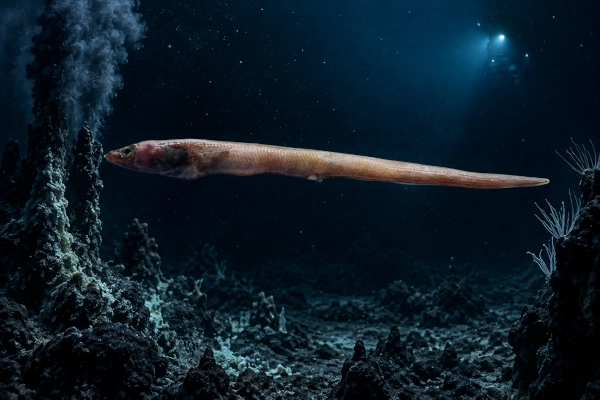
Indian marine scientists have described a new species of deep-sea conger eel from the Arabian Sea off Kerala, adding another previously undocumented species to India’s growing inventory of marine biodiversity.
The new species, named Ariosoma cmfriense, was identified by scientists from the ICAR-Central Marine Fisheries Research Institute in Kochi. The specimen was collected from waters off Kollam at a depth of approximately 300 metres in January 2026 as part of research associated with India’s Deep Ocean Mission.
The discovery was established through a combination of detailed anatomical examination and molecular analysis. Researchers compared the specimen with 12 recognised species of the genus Ariosoma reported from Indian and neighbouring waters before concluding that it represented a species previously unknown to science.
The formal description has now been published in the international taxonomic journal Zootaxa.
A New Species From Kerala’s Deep Waters
The new eel belongs to the family Congridae, a diverse group commonly known as conger eels. Members of this family occur in marine environments across tropical and temperate regions, with some species inhabiting relatively shallow coastal waters and others occupying deeper areas of the continental shelf and slope.
Ariosoma cmfriense was collected off Kollam on India’s southwest coast. At approximately 300 metres below the surface, sunlight is greatly diminished and environmental conditions differ considerably from those found in the shallow coastal waters that support most familiar marine fisheries.
Deep-water environments remain considerably less documented than coastal ecosystems, partly because surveying them requires specialised vessels, sampling equipment and scientific expeditions.
The discovery therefore adds another piece to the developing picture of biological diversity in the deeper waters of the Arabian Sea.
How Scientists Identified the New Eel
Declaring an animal a new species requires considerably more evidence than identifying an unusual-looking specimen.
The ICAR-CMFRI researchers examined a combination of anatomical characteristics that distinguished the eel from previously recognised members of the genus.
Ariosoma cmfriense has a total vertebral count of 135 and between 127 and 130 lateral-line pores. Its preanal length accounts for approximately 43.9 percent of its total body length, and it possesses two supraorbital pores.
The dorsal fin begins just ahead of the base of the pectoral fin. The pectoral fin itself is plain rather than displaying the two-toned appearance found in some related species.
Researchers also observed a dark patch over the operculum, the bony structure covering the gills, along with fine black speckling across the body below the lateral line. According to the scientific description, this pattern of fine black speckling is not found among the other comparable Ariosoma species examined by the researchers.
It was the combination of these characteristics, rather than any single feature, that provided the morphological basis for recognising the specimen as distinct.
DNA Analysis Confirmed a Separate Lineage
The researchers supplemented conventional taxonomy with molecular analysis.
DNA barcoding was conducted using the mitochondrial cytochrome c oxidase subunit I, or COI, gene. This section of mitochondrial DNA is widely used in animal taxonomy because genetic differences within the region can help scientists distinguish between closely related species.
The resulting analysis placed Ariosoma cmfriense as a distinct evolutionary lineage. Its closest identified relative in the analysis was Ariosoma indicum.
Despite that relationship, the two showed approximately seven percent genetic divergence in the COI sequence. The researchers considered this divergence, together with the clear morphological differences, consistent with recognition of A. cmfriense as a separate species.
The use of both anatomical and genetic evidence strengthens the identification considerably. Modern integrative taxonomy increasingly combines traditional measurements and physical characteristics with molecular techniques, particularly when dealing with groups containing species that can appear superficially similar.
A Small Specimen With Scientific Importance
The specimen used for the formal description measured approximately 255 millimetres in total length.
It has been designated as the holotype of the species. In biological taxonomy, a holotype is the individual specimen upon which the formal scientific description and name of a new species are based.
The holotype has been deposited in the ICAR-CMFRI Marine Biodiversity Museum in Kochi, ensuring that it remains available as a permanent scientific reference.
Future researchers examining other specimens believed to belong to Ariosoma cmfriense can compare them with the documented characteristics of the type specimen.
Maintaining such biological collections is an important part of taxonomy because a species description must remain verifiable long after the original research has been published.
Named After ICAR-CMFRI
The species name cmfriense honours the Central Marine Fisheries Research Institute.
The naming coincides with ICAR-CMFRI’s 80th anniversary year and recognises the institute’s contribution to the study of India’s marine resources and biodiversity.
Established in 1947, CMFRI has developed extensive research programmes covering marine fisheries, biodiversity, aquaculture, environmental monitoring and the biological resources of India’s coastal and offshore waters.
The discovery off Kollam is particularly relevant to the institute’s expanding work on deeper marine environments, where many species remain poorly documented compared with organisms inhabiting India’s coastal ecosystems.
Part of India’s Deep Ocean Mission
The discovery emerged from research undertaken under India’s Deep Ocean Mission, a national programme led by the Ministry of Earth Sciences.
The mission is intended to expand India’s scientific and technological capability for exploring and understanding the deep ocean. Its activities cover areas ranging from deep-sea technology and ocean observation to marine biodiversity and biological-resource assessment.
Although discussions surrounding deep-ocean exploration frequently focus on minerals and specialised underwater technology, biological exploration forms another important component of understanding these environments.
Before marine resources or ecosystems can be effectively studied and managed, scientists need to know which organisms inhabit them, how they are distributed and how different species relate to one another.
Taxonomic surveys therefore provide baseline information upon which more detailed ecological and conservation research can subsequently be built.
The Arabian Sea Still Holds Biological Surprises
The discovery of Ariosoma cmfriense also demonstrates how much remains to be documented in India’s deeper marine waters.
The Arabian Sea supports an enormous range of environments extending from coral reefs, estuaries and coastal shelves to deep continental slopes, submarine features and open-ocean ecosystems.
Much of India’s marine biological research has historically concentrated on coastal areas because of their direct importance to fisheries and coastal communities. Deeper environments are harder and more expensive to sample systematically.
As research vessels and deep-sea survey programmes begin examining these regions more extensively, additional species records and potentially more species new to science are likely to emerge.
This does not necessarily mean that the animals themselves are newly evolved or recently arrived. In most cases, such discoveries involve species that may have inhabited their ecosystems for very long periods but had never previously been collected, recognised or formally described by scientists.
Why Taxonomy Matters
The discovery also highlights the continuing importance of taxonomy at a time when biodiversity research increasingly depends on sophisticated genetic and computational technologies.
DNA analysis is extremely valuable, but the identification of Ariosoma cmfriense demonstrates why traditional anatomical work remains essential. Vertebral counts, fin positions, body proportions, pigmentation patterns and sensory pores all contributed to separating the new species from its relatives.
Molecular evidence then provided an independent line of evidence supporting that distinction.
Knowing which species occur within an ecosystem is fundamental to understanding how that ecosystem functions. Without reliable species identification, researchers can struggle to determine geographical distributions, population trends or ecological relationships.
This becomes particularly important in deep-sea environments, where scientific knowledge remains comparatively limited and baseline biological information is still being assembled.
Another Addition to India’s Marine Biodiversity
Ariosoma cmfriense now joins the documented diversity of conger eels occurring in Indian waters and provides another example of the biological discoveries emerging from systematic exploration of the country’s marine environment.
The significance of the discovery lies not in the size of the animal but in the information it provides about a part of India’s marine territory that remains incompletely understood.
A single 255-millimetre specimen collected approximately 300 metres below the Arabian Sea has revealed a distinct evolutionary lineage that had not previously been recognised by science.
As India’s Deep Ocean Mission and other marine research programmes extend scientific exploration farther offshore and into deeper waters, discoveries such as Ariosoma cmfriense are helping build a more complete picture of the biodiversity that exists beneath the country’s surrounding seas.
References
Indian Council of Agricultural Research — ICAR-CMFRI, Kochi Describes New Eel Species from Arabian Sea
https://icar.gov.in/en/icar-cmfri-kochi-describes-new-eel-species-arabian-sea
ICAR-Central Marine Fisheries Research Institute Digital Repository — Ariosoma cmfriense sp. nov., a New Species of Conger Eel from Indian Waters
https://eprints.cmfri.org.in/19965
Zootaxa — Ariosoma cmfriense sp. nov., a New Species of Conger Eel (Anguilliformes: Congridae) from Indian Waters
https://www.mapress.com/zt
You may also like
-
Black-Headed Ibis Flock Turns Tirunavaya Paddy Fields Into a Spectacular Bird Haven
-
Bihar’s 700-Year-Old Banyan Becomes World’s Oldest Scientifically Dated Ficus benghalensis
-
Mizoram Adds Two New Amphibians as Scientists Uncover Hidden Diversity in Northeast India
-
New Metallic Golden-Green Beetle Species Discovered in Wayanad Wildlife Sanctuary
-
ZSI Publishes Major Faunal Inventory of Visakhapatnam as Urban Biodiversity Comes Into Focus
