India has emerged as the world’s largest vaccine producer by volume and one of the most important suppliers to the global immunisation system, with its expanding biotechnology ecosystem now positioning the country for a larger role in next-generation vaccine development and epidemic preparedness.
Union Minister of State for Science and Technology Dr Jitendra Singh said India now combines large-scale manufacturing capability with advanced research, clinical infrastructure and a diverse disease environment that can support the development of vaccines and biomedical solutions for future epidemics and pandemics.
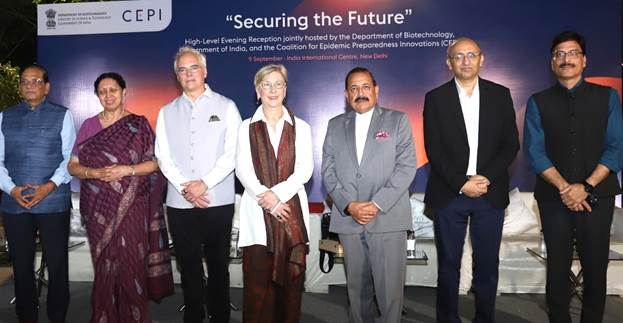
He was addressing a high-level reception for the Coalition for Epidemic Preparedness Innovations, or CEPI, Board and Investors Council in New Delhi. The event was jointly hosted by the Department of Biotechnology and CEPI and brought together scientists, policymakers, industry representatives and international partners working in vaccine development and epidemic preparedness.
India Supplies Vaccines to More Than 100 Countries
India currently supplies vaccines to more than 100 countries and accounts for nearly 60 per cent of global vaccine production by volume. It also meets more than 65 per cent of the World Health Organization’s routine immunisation vaccine requirements.
Dr Singh said India’s vaccine capabilities have moved well beyond the country’s earlier reputation as primarily a low-cost manufacturing base. The domestic ecosystem now spans vaccine research, advanced biologics, clinical development, large-scale manufacturing and newer technology platforms.
The transformation became particularly visible during the COVID-19 pandemic, when India developed and manufactured vaccines domestically while also supplying doses to other countries.
Bioeconomy Reaches $195.3 Billion
India’s broader biotechnology sector has expanded rapidly alongside its vaccine industry. The country’s bioeconomy reached $195.3 billion in 2025, recording year-on-year growth of 18 per cent.
India’s biotech startup ecosystem expanded to 11,855 companies, including 1,780 startups added during 2025 alone. Biopharma accounts for nearly 30 per cent of the country’s bioeconomy, giving vaccine and biologics development an increasingly important position within the wider biotechnology sector.
Dr Singh said the progress achieved over the past decade reflects a wider transformation in India’s scientific and epidemic-preparedness capabilities.
Disease Diversity Could Become a Research Advantage
India’s disease profile also offers an unusual scientific advantage for vaccine and pathogen research.
The country continues to face a wide range of communicable diseases while simultaneously experiencing an increasing burden of non-communicable and metabolic disorders. This creates complex public-health challenges but also provides researchers with opportunities to study pathogens, disease patterns and interactions across different biological and environmental conditions.
Dr Singh said India’s combination of microbial diversity and scientific expertise could contribute not only to domestic health preparedness but also to the global repository of knowledge and biomedical solutions for emerging health threats.
India-CEPI Partnership Renewed for Five Years
India has been associated with CEPI since the organisation’s formative years and remains one of its founding members and strategic partners.

The partnership involving the Department of Biotechnology, Biotechnology Industry Research Assistance Council and CEPI was first formalised in October 2019. The engagement was renewed in September 2025 for another five years, opening a new phase of cooperation focused on vaccines for emerging infectious diseases and preparedness for future epidemics.
The initiative is being implemented in India through the Ind-CEPI Mission, with BRIC-Translational Health Science and Technology Institute and BIRAC playing central roles.
Ind-CEPI Delivers India’s First mRNA COVID Vaccine
The Ind-CEPI Mission has already produced several significant outcomes.
Among them is GEMCOVAC-19, India’s first domestically developed mRNA COVID-19 vaccine, which received Emergency Use Authorisation.
The programme has also supported an inactivated Chikungunya vaccine candidate that has progressed to Phase II/III clinical trials.
Researchers are additionally developing multivalent self-assembled nanocage-based vaccine candidates targeting monkeypox and pan-sarbecoviruses. These candidates have reached advanced pre-clinical stages.
Together, these programmes show that India is moving into more sophisticated vaccine platforms rather than relying solely on conventional manufacturing technologies.
Indian Laboratories Join CEPI Global Network
India is also contributing laboratory and pre-clinical infrastructure to CEPI’s global vaccine-development network.
The BRIC-THSTI Bioassay Laboratory has been recognised as one of CEPI’s 17 centralised network laboratories. It has supported eight vaccine candidates at stages ranging from pre-clinical development to Phase III efficacy studies for developers in India and other countries.
The laboratory has tested more than one lakh samples related to vaccine development.
BRIC-THSTI’s animal facility has also joined CEPI’s pre-clinical network, further integrating Indian research infrastructure with international epidemic-preparedness programmes.
More Than 2,400 Participants Trained Across 14 Countries
Capacity building has become another important element of the India-CEPI partnership.
BRIC-THSTI and CEPI have jointly conducted advanced vaccinology courses, while the PACT programme has provided online training to more than 2,400 participants from 14 friendly and neighbouring countries.
The programme is aimed at strengthening clinical-trial capabilities and preparing a broader regional network of researchers and institutions that can respond more quickly during future outbreaks.
Focus Shifts to Universal and Pan-Pathogen Vaccines
The next phase of the Ind-CEPI Mission is expected to focus increasingly on universal and pan-pathogen vaccines, advanced biomanufacturing and broader national and international research networks.
Pan-pathogen vaccine strategies seek to develop protection against entire families or groups of related viruses rather than creating a separate vaccine only after each new pathogen emerges. Such platforms could substantially shorten response times during future outbreaks.
India’s combination of scientific talent, disease surveillance opportunities, research laboratories, manufacturing scale and clinical-trial capabilities gives it the potential to become an important contributor to such programmes.
From Vaccine Manufacturing to Global Health Preparedness
Dr Singh said India has moved considerably beyond the epidemic-preparedness limitations it faced a decade ago and can now contribute to the international architecture for responding to emerging diseases.
The objective is increasingly to combine scientific research, rapid vaccine development, scalable manufacturing and international partnerships so that biomedical interventions can move from laboratories to deployment more quickly during future outbreaks.
The return of CEPI’s Board and Investors Council to New Delhi after a decade therefore carries wider significance. It reflects India’s evolution from being primarily a major supplier of affordable vaccines into a country increasingly involved in advanced vaccine research, global laboratory networks and the development of technologies intended to prepare for the next pandemic before it begins.
You may also like
-
India Proposes BRICS Gateway to Help 100 Startups Expand Across Member Markets Every Year
-
RVNL Completes 10.8-km Himalayan Escape Tunnel as Rishikesh–Karnaprayag Rail Project Nears Final Tunnelling Stage
-
Indian Railways Freight Loading Rises 5.4% in August as Passenger and Cargo Connectivity Expands
-
CAZRI’s New Moth Bean Varieties Withstand 35-Day Dry Spell in Rajasthan
-
The Return of Strategic Autonomy in a Fragmented World
