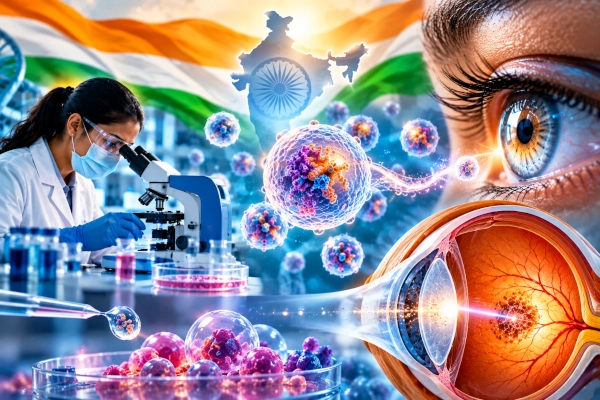
India’s biotechnology sector has taken another step towards developing advanced regenerative medicines, with Bengaluru-based Pandorum Technologies and Hyderabad-based Nucelion Therapeutics announcing a manufacturing collaboration to advance two government-supported research programmes targeting serious eye diseases.
The partnership will focus on developing investigational therapies for advanced keratopathy and wet age-related macular degeneration (wet AMD), two conditions associated with severe visual impairment and damage to different structures of the eye.
The research programmes have a combined planned financial outlay of ₹16.97 crore, including up to ₹8 crore in funding under the Central Government’s Promotion of Research and Innovation in Pharma-MedTech Sector (PRIP) scheme.
Nucelion Therapeutics, a wholly owned subsidiary of Bharat Biotech, will provide specialised process development and manufacturing support for Pandorum’s proprietary designer-exosome technology. The collaboration aims to develop reproducible manufacturing processes capable of supporting future clinical studies in India and international markets, subject to regulatory approvals.
The initiative brings together Indian expertise in tissue engineering, regenerative medicine, advanced biologics manufacturing and pharmaceutical research, highlighting the country’s growing capabilities in developing complex biological therapies.
Indigenous Designer-Exosome Technology at the Centre of Research
Pandorum Technologies is developing a new generation of cell-free regenerative medicines based on engineered extracellular vesicles known as designer exosomes.
Exosomes are extremely small membrane-bound particles naturally released by cells. They carry biological molecules involved in communication between cells and can influence how surrounding tissues respond to injury, inflammation and disease.
Researchers are investigating whether these naturally occurring communication mechanisms can be engineered to deliver therapeutic signals to damaged tissues.
Pandorum’s approach involves developing designer exosomes whose biological activity can be adjusted to target specific disease processes, including inflammation, fibrosis and abnormal blood vessel development.
Inflammation can cause tissue damage when it becomes excessive or persistent, while fibrosis involves the formation of scar tissue that may interfere with normal organ function. Abnormal blood vessel growth is particularly important in several retinal diseases, including wet age-related macular degeneration.
The company’s research platform seeks to influence these processes while supporting tissue repair and restoring biological function.
Unlike conventional cell-based regenerative therapies, the approach being developed by Pandorum uses biological particles derived from cells rather than administering living therapeutic cells.
This distinction creates opportunities for developing cell-free treatments, although their safety, effectiveness, stability and manufacturing consistency must be established through rigorous preclinical and clinical evaluation.
First Research Programme Targets Advanced Keratopathy
One of the two supported programmes focuses on advanced keratopathy, a broad category of serious disorders affecting the cornea.
The cornea is the transparent outer structure at the front of the eye and plays an essential role in focusing incoming light onto the retina.
Severe corneal diseases can result from chronic inflammation, tissue injury, infections, degenerative conditions or abnormalities affecting the surface and supporting structures of the eye.
Damage to the cornea can compromise its transparency and interfere with normal vision. In advanced cases, patients may experience persistent discomfort, impaired vision and significant deterioration in quality of life.
Pandorum’s research programme is directed towards the clinical evaluation of an investigational regenerative therapy intended to address severe corneal disease.
The company’s designer-exosome platform is being developed to modulate biological processes associated with inflammation and tissue damage while supporting the restoration of normal tissue function.
The proposed approach differs from treatments that primarily manage symptoms or address individual complications because it seeks to influence the biological processes associated with tissue injury.
However, whether these mechanisms will produce meaningful clinical benefits remains to be established through appropriately designed studies.
The October announcement does not establish that the new treatment has completed clinical trials or received regulatory approval.
Second Programme Focuses on Wet Age-Related Macular Degeneration
The second research programme targets wet age-related macular degeneration, a retinal disorder that can cause serious loss of central vision.
Age-related macular degeneration affects the macula, the central region of the retina responsible for detailed vision required for activities such as reading, recognising faces and seeing fine objects.
In the wet form of the disease, abnormal blood vessels develop beneath or within the retina and may leak fluid or blood.
These changes can damage retinal tissue and lead to deterioration of central vision.
Current treatment approaches frequently involve medicines that inhibit vascular endothelial growth factor, a biological signal involved in abnormal blood vessel formation.
Although these treatments have improved the management of wet AMD, researchers continue to investigate additional approaches that could address other aspects of the disease process and improve long-term outcomes.
Pandorum’s programme is exploring the potential of designer exosomes to influence biological pathways associated with vascular abnormalities, inflammation and tissue damage.
The project is currently focused on preclinical development and preparing the technology for possible future clinical translation.
This means the proposed therapy must undergo further laboratory investigation, safety assessments and regulatory evaluation before it can be tested in patients through authorised clinical studies.
The development programme represents an investigational approach rather than an established alternative to existing treatments.
Bharat Biotech Subsidiary to Provide Advanced Manufacturing Capabilities
Nucelion Therapeutics will play a central role in translating Pandorum’s laboratory research into manufacturing processes suitable for pharmaceutical development.
The Hyderabad-based company operates as a specialised contract development and manufacturing organisation focused on advanced therapies, including cell and gene therapy technologies.
Its responsibilities under the collaboration will include process development, manufacturing support and the establishment of methods designed to improve the consistency and reproducibility of designer-exosome production.
Producing complex biological medicines involves considerably more than increasing the quantity of material manufactured.
Developers must establish methods for controlling product characteristics, assessing biological activity, identifying impurities and ensuring that different manufacturing batches meet defined quality requirements.
These considerations are particularly important for exosome-based therapies because their biological characteristics can be affected by the cells used in production, manufacturing conditions, purification methods and storage processes.
Nucelion’s involvement is intended to help establish manufacturing procedures appropriate to the development stage and technical requirements of each ophthalmology programme.
The broader collaboration aims to provide materials manufactured according to Good Manufacturing Practice standards for eventual use in clinical studies in India and abroad.
Such manufacturing activities will remain subject to the applicable regulatory and quality requirements.
₹16.97 Crore Research Outlay Supported by Government PRIP Scheme
The two ophthalmology projects are being advanced with support from the Government of India’s Promotion of Research and Innovation in Pharma-MedTech Sector scheme.
The combined planned financial outlay for the projects is ₹16.97 crore, including up to ₹8 crore in funding under PRIP.
The scheme is intended to strengthen India’s research capabilities in pharmaceuticals and medical technologies by encouraging industry-led innovation, collaboration with research institutions and the development of advanced healthcare products.
India has established a substantial global presence in pharmaceutical manufacturing, particularly in generic medicines and vaccines.
However, developing innovative biological medicines requires additional investment in scientific research, specialised production infrastructure, intellectual property development and clinical evaluation.
Government-backed research programmes such as PRIP seek to support this transition by helping Indian companies undertake technologically demanding research and development activities.
The Pandorum–Nucelion programmes illustrate how public research support can be combined with private-sector scientific expertise and specialised manufacturing capabilities.
The planned expenditure will support the development of two investigational therapies, rather than the immediate commercial production of approved medicines.
Manufacturing Consistency Remains Critical for Regenerative Medicines
One of the principal challenges facing emerging regenerative medicine technologies is establishing consistent manufacturing processes.
Unlike many conventional medicines based on relatively simple chemical compounds, biological therapies may contain complex molecular structures whose characteristics depend heavily on the conditions under which they are produced.
For designer exosomes, researchers must understand how manufacturing conditions influence the biological signals carried by the particles and how those signals interact with target tissues.
Pandorum’s platform attempts to connect product design, manufacturing conditions, biological activity and tissue responses within an integrated research framework.
This approach is intended to help scientists examine how changes in product characteristics affect therapeutic performance.
Nucelion’s manufacturing expertise will be used to translate these requirements into controlled production processes supported by appropriate analytical methods and quality systems.
Dr. Raghu Malapaka, Chief Business Officer of Nucelion Therapeutics, emphasised that the development of advanced therapies requires manufacturing processes, analytical methods and product quality to progress together.
He indicated that the company’s role would be to help transform Pandorum’s product requirements into reproducible development-stage manufacturing processes.
The collaboration is expected to contribute to India’s capabilities in manufacturing complex biological medicines and preparing them for rigorous scientific evaluation.
Pandorum Expands Research in Programmable Regenerative Medicine
Pandorum Technologies has been developing technologies that combine biological engineering with regenerative medicine research.
The company’s work focuses on understanding how biological signals can be used to influence damaged or diseased tissues and potentially support the restoration of their normal functions.
Its designer-exosome platform forms part of a broader research strategy involving programmable regenerative medicines.
The concept involves developing biological products whose activity can be adjusted according to the characteristics of particular diseases.
For ophthalmic applications, the research focuses on biological pathways associated with inflammation, tissue injury, scarring and abnormal vascular activity.
Dr. Tuhin Bhowmick, Co-founder and Chief Executive Officer of Pandorum Technologies, has emphasised the importance of demonstrating that regenerative medicines can produce reproducible biological effects and undergo appropriate evaluation in patients.
The collaboration with Nucelion is intended to provide the specialised manufacturing capabilities necessary to advance the company’s research programmes through successive stages of development.
The two organisations had previously established a broader manufacturing partnership in January 2026 to support the development of Pandorum’s exosome-based therapeutic platform.
The October announcement identifies two additional government-supported ophthalmology programmes within that wider collaboration.
Strengthening India’s Advanced Biopharmaceutical Research Ecosystem
The partnership reflects the increasing role of Indian biotechnology companies in developing advanced therapeutic technologies rather than concentrating exclusively on established pharmaceutical manufacturing activities.
The development of novel biological medicines requires coordinated contributions from research scientists, biotechnology startups, specialised manufacturers, analytical laboratories and clinical research institutions.
Such collaboration becomes particularly important when technologies move from laboratory investigation towards human clinical trials.
By linking Pandorum’s research platform with Nucelion’s manufacturing capabilities, the two companies aim to strengthen domestic expertise across multiple stages of advanced pharmaceutical development.
The initiative could also contribute to the development of specialised scientific and technical skills in areas such as extracellular vesicle engineering, advanced biologics production, analytical characterisation and pharmaceutical quality assurance.
For India, building these capabilities is relevant to the broader objective of strengthening indigenous biomedical innovation and reducing dependence on overseas research and manufacturing infrastructure for emerging therapeutic technologies.
The ability to develop and manufacture complex biological products domestically could eventually support international research partnerships and improve India’s participation in advanced pharmaceutical markets.
However, commercial opportunities will depend on the successful demonstration of safety and efficacy, regulatory approvals and the establishment of economically viable production methods.
A Step Towards Indigenous Regenerative Therapies
The announcement on 28 October 2026 represents a significant research and manufacturing development within India’s emerging regenerative medicine industry.
The collaboration brings together two Indian biotechnology companies with complementary capabilities to pursue investigational treatments for severe corneal disease and wet age-related macular degeneration.
With a combined planned outlay of ₹16.97 crore and support of up to ₹8 crore under the PRIP scheme, the programmes demonstrate the role of coordinated public and private investment in advanced healthcare research.
The immediate objective is to develop the scientific evidence, manufacturing processes and quality systems required to advance the two therapies through their respective research stages.
Neither programme represents an approved treatment, and their eventual clinical effectiveness remains to be established.
Nevertheless, the initiative contributes to India’s efforts to build indigenous capabilities in advanced biological medicines, specialised pharmaceutical manufacturing and regenerative healthcare research.
You may also like
-
Ayurveda for Sedentary Lifestyles: Restoring Movement, Digestion and Balance in Modern Life
-
Zydus Lifesciences Secures USFDA Approval for Advanced Transdermal Hormone Therapy
-
Ayurveda and Screen Time: Protecting the Eyes, Mind and Sleep in the Digital Age
-
The Ayurvedic Approach to Work-Life Balance: Restoring Harmony Between Work, Health and Personal Life
-
Ayurveda and Mental Fatigue in the Digital Age: Ancient Wisdom for a Calm and Focused Mind
