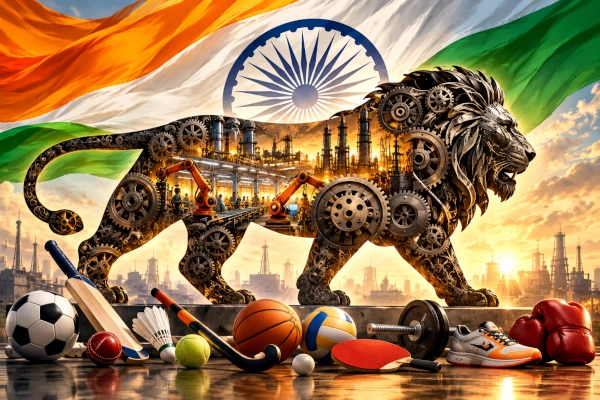
The Union Cabinet, chaired by Prime Minister Narendra Modi, has approved the Khelo India Sports Goods Manufacturing Scheme with a financial outlay of ₹1,856.67 crore to strengthen India’s domestic sports equipment manufacturing industry and establish the country as a globally competitive production and export hub.
The scheme will be implemented from the financial year 2026–27 to 2033–34, providing targeted support for industrial investment, advanced manufacturing technologies, research and development, skill enhancement, quality certification and international market expansion.
Announced in the Union Budget 2026–27, the programme aims to reduce dependence on imported sports equipment while encouraging Indian manufacturers to develop internationally competitive products. It is aligned with the Khelo Bharat Niti 2025, Make in India and Atmanirbhar Bharat initiatives.
The government expects the programme to attract private investment, expand domestic manufacturing capacity, create employment opportunities and strengthen India’s participation in global sports equipment supply chains.
Dedicated Sports Goods Manufacturing Zones to Be Developed
A major component of the scheme involves establishing dedicated Sports Goods Manufacturing Zones (SGMZs), designed to create integrated industrial ecosystems for manufacturing sports equipment and related products.
These zones will bring manufacturers, component suppliers, testing laboratories, design centres, prototyping facilities and supporting enterprises together within specialised industrial clusters.
The manufacturing zones will be developed through convergence with existing industrial infrastructure under the Bharat Audyogik Vikas Yojna (BHAVYA) and industrial parks associated with the National Industrial Corridor Development Corporation (NICDC).
According to the government’s explanatory backgrounder, the programme envisages the possibility of establishing four integrated manufacturing zones, each covering more than 300 acres.
The proposed industrial clusters are intended to reduce logistical costs, improve access to shared infrastructure and strengthen connections between equipment manufacturers and their suppliers.
The development of dedicated manufacturing zones could also encourage international sports equipment companies to establish production facilities in India while creating opportunities for domestic component manufacturers and smaller enterprises.
₹1,130 Crore Allocated for Investment and Production Incentives
The government has earmarked ₹1,130 crore for two major components intended to encourage new industrial investment and expand domestic production.
The first component, Anchor Investment Support, will encourage established Indian and international manufacturers, sporting goods brands and major retail companies to establish manufacturing facilities within designated Sports Goods Manufacturing Zones.
Under the proposed framework, eligible anchor investors committing at least ₹100 crore may receive capital expenditure support of 20%.
The second component, Turnover Linked Support, is designed to incentivise manufacturers to expand production capacity and increase manufacturing output.
Eligible manufacturers investing ₹10 crore or more may receive turnover-linked incentives of up to 15%, subject to the scheme’s applicable conditions.
These measures are intended to attract larger manufacturing investments while enabling domestic companies to scale up their operations.
The government expects the incentives to improve domestic value addition, strengthen supplier networks and encourage Indian manufacturers to enter higher-value segments of the global sports equipment industry.
Special Support for MSMEs and Existing Manufacturing Clusters
The scheme places considerable emphasis on micro, small and medium enterprises, which form the backbone of India’s existing sports goods manufacturing industry.
Traditional manufacturing centres such as Jalandhar in Punjab and Meerut in Uttar Pradesh have developed extensive networks of small enterprises producing sporting equipment, accessories and related products.
According to government estimates, small and micro enterprises account for nearly 90% of production in India’s sports goods sector.
The new programme will support the modernisation of existing manufacturing clusters through improvements in common facilities, shared infrastructure and production capabilities.
Financial assistance for upgrading these clusters will be provided through arrangements involving the Central and State Governments.
Improved access to testing facilities, modern machinery and technical infrastructure could help smaller manufacturers raise product quality and participate more effectively in domestic and international supply chains.
The programme also seeks to create opportunities for Indian MSMEs to supply components and specialised products to larger manufacturers operating within the proposed industrial zones.
₹105 Crore Allocated for International Quality Certification
The Cabinet-approved scheme includes a dedicated allocation of ₹105 crore to help Indian manufacturers obtain and renew certifications issued by international sports federations.
International certification is particularly important for sports equipment used in professional competitions, where manufacturers must comply with established performance, safety and technical standards.
The certification process can involve specialised product testing, material evaluation, performance assessment and compliance with standards prescribed by international sporting organisations.
For smaller Indian manufacturers, the cost of obtaining recognised certifications can present a barrier to entering international markets.
Government assistance is intended to reduce these constraints and enable more Indian companies to manufacture equipment suitable for professional sporting competitions.
The initiative could also improve international confidence in Indian-manufactured sports equipment and support domestic companies seeking to supply products to overseas sports federations, training institutions and commercial distributors.
Research Centres to Develop Advanced Sports Equipment Technologies
Research, innovation and technology development constitute another important element of the manufacturing scheme.
The government plans to support the establishment of Centres of Excellence at leading educational and research institutions to promote advanced research into sports equipment design, material sciences, protective equipment and modern manufacturing processes.
Research activities will also be supported through convergence with the Anusandhan National Research Foundation.
The proposed research ecosystem is intended to encourage collaboration between scientists, engineering institutions, manufacturers and technology startups.
Specialised research could contribute to the development of lightweight materials, improved protective equipment, precision-engineered sporting products and manufacturing techniques capable of meeting demanding international performance requirements.
The scheme will also provide support for startups developing new products, technologies and manufacturing processes.
Such enterprises may receive assistance for product development, testing, technical validation and commercialisation, helping translate research into market-ready sporting goods.
The initiative reflects an effort to move India’s sports equipment industry beyond conventional manufacturing towards greater participation in technology-intensive and higher-value product segments.
Skill Development to Support Industrial Expansion
Recognising the employment-intensive nature of sports goods manufacturing, the programme includes provisions for workforce training and skill development.
Training initiatives will be undertaken in collaboration with the Ministry of Skill Development and Entrepreneurship and relevant industry stakeholders.
The objective is to develop a workforce capable of operating advanced manufacturing equipment, handling specialised materials, maintaining production quality and meeting internationally accepted technical standards.
The development of specialised manufacturing skills could benefit both established industrial centres and emerging sports equipment production clusters.
It may also create new opportunities for technicians, designers, production engineers, equipment-testing professionals and workers employed in ancillary manufacturing industries.
India Targets Larger Share of Global Sports Equipment Market
The programme also seeks to strengthen India’s position in international sports goods markets through export promotion, branding and market development.
According to the government’s backgrounder, the global sports equipment market was valued at approximately US$140 billion in 2024 and is projected to reach around US$283 billion by 2036.
India’s existing manufacturing capabilities, established industrial clusters and skilled workforce provide a foundation for expanding participation in this market.
The scheme will seek to improve the international visibility of Indian sports equipment manufacturers and help them establish commercial relationships with overseas buyers.
Export promotion activities will be undertaken through convergence with the government’s Export Promotion Mission.
Greater international market access could encourage domestic manufacturers to develop specialised products, invest in higher-quality materials and improve compliance with international standards.
By combining industrial incentives with technological development and export support, the government aims to encourage Indian companies to compete more effectively with established global sports equipment manufacturers.
Manufacturing Programme to Support India’s Sporting Ambitions
The scheme is also intended to complement India’s broader efforts to develop sporting infrastructure, improve athlete training and expand participation in competitive sports.
The availability of high-quality, internationally certified equipment manufactured domestically could benefit sporting institutions, training academies, professional athletes and grassroots development programmes.
The government’s backgrounder identifies major international sporting events, including the 2028 Los Angeles Olympics, the 2030 Commonwealth Games in Ahmedabad and the 2032 Brisbane Olympics, as opportunities for increased demand for sporting equipment.
India’s planned bid to host the 2036 Olympic Games also forms part of the longer-term context for strengthening the domestic sports industry.
The manufacturing initiative is expected to support programmes such as Khelo India and Fit India by improving the availability of sports equipment while developing domestic industrial capabilities.
A New Industrial Opportunity for Indian Manufacturers
The Cabinet’s approval marks an important policy initiative aimed at developing sports goods manufacturing into a larger industrial sector.
The ₹1,856.67 crore programme combines manufacturing incentives, dedicated industrial zones, MSME support, scientific research, international certification and export promotion within a coordinated framework.
For established manufacturers, the initiative offers opportunities to expand capacity, adopt advanced production technologies and enter new international markets.
For smaller enterprises, the development of shared facilities and modern manufacturing clusters could improve competitiveness and facilitate participation in larger industrial supply chains.
The eventual impact will depend on the establishment of manufacturing zones, the participation of domestic and international investors, the uptake of government incentives and the successful commercialisation of new technologies.
If implemented effectively, the scheme could strengthen India’s ability to design, develop and manufacture high-quality sporting equipment while supporting employment, technological innovation and export growth.
You may also like
-
Navin Fluorine Expands US Specialty Chemicals Supply Contract to $590 Million, Extends Agreement Until 2032
-
Brazilian Military Delegation Explores India’s BrahMos and Akash Missile Systems During Two-Week Defence Visit
-
India Clears VVIP Helicopter Procurement Proposal for IAF; 24 Aircraft Planned at Estimated ₹10,000 Crore
-
India-Russia Bilateral Trade Surges 24.3% to $47.7 Billion in First Seven Months of 2026
-
India Simplifies Nearly 48,000 Business Compliances as DPIIT Advances Trust-Based Governance
