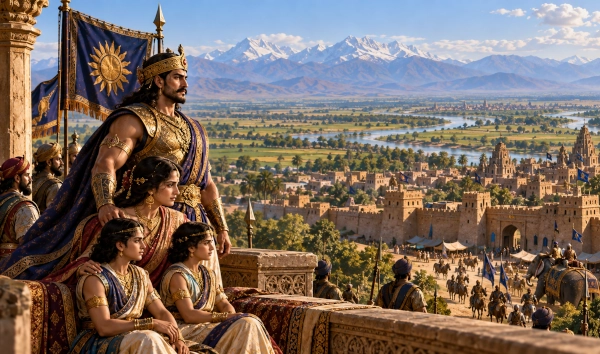
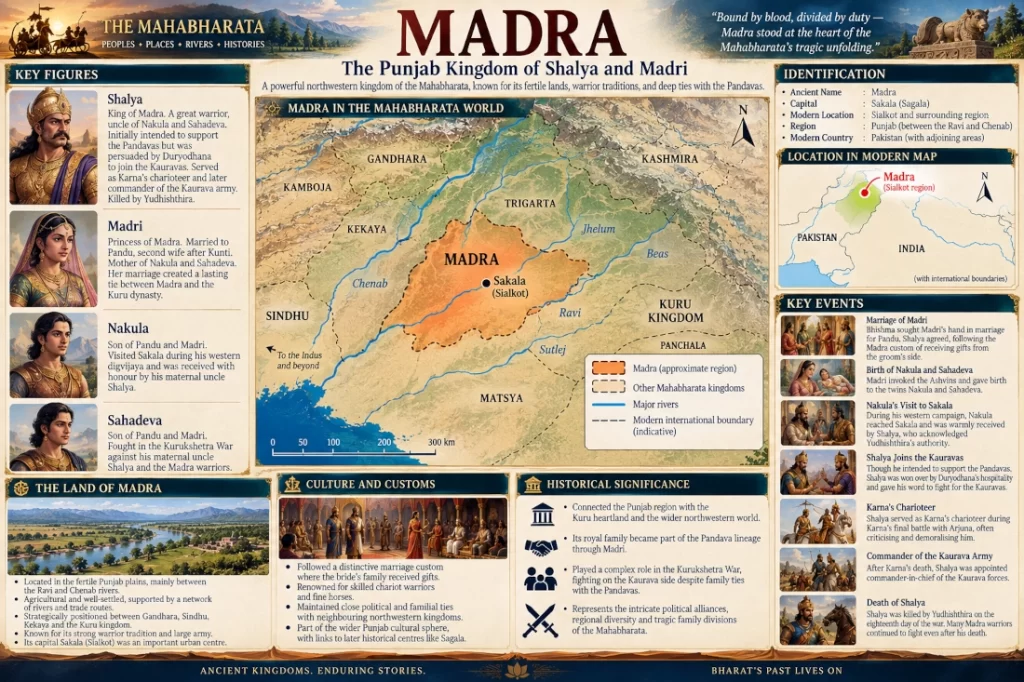
Among the important northwestern kingdoms described in the Mahabharata, Madra holds a particularly close connection with the Pandavas. Its princess Madri became the second wife of Pandu and the mother of Nakula and Sahadeva, while her brother Shalya, king of Madra, emerged as one of the most prominent warriors of the Kurukshetra War. The kingdom is generally identified with the Sialkot region and surrounding parts of Punjab in present-day Pakistan, with its capital at Sakala, also known as Sagala.
Ancient geographical studies place the heartland of Madra in the fertile Punjab plains, particularly in the region between the Ravi and Chenab rivers. This area formed part of one of the most important agricultural and strategic zones of northwestern Bharat. Its river systems supported cultivation, settlements and movement, while its location connected it with neighbouring regions such as Gandhara, Trigarta, Kekaya, Sindhu and the territories farther east towards the Kuru realm.
The identification of Madra with the Sialkot region is strengthened by the Mahabharata itself, which refers to Sakala as the city of the Madra. The city appears prominently during Nakula’s western military campaign before Yudhishthira’s Rajasuya sacrifice. As Nakula advanced through western and northwestern kingdoms, he eventually reached Sakala, where he met his maternal uncle Shalya. Rather than engaging in a major battle, Shalya accepted Yudhishthira’s authority out of affection for his nephew and honoured Nakula with gifts and tribute before allowing him to continue his campaign.
This episode is significant because it establishes a direct relationship between the Madra kingdom and the Pandava family. Nakula was not merely passing through another conquered territory. He had reached the homeland of his mother, Madri, and the court of his maternal relatives. The political relationship between Madra and the Pandavas was therefore reinforced by family ties that had begun a generation earlier with the marriage of Madri and Pandu.
Madri’s marriage to Pandu is one of the earliest major appearances of Madra in the epic. After Pandu had married Kunti, Bhishma travelled to Madra seeking another royal alliance for the Kuru dynasty. He approached Shalya and asked for his sister Madri’s hand in marriage. Shalya agreed but explained that the Madra royal family followed a traditional custom under which the bride’s family received substantial gifts from the groom’s side. Bhishma accepted the custom and presented gold, precious stones, elephants, horses, chariots, ornaments and other wealth before Madri was married to Pandu.
The episode is noteworthy because it preserves a distinct regional marriage tradition associated with Madra. The Mahabharata does not portray all kingdoms as culturally identical, and the reference to the Madra custom suggests that the northwestern kingdom retained traditions different from those of the Kuru heartland. Such details provide valuable insight into the diversity of social customs remembered within the epic.
Madri later accompanied Pandu and Kunti into the forest after Pandu withdrew from royal life. Following the curse that prevented Pandu from approaching his wives, Kunti used the mantra granted to her by the sage Durvasa to invoke divine beings and bear children. Madri eventually requested the opportunity to use the same mantra and invoked the divine Ashvins. She subsequently gave birth to the twins Nakula and Sahadeva.
Through Madri, the two youngest Pandavas therefore possessed a direct connection with the royal house of Madra. Shalya was their maternal uncle, and this relationship remained politically and emotionally important throughout the epic. His later participation in the Kurukshetra War on the Kaurava side created one of the many tragic family divisions that define the conflict.
Shalya himself is repeatedly portrayed as a powerful and respected ruler. He appears among the great kings and warriors of the age and is frequently identified as the king of the Madras. His military reputation was considerable, and when the Kurukshetra War became inevitable, he initially intended to support the Pandavas. As the maternal uncle of Nakula and Sahadeva, his natural inclination was to fight alongside them.
Duryodhana, however, learned that Shalya was travelling with a large army to join Yudhishthira. He devised a plan to secure the Madra king’s support before Shalya could reach the Pandava camp. Magnificent resting places were established along Shalya’s route, complete with food, drink, lodging and entertainment. Shalya assumed that Yudhishthira had arranged this extraordinary hospitality and, impressed by the generosity shown to him and his soldiers, promised to reward the person responsible.
Only then did Duryodhana reveal that he had organised the reception. Bound by his promise, Shalya agreed to grant Duryodhana a favour. Duryodhana asked him to join the Kaurava side in the coming war. Despite his family connection with the Pandavas, Shalya considered himself bound by his word and accepted.
The decision placed Shalya and the warriors of Madra in an extremely difficult position. The Madra army now fought for Duryodhana even though Shalya’s own nephews stood among the Pandava ranks. The Mahabharata repeatedly refers to Madra or Madraka warriors participating in the Kaurava formations, showing that the kingdom contributed a substantial force to the war.
Shalya’s role became especially important during the final stages of the conflict. After the deaths of Bhishma and Drona, Karna emerged as the leading Kaurava commander. During Karna’s final confrontation with Arjuna, Shalya was appointed his charioteer. This was no ordinary assignment, since Shalya was himself a king and accomplished warrior.
The relationship between Karna and Shalya was tense from the beginning. Their conversations are marked by sharp exchanges, and Shalya repeatedly questioned Karna’s confidence while praising the abilities of Arjuna and Krishna. Their disagreements continued even as Karna prepared for his decisive battle with Arjuna. Despite the friction between them, Shalya remained at the reins until Karna was ultimately killed on the seventeenth day of the war.
With Karna’s death, the Kaurava army had lost almost all of its great commanders. Bhishma had fallen, Drona had been killed, and Karna was dead. Duryodhana then appointed Shalya as commander-in-chief of the remaining Kaurava army.
Shalya led the surviving forces into battle on the eighteenth and final day of Kurukshetra. His greatest confrontation came against Yudhishthira, who personally engaged him in combat. The duel became one of the most important encounters of the final day. Although Yudhishthira is often remembered more for his adherence to dharma than for battlefield ferocity, he fought Shalya with determination and eventually killed the Madra king.
Shalya’s death deeply affected the remaining Madra warriors. The epic describes large numbers of Madraka chariot fighters charging furiously against the Pandavas after their king fell. The battle placed Nakula and Sahadeva in the painful position of fighting warriors from the kingdom of their own mother and maternal uncle.
Madra’s importance, however, extends beyond the events of the Mahabharata. The city of Sakala continued to appear in later historical and literary traditions. In Buddhist sources it is known as Sagala, and it later became famous in connection with the Indo-Greek ruler Menander, known in Buddhist literature as King Milinda. This does not mean that the Madra kingdom of the epic continued unchanged into the Indo-Greek period, but it does indicate the enduring importance of the Sialkot region as an urban and political centre in northwestern South Asia.
The geography of Madra also helps explain its prominence. The plains between the Ravi and Chenab formed part of the wider Punjab river system, one of the richest agricultural zones of the subcontinent. These rivers supported dense settlement and cultivation, while overland routes connected the region eastwards with the Kuru heartland, northwestwards with Gandhara, southwards with Sindhu and westwards with the wider Indus world.
Such a location would have provided Madra with the agricultural resources, horses, manpower and transport routes required to maintain the substantial army attributed to Shalya. It was therefore not a peripheral or isolated kingdom, but part of a highly connected political landscape stretching across the northwestern regions of ancient Bharat.
In modern geographical terms, the principal Madra kingdom can be identified broadly with Sialkot and the surrounding central Punjab region of present-day Pakistan, particularly the territory associated with the Ravi-Chenab Doab. Ancient references occasionally speak of additional groups known as northern or southern Madras, suggesting that the name may sometimes have extended beyond the core kingdom centred on Sakala.
Madra occupies a distinctive place in the Mahabharata because its history is inseparable from both sides of the Kuru conflict. Its princess Madri entered the Kuru dynasty as Pandu’s wife and became the mother of Nakula and Sahadeva. Her brother Shalya initially intended to support the Pandavas but was drawn by his word into Duryodhana’s camp. He later became Karna’s charioteer, commanded the surviving Kaurava army and finally fell in battle against Yudhishthira.
The ancient kingdom of Madra can therefore be identified most closely with the Sialkot region and surrounding Punjab in present-day Pakistan. Situated in the fertile country between the Ravi and Chenab, it was a strategically important northwestern realm whose royal family became deeply intertwined with the story of the Pandavas and the tragedy of Kurukshetra.
You may also like
-
BRICS Theatre Festival 2026 Opens in New Delhi, Bringing Together Nine Nations to Strengthen Cultural Cooperation
-
Sauvira: The Indus Realm Linked With Jayadratha in the Mahabharata
-
Sindhu: The Indus Kingdom of Jayadratha in the Mahabharata
-
Kuninda or Kulinda: The Himalayan Realm of the Mahabharata in Uttarakhand and Himachal Pradesh
-
Durga versus Mahishasura: Weapons, Battlefield Tactics and the Triumph of Shakti
