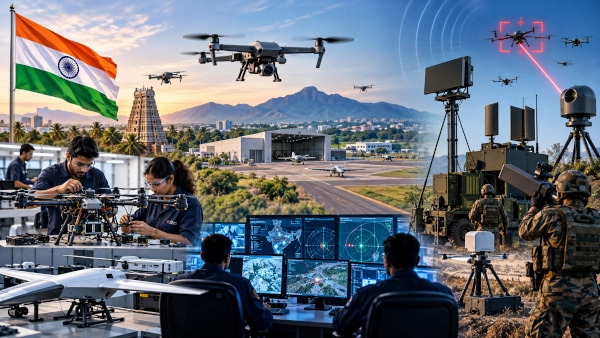
India’s unmanned-systems ecosystem is moving beyond the development of individual drones toward a broader network that links unmanned aerial vehicles, counter-drone systems, electronic warfare, sensors, testing facilities and indigenous manufacturing. That shift was highlighted at the 3rd International Conference on UAVs & Counter-UAVs, held in Coimbatore on September 3, 2026, under the theme Advancing UAV & Counter-UAV Systems for Future Defence.
The conference brought together more than 140 industry delegates, including defence experts, government representatives, technology companies, startups and global participants. It was organised by the PHD Chamber of Commerce and Industry, with support from organisations including the Department of Defence Production, Ministry of MSME and Tamil Nadu Industrial Development Corporation, reflecting the growing role of public-private collaboration in India’s unmanned-systems sector.
UAVs and Counter-UAV Systems Are Converging
The discussions in Coimbatore reflected a wider change in modern warfare. UAVs are no longer limited to surveillance and reconnaissance. They are increasingly being used for precision attack, communications relay, targeting, logistics, electronic warfare and autonomous operations.
At the same time, proliferation of inexpensive drones has created an equally important requirement for systems capable of detecting, tracking, identifying and neutralising them. This is pushing UAV and counter-UAV development closer together, with sensors, electronic warfare, artificial intelligence, command-and-control systems and interceptors increasingly forming parts of the same wider defence architecture.
The conference agenda consequently covered next-generation UAV technologies, counter-UAV systems, future air-defence requirements, manufacturing, government-industry interaction and technology demonstrations rather than treating drone development as an isolated sector.
Tamil Nadu Positions Itself as a UAV Testing Hub
One of the most important developments highlighted at the event was Tamil Nadu’s effort to build dedicated infrastructure for testing unmanned aerial systems.
TIDCO, which serves as the nodal agency for the Tamil Nadu Defence Industrial Corridor, showcased the Association for Drone Avionics Research and Testing, or ADART, UAS testing facility being established at Vallam Vadagal near Sriperumbudur. According to TIDCO, the facility is being developed under the Government of India’s Defence Testing Infrastructure Scheme and is intended to strengthen the state’s UAV ecosystem by providing industry with specialised testing capabilities.
The facility could become particularly important for startups and MSMEs that have developed promising UAV technologies but lack access to expensive military-grade testing infrastructure.
Defence Ministry Backs Dedicated UAS Testing Facility
The Ministry of Defence had formally signed an agreement with TIDCO in July 2024 to establish three specialised testing facilities in Tamil Nadu covering Unmanned Aerial Systems, Electronic Warfare and Electro-Optics.
The projects are being established under the Defence Testing Infrastructure Scheme, which was launched with an outlay of ₹400 crore to create advanced testing infrastructure for India’s defence and aerospace industries. Under the scheme, the government can provide up to 75% of project funding as grant-in-aid, with the remaining portion funded by special-purpose vehicles involving private companies and government entities.
For the UAS testing facility, Kerala government undertaking Keltron was identified by the Ministry of Defence as the lead member of the special-purpose vehicle, alongside private-sector consortium partners. The facility is intended to provide testing services to both government and private companies once completed.
Testing Infrastructure Addresses a Major Industry Bottleneck
The Defence Testing Infrastructure Scheme was created partly because sophisticated defence testing facilities are too expensive for many individual companies to establish independently.
The Department of Defence Production identifies lack of accessible testing infrastructure as one of the constraints affecting domestic defence manufacturing. Its scheme therefore focuses on creating common facilities that startups, MSMEs and larger manufacturers can use for testing and certification.
This is particularly relevant to UAV development. Building a functioning prototype is only one part of producing a military-grade unmanned system. A platform must also demonstrate reliability, communications resilience, electromagnetic compatibility, sensor performance and operation under different environmental and operational conditions.
Shared testing infrastructure can therefore help bridge the gap between a prototype demonstrated by a startup and a system mature enough to enter military evaluation or serial production.
Electronic Warfare and Electro-Optics Included in the Same Ecosystem
Tamil Nadu’s approach also extends beyond UAV airframes.
Alongside the UAS facility, the Ministry of Defence approved dedicated testing centres for Electronic Warfare and Electro-Optics within the Tamil Nadu Defence Industrial Corridor. Bharat Electronics Limited and India Optel Limited were identified as lead members for the EW and EO testing facilities respectively.
These capabilities have direct relevance to both UAV and counter-UAV systems. Electro-optical sensors are widely used for surveillance, target identification and tracking, while electronic-warfare systems can detect, disrupt or interfere with drone communications and navigation.
Developing testing facilities across these related technology domains could therefore allow Tamil Nadu to support a broader unmanned-warfare supply chain rather than concentrating only on the manufacture of drone platforms.
Coimbatore MSMEs Could Enter the UAS Supply Chain
TIDCO Senior Vice President V. Vinayagam used the conference to highlight opportunities for Coimbatore’s manufacturing base, MSMEs and startups to participate in the unmanned-aircraft value chain by using common facilities and adapting existing industrial capabilities.
Coimbatore already has a strong engineering base across precision manufacturing, motors, pumps, electronics, automotive components and industrial machinery. Many of these capabilities can potentially be adapted for defence and aerospace production, including UAV structures, propulsion components, electronics and ground-support equipment.
The Coimbatore District Small Industries Association also emphasised the importance of emerging UAV and counter-UAV technologies for local MSMEs and supported closer cooperation between industry, technology developers and defence organisations.
From Individual Drones to Integrated Defence Systems
The broader significance of the conference lies in the changing structure of the drone sector itself.
Future counter-UAV systems will increasingly require multiple technologies to work together. Radar and electro-optical sensors may first detect and classify an incoming drone. Electronic-warfare equipment may then attempt to disrupt its communications or navigation. If that fails, kinetic interceptors or other neutralisation systems may be required.
Artificial intelligence and automated command systems can help coordinate these different layers, particularly when responding to swarms or large numbers of inexpensive drones.
As a result, the challenge is no longer simply to build a better UAV or a better anti-drone weapon. India increasingly needs companies capable of integrating sensors, communications, electronic warfare, artificial intelligence, effectors and command systems into deployable operational networks.
Building a Path From Startup to Military Deployment
India already has a rapidly expanding community of UAV startups and defence MSMEs. Their next challenge is converting innovation into systems that can be manufactured reliably and validated against demanding military requirements.
The UAS testing infrastructure being created at Vallam Vadagal could provide an important part of that pathway. TIDCO’s own 2026 documentation identifies ADART as a specialised testing centre under the Defence Testing Infrastructure framework at the SIPCOT Industrial Park in Vallam Vadagal.
The Ministry of Defence has stated that the wider DTIS programme is intended specifically to boost indigenous defence manufacturing, reduce dependence on imports and give domestic companies access to advanced testing services.
Tamil Nadu Builds a Broader Defence Technology Base
The Coimbatore conference therefore represents more than a discussion about drones. It coincides with the creation of physical infrastructure intended to help Indian companies design, test, validate and eventually manufacture increasingly sophisticated unmanned and counter-unmanned systems.
Tamil Nadu is positioning the Defence Industrial Corridor as a network connecting startups, MSMEs, major defence companies, testing centres and government agencies across UAVs, electronic warfare, electro-optics and other strategic technologies.
For India’s rapidly expanding drone sector, that transition may be just as important as developing the next UAV itself.
You may also like
-
German Cable Major LAPP Makes Bhopal Its Largest Manufacturing Facility Worldwide
-
Syrma SGS and Italy’s Elemaster Open Advanced Electronics Manufacturing Hub in Bengaluru
-
Novonesis Bets €600 Million on India With Advanced Enzyme Manufacturing Hub in Maharashtra
-
Russia Renews Su-57E Offer to India as Ambassador Alipov Signals Deep Technology Cooperation
-
Dixon Technologies Plans Entry Into Aerospace and Defence Electronics as Next Growth Frontier
