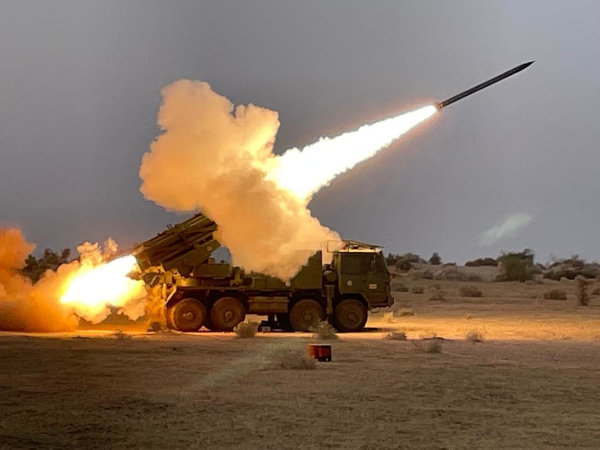
India’s Pinaka rocket-artillery programme is beginning to move into a much heavier long-range category, with the Defence Research and Development Organisation working on a 370-mm Extended Long Range Guided Rocket, or ELRGR, that could eventually provide the Indian Army with a precision-strike capability approaching the 250–300-km class.
The clearest evidence of the new configuration comes from DRDO’s Research Centre Imarat in Hyderabad, which has sought the fabrication of five sets of 370-mm ELRGR rocket-motor systems. The requirement covers specialised manufacturing processes including flow forming, precision machining, welding of 11-10 precipitation-hardening steel and proof-pressure testing. The motor sets are to be supplied to RCI within a six-month delivery window.
The 370-mm figure is significant because it represents a substantial increase over the 214-mm diameter used by the traditional Pinaka rocket family. Merely comparing their circular cross-sections, a 370-mm body provides roughly three times the area of a 214-mm body. That does not mean the new rocket will automatically carry three times as much propellant, because motor length, casing thickness, nozzle geometry and internal architecture will all differ, but it illustrates the scale of the propulsion change required for a much longer-range weapon.
The development appears to represent the next step beyond the Pinaka Long Range Guided Rocket, or LRGR-120, which DRDO successfully tested to its maximum range of 120 km on December 29, 2025. DRDO subsequently conducted another flight test on July 8, 2026, validating the rocket at a user-defined minimum range of 60 km. During that test the weapon carried out its planned in-flight manoeuvres and struck its designated target while being fired from an existing Pinaka launcher.
That 120-km system demonstrated an important feature of the evolving Pinaka architecture: rockets with substantially different ranges can potentially be accommodated within the wider Pinaka weapon-system ecosystem. DRDO said the LRGR was developed by the Armament Research and Development Establishment, working with the High Energy Materials Research Laboratory, with support from the Defence Research and Development Laboratory and RCI.
The new 370-mm ELRGR, however, represents a considerably larger engineering step. Achieving ranges approaching 300 km requires more than simply adding propellant to an existing Pinaka rocket. The weapon must combine a larger propulsion system with an efficient airframe, precision navigation and guidance, flight-control capability and sufficient structural strength to survive the stresses generated during launch and high-speed flight.
RCI’s involvement is particularly relevant because the Hyderabad laboratory specialises in technologies including inertial navigation, control engineering, onboard computers, seekers and mission software for Indian missile and guided-weapon programmes. These capabilities are central to transforming a long-range rocket from a ballistic artillery projectile into a precision-guided weapon capable of correcting its trajectory during flight.
Several reports have referred to the future weapon as Pinaka-IV and associated it with a planned range of around 300 km. The latest 370-mm motor requirement strengthens the case that DRDO is building a substantially larger extended-range guided rocket. Nevertheless, the RCI fabrication requirement itself does not publicly specify a 300-km performance figure, warhead weight, complete rocket dimensions or launcher configuration. The 300-km figure should therefore be treated as a development objective reported for the programme rather than an already demonstrated capability.
This distinction is important because the programme remains at the development and hardware-fabrication stage. The five motor sets are likely intended to support engineering, qualification and subsequent developmental activity rather than operational production. Extensive static motor tests, structural qualification, guidance trials and full flight tests would still be required before the system could move toward Army induction.
If DRDO ultimately achieves a range close to 300 km, the result would transform the role of the Pinaka family. The original system was conceived primarily as battlefield rocket artillery, while the 120-km LRGR already pushes Pinaka into deep precision fires. A 250–300-km guided rocket would extend that reach much further and begin filling the space between conventional multiple-launch rocket systems and more expensive tactical missile systems.
The programme would also reinforce the increasingly layered structure of India’s indigenous artillery rockets. The Pinaka family has progressed from relatively short-range unguided rockets to extended-range and guided variants, followed by the 120-km LRGR. The 370-mm ELRGR now indicates that DRDO is preparing another major increase rather than trying to extract incremental range from the original rocket dimensions.
For now, the most important new fact is therefore not simply the often-repeated 300-km Pinaka-IV figure. It is the emergence of actual 370-mm ELRGR propulsion hardware under a DRDO requirement. That provides tangible evidence that India’s next-generation long-range guided rocket has progressed into hardware development and that the future Pinaka ecosystem is moving well beyond the dimensions and battlefield reach of the system with which the programme began.
You may also like
-
Inside PRAGYA: India’s First Private Tokamak Begins Producing Plasma
-
BDL Begins Localised Production of 5th-Generation Spike LR2 Missile in India
-
From Aero-Engine Parts to Jet-Powered Drones: How Raghu Vamsi Is Building an Integrated Indian Aerospace Company
-
Ramco Systems and Safran Build Direct Digital Link for Helicopter Engine Maintenance Data
-
IAF and IIT Bombay Join Hands for Master’s-Level Education of India’s Flight Test Crew
