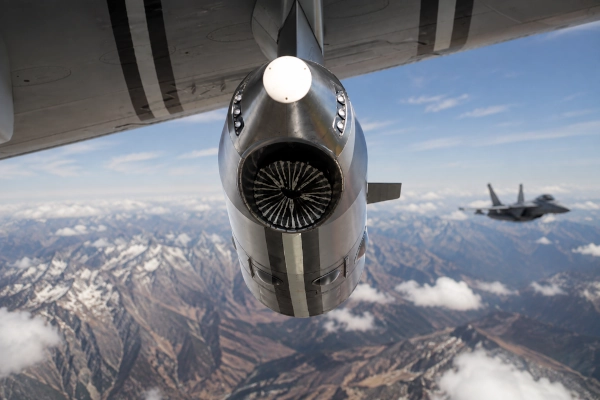
India has moved a step closer to developing its own airborne refuelling hardware, with the Defence Research and Development Organisation inviting industry bids for the development of an indigenous Air-to-Air Refuelling Pod for the Indian Air Force.
The project is being pursued through DRDO’s Technology Development Fund, which uses Indian industry to develop strategically important technologies that are presently unavailable or dependent on foreign suppliers.
The open tender was published on September 2, 2026, under the title Development of Air To Air Refuelling Pod. Bid submissions are scheduled to begin on September 25 and close on October 20, 2026, with technical and financial bids subsequently evaluated under the TDF process. The development contract is structured on a turnkey basis with a planned duration of 1,095 days, or approximately three years.
Indigenous Refuelling Pod Moves to Development Stage
The latest tender represents an important progression for a programme that DRDO has been examining for several years.
An indigenous Air-to-Air Refuelling Pod was identified under the TDF framework as early as 2022, when DRDO outlined the requirement for a new-generation refuelling system for tanker aircraft operated by the IAF.
The programme subsequently moved through an industry-engagement stage, with a Request for Information issued in 2025 seeking proposals for indigenous development of the system. The September 2026 RFP now invites formal bids for its development, indicating that the programme has advanced beyond preliminary market assessment.
The development objective is therefore not simply to study aerial-refuelling technology, but to create an Indian industrial capability capable of producing, integrating and supporting a complete refuelling pod.
How the Refuelling Pod Would Work
Air-to-air refuelling allows a tanker aircraft to transfer fuel to another aircraft while both remain airborne. It can substantially extend the receiver’s endurance, combat radius and time available over an operational area.
DRDO’s earlier description envisaged a tanker configuration incorporating two wing-mounted refuelling pods, with provision for another fuselage-mounted unit. Fuel would be drawn from the tanker aircraft’s own fuel system and delivered to receiving aircraft through the pods.
The concept uses the hose-and-drogue method, in which the tanker deploys a flexible hose terminating in a basket-shaped drogue. The receiving aircraft approaches from behind and connects its refuelling probe to the drogue, allowing fuel to be transferred while the two aircraft fly in formation.
This method is particularly relevant to the IAF because aircraft including the Su-30MKI, Rafale, Mirage 2000, Jaguar and Tejas are equipped or configured for probe-and-drogue refuelling.
A Complex Aerospace System, Not Simply a Fuel Hose
Developing an aerial-refuelling pod involves considerably more engineering than installing a hose beneath an aircraft.
The system must deploy and retract the hose reliably while operating in high-speed airflow, regulate fuel pressure, compensate for movement between the tanker and receiving aircraft and automatically respond to abnormal loads or unsafe conditions.
The pod also requires sensors, control electronics, valves, pumps, structural mechanisms and communication with an operator station aboard the tanker.
One of the difficult engineering problems is maintaining stable hose-and-drogue behaviour in turbulent airflow behind a large aircraft. Excessive oscillation can make contact difficult for the receiving pilot and increase the risk of damage.
Fuel transfer must simultaneously remain tightly controlled because the tanker and receiver can be moving at several hundred kilometres per hour only metres apart.
Creating this capability domestically therefore involves expertise spanning aerodynamics, flight-control engineering, fuel systems, mechanical design, electronics and safety-critical aerospace software.
Why Aerial Refuelling Is a Force Multiplier
Airborne refuelling has a disproportionate effect on combat-aircraft capability because it reduces the dependence of fighters on their internal fuel capacity.
A fighter can take off carrying a larger weapons load, receive additional fuel once airborne and subsequently operate much farther from its home base. Aircraft performing combat air patrols can also remain on station longer instead of repeatedly returning to land and refuel.
For strike missions, tanker support allows aircraft to reach distant targets while preserving enough fuel for manoeuvring, combat and diversion to alternate airfields.
The same capability becomes particularly valuable across India’s large maritime and continental operating areas, where distances between bases and mission locations can be substantial.
India Currently Depends on Foreign Refuelling Technology
India’s aerial-refuelling capability has historically depended heavily on imported equipment.
The IAF operates Il-78MKI tanker aircraft, which use hose-and-drogue systems to refuel combat aircraft in flight. India has also examined additional tanker solutions over several procurement cycles as it seeks to expand the size and availability of its airborne-refuelling fleet.
The refuelling hardware itself represents a specialised technology controlled by a relatively small group of international aerospace companies.
An indigenous pod would therefore address a different element of self-reliance from simply acquiring tanker aircraft. Even where the underlying transport aircraft is foreign-designed, India could potentially control the refuelling mission equipment, integration, maintenance and future upgrades.
Could Support Future Tanker and Transport Aircraft
The new RFP describes the programme around the development of the refuelling pod rather than naming a specific future tanker platform.
That distinction is important.
An independently developed modular pod could potentially be adapted to more than one suitable tanker or transport-aircraft configuration, provided the aircraft structure, fuel system, aerodynamics and mission architecture are engineered for the installation.
This would give the IAF greater flexibility when creating future tanker capability instead of tying the refuelling system permanently to one imported aircraft configuration.
Reports suggesting that the pod has already been selected for specific aircraft such as the C-17, C-130J or another transport platform remain speculative. DRDO has not publicly identified those aircraft as confirmed integration platforms under the September RFP.
Industry Will Lead Development Through TDF
The programme also reflects the changing way DRDO is developing selected defence technologies.
Rather than carrying out every stage entirely within government laboratories, the Technology Development Fund supports Indian companies in developing military technologies against service requirements.
For the Air-to-Air Refuelling Pod, the selected industrial partner will be expected to undertake the detailed development programme, build the required hardware and progress the system towards testing and qualification.
The September tender calls for bidders to provide a Detailed Project Report along with evidence of technical capability and industrial qualifications. The formal bid-opening process follows in October after the pre-bid and clarification stages.
This approach can build a domestic supplier capable not only of producing the first system but also supporting subsequent manufacture, maintenance and upgrades.
Refuelling Technology Has Wider Strategic Value
Control over aerial-refuelling technology could eventually have applications beyond dedicated tanker aircraft.
Many modern transport aircraft can be developed into multi-role platforms that perform cargo or passenger missions during normal operations and tanker missions when required. Modular refuelling equipment forms an important part of such conversions.
An indigenous system could consequently expand the options available to India as it develops future tanker fleets and considers multi-role transport solutions.
There is also potential long-term relevance to India’s growing aerospace export ambitions. Relatively few countries possess independent capability to design and manufacture complete aerial-refuelling systems, giving successful development greater strategic value than the size of the individual pod might suggest.
Three-Year Development Programme Now Ahead
The September 2026 tender marks the most concrete industrial step yet in DRDO’s Air-to-Air Refuelling Pod programme.
The concept was identified several years ago, progressed through industry consultation and has now reached the competitive development-bid stage. The selected company will face the considerably harder task of converting the requirement into flight-worthy aerospace hardware that can withstand demanding refuelling operations.
Successful development would give India control over another critical subsystem required for long-range combat aviation. Instead of depending entirely on foreign suppliers for the equipment that turns a transport aircraft into an aerial tanker, the country would possess a domestically developed refuelling system that could be manufactured, maintained and progressively upgraded within the Indian defence-industrial ecosystem.
You may also like
-
Indian Semiconductor Companies Propose New Manufacturing and Chip Design Investments in Madhya Pradesh
-
CSIR-CRRI Partners with Industry to Develop Advanced Indigenous Airport Runway and Pavement Materials
-
Paras Semiconductors Secures 43 Acres in Madhya Pradesh for Proposed ₹6,200 Crore Advanced Chip Packaging Facility
-
Indian Army Special Forces Depart for Indonesia for Exercise Garuda Shakti 2026
-
India to Train 600 Nigerian Army Soldiers in Specialised Jungle and Mountain Warfare
