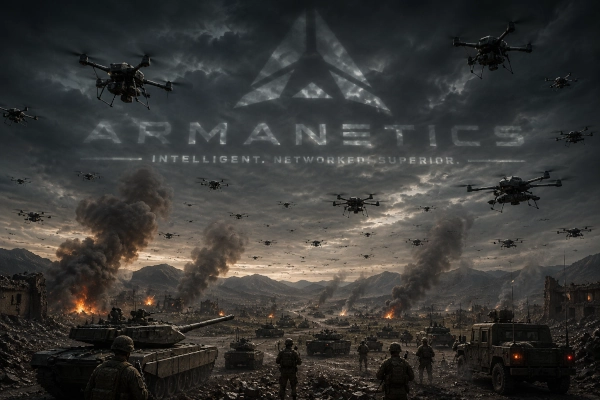
Indian defence technology startup Armanetics has successfully field-demonstrated its ARMANET swarm drone platform in the presence of senior Indian Army leadership, marking an important development in India’s expanding ecosystem of autonomous and networked unmanned systems.
ARMANET is not simply a new drone airframe. It is a mission operating and swarm-coordination platform designed to allow a single operator to command multiple unmanned aerial vehicles as an integrated formation rather than controlling each aircraft separately. Armanetics says the system has undergone months of development and field testing before the recent Army demonstration.
The company publicly disclosed the trial in late August, with wider reporting emerging on September 2, 2026. No procurement contract, trial location, number of aircraft involved or Army induction schedule has been announced, placing ARMANET at the technology-demonstration and evaluation stage rather than operational deployment.
One Operator Can Coordinate an Entire UAV Formation
The central objective of ARMANET is to reduce the manpower normally required to operate multiple UAVs.
Conventional drone operations often require individual pilots or crews to manage separate aircraft. ARMANET brings multiple UAVs into a single mission-control environment, where an operator can monitor the fleet, define formations, coordinate movement and execute mission-level commands across the entire group.
The platform supports automatic connection of available UAVs, coordinated launch sequences and a single-command mission abort function. Operators can also create user-defined formations and manage several aircraft simultaneously through the same interface.
This architecture allows a military unit to increase the number of airborne platforms without requiring a proportional increase in trained drone operators.
ARMANET Is Primarily a Software and Autonomy Platform
A significant feature of the programme is that ARMANET is designed as a software layer capable of coordinating unmanned systems rather than being restricted to a single proprietary aircraft.
Armanetics describes the platform as the software responsible for mission execution, command, distributed telemetry and coordinated autonomous operations across multiple unmanned systems.
The company’s current swarm demonstrators use quadcopters, but its stated architecture also supports heterogeneous unmanned platforms. This could eventually allow aircraft with different payloads and mission roles to operate within the same coordinated network.
That approach is strategically important because military swarms are most useful when individual aircraft perform complementary tasks rather than every drone carrying identical sensors or payloads.
Drones Share Target Coordinates Across the Swarm
ARMANET includes a target-information sharing capability through which designated UAVs can transfer target coordinates to other aircraft in the formation.
Each UAV can operate as an edge sensor node, collecting information and sharing spatial and target data with the wider mission system.
A reconnaissance drone could therefore detect or identify a target before passing its coordinates to another aircraft assigned to a different mission role. This reduces dependence on every UAV independently detecting the same target.
The company also lists coordinated strike operations among ARMANET’s capabilities, enabling multiple aircraft to execute synchronised missions from the same control architecture.
Coordinated Payload Delivery Opens Multiple Tactical Roles
Armanetics has demonstrated ARMANET as more than a formation-flying system.
The platform supports coordinated payload delivery, allowing several UAVs to release payloads across a designated area in a synchronised manner. It also enables mission-level tasking in which the swarm’s behaviour is managed collectively rather than through separate commands to every aircraft.
Such technology can support several military applications. Armanetics identifies air-defence training, aerial threat simulation, decoy missions, deception operations and coordinated payload deployment among the principal roles for its swarm architecture.
For air-defence training, multiple UAVs can reproduce complex attack profiles and approach formations, allowing radar, electronic warfare and weapon crews to practise against more realistic massed aerial threats.
Swarms Can Create Decoys and Saturation Effects
Another application identified by Armanetics is airspace saturation and deception.
Rather than sending a single UAV towards a defended area, several inexpensive aircraft can approach from different directions or follow coordinated flight patterns. Some can represent genuine mission platforms while others function as decoys designed to complicate detection and classification.
Such operations can force air-defence networks to track more objects simultaneously and make it harder to distinguish the most important targets from expendable aircraft.
This approach has become increasingly relevant as modern conflicts demonstrate how large numbers of relatively inexpensive unmanned systems can place considerable pressure on traditional air-defence architectures.
Dynamic Task Reallocation Adds Autonomy
The swarm system incorporates more than common flight-path control.
According to Armanetics, the ARMANET software handles dynamic task reallocation and automated collision avoidance across connected aircraft.
Task reallocation is important in autonomous multi-agent operations because the loss or unavailability of one aircraft should not necessarily terminate the entire mission. Responsibilities can instead be redistributed across remaining UAVs according to the mission software.
Collision avoidance is equally important when several drones operate in close formations or change positions dynamically. Coordinating large numbers of aircraft requires continuous management of their relative location, direction and speed.
These software functions represent the core technological challenge in swarm warfare. Flying several drones together is comparatively straightforward; allowing them to behave as an organised and adaptable group requires substantially more sophisticated autonomy.
Zero-Cloud Architecture Designed for Military Operations
ARMANET has also been developed with what the company describes as a zero-cloud-dependency architecture.
This means mission execution does not depend on access to an external commercial cloud service. Such an architecture is particularly relevant to defence users, where communications infrastructure may be unavailable, restricted or unsuitable for sensitive operational data.
Local mission control also gives military operators greater control over data, software and network architecture.
Armanetics has not publicly released detailed information on ARMANET’s encryption, anti-jamming performance, communications range or operation in GNSS-denied environments, so these capabilities should not yet be treated as demonstrated features.
Ranchi Startup Builds Indigenous Military Autonomy
Armanetics describes itself as an Indian military technology company focused on unmanned aerial systems, swarm technology and mission software. Its development work combines aerospace engineering, software, autonomy and intelligent systems.
The emergence of the company from Ranchi is also notable because India’s defence-startup ecosystem has traditionally been concentrated heavily around Bengaluru, Hyderabad, Pune and the Delhi-NCR region.
ARMANET represents the company’s primary multi-UAV programme, but Armanetics is simultaneously developing PARAM, a fixed-wing unmanned aerial platform intended for target-drone training, autonomous decoy missions and future coordinated aerial operations.
The longer-term architecture could therefore extend swarm coordination beyond small quadcopters towards mixed fleets containing different types of aircraft.
Indian Army Evaluation Is the Important Next Stage
The presence of senior Indian Army leadership during the ARMANET field trial gives the demonstration greater relevance than an internal company test.
Armanetics says it received operational feedback following the demonstration and is continuing to improve the platform’s capability, reliability and scalability.
The company has not disclosed the number of drones flown simultaneously, maximum swarm size, operating radius, endurance or payload capacity during the Army demonstration. These parameters will be important in determining whether ARMANET can progress from a successful technology demonstrator into an operational military system.
There is also no public confirmation from the Ministry of Defence or Indian Army of an acquisition programme specifically for ARMANET.
The current achievement should therefore be viewed as a successful industry-led field demonstration before Indian Army leadership, rather than an induction or procurement milestone.
Indigenous Swarm Software Becomes Strategically Important
India’s growing investment in autonomous systems increasingly places emphasis on the software controlling the drones rather than only the aircraft themselves.
Swarm algorithms, mission-management software, communications architecture and autonomous decision-making determine whether dozens of UAVs can behave as one coordinated force. Control over these technologies also reduces dependence on foreign software stacks that could create security or supply-chain vulnerabilities.
ARMANET addresses this layer directly by providing an Indian-developed mission architecture capable of coordinating multiple UAVs through a single operator interface.
The recent Army demonstration gives Armanetics an important opportunity to move from startup-level development towards military evaluation. Its significance lies in demonstrating an indigenous multi-UAV command and autonomy architecture that can support surveillance, deception, training and coordinated mission execution while reducing the number of operators required to manage a drone formation.
As India’s armed forces expand their use of unmanned systems, technologies such as ARMANET could become increasingly important in moving from individually piloted drones towards networked groups of autonomous aircraft operating as a single battlefield system.
You may also like
-
Indian Semiconductor Companies Propose New Manufacturing and Chip Design Investments in Madhya Pradesh
-
CSIR-CRRI Partners with Industry to Develop Advanced Indigenous Airport Runway and Pavement Materials
-
Paras Semiconductors Secures 43 Acres in Madhya Pradesh for Proposed ₹6,200 Crore Advanced Chip Packaging Facility
-
Indian Army Special Forces Depart for Indonesia for Exercise Garuda Shakti 2026
-
India to Train 600 Nigerian Army Soldiers in Specialised Jungle and Mountain Warfare
