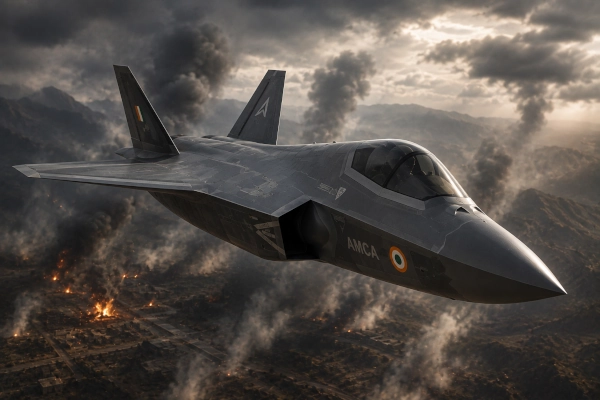
India’s Advanced Medium Combat Aircraft programme is being built around a much broader indigenous stealth effort than airframe shaping alone, with DRDO developing a family of radar-absorbing coatings, structures, electromagnetic materials and high-temperature stealth solutions intended for future combat aircraft.
The Advanced Medium Combat Aircraft, or AMCA, is India’s indigenous fifth-generation stealth fighter programme being executed by the Aeronautical Development Agency under DRDO. The Ministry of Defence describes it as India’s first advanced stealth combat-aircraft project, while DRDO showcased a full-scale AMCA model at Aero India 2025 as a 5.5-generation aircraft incorporating low-observable technologies and other advanced systems.
Behind the aircraft programme sits an increasingly mature Indian materials-development effort. DRDO’s official technology roadmap identifies radar-absorbing coatings, low-frequency absorbing materials, high-temperature radar-absorbing materials for aircraft exhausts, electromagnetic cloaking materials, metasurfaces and specialised stealth materials for aerospace applications among technologies being developed by its laboratories.
AMCA Stealth Goes Beyond the Shape of the Aircraft
The characteristic external shape of AMCA remains the most visible element of its low-observable design. Stealth aircraft use carefully aligned surfaces, internal weapon carriage, shielded engine faces and controlled edge geometry to reduce the amount of radar energy reflected back towards hostile sensors.
Material technology provides the second major element of that architecture.
Even a carefully shaped aircraft contains areas where electromagnetic reflections must be further suppressed. Radar-absorbing materials can be incorporated into structural components or applied as specialised coatings to reduce the strength of radar returns from selected parts of the airframe.
For AMCA, the objective is therefore not to rely on one universal “stealth paint”, but to combine shaping, composites, coatings and specialised structures according to the electromagnetic behaviour of different sections of the aircraft.
DRDO Has Developed Indigenous Radar-Absorbing Paint
One of the clearest examples of India’s indigenous capability comes from Defence Laboratory, Jodhpur, which has developed polyurethane-based Radar Absorbing Paint using domestically developed magnetic functional filler materials.
DRDO states that the coating is suitable for airborne as well as land-based strategic platforms and has been engineered to attenuate reflected radar energy without imposing a large weight penalty.
Under DRDO’s published test parameters, the material demonstrates more than 90% microwave absorption. It can be applied to aluminium and aluminium-alloy surfaces as well as carbon-fibre-reinforced polymer composites, both of which are highly relevant to aerospace structures.
The coating is also designed to tolerate environmental conditions encountered by aircraft. DRDO lists resistance to hydraulic oil, water and aviation turbine fuel, thermal stability across high and low temperatures, resistance to thermal shock and the ability to withstand aerodynamic vibration.
These properties matter because a laboratory material that absorbs radar energy is of limited military value unless it can survive years of operational flying, temperature cycling, vibration, maintenance and exposure to aviation fluids.
Radar-Absorbing Structures Form Another Layer
DRDO’s work extends beyond surface coatings into Radar Absorbing Structures, or RAS.
In such systems, radar attenuation is incorporated into the aircraft structure itself rather than relying entirely on material applied over the surface. Structural composites can therefore perform both mechanical and electromagnetic functions.
Defence Laboratory, Jodhpur has worked on low-observable materials using magnetic flakes and ferrites as functional ingredients and has developed routes for converting these materials into radar-absorbing paints, structures and flexible absorbing sheets.
The significance for future aircraft is substantial. Structural absorption can reduce dependence on thick external coatings while allowing low-observable characteristics to be designed into components from the beginning.
DRDO’s present technology roadmap explicitly includes stealth materials, components and technologies for aerospace applications, demonstrating that this work is being pursued as a continuing strategic capability rather than as a one-off coating programme.
Different Radar Bands Require Different Materials
Stealth becomes considerably more difficult because radar does not operate at a single frequency.
Fire-control radars, airborne early-warning systems and long-range surveillance radars may operate in different portions of the electromagnetic spectrum. A material optimised for one frequency range may perform very differently against another.
DRDO is consequently pursuing low-frequency material solutions for L- and S-band applications, alongside broader radar-absorbing coatings and electromagnetic stealth technologies.
This is important for AMCA because modern air-defence networks increasingly combine multiple radar bands. Lower-frequency radars may be useful for detecting the presence of low-observable aircraft even when they cannot provide the precision required for weapon engagement.
A future stealth aircraft must therefore reduce signatures across a wider electromagnetic environment rather than optimising itself solely against one type of fire-control radar.
High-Temperature RAM Targets the Engine Exhaust Problem
One of the most difficult areas of stealth aircraft design is the engine and exhaust system.
Aircraft engines create several signatures simultaneously. Compressor components can reflect radar energy, while the exhaust and hot engine sections generate strong infrared emissions.
DRDO’s official stealth-material roadmap specifically identifies high-temperature radar-absorbing materials for aircraft exhaust nozzles as a development area at Defence Laboratory, Jodhpur. It separately lists plume infrared-signature suppression technology.
Conventional radar-absorbing materials cannot simply be placed around an exhaust nozzle because the region experiences extreme temperatures, vibration and substantial structural loads.
High-temperature absorbing materials therefore represent an important enabling technology for advanced combat aircraft where rear-aspect radar and infrared signatures need to be reduced without compromising engine performance.
Metasurfaces and Electromagnetic Cloaking Represent the Next Layer
DRDO is simultaneously investigating technologies that extend beyond conventional absorbing coatings.
Its materials roadmap includes frequency-selective surfaces, metasurfaces, intelligent reflecting surfaces, artificial electromagnetic materials and electromagnetic cloaking materials.
Metasurfaces use engineered structures whose electromagnetic characteristics are controlled by their geometry rather than solely by their chemical composition. They can potentially manipulate how electromagnetic waves are absorbed, reflected or redirected.
These technologies could eventually allow greater control over radar signatures while reducing some of the thickness and mass associated with traditional absorbing materials.
DRDO also lists low-observable antenna technologies and radomes for airborne platforms. This is particularly important because antennas, apertures and sensors can compromise the radar signature of an otherwise carefully shaped aircraft.
AMCA’s challenge is therefore to make its sensors highly capable without allowing those same sensors to become prominent radar reflectors.
Stealth Canopy Technology Is Also Being Developed in India
The cockpit canopy presents another difficult electromagnetic problem.
A transparent canopy can allow radar waves to enter the cockpit and reflect from the pilot, seat, displays and internal structures, creating a significant radar return.
DRDO laboratories have developed transparent protective coatings intended for aircraft canopies used with conductive stealth layers. NMRL has documented coatings designed to retain high optical transparency while protecting the underlying radar-related conductive coating from environmental and mechanical degradation.
Such technologies demonstrate how stealth engineering extends into areas that appear relatively minor compared with wings or engine intakes.
A fifth-generation aircraft requires hundreds of these details to work together. Doors, access panels, sensor windows, radomes, canopies, fasteners, intakes and control surfaces can all influence the final radar signature.
Indigenous Materials Reduce a Critical Foreign Dependency
Developing RAM domestically has strategic value beyond reducing the import bill.
Stealth materials are among the most closely guarded technologies in military aerospace. Their composition, thickness, application techniques and frequency-dependent behaviour directly reveal information about an aircraft’s low-observable design.
Dependence on foreign suppliers would therefore create both availability and security concerns.
Domestic control also allows Indian designers to tailor materials specifically to AMCA’s airframe rather than adapting a foreign product developed for another aircraft geometry.
Manufacturing and repair are equally important. Radar-absorbing surfaces require inspection and maintenance throughout the aircraft’s operational life. Indigenous formulations can allow specialised repair, recoating and production processes to remain within the Indian defence ecosystem.
AMCA Programme Is Moving Into the Prototype Phase
The stealth-material work is progressing alongside a major change in the AMCA programme itself.
In May 2025, Defence Minister Rajnath Singh approved a new AMCA Programme Execution Model under which ADA will develop the aircraft through partnerships with Indian industry. Public and private-sector companies are being allowed to compete independently, through joint ventures or as consortia.
The government plans to develop five AMCA prototypes before moving towards series production.
The programme received another infrastructure boost in 2026 with the establishment of ADA’s Core Integration and Flight Testing Centre at Puttaparthi in Andhra Pradesh. The facility, being created at a cost of approximately ₹2,000 crore, is intended to accelerate development and flight testing of AMCA and other future indigenous aircraft. The overall AMCA development programme has an outlay of around ₹15,000 crore.
India Is Building the Stealth Ecosystem, Not Just a Stealth Aircraft
The significance of DRDO’s materials programme extends beyond AMCA itself.
Radar-absorbing coatings, high-temperature materials, low-observable antennas, metasurfaces and electromagnetic-signature technologies can eventually support unmanned combat aircraft, cruise missiles, future fighter programmes and other aerospace platforms.
This creates a reusable national technology base rather than technologies tied exclusively to one airframe.
The AMCA programme becomes particularly important in this context because it forces India to master several technologies simultaneously: low-observable aerodynamics, advanced composites, embedded sensors, internal weapon carriage, electronic warfare, AESA radar, mission computers and specialised stealth materials.
DRDO’s published work shows that the materials component of this challenge is already being addressed through a broad family of indigenous technologies.
The confirmed picture is nevertheless significant: India is no longer approaching AMCA stealth purely as an aerodynamic-design problem. It is building domestic capability across radar-absorbing paints, structural absorbers, low-frequency materials, high-temperature RAM, electromagnetic surfaces and low-observable aerospace components.
That materials ecosystem will be fundamental to turning AMCA from a geometrically stealthy airframe into a genuinely low-observable combat aircraft whose critical signature-management technologies can be manufactured, maintained and improved within India.
You may also like
-
Indian Semiconductor Companies Propose New Manufacturing and Chip Design Investments in Madhya Pradesh
-
CSIR-CRRI Partners with Industry to Develop Advanced Indigenous Airport Runway and Pavement Materials
-
Paras Semiconductors Secures 43 Acres in Madhya Pradesh for Proposed ₹6,200 Crore Advanced Chip Packaging Facility
-
Indian Army Special Forces Depart for Indonesia for Exercise Garuda Shakti 2026
-
India to Train 600 Nigerian Army Soldiers in Specialised Jungle and Mountain Warfare
