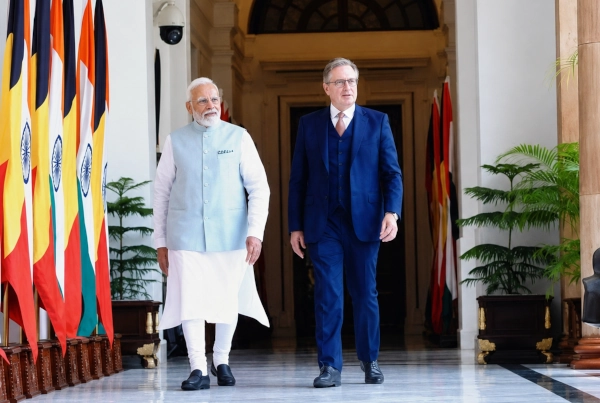
India and Belgium have significantly broadened their bilateral partnership, unveiling new mechanisms for defence cooperation, investment facilitation, counter-terrorism, renewable energy, semiconductors and skilled mobility during Belgian Prime Minister Bart De Wever’s official visit to India from September 2 to 4, 2026.
De Wever, who is making his first visit to India since assuming office in February 2025, arrived with Belgian Defence and Foreign Trade Minister Theo Francken, senior officials and a high-level business delegation. His talks with Prime Minister Narendra Modi reflected an effort by both countries to move the relationship beyond its traditional strengths in diamonds, chemicals and pharmaceuticals towards defence manufacturing, emerging technologies, clean energy and advanced industrial cooperation.
The visit builds upon the inaugural India-Belgium Strategic Dialogue held in Brussels on July 15, 2026. That mechanism has created a regular framework for cooperation covering trade and investment, technology, green transition, connectivity, defence, security and people-to-people exchanges. The two governments also agreed to use forthcoming Foreign Office Consultations to advance priorities identified through the Strategic Dialogue.
A major economic objective emerging from the summit is to double India-Belgium bilateral trade over the next five years. The two sides identified semiconductors, chemicals, pharmaceuticals, defence manufacturing, critical-mineral refining and recycling, sustainable industries and nuclear energy among sectors offering substantial scope for expansion. The historic Antwerp-Mumbai-Surat diamond relationship will remain an important commercial link, but the broader strategy now seeks to diversify economic engagement into higher-technology and strategic industries.
The economic push is being reinforced by the launch of an India-Belgium Investment Fast-Track Mechanism, intended to assist Belgian companies investing in India as well as Indian companies entering Belgium. The mechanism will help businesses address investment bottlenecks and provide a dedicated channel for facilitating long-term projects. Belgium’s sovereign wealth institution, SFPIM, and India’s National Investment and Infrastructure Fund are also working towards formalising cooperation that could support an Indo-Belgian economic and investment corridor.
The partnership is also closely connected with the wider India-European Union relationship. Modi and De Wever welcomed the conclusion of negotiations for the India-EU Free Trade Agreement at the January 27, 2026 India-EU Summit and called for its timely implementation. They also sought early completion of negotiations on the India-EU Investment Protection Agreement and the Agreement on Geographical Indications. Both countries see these arrangements as instruments for expanding market access, diversifying critical supply chains and increasing investment flows between India and Europe.
Defence Cooperation Gets an Institutional Framework
One of the most consequential outcomes of the visit was the signing of a Letter of Intent between the Indian and Belgian defence ministries, creating a formal framework for regular exchanges, staff talks, military education and training, research cooperation and defence-industrial partnerships.
The agreement builds on discussions between the two defence ministers in March 2025 and marks a shift towards more structured military engagement. Cooperation is expected to include maritime security, emerging defence technologies, military exchanges and Indo-Pacific security. Belgium’s frigate LEOPOLD I is scheduled to visit India from November 5 to 8, 2026, while additional exchanges involving defence colleges of both countries are also planned.
Military-to-military communication will receive another boost through expanded defence representation. Belgium has appointed a Defence Attaché in New Delhi, while India plans to station a resident Defence Attaché at its embassy in Brussels.
Defence-industrial cooperation is emerging as another important pillar. Both governments encouraged companies to pursue opportunities involving defence manufacturing, technological innovation, co-development and co-production, while welcoming multiple agreements already established between Indian and Belgian defence industries.
Counter-Terrorism and Cybercrime Cooperation Deepens
Belgium reaffirmed solidarity with India against terrorism, including cross-border terrorism, and again condemned the April 2025 terrorist attack in Pahalgam. Both countries called for stronger international action against terrorist organisations, financing networks and safe havens through mechanisms including the United Nations and Financial Action Task Force.
India and Belgium will also explore establishing a Joint Working Group on Counter-Terrorism, potentially creating a dedicated channel for intelligence, policy and institutional cooperation against evolving terrorist threats.
Law-enforcement cooperation was strengthened separately through an MoU between India’s Central Bureau of Investigation and Belgium’s Federal Police. The arrangement covers transnational organised crime, cybercrime, information sharing, capacity building and cooperation in tracing fugitives.
Semiconductors and Advanced Technology Move Up the Agenda
Technology cooperation is increasingly becoming a strategic component of the relationship. India and Belgium agreed to promote closer engagement between India’s semiconductor and microelectronics ecosystem — including semiconductor companies, the ChipIn Centre, C-DAC and universities — and Belgium-based imec, one of the world’s prominent semiconductor research organisations.
The objective is to develop deeper partnerships in semiconductor technologies while strengthening resilient advanced-technology ecosystems in both countries. Cooperation in artificial intelligence, digital innovation and startup incubation is also being expanded, including links between India’s MeitY Startup Hub and Hub Brussels.
Scientific collaboration already extends into astronomy, astrophysics and space technologies through the Belgo-Indian Network for Astronomy and Astrophysics. Belgium has contributed to several major astronomical facilities in India, providing an existing scientific base on which broader technology partnerships can develop.
Green Hydrogen, Offshore Wind and Energy Storage
India and Belgium also renewed their MoU on renewable-energy cooperation, expanding an earlier framework established in 2015. The updated arrangement covers green hydrogen, solar energy, energy storage, offshore wind, bio-energy, small hydropower and pumped-storage projects.
Green hydrogen is receiving particular attention because Belgium can provide European infrastructure, logistics and industrial expertise while India is developing large-scale renewable-energy and hydrogen production capacity. Existing cooperation involving GH2 India, the Belgian Hydrogen Council and Flanders Investment & Trade is intended to expand across hydrogen production, transportation, storage and industrial use.
Maritime infrastructure represents another area of complementarity. The two countries are exploring collaboration in ports, logistics, dredging, connectivity and offshore-wind infrastructure. Belgian expertise in dredging and port development could therefore become increasingly relevant as India expands its port capacity and offshore renewable-energy ambitions.
Healthcare, Education and Skilled Mobility
Healthcare and life sciences remain strong commercial and institutional bridges between the two countries. India and Belgium identified pharmaceuticals, biotechnology, clinical research and advanced healthcare solutions as areas where closer links between companies, universities and research institutions can generate new opportunities.
Mobility is simultaneously becoming an important component of the economic relationship. Belgium plans to strengthen visa-processing capacity in India as business, academic and professional exchanges expand. Both governments also welcomed European initiatives creating legal pathways for professionals, skilled workers and students and encouraged airlines to examine the possibility of establishing direct air connectivity between India and Belgium.
Existing programmes facilitating the movement of qualified Indian nurses to Belgium were recognised, while discussions will continue towards a broader bilateral MoU on mobility and migration. Modi also invited leading Belgian universities and academic institutions to establish campuses in India under India’s National Education Policy. Cooperation in vocational education, apprenticeships, emerging skills and recognition of qualifications will also be explored.
Belgium Reaffirms Support for India’s Permanent UNSC Membership
Diplomatically, Belgium reaffirmed its support for India’s candidature for permanent membership of a reformed and expanded United Nations Security Council. The two countries additionally agreed to support each other’s bids for non-permanent Security Council membership, with India seeking a seat for 2028-29 and Belgium for 2037-38.
The leaders also exchanged views on Ukraine and West Asia, backing dialogue and diplomacy while stressing the importance of protecting maritime routes and maintaining safe and uninterrupted commercial shipping.
The 2026 summit therefore represents a broad transformation of India-Belgium relations. What was once largely an economic partnership centred on diamonds, chemicals, pharmaceuticals and European trade links is developing into a more strategic relationship involving defence production, maritime security, semiconductors, critical minerals, green hydrogen, investment and advanced research.
With the 80th anniversary of diplomatic relations approaching in 2027, both governments now have institutional mechanisms capable of carrying the partnership forward. De Wever also invited Modi to undertake a bilateral visit to Belgium, providing an opportunity for the next stage of the relationship to be developed as India simultaneously deepens its strategic and economic engagement with the European Union.
You may also like
-
India Strengthens Trade Ties with Netherlands as Piyush Goyal Visits Port of Rotterdam
-
India to Train 600 Nigerian Army Soldiers in Specialised Jungle and Mountain Warfare
-
India and Russia Strengthen Parliamentary Diplomacy as Om Birla Meets State Duma Chairman Vyacheslav Volodin
-
India Seeks South Korean Shipbuilding Partnerships as Sarbananda Sonowal Begins Four-Day Visit to Busan
-
India and Italy Hold First Maritime Security Dialogue in Rome, Strengthen Strategic Maritime Cooperation
