GI Produce of India
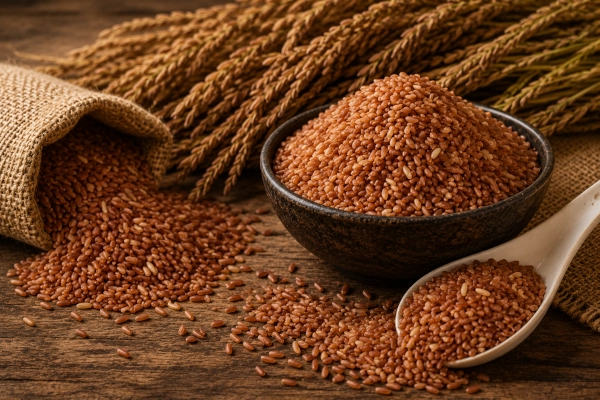
Palakkadan Matta Rice is one of Kerala’s most distinctive traditional rice products, immediately recognisable by its bold grain, reddish-brown outer layer and characteristic earthy flavour. Closely associated with the paddy fields of Palakkad, the rice reflects an agricultural landscape shaped by heavy soils, intense sunshine, monsoon humidity, rivers descending from the Western Ghats and the unusual winds that pass through the Palakkad Gap.
Unlike highly polished white rice, traditional Palakkadan Matta retains much of its coloured outer layer and is commonly parboiled before milling. The resulting rice has a firm texture, substantial grain and distinctive taste that has made it a staple of Kerala meals as well as an ingredient in traditional snacks and rice preparations.
A Rice Born in the Palakkad Plains
Palakkad occupies one of Kerala’s most important agricultural landscapes. The district lies immediately east of the main crest of the Western Ghats and contains the Palakkad Gap, the great natural break in the mountain chain that connects Kerala with the plains of Tamil Nadu.
This opening has a major influence on the local environment. Winds passing through the gap, high atmospheric humidity, strong sunshine and water descending from the Western Ghats combine with Palakkad’s distinctive soils to create conditions traditionally associated with the character of Palakkadan Matta Rice. Kerala’s Department of Agriculture specifically identifies these geographical and climatic influences as factors contributing to the rice’s distinctive quality and taste.
The rice is especially associated with paddy lands known locally as Poonthalpadam. These fields contain heavy soils with a high proportion of clay and silt, allowing them to retain considerable amounts of water during cultivation.
The Black Cotton Soils of Palakkad
One of the unusual geographical factors behind Palakkadan Matta is the presence of black cotton or regar-type soils derived from lime-rich rocks in parts of Palakkad. Kerala government information describes these soils as particularly important to the traditional production environment of the rice.
The Poonthalpadam soils can contain around 60–80 percent clay and silt. Their low permeability and high water-holding capacity make them well suited to maintaining standing water during paddy cultivation.
This soil environment distinguishes Palakkad from many other rice-growing landscapes in Kerala. Combined with the district’s climate, rivers and winds, it contributes to the geographical identity that separates genuine Palakkadan Matta from ordinary red rice cultivated elsewhere.
Not One Rice Variety, but a Traditional Group
An important feature of Palakkadan Matta is that the name does not refer to a single paddy variety. The GI identity encompasses a group of traditional cultivars historically cultivated in the Palakkad region and processed to produce the characteristic Matta rice.
Kerala’s Department of Agriculture identifies ten principal varieties under the traditional Palakkad Matta group: Aryan, Aruvakkari, Chitteni, Chenkazhama, Chattadi, Thavalakkannan, Eruppu, Poochamban, Vattan Jyothi and Kunju Kunji.
These cultivars do not necessarily produce rice identical in every respect. Individual varieties can show subtle differences in flavour, crop characteristics and grain qualities, but they share the regional characteristics that together form the Palakkadan Matta identity.
This makes the GI especially valuable from a biodiversity perspective. Rather than protecting a single commercial cultivar, it helps preserve a family of locally adapted rice varieties that embody generations of farmer selection.
The Distinctive Red Pericarp
The most immediately visible characteristic of Palakkadan Matta Rice is its red pericarp, the coloured outer layer surrounding the grain.
Traditional Matta rice is comparatively coarse and bold rather than thin and delicate. When milled without excessive polishing, enough of the reddish outer layer remains to give the grain its characteristic red-brown appearance.
This coloured layer is one reason Palakkadan Matta has traditionally been regarded as a more substantial rice than heavily polished white varieties. Kerala government agricultural literature notes that the coarse grain with its red pericarp retains valuable nutritional components and dietary fibre.
The grain’s identity therefore depends partly upon what is not removed during processing. Excessive polishing would strip away much of the outer layer that gives Matta rice its colour, texture and traditional character.
Bold Grain and Earthy Taste
Palakkadan Matta is not an aromatic rice in the manner of Basmati or Kerala’s Gandhakasala. Its appeal instead lies in its distinctive flavour, robust texture and substantial grain.
The cooked rice has a fuller mouthfeel than many polished varieties. The grains become soft enough to eat comfortably while retaining a degree of firmness and separation that suits Kerala’s traditional curries, vegetable dishes and fish preparations.
Kerala’s official GI portal attributes part of the characteristic flavour to the special soil in which the rice is grown. The combination of black cotton soil, high clay content, sunshine, humidity and regional climatic conditions gives the grain an identity closely connected with Palakkad itself.
For generations of households, this taste has become as recognisable as the rice’s red colour.
The Role of Parboiling
Traditional Palakkadan Matta is generally associated with parboiling, an important processing method in Kerala’s rice culture.
Parboiling involves soaking paddy, treating it with heat or steam and drying it before milling. This alters the physical structure of the grain and helps it withstand milling while also influencing the texture of the finished rice.
Kerala’s Department of Agriculture notes that parboiling helps retain nutritional components within Palakkadan Matta.
The process also contributes to the firm cooked texture that consumers associate with Matta rice. Because the grains are bold and substantial, they require different cooking times and water proportions from delicate white rice.
For households accustomed to Kerala-style red rice, the slightly chewy texture is a defining virtue rather than a defect.
Cultivation Through the Kerala Monsoon
Palakkadan Matta is rooted in the traditional wetland paddy agriculture of Kerala.
Fields are prepared before sowing or transplanting, with water management playing a central role throughout the growing period. Heavy Palakkad soils are particularly suited to retaining the moisture needed for paddy, while the southwest and northeast monsoons historically shaped the agricultural calendar.
Traditional varieties can be comparatively tall and often require more time in the field than modern short-duration commercial cultivars. Farmers therefore make a conscious economic choice when preserving Matta varieties, balancing the lower productivity of some traditional cultivars against the premium received for authentic rice.
The preservation of seed is equally important. When several traditional cultivars are maintained within a region, farmers must prevent unintended mixing if each variety is to retain its identity from one generation to another.
The Palakkad Gap — A Natural Influence on the Crop
Few agricultural regions in Kerala are influenced by a geological feature as dramatic as the Palakkad Gap.
The gap interrupts the otherwise continuous Western Ghats and permits strong easterly winds to reach the Palakkad plains. Kerala agricultural authorities explicitly include these winds among the natural factors influencing the character of Palakkadan Matta Rice.
The gap also contributes to Palakkad’s relatively hotter and drier conditions compared with several other districts west of the Ghats. Yet the region simultaneously receives monsoon rainfall and benefits from river systems draining the mountains.
This combination of strong sunshine, humidity, wind, river water and moisture-retaining soils produces a distinctive agricultural environment. Palakkadan Matta is consequently an excellent example of a GI in which physical geography genuinely helps explain the product.
From Harvested Paddy to Red Matta Rice
Once the crop reaches maturity, the paddy is harvested, threshed and dried before entering the processing chain.
The grain must be handled carefully because moisture levels influence storage quality and parboiling performance. Traditionally, knowledge about drying and processing was embedded within farming and milling communities rather than separated into large industrial operations.
Parboiling is followed by drying and milling. The milling process removes the husk while retaining sufficient bran and pericarp to preserve the characteristic red colour.
The degree of polishing matters greatly. Consumers purchasing traditional Matta generally expect the rice to retain its recognisable coloured outer layer rather than resemble highly milled white rice.
Modern mills have mechanised much of this process, but the underlying objective remains unchanged: produce a clean, properly cooked and milled grain while preserving the characteristics for which Palakkadan Matta is valued.
A Staple of the Kerala Meal
Palakkadan Matta has a natural affinity with Kerala cuisine.
Its robust grain stands up particularly well to sambar, avial, olan, pulissery, thoran, fish curry, meat curry and other richly flavoured accompaniments. The rice absorbs gravies without disintegrating easily, making it well suited to the traditional Kerala meal where several dishes may be served together.
It is also familiar as the central grain in everyday rice-and-curry meals. For many households, especially in central and northern Kerala, the reddish colour and firm texture of Matta rice represent the expected appearance of cooked rice rather than an alternative to white rice.
The grain also has a strong presence in Kerala restaurants and traditional meals served on banana leaves, strengthening its association with the state’s culinary identity.
From Meals to Traditional Snacks
Palakkadan Matta has traditionally been used for more than boiled rice.
Kerala agricultural literature records its use in preparations including murukku and kondattam, demonstrating how rice cultivation historically supported a much broader food economy.
Rice flour produced from traditional grains can be incorporated into snacks and other preparations, while cooked Matta is also used for kanji, Kerala’s traditional rice gruel.
This versatility helped create sustained demand for the crop. A variety used only on ceremonial occasions can easily disappear when customs change, whereas a rice incorporated into everyday meals and multiple traditional foods has a stronger chance of surviving.
Matta Rice and Kerala’s Red Rice Tradition
Red rice occupies an important position in Kerala’s agricultural and culinary history.
The state developed numerous red-kernelled varieties suited to different ecological settings, ranging from conventional wetlands to saline coastal fields and highland environments. Palakkadan Matta belongs to this larger tradition but is distinguished by its particular geographical origin and group of recognised cultivars.
Its GI protection therefore should not be interpreted as meaning that every red rice grown in Kerala is Palakkadan Matta. Colour alone is insufficient.
Authentic Palakkadan Matta combines recognised traditional varieties, regional cultivation and the product characteristics associated with its Palakkad origin.
The Legend Behind the Name “Matta”
Local tradition preserves an appealing story concerning the origin of the name Matta.
According to folklore recorded by Kerala’s official GI portal, the rice was once considered a grain reserved for royal consumption. A farmer supposedly smuggled seed from the ruler’s field by concealing it inside the sheath or covering of an areca palm, locally associated with the word matta, and secretly cultivated it so ordinary people could experience the prized rice.
The story belongs to folklore rather than securely documented agricultural history, but such traditions are culturally important. They show how deeply a crop can become embedded in collective memory.
The rice’s continued description as possessing a certain “royal” character also reflects the esteem with which traditional Palakkad farming communities regarded it.
Preserving Traditional Rice Diversity
The survival of Palakkadan Matta is important because Kerala has lost a substantial proportion of its traditional rice diversity.
Modern agricultural change brought higher-yielding, shorter-duration and more easily managed cultivars into widespread use. Such varieties played an essential role in increasing productivity, but their adoption also reduced the acreage devoted to many local landraces.
Traditional Palakkad Matta cultivars can face several commercial disadvantages. Some yield less than modern varieties, some are taller or more prone to lodging, and the maintenance of genuine seed requires additional care.
GI protection helps change this economic calculation by turning geographical authenticity into market value.
If farmers can receive a premium for genuine Palakkadan Matta, preserving traditional cultivars becomes economically more viable than when they must compete with commodity rice solely on yield.
Farmers at the Centre of the GI Movement
Palakkadan Matta is notable because its GI protection emerged through a farmer-led initiative.
The registered proprietor is Palakkadan Matta Farmers Producer Company Limited, based at Karukamanikalam in the Chittur area of Palakkad. The company was formed by farmers in 2005 and played the central role in securing recognition for their traditional product.
Kerala Tourism describes the Palakkadan Matta and Navara initiatives associated with farmers in the region as pioneering examples of farmer-led agricultural GI registration.
This history makes the product particularly significant within India’s GI movement. The protection was not simply imposed from above as a branding exercise; cultivators themselves organised around the need to preserve and obtain recognition for a crop they considered part of their agricultural heritage.
GI Protection and Market Identity
The GI registration provides a legal framework for distinguishing genuine Palakkadan Matta from rice using the name without possessing the required geographical connection.
This is important because “Matta rice” has become a widely recognised commercial term. As demand grows outside Kerala and among the global Malayali diaspora, the premium associated with the name creates incentives for ordinary red rice to be marketed in ways that can blur geographical identity.
A functioning GI system can help authorised producers defend the connection between the product and its place of origin.
The registration also creates opportunities for better branding, packaging, farmer collectives, direct sales and value-added products. For a traditional crop facing competition from higher-yielding rice, these market advantages can be essential to long-term survival.
A Rice with a Global Kerala Market
Migration has carried the taste for Kerala red rice far beyond Palakkad.
Large Malayali communities in the Gulf, Europe, North America and other regions have created international demand for traditional Kerala foods, including Matta rice. Packaged Kerala red rice is now routinely exported and sold through Indian grocery networks abroad.
This market has transformed what was once primarily a regional agricultural product into a rice recognised by consumers thousands of kilometres from the fields where it originated.
Yet international popularity also increases the importance of authenticity. As the commercial use of the word “Matta” expands, the GI provides a means of preserving the specific identity of Palakkadan Matta Rice.
The Challenge of Keeping Farmers in the Fields
GI recognition by itself does not guarantee that a traditional crop will survive.
Kerala’s GI portal notes continuing challenges involving relatively low yields, inadequate systems for procurement from growers, limited capital for processing and value addition, and difficulties in developing sufficiently strong marketing networks.
These pressures can encourage farmers to shift towards other crops or more productive rice varieties.
The future of Palakkadan Matta therefore depends upon converting cultural prestige into dependable farm income. Farmer collectives, assured procurement, quality seed, better processing, traceability and stronger premium markets are as important as the GI certificate itself.
If the farmers who preserve the traditional cultivars cannot earn sustainable returns, the authenticity the GI seeks to protect will become increasingly difficult to maintain.
GI Details at a Glance
- Geographical Indication: Palakkadan Matta Rice
- State: Kerala
- Product: Agricultural — Rice
- Class: 30
- Application Number: 36
- Date of Filing: 18 April 2005
- GI Journal: Journal No. 17
- Journal Availability Date: 20 June 2007
- Certificate Number: 41
- GI Certificate Date: 24 September 2007
- Registered Proprietor: Palakkadan Matta Farmers Producer Company Limited, Karukamanikalam, Chittur College P.O., Palakkad, Kerala
- Geographical Area: Kerala, with the traditional production identity centred on Palakkad district
- Registration Valid Until: 17 April 2035
The details above are taken from the current Geographical Indications Registry of Intellectual Property India. The Registry records Palakkadan Matta Rice as a registered agricultural GI and confirms that its renewed registration is valid until April 2035.
The Red Grain that Carries the Taste of Palakkad
Palakkadan Matta Rice represents the close relationship between food and landscape particularly well. Its bold red grain cannot be separated from the heavy clay-rich fields in which traditional varieties are grown, the rivers descending from the Western Ghats, the intense Palakkad sun or the winds passing through the great gap in the mountains.
It is also a product of human continuity. Generations of farmers preserved Aryan, Aruvakkari, Chitteni, Chenkazhama, Chattadi, Thavalakkannan, Eruppu, Poochamban, Vattan Jyothi, Kunju Kunji and related traditional rice culture because the grain possessed a flavour and identity valued within their communities.
Parboiling, careful milling and the retention of the red outer layers then transform that paddy into the familiar rice served with Kerala curries, made into kanji or incorporated into traditional snacks.
Today, the GI gives legal recognition to what Palakkad’s farmers have understood for generations: Palakkadan Matta is not merely red rice. It is a grain whose colour, texture, taste and cultural identity belong to the fields and farming traditions of Kerala’s Palakkad country.
You may also like
-
ICAR Scientists Develop Indigenous Protective Gloves for Cotton Farmers, Sign Commercial Manufacturing Agreement
-
BHEL–Coal India Joint Venture Begins Construction of ₹25,016 Crore Indigenous Coal Gasification Project in Odisha
-
PM Modi to Inaugurate RBI’s Tier IV Data Centre and Cybersecurity Training Institute in Bhubaneswar
-
India Creates 11 Crore Digital Farmer IDs Five Months Ahead of Target, Strengthening AgriStack Infrastructure
-
Chak-Hao Black Rice of Manipur and Nagaland: The Aromatic Purple Heritage Grain with GI Recognition
