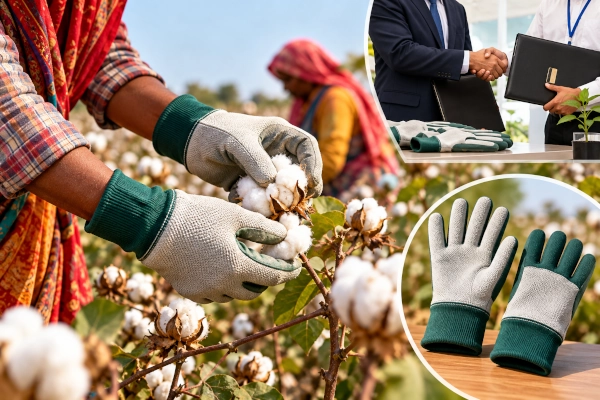
Indian agricultural scientists have developed specialised protective gloves to safeguard cotton-picking workers from injuries during manual harvesting. The innovation, developed by the ICAR–Central Institute for Research on Cotton Technology (ICAR-CIRCOT), Mumbai, addresses the occupational hazards associated with handling mature cotton bolls, particularly injuries caused by sharp cotton bracts. The gloves are designed to provide protection while maintaining the flexibility, comfort and freedom of movement required for cotton harvesting.
To facilitate commercial manufacturing and wider availability, ICAR-CIRCOT signed a technology-transfer agreement with Trust ARS Rubber Private Limited, Chengalpattu, Tamil Nadu, on October 22, 2026. The Ministry of Agriculture and Farmers Welfare officially announced the development on October 23, highlighting the initiative as a practical contribution to agricultural worker safety and indigenous technology commercialisation.
The reusable gloves are intended to withstand repeated use in agricultural environments, offering a protective solution suited to the everyday requirements of cotton-picking workers. The partnership also demonstrates how technologies developed at public agricultural research institutions can be transferred to Indian manufacturers for commercial production, strengthening the connection between scientific innovation and practical farming applications.
ICAR-CIRCOT Transfers Protective Glove Technology to Tamil Nadu Manufacturer
The ICAR–Central Institute for Research on Cotton Technology signed a Memorandum of Understanding with Trust ARS Rubber Private Limited to facilitate the commercialisation of its newly developed protective gloves. The agreement establishes cooperation between the research institute and the industry partner for bringing the technology closer to agricultural workers who could benefit from improved hand protection during cotton harvesting.
The gloves were developed in response to the challenges faced by workers engaged in manually collecting cotton from mature plants. During harvesting, repeated contact with dry and sharp cotton bracts can cause cuts, scratches and discomfort. Such injuries are particularly relevant because cotton picking requires frequent and precise hand movements throughout the working day.
ICAR-CIRCOT’s technology seeks to address these occupational hazards through protective equipment specifically designed for cotton-picking activities. The institute has focused on developing gloves that combine a protective barrier with the flexibility needed to handle cotton fibres efficiently. Their reusable construction is intended to make them suitable for repeated harvesting operations.
The agreement with Trust ARS Rubber Private Limited provides a pathway for transferring this research-based innovation into commercial manufacturing. Through the partnership, the institute aims to extend the practical benefits of its technology beyond research and demonstration activities, enabling its eventual availability to farmers and agricultural workers.
Sharp Cotton Bracts Pose Occupational Risks During Manual Harvesting
Cotton harvesting remains an important labour-intensive agricultural activity in several cotton-growing regions of India. Workers manually collect mature cotton from opened bolls, a process that requires repeated contact with plant structures throughout the harvesting period. Although cotton fibres are soft, the surrounding bracts and dried plant material can be stiff, pointed and abrasive.
Cotton bracts are modified leaf-like structures that surround the developing flower and boll. As cotton plants mature, these structures may become harder and can cause scratches or minor puncture injuries when workers reach into the plant to collect opened cotton. Repeated exposure increases the importance of suitable protective equipment, especially during prolonged harvesting activities.
The task also requires considerable finger flexibility and dexterity. Workers must separate cotton from opened bolls without unnecessarily collecting plant debris or damaging the harvested material. Protective gloves that are too thick or rigid can interfere with these movements, making conventional industrial gloves unsuitable for some agricultural applications.
Developing task-specific protection therefore requires a careful balance between physical safety and ease of movement. ICAR-CIRCOT’s innovation addresses this requirement by focusing on a glove design intended to protect the hands while allowing workers to continue performing the normal movements involved in cotton picking.
Indigenous Glove Design Combines Hand Protection, Comfort and Flexibility
The protective gloves developed by ICAR-CIRCOT are designed to reduce direct contact between workers’ hands and the sharp structures surrounding cotton bolls. Their protective function is intended to minimise scratches and other minor injuries associated with repeated handling of mature cotton plants.
An important feature of the design is its emphasis on flexibility. Cotton harvesting involves grasping and separating relatively small quantities of cotton using the fingers and thumb. Gloves must therefore allow natural hand movements while providing sufficient protection against rough and pointed plant material.
Comfort is equally important because agricultural workers may wear protective equipment for extended periods. Poorly designed gloves can cause discomfort, restrict movement or interfere with work, potentially discouraging consistent use. By considering comfort alongside protection, the researchers have sought to create equipment more suitable for practical harvesting conditions.
The technology also incorporates a reusable construction intended to withstand repeated agricultural use. This characteristic may offer practical advantages over single-use protective products, particularly where workers require dependable hand protection throughout a harvesting season. The official announcement establishes these intended features, although detailed material specifications and independently measured protection ratings have not been provided.
Reusable Gloves Designed for Repeated Agricultural Field Use
The reusable nature of ICAR-CIRCOT’s protective gloves is particularly relevant to cotton cultivation, where harvesting frequently involves several rounds of manual picking as bolls mature at different times. Workers therefore require protective equipment that remains comfortable and functional through repeated use.
Agricultural environments can expose gloves to dust, plant debris, moisture and mechanical wear. Equipment intended for these conditions must possess sufficient durability to maintain its usefulness during normal harvesting activities. The ICAR-CIRCOT design seeks to address this requirement by providing a reusable alternative suited to regular field operations.
Reusable protective equipment can also have economic advantages when its service life justifies the initial purchase cost. Farmers and agricultural workers may find such products more practical if they remain effective over multiple harvesting sessions and do not require frequent replacement.
However, the actual economic benefits will depend on factors such as commercial pricing, product durability, cleaning requirements and availability. These considerations will become clearer as the transferred technology progresses towards manufacturing and distribution.
Technology Transfer Creates a Pathway for Commercial Manufacturing
The agreement with Trust ARS Rubber Private Limited represents an important stage in moving the protective glove technology from institutional research towards commercial production. Agricultural innovations often require manufacturing partnerships to achieve wider distribution, particularly when research institutes do not directly operate large-scale commercial production facilities.
Technology transfer allows an industrial partner to use a developed technology within the scope of an agreed commercialisation arrangement. The process can involve adapting research-developed designs for manufacturing, establishing production procedures and maintaining consistent product quality.
For protective gloves, manufacturing consistency is especially important because the equipment must provide dependable protection while preserving the flexibility and comfort intended by its design. Material selection, sizing, finishing and quality control can influence how effectively the finished product performs during agricultural work.
The collaboration between ICAR-CIRCOT and the Chengalpattu-based manufacturer brings together agricultural research and industrial production capabilities. It also demonstrates the potential for cooperation between institutions and manufacturers located in different states to address challenges encountered across India’s agricultural sector.
The agreement establishes the pathway for commercialisation, while the actual commencement of manufacturing and market availability will depend on subsequent implementation by the industry partner.
Agricultural Occupational Safety Becomes an Important Area of Innovation
Agricultural technology development has traditionally focused on improving crop yields, reducing production costs, controlling pests and increasing mechanisation. However, the safety and physical well-being of the people performing agricultural work are equally important components of an efficient and sustainable farming system.
Many agricultural operations involve repetitive movements, contact with sharp plant material, exposure to dust and prolonged physical activity. These conditions create occupational risks that may not always receive the same attention as mechanisation or improvements in crop productivity.
Protective equipment designed for specific agricultural tasks can help reduce some of these risks. Gloves, suitable footwear, protective clothing and other safety products may provide practical benefits when they are appropriate for the activity and comfortable enough for regular use.
ICAR-CIRCOT’s protective gloves illustrate how agricultural engineering can address worker safety through relatively straightforward technological interventions. Instead of requiring substantial changes to existing harvesting practices, the innovation seeks to provide additional protection while allowing workers to continue familiar manual operations.
Such developments can encourage greater attention to occupational safety within agricultural research and create opportunities for specialised protective equipment suited to different crops and farming activities.
ICAR-CIRCOT’s Research Supports India’s Cotton Value Chain
The Central Institute for Research on Cotton Technology, headquartered in Mumbai, operates under the Indian Council of Agricultural Research. The institute conducts scientific and technological research associated with cotton processing, fibre quality, materials development, value addition and other activities relevant to the cotton sector.
India’s cotton industry encompasses a large agricultural and industrial value chain involving cultivation, harvesting, ginning, spinning, textile manufacturing and associated processing activities. Technological improvements at different stages can contribute to better resource utilisation, product quality and working conditions.
ICAR-CIRCOT’s research programmes aim to develop solutions relevant to this wider cotton ecosystem. Its activities include improving the utilisation of cotton and associated materials, developing processing technologies and transferring research outcomes to industrial users.
The protective glove innovation demonstrates how the institute’s technical expertise can also address challenges encountered at the agricultural production stage. By focusing on the safety of cotton-picking workers, the institute has developed an application that directly relates to the people involved in harvesting the crop.
The technology-transfer agreement also reflects ICAR’s broader efforts to encourage practical utilisation of research through cooperation with manufacturers and other stakeholders.
Protective Gloves Can Support Safer Manual Cotton Harvesting
Manual cotton harvesting requires considerable physical effort and repeated hand movements, making the condition of workers’ hands important for carrying out the task comfortably. Scratches and minor injuries caused by plant structures can create discomfort and interfere with routine harvesting activities.
Appropriate protective gloves may reduce direct contact with sharp cotton bracts and provide an additional barrier against minor mechanical injuries. Their usefulness depends on maintaining sufficient flexibility for workers to handle cotton efficiently without excessive restriction.
The design developed by ICAR-CIRCOT seeks to achieve this balance through a combination of protection, comfort and durability. By adapting the equipment to the actual requirements of cotton picking, the institute aims to encourage practical use during harvesting operations.
Improved hand protection may also contribute to greater comfort during prolonged work. Nevertheless, any measurable improvement in harvesting productivity or reduction in injury rates would require systematic field assessment.
The importance of the innovation lies in addressing a specific occupational hazard through equipment designed for the task. It demonstrates that improvements in agricultural working conditions can emerge from focused research into everyday farming challenges.
Indigenous Agricultural Safety Equipment Supports Make in India
The commercialisation of ICAR-CIRCOT’s protective gloves is consistent with India’s broader emphasis on indigenous technology development and domestic manufacturing. Agricultural innovation involves not only major machinery and sophisticated digital systems but also specialised products that improve the safety and effectiveness of routine farming operations.
India’s agricultural sector requires a wide range of supporting equipment, including harvesting accessories, protective clothing, handling tools and specialised materials. Developing these products domestically creates opportunities to adapt their design to local agricultural practices, working conditions and user requirements.
The partnership between ICAR-CIRCOT and Trust ARS Rubber Private Limited provides an example of how research institutions can collaborate with Indian companies to manufacture agricultural technologies developed within the country.
Such cooperation can also encourage industrial participation in smaller technological innovations that address clearly identified problems. Products developed through these arrangements may contribute to broader manufacturing capabilities while supporting the needs of farmers and agricultural workers.
The transfer of the protective glove technology therefore represents both an agricultural safety initiative and an example of research-led domestic product development.
Research and Industry Collaboration Strengthens Agricultural Technology Adoption
The practical impact of an agricultural innovation depends on more than successful development within a research laboratory. Products must also be manufactured consistently, offered at accessible prices and made available through channels that reach their intended users.
Technology-transfer partnerships provide an important connection between scientific research and commercial implementation. Research institutions contribute technical knowledge and developed designs, while industry partners bring manufacturing experience and access to commercial distribution networks.
The ICAR-CIRCOT agreement demonstrates this relationship through a technology intended to address an everyday harvesting challenge. The institute has developed the protective equipment, while the commercial partner will support the process of bringing the innovation into wider use.
Future adoption will depend on the gloves’ performance under practical field conditions, their affordability and the willingness of workers and farmers to incorporate them into normal harvesting routines.
The initiative also provides a useful example of how agricultural research can address human-centred challenges. By considering the needs of workers alongside broader production requirements, research institutions can develop technologies that support safer and more comfortable agricultural practices.
ICAR’s Protective Glove Innovation Advances Agricultural Worker Safety
The development of indigenous protective gloves by ICAR-CIRCOT represents a practical advancement in India’s agricultural occupational safety efforts. The technology addresses injuries associated with sharp cotton bracts while seeking to preserve the comfort and flexibility required for manual harvesting.
The technology-transfer agreement signed with Trust ARS Rubber Private Limited on October 22, 2026, marks an important step towards commercialising the innovation and making it available to a wider group of agricultural users. The collaboration combines scientific research with domestic manufacturing expertise to address a specific challenge faced by cotton-picking workers.
The initiative also highlights the importance of expanding agricultural innovation beyond crop productivity and machinery development. Technologies that improve worker protection and comfort can contribute to more sustainable farming practices and support the well-being of people involved in agricultural production.
By creating a pathway for the commercial manufacture of specialised protective gloves, ICAR-CIRCOT has demonstrated how indigenous research can produce practical solutions for India’s farming sector. The development strengthens cooperation between public research institutions and Indian industry while encouraging greater attention to safety in everyday agricultural operations.
References
1. Press Information Bureau, Ministry of Agriculture and Farmers Welfare — October 23, 2026.
ICAR-CIRCOT Signs MoU for Technology Transfer of Protective Gloves for Cotton Picking Workers.
https://www.pib.gov.in/PressReleseDetailm.aspx?PRID=2327349&lang=1®=3
2. ICAR–Central Institute for Research on Cotton Technology — October 23, 2026.
ICAR-CIRCOT Signs MoU for Technology Transfer of Protective Gloves for Cotton Picking Workers.
https://circot.icar.gov.in/icar-circot-signs-mou-technology-transfer-protective-gloves-cotton-picking-workers
3. Indian Council of Agricultural Research — October 23, 2026.
ICAR-CIRCOT, Mumbai Signs MoU for Technology Transfer of Protective Gloves for Cotton Picking Workers.
https://icar.gov.in/en/icar-circot-mumbai-signs-mou-technology-transfer-protective-gloves-cotton-picking-workers
4. ICAR–Central Institute for Research on Cotton Technology.
Official institutional information on cotton technology research, agricultural engineering and technology commercialisation.
https://circot.icar.gov.in/
You may also like
-
India Moves Towards Five-Year Assured Orders for Defence Startups Under New Procurement Reforms
-
BHEL–Coal India Joint Venture Begins Construction of ₹25,016 Crore Indigenous Coal Gasification Project in Odisha
-
Zen Technologies Introduces Indigenous Hyper-Strike Falcon AI-Guided Counter-Drone Interceptor
-
L&T and Germany’s SCHOTTEL Expand Partnership for Controllable Pitch Propeller Systems in Indian Shipbuilding
-
PM Modi to Inaugurate RBI’s Tier IV Data Centre and Cybersecurity Training Institute in Bhubaneswar
