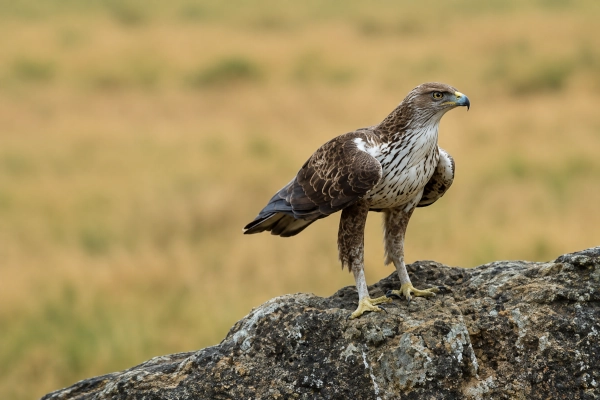
A pair of Bonelli’s Eagles (Aquila fasciata) has been officially documented for the first time inside Sardarpur Kharmor Wildlife Sanctuary in Madhya Pradesh’s Dhar district, adding an important raptor record to a protected landscape traditionally associated with the critically endangered Lesser Florican. Forest Department personnel photographed the two eagles perched together on a babool tree, providing the sanctuary’s first confirmed documentation of the species.
The sighting is particularly notable because Sardarpur is dominated by open grassland and relatively flat terrain, whereas Bonelli’s Eagles are more commonly associated with rocky hills, cliffs, scrubland and open woodland. The species is nevertheless an adaptable hunter and can use open habitats where prey is sufficiently abundant. Its appearance at Sardarpur suggests that the sanctuary and surrounding landscape are supporting a wider range of predatory birds than previously documented.
Forest Ranger Shailendra Solanki described the presence of the pair as an indication that the landscape is developing favourable conditions for large raptors. Bonelli’s Eagles are powerful predators capable of taking birds, reptiles and small mammals, and their presence near the top of the local food chain can reflect the availability of prey and functioning habitat at lower ecological levels.
The latest observation follows growing evidence of avian diversity within Sardarpur. A 2024–25 bird survey recorded more than 95 bird species in the sanctuary, suggesting that the protected area is increasingly important not only for its original flagship species but also for migratory birds, grassland species and raptors. Forest officials expect the Bonelli’s Eagle record to encourage further ornithological monitoring and documentation in the region.
Sardarpur Wildlife Sanctuary was originally notified in 1983, with an area of about 348.12 sq km, primarily to conserve the Lesser Florican, locally known as the Kharmor. The sanctuary’s landscape consists largely of grasslands, which provide breeding and feeding habitat for open-country birds. Government conservation assessments have historically identified Lesser Florican conservation as the principal management objective of the protected area.
The sanctuary underwent a major boundary reorganisation in 2025, reducing its protected area to approximately 132.83 sq km. The revised boundary retained forest and ecologically important areas while removing extensive revenue and privately held land from the original sanctuary. The change followed recommendations considered by the Standing Committee of the National Board for Wildlife.
The new eagle record comes at a sensitive time for the sanctuary’s original conservation mission. Forest officials say the Lesser Florican has not been sighted there since 2022, with habitat disturbance from infrastructure, power lines, wind-energy development and traffic among the pressures affecting the species. The appearance of a large predator therefore does not remove the need for continued grassland management specifically tailored to the Florican.
Bonelli’s Eagle is a medium-to-large raptor with a wingspan that can approach 1.8 metres. It is distributed across parts of southern Europe, North Africa, the Middle East and South Asia, including India. The species is currently classified globally as Least Concern, but it remains legally protected in India and is listed under Schedule I of the Wildlife (Protection) Act, giving it one of the country’s highest levels of statutory protection.
The species usually hunts over open or semi-open landscapes while relying on nearby rocky outcrops, ridges or trees for resting and nesting. Research on Bonelli’s Eagles has shown that they often use mosaics of scrub, open ground, cultivated land and rocky habitat, particularly where prey remains abundant. This ecological flexibility may help explain the pair’s presence in Sardarpur despite the sanctuary’s largely grassland character.
The documentation of the pair considerably strengthens the case for broader biodiversity monitoring at Sardarpur. While the sanctuary was created around the conservation needs of one highly threatened grassland bird, its growing inventory of raptors and other avifauna demonstrates that the landscape supports a more complex ecological community.
For conservation managers, the challenge will be to protect this wider diversity without losing sight of the habitat requirements of the Lesser Florican. Continued camera monitoring, structured bird surveys and assessment of nesting and feeding areas could determine whether the Bonelli’s Eagles are merely passing through Sardarpur or have begun using the sanctuary regularly.
Either way, the first official record adds an important new dimension to Sardarpur’s wildlife profile. A sanctuary once known almost entirely for the elusive Kharmor is increasingly emerging as a valuable grassland and raptor habitat in western Madhya Pradesh, underlining the conservation importance of maintaining open landscapes alongside forests and wetlands.
You may also like
-
Satpura Tiger Reserve’s Barasingha Population Crosses 300 as Madhya Pradesh Plans New Wildlife Corridors
-
Karnataka’s Tiger Population Could Cross 700 as New Census Builds on Official Count of 563
-
Project Cheetah Expands as Veerangana Durgavati Tiger Reserve Becomes Madhya Pradesh’s Third Cheetah Habitat
-
Kashmir Markhor Population Rises to 227 as Kazinag Conservation Efforts Show Results
-
ICAR-CIFRI Pushes Conservation of Indigenous Himalayan Fish for Biodiversity and Livelihood Security
