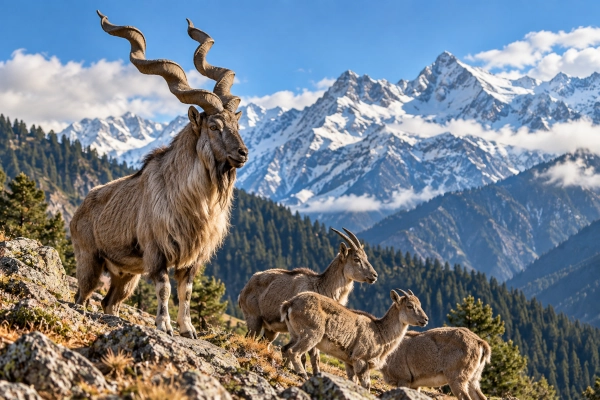
The population of the Kashmir markhor in the Kazinag landscape of Jammu and Kashmir has risen to an estimated 227 animals in 2026, according to a recent assessment by the Jammu and Kashmir Department of Wildlife Protection and the Wildlife Trust of India.
The increase is modest compared with the 221 animals estimated in 2023, but the longer-term trend is much more significant. The Kazinag population stood at around 133 animals in 2005, showing that sustained conservation measures over two decades have helped one of India’s rarest mountain ungulates recover gradually.
Kazinag Remains the Markhor’s Main Indian Stronghold
Kazinag National Park and the adjoining Limber and Lachipora wildlife sanctuaries remain the most important habitat for the Kashmir markhor in India.
The 2026 estimate places the population at 227 ± 13.9 animals. Earlier assessments recorded 152 markhor in 2010, 142 in 2012, 187 in 2016, 184 in 2018 and 221 in 2023.
The figures show that recovery has not been linear. Numbers have fluctuated between survey periods, but the overall trend has remained positive, particularly when compared with the 2005 baseline.
Strong Recruitment Is an Encouraging Sign
The latest assessment recorded a relatively high number of young animals, suggesting that breeding and juvenile survival are supporting the population.
Researchers found around 69 kids for every 100 adult females, along with approximately 33 adult males for every 100 females.
Strong recruitment is important in a small population because long-term recovery depends on young animals surviving and entering the breeding population. It also suggests that habitat conditions in parts of Kazinag remain suitable for reproduction.
Four Years of Monitoring Covered More Than 2,000 Kilometres
The latest population assessment formed part of the 2022–26 phase of the Markhor Recovery Project.
Field teams monitored 12 permanent trails over four years and covered more than 2,000 kilometres. During the 2026 assessment alone, researchers recorded around 600 direct sightings across different seasons.
Monitoring was carried out across Kazinag National Park, Limber Wildlife Sanctuary, Lachipora Wildlife Sanctuary and Naganari Conservation Reserve. This wider landscape-level approach helps researchers understand how markhor move between seasonal habitats rather than treating individual protected areas in isolation.
Recovery Work Has Continued Since 2005
The Markhor Recovery Project began in 2005 with the objective of securing the species in its remaining Indian range.
Conservation measures have included regular population monitoring, habitat protection, anti-poaching surveillance, control of grazing pressure and greater involvement of local communities.
More than 140 frontline wildlife personnel have reportedly been trained and equipped through the programme, while community-based Markhor Watchers have been involved in reporting illegal grazing and poaching.
This combination of field enforcement and local participation has become an important part of conservation in remote mountain landscapes where permanent official presence can be difficult.
Grazing Pressure Remains a Major Threat
Livestock grazing continues to be one of the most serious pressures on markhor habitat.
Domestic animals compete with markhor for forage and can also increase the risk of disease transmission. The pressure becomes more serious when large herds remain within sensitive habitats during breeding or birthing periods.
Wildlife authorities have therefore focused on reducing grazing inside critical parts of Kazinag, Limber and Lachipora. Protection is particularly important during the November–December rutting season and the May birthing period.
Reducing disturbance during these stages can directly improve breeding success and juvenile survival.
Hirpora Remains More Fragile
The situation in Hirpora Wildlife Sanctuary is less encouraging.
The latest assessment does not provide a directly comparable markhor population estimate for Hirpora, but habitat studies indicate that suitable areas remain more restricted than in Kazinag.
Only a limited share of Hirpora has been assessed as highly suitable during summer and winter, while illegal grazing and other human pressures remain persistent challenges.
Authorities have increased anti-grazing enforcement in the sanctuary, including tighter checks on livestock movement and permits for transient herders.
The contrast between Kazinag and Hirpora shows that markhor recovery remains uneven across the wider landscape.
Technology Could Improve Future Monitoring
Researchers are also exploring the use of modern monitoring tools to improve population estimates.
Thermal drones, camera traps and radio collars can help track markhor in steep terrain where conventional surveys are difficult. Such systems can also provide better information on seasonal movement, habitat use and mortality.
Thermal-drone trials have already been conducted in parts of the landscape, indicating that future surveys could become more precise and less dependent on direct visual observation.
For a species living in rugged Himalayan terrain, better monitoring technology can significantly improve conservation planning.
Community Participation Is Becoming More Important
The Markhor Recovery Project has increasingly linked wildlife protection with local livelihoods.
Community initiatives have included nature guides, homestays, school outreach and livelihood programmes designed to build support for conservation around protected areas.
This approach is particularly important in mountain regions where livestock grazing and resource use are closely tied to local economies.
Conservation becomes more sustainable when communities see direct benefits from protecting wildlife and when local residents participate in monitoring and habitat protection.
Markhor Still Faces Long-Term Risks
The Kashmir markhor remains vulnerable despite the recent increase.
Major threats include habitat fragmentation, livestock competition, poaching, road construction, mining, power infrastructure, border fencing and other forms of disturbance.
The species receives the highest level of legal protection under India’s Wildlife Protection Act and is also listed under Appendix I of CITES.
Its long-term survival will therefore depend not only on increasing numbers inside protected areas but also on maintaining movement corridors and reducing pressure across the wider Himalayan landscape.
A Gradual but Meaningful Recovery
The rise from 221 animals in 2023 to 227 in 2026 may appear small, but the broader recovery from around 133 animals in 2005 is far more significant.
Kazinag shows that patient conservation can produce measurable results when habitat protection, community participation, monitoring and enforcement continue over many years.
The next priority will be to consolidate these gains while improving habitat quality in more fragile areas such as Hirpora and strengthening connectivity between markhor populations.
For one of India’s rarest mountain mammals, the Kazinag recovery represents an important example of how sustained conservation can gradually rebuild a vulnerable population.
References
- Jammu and Kashmir Department of Wildlife Protection and Wildlife Trust of India — Recovery of Kashmir Markhor: A Threatened Mountain Ungulate in Jammu and Kashmir, Impact Report, 2026.
- Wildlife Trust of India — Kashmir Markhor Recovery Project, 2022–26.
- The Tribune — Kazinag National Park: Markhor Count Rises to 227 in J&K, October 2026.
- IUCN Red List — Capra falconeri.
You may also like
-
Thousands of Butterflies Migrate Across Tamil Nadu as Northeast Monsoon Arrives
-
Indian Researcher Surveys Over 3,000 Western Ghats Frogs to Track Deadly Amphibian Fungus
-
Zoological Survey of India Discovers Three New Centipede Species in Western Ghats of Kerala and Karnataka
-
Scientists Document 3,261 Flowering Plant Species in Agasthyamalai Biosphere Reserve, Including 1,018 Indian Endemics
-
Scientists Discover Two Rare Blind Fish Species in Assam’s Underground Waters, Revealing Hidden Biodiversity
