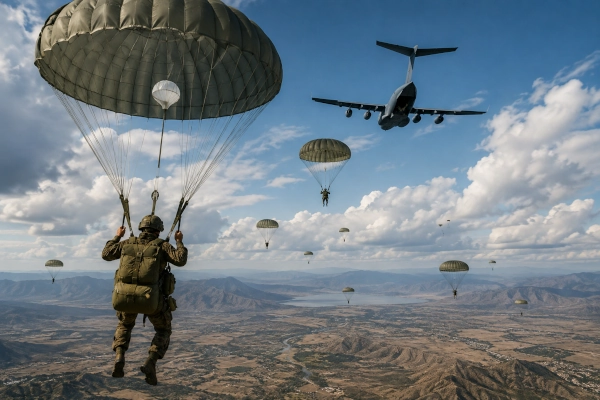
Personnel from the Indian Army’s Para Special Forces are participating in the Vyzov-7 international special-forces competition in Russia, placing Indian operators alongside military and security teams from several countries in a demanding series of tactical combat events.
The seventh edition of Vyzov, also translated as Challenge-7, is being conducted at a training ground of Russia’s Central Military District near Yekaterinburg in the Ural region. The competition began on 24 August and is scheduled to conclude on 30 August 2026, when the final obstacle-course event and awards ceremony are expected to take place.
Russian official reporting has confirmed India’s participation in the international event. Russia’s National Guard said that 37 teams representing security agencies, special-purpose units and shooting organisations were taking part, with participants coming from six countries including India. Russian military reporting separately confirmed Indian participation in the competition.
Indian defence reporting has identified the Indian contingent as personnel from the Indian Army’s Para (Special Forces), giving the exercise particular significance because the competition is designed specifically around the capabilities required from small special-operations teams.
Eight Events Based on Tactical Combat Scenarios
Vyzov-7 is substantially different from a conventional military shooting championship. The organisers have designed eight competitive stages based on tactical scenarios intended to reproduce some of the pressures encountered during special operations.
Participants are required to demonstrate proficiency with several categories of weapons while simultaneously being evaluated on speed, accuracy, physical endurance, coordination and tactical decision-making.
Among the scenarios are building assaults, simulated hostage rescue, evacuation from an ambush and battlefield conditions, sniper operations and an obstacle course. Teams must therefore operate as coordinated tactical elements rather than simply competing as individual marksmen.
Russian military reporting says the scenarios have been designed to approximate realistic operational conditions. During the opening phase, teams carried out the “Liberation” exercise, which involved assaulting a building and rescuing simulated hostages. Snipers and assault elements were required to coordinate their actions during the operation.
The competition also tests weapons handling across pistols, rifles, assault rifles and sniper systems. A separate stage for sniper pairs and a military-style relay are among the events planned during the week-long competition.
Testing More Than Marksmanship
Special-forces competitions of this type provide a different test from conventional field exercises. A team can possess excellent individual shooters yet lose considerable time if movement, communication, casualty handling or room-clearing procedures are inefficient.
Vyzov-7 consequently places significant emphasis on teamwork under pressure.
Operators may have to move rapidly between firing positions, distinguish targets, coordinate assault and sniper elements, evacuate personnel and complete physically demanding movements while maintaining weapons safety and shooting accuracy.
Such events can reveal differences in doctrine and training methods between participating organisations. Hostage-rescue procedures, tactical medicine, equipment layouts, weapon transitions and small-team assault techniques can vary considerably among countries and even among different special-purpose organisations within the same country.
For the Indian contingent, observing these approaches can be as valuable as the competitive results themselves.
Para SF Gets International Exposure
The Indian Army’s Para Special Forces constitute its specialised force for missions requiring capabilities beyond those normally assigned to conventional infantry formations. Their training encompasses areas such as special reconnaissance, direct-action missions and operations behind hostile lines under demanding environmental and tactical conditions.
Participation at Vyzov-7 gives Indian personnel an opportunity to operate in an unfamiliar training environment while being measured against other specialised teams completing the same tasks.
The presence of numerous Russian teams is particularly noteworthy because Russia maintains several categories of military and internal-security special-purpose units with different operational responsibilities. Belarus, Kazakhstan, Kyrgyzstan and other foreign contingents also bring their own tactical systems and training practices to the competition.
Rather than being a conventional India-Russia bilateral exercise, therefore, Vyzov-7 functions as a multinational special-forces competitive environment in which participants can directly compare methods and performance.
Tactical Medicine Also Part of the Environment
Images and reporting from the competition additionally show participants being introduced to modern tactical-medicine techniques and equipment.
Medical treatment and casualty evacuation have become increasingly important components of contemporary special-operations training. Small teams operating away from conventional formations may have to stabilise wounded personnel and organise evacuation while remaining under tactical pressure.
Combining tactical medicine with shooting, assault and evacuation exercises consequently provides a broader evaluation of a special-forces team’s ability to sustain an operation rather than simply reach and engage a target.
Competition Runs Until 30 August
Vyzov-7 is scheduled to continue through 30 August, with teams progressing through the remaining competitive stages before the final results are declared.
The concluding stage is expected to include an obstacle course before the formal awards ceremony.
Until those results are officially released, reports circulating on social media about individual rankings or the performance of particular national contingents should be treated cautiously. Similarly, claims identifying the precise Para SF battalions represented within the Indian team have not yet been confirmed through an official Indian Army announcement.
What has been firmly established is that India is participating in one of Russia’s specialised international tactical competitions, with Indian special-forces personnel operating alongside counterparts from several foreign military and security organisations.
For the Indian Para SF personnel involved, the importance of Vyzov-7 extends beyond the final standings. The competition provides exposure to unfamiliar tactical drills, different equipment configurations and alternative approaches to hostage rescue, assault operations, sniper employment, battlefield evacuation and small-team combat.
Such international interaction allows specialised units to test established procedures against different standards and return with lessons that can potentially be incorporated into future training.
With the competition continuing until 30 August, attention will now turn to the remaining tactical events and the final standings of Vyzov-7, providing a clearer picture of how the participating international special-forces teams performed across the full range of challenges.
You may also like
-
Indian Navy Vice Chief Inspects Japan’s Mogami-Class Stealth Frigate as India-Japan Shipbuilding Cooperation Expands
-
Philippine Marine Wargames Reportedly Show BrahMos Can Penetrate Chinese Destroyer Air Defences
-
Safran Signs 18 Agreements with Indian Aerospace Suppliers, Expanding Make in India Manufacturing Partnerships
-
Indian Army’s Vajra Corps Certifies First Batch of Drone Operators, Strengthens Battlefield Surveillance
-
India to Seek 35% Increase in Defence Modernisation Budget for FY 2027–28
