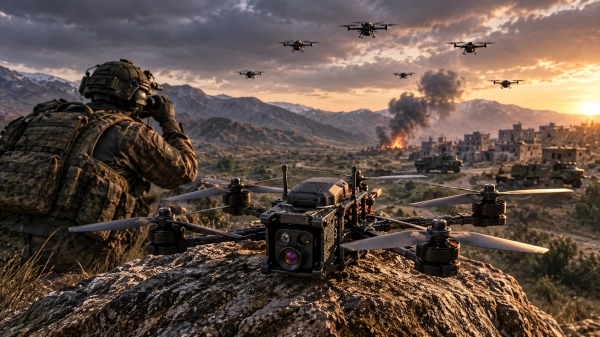
India’s rapidly expanding unmanned-systems ecosystem is producing an increasingly diverse class of compact battlefield drones, with Bengaluru-based UAV developer S7 Systems unveiling a new 7-inch Tactical UAV designed for short-range reconnaissance, thermal observation and coordinated multi-drone operations.
The compact platform has been developed around the requirement for a small, rapidly deployable aircraft capable of carrying useful tactical sensors without the logistical footprint associated with larger reconnaissance UAVs. S7 Systems says the drone offers a 20-minute flight endurance, an operational range of 2 kilometres and payload capacity of up to 300 grams, while supporting configurable sensors, communications and mission equipment.
The system also incorporates daylight imaging, thermal sensing, GNSS navigation, an optical-flow positioning sensor and dual-band communications operating across 2.4 GHz and 900 MHz. Most significantly, S7 Systems lists multi-UAV coordination or swarm capability among the platform’s features, suggesting that the aircraft is being developed as more than a conventional individually operated FPV drone.
A Tactical UAV in a Very Small Form Factor
The central feature of the new aircraft is its compact size. S7 Systems describes the platform as a 7-inch tactical UAV, positioning it for missions in which infantry and small units require an aerial sensor that can be transported and deployed without extensive support equipment.
Modern tactical drones are increasingly moving towards both ends of the size spectrum. Large unmanned aircraft provide long endurance, sophisticated sensors and substantial communications range, but they require larger logistical and operational footprints. At the opposite end, compact electrically powered UAVs can be carried much closer to the front line and launched rapidly when units need immediate information about terrain, buildings or potential threats.
S7 Systems appears to be targeting the latter requirement. The company describes the aircraft as compact and agile while still providing a configurable payload architecture that allows its sensors and other mission equipment to be adapted according to customer requirements.
20-Minute Endurance and Two-Kilometre Tactical Reach
The UAV is designed for approximately 20 minutes of flight time and has a stated operational range of 2 kilometres.
Those figures position it primarily as a short-range tactical system rather than a long-endurance intelligence, surveillance and reconnaissance platform. Such an aircraft could potentially be deployed by units requiring an immediate aerial view of nearby terrain, structures, routes or areas that may be unsafe to inspect directly.
A two-kilometre reach can allow an operator to look beyond immediate line-of-sight obstacles while remaining physically separated from the area being observed. This can be especially useful in environments where sending personnel forward simply to determine what lies behind a ridge, building or tree line would create unnecessary exposure.
The relatively short endurance is characteristic of the trade-offs associated with very compact electrically powered UAVs. Batteries, sensors, communications equipment and payload must all fit within a small airframe while preserving sufficient power for flight.
S7 Systems has selected an 8,000 mAh 6S battery for the platform, giving the aircraft the electrical capacity required to support both propulsion and its onboard sensors within the stated 20-minute operating window.
Thermal Imaging Gives the Drone a Day-Night Role
One of the most operationally interesting features is the inclusion of a thermal imaging sensor alongside a conventional vision-based camera.
A daylight camera provides visual information when lighting conditions are favourable, but thermal imaging can detect differences in heat emitted by people, vehicles and other objects. This can extend the usefulness of a small reconnaissance drone after sunset or in conditions where conventional visual contrast is poor.
Thermal capability can also be valuable for locating personnel hidden against complex terrain or identifying heat-producing objects that may be difficult to distinguish using an ordinary camera alone.
For a compact aircraft, the combination of visible and thermal imaging provides significantly greater mission flexibility than a basic FPV camera.
S7 Systems has not publicly provided details such as the thermal sensor’s resolution, magnification, detection range or whether the payload is mechanically stabilised. It would therefore be premature to attribute long-range target-identification performance to the platform. What is confirmed is that thermal sensing forms part of the announced configuration.
Optical Flow Adds Another Layer of Positioning
The platform combines a GNSS navigation module with an optical-flow sensor for positioning.
GNSS provides satellite-based location information under ordinary operating conditions. Optical-flow systems work differently, using visual information about the terrain or surface below the aircraft to detect relative movement and assist with position holding.
This can be particularly useful for maintaining stable flight close to the ground or in environments where satellite positioning may be weak or temporarily unavailable.
However, the presence of optical flow should not automatically be interpreted as proof that the UAV is designed for completely GPS-denied battlefield operations. S7 Systems has not publicly claimed that the aircraft possesses a full inertial, vision-based or terrain-referenced navigation architecture capable of completing its complete mission without satellite navigation.
The safer interpretation is that optical flow provides an additional local-positioning capability alongside GNSS, potentially improving stability and flexibility in suitable operating environments.
Dual-Band Communications Across 2.4 GHz and 900 MHz
S7 Systems has also equipped the platform with dual-band communications using 2.4 GHz and 900 MHz frequencies.
Using more than one communications band potentially provides designers with greater flexibility when configuring command, control, telemetry and data transmission. Different frequencies involve different compromises involving bandwidth, propagation and antenna requirements.
For tactical drones, reliable communications are particularly important because the aircraft may need to return live imagery while simultaneously receiving navigation and control commands.
S7 Systems has not publicly disclosed the architecture of its datalink, encryption, frequency-hopping capability or resistance to electronic attack. The announced dual-band configuration should therefore not be described as an anti-jamming system unless further technical information becomes available.
Nevertheless, the choice indicates that communications flexibility has been considered as an important part of the design rather than treating the aircraft simply as a recreational-style FPV platform.
300-Gram Payload Allows Mission Customisation
Despite its compact dimensions, the UAV can carry a payload of up to 300 grams.
That payload capacity gives S7 Systems scope to configure different lightweight sensors and mission modules while keeping the aircraft small enough for tactical deployment.
The company specifically states that the aircraft can be customised according to customer requirements, including changes to payloads, sensing systems, communications equipment, navigation and mission-specific configurations.
This modular approach is increasingly important in the drone sector because tactical requirements can vary substantially between users. A reconnaissance unit may prioritise imaging quality, another customer may require a specialised detector, while a different mission could place greater emphasis on communications or navigation equipment.
Instead of producing a single rigid configuration, a modular platform allows the basic airframe, power system and flight-control architecture to support multiple mission packages.
With only 300 grams available, however, payload selection will necessarily involve careful trade-offs between sensor capability, endurance and aircraft performance.
Swarm Capability Is the Most Ambitious Feature
Perhaps the most notable element of the new UAV is S7 Systems’ claim that it supports swarm capability through multi-UAV coordination.
The term “swarm” can describe a wide range of capabilities, from relatively simple coordinated flight among several aircraft to highly autonomous distributed systems in which drones communicate, allocate tasks and respond collectively to changing conditions.
S7 Systems has not yet publicly detailed the level of autonomy involved in its system. It would therefore be inaccurate to assume that the new aircraft possesses fully autonomous battlefield swarming comparable with experimental military swarm programmes.
Nevertheless, even basic coordinated operation of several small drones can create significant tactical advantages.
Multiple aircraft can potentially observe different directions simultaneously, distribute surveillance across a larger area or provide overlapping sensor coverage. A unit could theoretically launch several compact UAVs rather than depending on a single aircraft to inspect every location sequentially.
The company’s decision to incorporate multi-UAV coordination into such a small platform reflects a wider technological trend in which the value of unmanned systems is increasingly determined not only by the performance of one aircraft but by how multiple inexpensive platforms can operate together.
Small UAVs Are Reshaping Tactical Reconnaissance
Recent conflicts have dramatically increased military interest in compact drones.
Small quadcopters and FPV-class aircraft have demonstrated that inexpensive unmanned platforms can provide soldiers with immediate information that previously required larger reconnaissance assets.
A small unit equipped with its own UAV can inspect an area from above without waiting for a larger aircraft to become available. This shortens the time between identifying an information requirement and obtaining imagery.
Compact platforms can also be dispersed in much larger numbers than expensive conventional UAVs. Losing one aircraft consequently imposes a smaller financial and operational penalty.
These characteristics are driving defence companies worldwide to develop increasingly sophisticated sensors, communications systems and autonomous functions for drones that remain physically small and comparatively inexpensive.
S7 Systems’ 7-inch platform fits squarely within this emerging category.
A Broader UAV Portfolio Is Emerging at S7 Systems
The tactical UAV is not the only unmanned system publicly being developed under the S7 Systems name.
The developer has recently shown several concept and development platforms spanning reconnaissance, interception and loitering roles.
Its DARK design is described as a rapid-strike UAV with a 1.5-metre wingspan, a 1.5-kilogram payload and endurance of up to 1.8 hours. The proposed aircraft uses a 70 mm electric ducted-fan propulsion system intended to provide relatively high-speed performance.
S7 Systems has also publicised ARROW, a hand-launched loitering-munition concept with a stated 10-kilometre range, 70-minute endurance and 1.2-kilogram payload capacity.
Another concept, HORNET, is being positioned as a dual-role interceptor and loitering UAV, while the larger WASP blended-wing-body concept is described as having a 50-kilometre range, a four-kilogram payload and more than two hours of endurance. These remain company-announced development concepts rather than evidence of induction by the Indian Armed Forces.
Taken together, the projects indicate that S7 Systems is exploring an entire family of unmanned solutions rather than concentrating on a single drone configuration.
Designed Around Customisation Rather Than One Fixed Mission
A recurring feature across the company’s public work is mission customisation.
S7 Systems describes its UAV development activity as covering aircraft design, system integration, rapid prototyping and field testing, while its platforms are presented as configurable around different customer needs. Its public profile is based in Bengaluru East, Karnataka and describes work with UAV startups and organisations on mission-driven drone development.
This type of engineering approach is increasingly visible within India’s drone industry.
Instead of beginning with a large conventional aircraft programme, smaller teams can use modern flight controllers, batteries, composite structures, digital manufacturing and rapidly evolving sensor technology to iterate UAV designs much faster.
Such development cycles can allow a drone to be modified repeatedly based on operational feedback rather than remaining locked into one configuration for years.
The challenge is then to convert promising prototypes into rugged, repeatable and military-qualified production systems.
Electronic Warfare Will Be a Crucial Future Test
Another major challenge facing all tactical UAV manufacturers is electronic warfare.
GNSS interference and radio-frequency jamming have become routine features of modern high-intensity conflict. Small drones operating close to contested areas may therefore encounter disrupted satellite navigation or interference with their command-and-control links.
The S7 platform’s optical-flow positioning and dual-band communications provide potentially useful design flexibility, but the developer has not yet released enough information to establish how the UAV would perform under sustained electronic attack.
Future iterations could become considerably more capable if they incorporate technologies such as enhanced inertial navigation, visual navigation, frequency-agile datalinks, autonomous return functions and onboard decision-making.
These capabilities are increasingly becoming critical differentiators between ordinary commercial drones and genuinely battlefield-resilient tactical UAVs.
Multi-UAV Operations Could Be the Larger Opportunity
The most interesting long-term possibility may ultimately lie in the aircraft’s multi-drone coordination capability.
A single small UAV provides one sensor viewpoint. Several networked aircraft can potentially create a distributed reconnaissance system.
One drone could observe a route while another watches an adjacent area. Multiple aircraft could maintain surveillance after individual units return for battery replacement. Coordinated platforms could also potentially pass information between themselves or divide observation tasks.
More advanced systems could eventually integrate artificial intelligence to identify objects, allocate routes or coordinate movement with reduced operator workload.
S7 Systems has not claimed all of these capabilities for the current platform, but its decision to design around multi-UAV coordination creates a pathway towards such applications.
That could prove more important over time than any individual specification of the current aircraft.
Another Sign of India’s Expanding Drone Ecosystem
The emergence of a compact tactical platform from S7 Systems also illustrates the breadth of India’s rapidly growing UAV development base.
Indian drone companies are now working across an unusually wide spectrum of unmanned technologies, ranging from tiny FPV aircraft and logistics drones to long-endurance surveillance platforms, loitering munitions, interceptor drones and autonomous swarm systems.
This ecosystem is increasingly being supported by domestic electronics companies, composite manufacturers, software developers, motor suppliers, battery specialists and engineering startups.
The result is a defence technology sector in which development is no longer concentrated solely within large public-sector organisations or a handful of major private manufacturers.
Small engineering teams can increasingly produce specialised platforms aimed at very specific battlefield problems.
S7 Systems’ 7-inch Tactical UAV is one example of this emerging model.
A Compact Platform With a Larger Technological Direction
The new aircraft is modest when judged purely by physical scale. It offers a two-kilometre range, approximately 20 minutes of endurance and a payload of just 300 grams.
But its significance lies in what has been integrated into that compact package.
The combination of daylight and thermal sensing, GNSS, optical-flow positioning, dual-band communications, configurable payloads and multi-UAV coordination represents the direction in which tactical drones are rapidly evolving.
Rather than functioning merely as remotely controlled flying cameras, small UAVs are increasingly becoming configurable networked sensors capable of operating alongside other unmanned systems.
S7 Systems still has to demonstrate the maturity, reliability and operational robustness of its platform, and no Indian military procurement should be inferred from the company’s unveiling.
Nevertheless, the development is another indication of how quickly India’s private unmanned-systems ecosystem is broadening.
You may also like
-
Indian Navy Vice Chief Inspects Japan’s Mogami-Class Stealth Frigate as India-Japan Shipbuilding Cooperation Expands
-
India and Russia Explore Joint Icebreaker Construction as Maritime Industrial Cooperation Expands
-
Philippine Marine Wargames Reportedly Show BrahMos Can Penetrate Chinese Destroyer Air Defences
-
Safran Signs 18 Agreements with Indian Aerospace Suppliers, Expanding Make in India Manufacturing Partnerships
-
Indian Army’s Vajra Corps Certifies First Batch of Drone Operators, Strengthens Battlefield Surveillance
