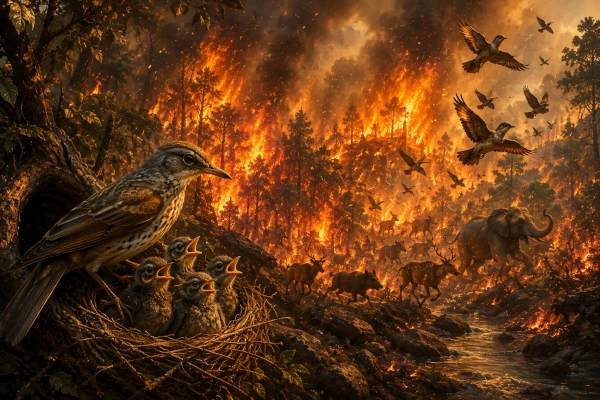
Among the most powerful images in the Mahabharata is that of a forest suddenly transformed into a wall of fire. Trees crack beneath the heat, smoke rolls across the land, frightened animals rush blindly in search of safety, and birds rise desperately into the sky while parents struggle to protect young that cannot escape on their own. The epic uses such scenes not merely to describe destruction but to explore a deeper question about responsibility: what should a person do when those who depend upon him are in danger?
One of the clearest examples appears in the Khandava-daha episode of the Adi Parva, within the story of the Sarngaka birds. At the centre of the episode is a mother bird named Jarita, her four helpless young and their absent father Mandapala. As the Khandava forest burns around them, the family is forced to consider whether they should hide, flee, remain together or accept the loss of some lives so that others might survive. Their conversation transforms a terrifying disaster into a profound meditation on foresight, leadership and the duty owed to dependants.
The Forest of Khandava
Khandava was a vast and ancient forest inhabited by birds, animals, serpents, Nagas, Rakshasas and many other beings. When Agni began consuming the forest, the flames spread through a living world that had provided shelter and sustenance to countless creatures for generations.
The Mahabharata describes the terror of the inhabitants vividly. Elephants, deer, lions, buffaloes, bears and other animals fled through smoke and flame, often without knowing where safety could be found. Birds filled the air, while creatures trapped on the ground searched desperately for openings through which they might escape. Some refused to abandon their offspring or companions even when separation might have improved their own chances of survival.
The destruction of Khandava therefore forms much more than a dramatic background to the story. It creates a situation in which instinct, affection and responsibility collide. An animal concerned only with itself may simply attempt to flee, but a parent or leader responsible for others faces a far more difficult decision.
Mandapala and the Need for Descendants
Before the fire, there lived a sage named Mandapala. After completing a life of austerity, he discovered that he had not obtained the spiritual destination he expected because he had left no descendants. Desiring offspring, he assumed the form of a Sarngaka bird and united with a female bird named Jarita.
Four sons were born from their union: Jaritari, Sarisrikka, Stambamitra and Drona. Although they possessed the bodies of young birds, the Mahabharata describes them as unusually intelligent and spiritually gifted because of their father’s nature.
Mandapala, however, did not remain with the family. While the young birds were still unable to care for themselves, he left Jarita and went to another female named Lapita. Jarita was therefore left with the responsibility of protecting and raising the four young birds largely by herself.
This detail becomes essential once the fire begins. The approaching disaster does not merely threaten the children; it exposes the consequences of leaving responsibility to someone else before dependants are capable of surviving independently.
Jarita Sees the Fire Approaching
When Jarita saw the flames spreading through Khandava, she immediately understood the danger. Her children were still too young to fly. Their wings had not developed sufficiently to carry them away, and they had neither the strength nor the speed necessary to escape across the burning forest floor.
Jarita herself could fly, but she could not carry all four children to safety. If she remained beside them, she might die with them. If she escaped alone, she would save herself while abandoning the young entrusted to her care. Attempting to carry them individually would force her to choose which child to rescue first while the others remained surrounded by the advancing flames.
The situation placed her in the most painful position a protector can face. She saw the danger clearly and understood what needed to happen, yet she did not possess enough physical power to remove everyone from it.
Jarita Searches for Another Solution
Rather than surrendering immediately to despair, Jarita looked for another possibility. Near the nest was a hole that had once belonged to a mouse. She suggested that the young birds enter the underground chamber while she covered the entrance with soil. The fire might then pass above them without reaching their hiding place, and once the danger was gone, she could return and uncover the entrance.
Jarita’s proposal was an act of foresight. She understood that survival did not require overpowering the fire. The family merely needed to find a place that the fire could not reach.
The episode therefore presents an important principle of leadership. A protector cannot always eliminate the danger confronting those under his care. Sometimes the more realistic task is to anticipate where the danger will move and place dependants somewhere beyond its reach before the crisis becomes uncontrollable.
The Young Birds Question the Plan
The four young birds, however, immediately recognised another danger. What if the mouse still lived inside the hole? The shelter that protected them from the flames might become a trap from which they could not escape.
Jarita assured them that she had personally seen a hawk seize the mouse and carry it away. As far as she knew, the hole was empty and therefore safe.
The chicks remained cautious. They reasoned that there might have been another mouse inside or some other danger that their mother had not seen. If they entered a confined underground space while unable to fly or defend themselves, they might exchange the visible danger of the fire for a hidden danger from which escape was impossible.
Their reasoning reveals one of the most interesting lessons of the story. They did not simply react to the most frightening danger before them. They compared risks and considered the possible consequences of each choice.
When Dependants See What the Leader Misses
The conversation between Jarita and her children overturns the normal expectation that wisdom must always come from the older and stronger member of the family. Jarita possesses experience, mobility and responsibility, while the chicks appear physically helpless. Yet their helplessness does not make them intellectually incapable.
They examine their mother’s proposal, identify a weakness in it and explain why the apparent refuge could itself become dangerous. Their questioning is not presented as disobedience for its own sake. It is part of the family’s attempt to survive.
This becomes a lesson in leadership. A protector must be willing to hear the concerns of the very people being protected. A decision may appear sensible from the position of authority while looking very different to those who must bear its consequences. Good leadership therefore requires not only giving instructions but also listening when dependants perceive a danger that has been overlooked.
The Children Ask Their Mother to Save Herself
The young birds then make an extraordinary argument. They tell Jarita that she should fly away and preserve her own life.
If their mother remains with them and all five perish, the entire family may disappear. If Jarita survives, however, she can continue living and perhaps produce other offspring. From the perspective of preserving the family line, they argue that her survival may matter more than remaining beside them when she has no means to save them.
Their reasoning is emotionally painful but strategically clear. Loyalty does not always require a leader or parent to die alongside those who cannot be rescued. If the protector’s death achieves nothing and removes the possibility of future protection, remaining may be an expression of attachment rather than effective responsibility.
Jarita resists the idea because her affection makes it almost impossible to abandon them. Yet the chicks continue reasoning with her until she finally accepts that her own survival may preserve something of the family even if the worst happens.
The Chicks Remain Before the Fire
After Jarita leaves, the four young birds remain alone as the fire approaches. Around them, the forest that had provided their home begins collapsing under the flames. Smoke grows thicker, trees burn and animals flee through the surrounding chaos.
The young birds cannot fly away. Their mother is no longer beside them, their father is elsewhere, and the underground refuge has been rejected because of its uncertain danger. The disaster they had previously discussed as an approaching possibility now stands directly before them.
At that moment, the story changes from one of physical planning to one of courage. The chicks possess neither weapons nor physical strength, but they still possess intelligence, composure and faith.
The Young Birds Appeal to Agni
The four chicks begin addressing Agni, recognising fire not only as a destructive force but also as a divine power connected with sacrifice, transformation and cosmic order. Their words reveal knowledge and spiritual understanding far beyond what might be expected from their bodies.
They praise Agni and ask for protection. Their appeal is not entirely without foundation because Mandapala, worried about his children, had already approached Agni and obtained a promise that they would not be harmed when Khandava burned.
When the flames finally reach their part of the forest, Agni remembers the promise. The fire passes without consuming the four young birds, and they survive the catastrophe that destroys so much of the world around them.
Mandapala’s Attempt to Protect His Children
Mandapala’s role in the story is morally complicated. He had left Jarita and the young birds before they were capable of caring for themselves, but when he learned that Khandava would burn, he became deeply anxious about their fate.
Unable to return immediately and physically remove them from danger, he approached Agni and asked that his children be spared. Agni accepted the request and promised not to destroy the four young birds.
Mandapala’s action does not erase his earlier neglect, but it demonstrates another important principle. Previous failure does not cancel present responsibility. A person who has neglected a duty is still obligated to act correctly when another opportunity to protect those dependants appears.
Leadership does not require pretending that mistakes never occurred. It requires recognising them and doing what can still be done before the consequences become irreversible.
Jarita Returns to the Burned Forest
Once the flames have passed, Jarita returns as quickly as she can. The landscape she knew has been transformed. The forest that once provided nesting places, shade, food and protection is blackened and filled with smoke.
She reaches the place where she left her children and discovers that all four are alive.
The terror she had carried with her is replaced by overwhelming relief. The children who had seemed certain to perish have survived, and the family is reunited in the middle of a ruined landscape.
Their physical home has been destroyed, but the lives within that home have been preserved. This contrast becomes one of the strongest meanings of the episode. A home is precious, but when preservation of the structure and preservation of life become impossible at the same time, the protection of life must take priority.
Mandapala Returns to His Family
Mandapala eventually returns as well. Although Agni had promised to protect his sons, he had continued worrying about them as the fire consumed Khandava.
His return does not immediately erase the pain caused by his earlier absence. Jarita and the children remember that he had left them during the period when they needed him most. Mandapala explains that he had secured Agni’s promise and trusted Jarita’s virtue and the intelligence of his offspring, yet those explanations do not remove the reality that Jarita had faced the approaching disaster largely alone.
Eventually the family is reconciled, and Mandapala leaves the destroyed region with Jarita and the surviving young birds. Their old forest home is gone, but the family itself continues.
The Creatures That Could Not Escape
The survival of Jarita’s family becomes more significant because the Mahabharata makes clear that countless other inhabitants of Khandava were not spared. Animals fled through fire and smoke, parents struggled beside their young, and birds attempted to escape into a sky already filled with danger.
The epic does not suggest that courage or careful planning guarantees survival in every catastrophe. Many creatures in Khandava undoubtedly possessed courage and affection, yet they still perished.
The story of the Sarngaka birds therefore does not offer a simplistic promise that good decisions always prevent tragedy. Instead, it demonstrates qualities that remain valuable even when outcomes cannot be guaranteed: foresight, careful comparison of risks, willingness to question assumptions, courage under pressure and responsibility towards those who cannot protect themselves.
Leadership Begins Before the Disaster
One of the strongest lessons in the story concerns timing. Once the flames reach the nest, the family’s available choices become extremely limited.
Jarita considers shelter while there is still time to think. The chicks analyse the danger before entering the hole. Mandapala approaches Agni before the fire reaches his offspring. Each act of survival depends upon recognising danger before the final moment.
The same principle appears repeatedly in the Mahabharata’s teachings on kingship. A ruler who waits until invasion, famine, rebellion or disaster has fully developed has already surrendered many of the choices that might once have been available.
Foresight therefore becomes one of the essential qualities of leadership. Protectors must recognise danger while there is still enough time to act.
The Duty Owed to Dependants
Jarita’s position also illustrates the moral burden carried by anyone responsible for vulnerable dependants. Her children cannot fly, and that inability changes the nature of her duty.
If every member of the family possessed equal strength and mobility, each could attempt to save itself. The chicks’ dependence upon Jarita means that she cannot consider her own survival in isolation.
The Mahabharata applies a similar principle to kingship. A ruler possesses resources, authority and knowledge beyond those available to ordinary subjects. Greater power therefore creates greater responsibility.
Those who are strong are not merely fortunate. Their strength creates an obligation towards people who cannot protect themselves in the same way.
Protection Does Not Always Mean Remaining
The young birds’ request that Jarita save herself introduces a more difficult lesson. Remaining beside dependants is not always the same thing as protecting them.
If Jarita had possessed the ability to carry them away, abandoning them would have been a failure of duty. Once it became clear that she could not physically rescue all four, however, remaining beside them might simply have added one more death without improving their chances.
The chicks therefore distinguish emotional loyalty from effective responsibility. A leader must sometimes withdraw in order to preserve the ability to protect others later.
This is one of the hardest decisions any protector can face because departure can look like abandonment even when it is strategically necessary.
The Importance of Listening
Jarita’s proposed refuge in the mouse hole is intelligent, but her children identify risks she has not fully considered. Their disagreement becomes a valuable lesson about decision-making during crisis.
Authority does not guarantee complete knowledge. Those closest to the consequences of a decision may understand certain dangers better than the person issuing the instruction.
Jarita explains why she believes the hole is safe, and the chicks explain why they remain uncertain. Their conversation demonstrates that responsible leadership allows information to move in both directions.
A leader who silences questions may also silence the warning that could prevent disaster.
When Every Choice Carries Risk
One of the most realistic aspects of the story is that none of the available choices is entirely safe. Remaining in the nest risks death by fire. Entering the underground hole may expose the chicks to a hidden predator. Attempting to carry the young away individually is physically impossible, while Jarita remaining beside them may cause the death of the mother without saving the children.
This is often the true nature of crisis. Leadership does not always involve choosing between an obviously correct path and an obviously foolish one. Sometimes every available choice carries danger, and the decision must be made with incomplete information.
The Mahabharata repeatedly places its characters in such circumstances because dharma becomes most difficult precisely when every option carries a cost.
The Difference Between a Home and Its Inhabitants
The destruction of Khandava also raises a profound question about the meaning of home. The forest had provided shelter, food and security to generations of creatures. Its trees, streams and nesting places formed the physical world in which they lived.
When the forest burned, that world disappeared.
Jarita’s family survived, however, and their survival demonstrates that the deepest purpose of a home is to protect the life within it. Buildings, forests and possessions matter because living beings depend upon them, but they are not more important than the beings themselves.
When both home and inhabitants can be saved, both should be protected. When destruction makes that impossible, preservation of life becomes the higher responsibility.
Foresight as a Form of Compassion
The story also reveals that foresight is not merely a cold strategic ability. In Jarita’s family, planning arises directly from affection.
Jarita searches for shelter because she loves her children. The young birds compare risks because they want both themselves and their mother to survive. Mandapala approaches Agni because he fears for the children he left behind.
Their planning is compassion converted into action.
A leader who genuinely cares for dependants should therefore think about danger before danger arrives. Concern that never becomes preparation may offer comfort, but it does not necessarily offer protection.
The Larger Warning of the Burning Forest
The frightened inhabitants of Khandava also provide a broader image of what happens when protection and order collapse. Once the forest is engulfed, strong and weak creatures alike are driven into confusion. Many flee without knowing where safety lies, while others remain beside those they love even when escape becomes almost impossible.
The Mahabharata’s teachings about kingship repeatedly warn against allowing human society to descend into an equivalent condition. The ruler exists partly to prevent ordinary people from living like frightened creatures who must face every disaster without organised protection.
Leadership therefore involves creating conditions in which dependants are not abandoned when danger appears and in which plans for survival exist before panic replaces judgment.
The Deeper Meaning of the Story
The four young birds survive despite possessing almost none of the qualities normally associated with physical strength. They cannot fly, fight or outrun the fire, yet they can reason. They can question assumptions, compare risks, advise their mother and retain courage even when escape appears impossible.
Jarita possesses another form of strength. She refuses to surrender responsibility merely because the problem seems beyond her power. She searches for alternatives, listens to her children and remains focused upon their survival.
Mandapala represents a more uncomfortable lesson. A person may fail in responsibility and still be required to act when another opportunity arises. Neglect does not remove duty.
Together, these characters transform the destruction of a forest into a meditation on leadership.
When the Forest Is Gone
By the end of the episode, the Khandava forest that once surrounded the birds has been devastated. Trees have burned, animals have scattered or died, and the familiar world into which the four chicks were born no longer exists.
Yet Jarita finds her children alive, Mandapala eventually returns, and the family continues beyond the destruction of its former home.
Their survival does not undo the tragedy of the forest, but it carries life beyond it.
The story therefore leaves behind a lesson that extends far beyond the birds themselves. Leadership cannot always save every possession, institution or familiar part of the world. Some disasters destroy things that cannot be preserved.
When that happens, the duty of the protector is to preserve what can still carry the future forward. The Sarngaka birds survive because danger is recognised, alternatives are considered, dependants are heard and responsibility does not disappear merely because circumstances become frightening.
The forest is lost, but the family survives. In the Mahabharata, that distinction becomes a powerful lesson about foresight, responsibility and the true purpose of leadership.
You may also like
-
Chanakya’s Warning for Modern India: Why Internal Disorder Is the Cheapest Weapon Against a Rising Power
-
The Jackal Who Remembered a Former Life: The King Who Learned That Conduct Matters More Than Birth
-
The Vulture and the Jackal: When Wisdom and Hope Hid the Motive of Hunger
-
India’s Medical Colleges More Than Double Since 2014 as MBBS Seats Rise 177%
-
The Tiger and the Wise Jackal: The Mahabharata’s Warning About Jealous Courtiers
