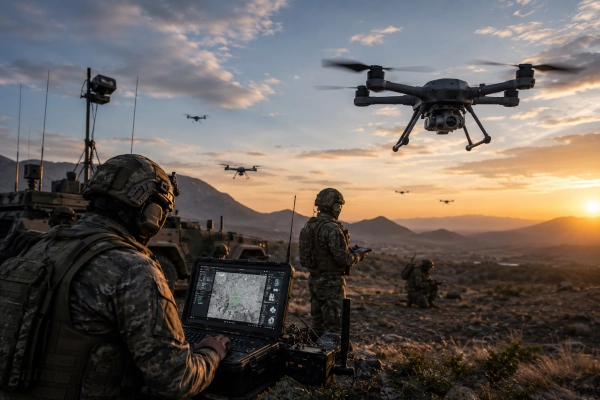
The Indian Army has operationalised its first Baaz Battalion, creating a specialised formation focused on unmanned aerial operations as drones become an increasingly important part of modern warfare. The unit has been raised under the Jalandhar-based 11 Corps, or Vajra Corps, in Punjab, giving the strategically important western sector a dedicated capability for sustained aerial surveillance, reconnaissance and battlefield awareness.
The Army describes the new formation as a means of improving aerial agility, responsiveness and battlefield reach while providing commanders with persistent “eyes in the sky.” Unlike small tactical drones routinely operated by frontline formations, Baaz Battalions are intended to handle more demanding unmanned missions over wider areas and longer periods. Their role is therefore as much about creating a specialised organisational structure for drone warfare as it is about adding more UAVs to the inventory.
The concept was publicly outlined in June 2026, when the Army announced plans for specialist drone formations as its unmanned inventory expanded rapidly. At the time, the force was reported to have grown from only a few hundred drones several years earlier to more than 50,000 unmanned systems, creating new requirements for trained operators, maintenance personnel, communications specialists, data analysts and commanders capable of integrating UAVs with conventional forces.
Baaz Battalions are expected to build on the Army’s existing Remotely Piloted Aircraft Flights and provide a higher-level capability distinct from the smaller drones used directly by infantry and other frontline units. Their principal value lies in maintaining surveillance beyond the immediate tactical horizon, allowing commanders to monitor troop movements, logistics routes, reserves and changes in enemy deployment across a much broader area.
The location of the first unit under Vajra Corps is significant. The corps is responsible for an important sector of Punjab along India’s western front, where persistent surveillance and rapid transmission of battlefield information can be especially valuable. A dedicated unmanned formation can provide commanders with a continuous aerial picture without exposing manned aircraft or personnel to unnecessary risk.
The development also reflects the Army’s broader adaptation to lessons from Operation Sindoor and recent conflicts, which have demonstrated the growing importance of drones for reconnaissance, target acquisition, precision attack and post-strike assessment. The Army has simultaneously expanded counter-drone capabilities, recognising that operating UAVs and defending against hostile unmanned aircraft have become closely connected battlefield requirements.
In July 2026, the Defence Acquisition Council approved procurement of the AKASH TARANG anti-UAV electronic-warfare system for Army formations along with a jet-powered kamikaze drone system. Other Army initiatives have included counter-UAS equipment, drone jammers, spoofers, armed drones and precision-strike systems, indicating that unmanned warfare is being integrated across surveillance, strike and force-protection roles rather than treated as a single equipment category.
A dedicated Baaz Battalion could also strengthen the Army’s sensor-to-shooter chain. Surveillance drones can locate and track targets, but the real battlefield advantage comes when that information is quickly processed, verified and transferred to artillery, missiles or other precision weapons. By concentrating drone operators, communications specialists and data-processing personnel within a specialist formation, the Army can work toward reducing the time between detecting a target and acting against it.
The specialised structure should also improve training and maintenance. Modern UAV operations increasingly depend on encrypted data links, electro-optical and thermal sensors, satellite navigation, artificial intelligence and electronic-warfare resilience. Operators must be able to continue functioning when GPS signals are jammed or communications are disrupted. Concentrating such expertise within dedicated formations allows experienced personnel to develop standard procedures and evaluate new technologies as they enter service.
The development could also strengthen the relationship between the Army and India’s expanding domestic drone industry. Dedicated units operating UAVs continuously can provide manufacturers with direct feedback on endurance, payload capacity, communications, navigation and resistance to electronic warfare. This is particularly important because smaller unmanned systems evolve far more rapidly than conventional aircraft and may require frequent improvements in software, sensors and communications equipment.
The Army has not publicly disclosed the detailed equipment inventory of the first Baaz Battalion. Reports linking specific long-range UAVs with the broader concept should therefore not be treated as confirmation that those platforms have already been assigned to the Jalandhar-based unit. What is confirmed is the creation of a specialised organisation designed to improve surveillance, responsiveness and battlefield reach.
The significance of the Baaz Battalion ultimately goes beyond any individual drone. By creating a permanent formation with dedicated personnel, doctrine, logistics and command arrangements, the Indian Army is institutionalising unmanned warfare as a core battlefield capability. The first unit under Vajra Corps could become a template for similar formations elsewhere as India’s drone inventory and operational concepts continue to expand.
You may also like
-
Indian Army Special Forces Depart for Indonesia for Exercise Garuda Shakti 2026
-
India to Train 600 Nigerian Army Soldiers in Specialised Jungle and Mountain Warfare
-
India Moves Towards Five-Year Assured Orders for Defence Startups Under New Procurement Reforms
-
Zen Technologies Introduces Indigenous Hyper-Strike Falcon AI-Guided Counter-Drone Interceptor
-
L&T and Germany’s SCHOTTEL Expand Partnership for Controllable Pitch Propeller Systems in Indian Shipbuilding
