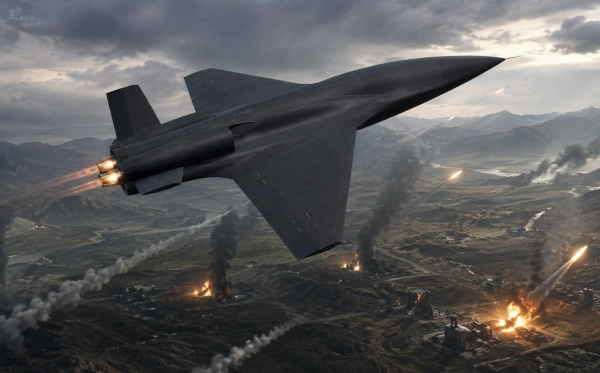
Bengaluru-based defence technology company Flying Wedge Defence & Aerospace (FWDA) has revealed the first physical footage of its FWD Supreme Lite, taking the company’s ambitious AI-piloted combat aircraft programme from digital designs into hardware development and ground testing.
The approximately 250-kg-class aircraft is being developed as the first flying technology demonstrator for the wider FWD Supreme family. Flying Wedge intends to use it to validate aerodynamic characteristics, flight-control architecture, autonomous technologies and other systems before transferring lessons from the demonstrator to substantially larger aircraft.
The company released the first video preview of Supreme Lite on August 20, 2026. The aircraft is currently progressing through airframe development, system integration and ground testing, with its maiden flight targeted for the third quarter of 2026.
The development represents an important milestone for the programme. However, Supreme Lite remains a technology demonstrator, rather than an operational fighter aircraft. Its coming flight-test programme will determine how successfully Flying Wedge can translate its ambitious autonomous combat-aircraft concept into a functioning airborne system.
From Digital Concept to a Real Airframe
Flying Wedge first publicly presented the wider FWD Supreme programme in June 2026, describing it as an indigenous AI-piloted fighter aircraft initiative built around autonomous operations and coordinated combat.
At that stage, the aircraft shown publicly existed primarily through digital visualisations. The company simultaneously disclosed that it was developing a much smaller Supreme Lite platform to prove the technology before attempting larger aircraft.
The August reveal changes the nature of the programme. Flying Wedge has now shown a physical aircraft progressing through integration and ground-testing activities.
According to the company, Supreme Lite will serve as the first flying testbed for the Supreme family. Engineers plan to progressively evaluate its aerodynamic configuration, flight architecture and other important technologies before incorporating matured systems into larger variants.
This approach allows a private aerospace company to test technologies on a relatively small and less expensive platform before committing resources to a much larger combat aircraft.
Supreme Lite Weighs Around 250 kg
The Supreme Lite sits well below the size of a conventional fighter aircraft.
Flying Wedge places the demonstrator in the approximately 250-kg all-up-weight class. Its primary role is therefore not to replicate the payload, range or performance of an operational fighter, but to function as an airborne laboratory for the systems required by future members of the Supreme family.
Such an incremental development strategy can provide valuable data on areas including flight stability, autonomous control, navigation, propulsion integration, communications and potentially coordinated operations.
Successful flight testing would also allow the company to progressively expand the autonomy available to the aircraft rather than attempting to demonstrate every intended capability during its first flights.
The initial objective will be considerably more fundamental: prove that the aircraft can safely fly, manoeuvre and recover while validating its basic control architecture.
First Flight Targeted for Q3 2026
Flying Wedge continues to target the third quarter of 2026 for the Supreme Lite’s maiden flight.
The company says the demonstrator is presently moving through airframe development, system integration and ground testing. These stages are necessary before the aircraft can safely begin flight trials.
The first flight will therefore become the programme’s most important near-term milestone.
Until now, most of the public discussion surrounding FWD Supreme has centred on its proposed AI architecture, future performance and Flying Wedge’s unconventional ideas for employing autonomous aircraft.
A successful maiden flight would shift the programme into experimental flight testing, where those concepts must increasingly be demonstrated through measurable aircraft performance.
AI Is Intended to Replace the Traditional Pilot
Flying Wedge’s long-term vision goes significantly beyond building another unmanned aerial vehicle.
The company describes FWD Supreme as an AI-piloted fighter aircraft programme, with artificial intelligence eventually assuming functions that a human pilot or remote operator would traditionally perform.
Earlier disclosures about the programme identified autonomous take-off, mission execution and recovery among its Phase 1 objectives. More advanced versions are intended to develop higher levels of mission autonomy and multi-aircraft cooperation.
An AI-piloted combat aircraft would differ significantly from many existing military drones.
Traditional remotely piloted aircraft depend heavily on operators controlling the platform through communications links. Higher levels of autonomy allow the aircraft to execute more tasks onboard, reducing constant dependence on a human operator.
This becomes especially important in a contested battlefield where communications may suffer from electronic warfare, jamming or physical disruption.
However, the precise level of autonomy that Supreme Lite will demonstrate during its early flight programme has not yet been publicly detailed.
Flying Wedge’s ‘Mobbing Doctrine’
The Supreme family sits at the centre of what Flying Wedge calls its “Mobbing Doctrine.”
The company argues that modern air forces face a growing economic problem. Advanced combat aircraft continue to become more capable, but they are also increasingly expensive to procure and operate. As individual aircraft become more valuable, militaries can afford fewer of them.
Flying Wedge proposes a different approach built around deploying larger numbers of lower-cost AI-piloted combat aircraft.
Instead of attempting to defeat an adversary purely through a small number of highly expensive platforms, multiple autonomous aircraft could cooperate and create numerical, tactical and economic pressure.
FWDA says this approach could combine combat mass with AI-enabled coordination and fighter-like performance.
The concept remains a company-developed doctrine rather than an adopted Indian military operational doctrine. Nevertheless, it reflects a broader international shift toward Collaborative Combat Aircraft, autonomous UCAVs and networked unmanned combat systems.
Supreme Heavy Will Be the More Ambitious Platform
Supreme Lite is only the first stage.
Flying Wedge has previously outlined a much larger aircraft called FWD Supreme Heavy, envisioned in approximately the one-tonne class.
The company has identified the larger platform for missions including intelligence, surveillance and reconnaissance, precision strike, collaborative combat and eventually broader air-dominance roles.
For the initial development phase, Flying Wedge has disclosed ambitious performance objectives for the Supreme programme. These include maximum speeds approaching Mach 0.9, cruise speeds of around Mach 0.5 and an intended operational range of approximately 700 to 1,000 kilometres, depending on mission configuration.
Those numbers are programme objectives associated with the larger development roadmap and should not be interpreted as demonstrated Supreme Lite performance.
A subsequent Phase 2 roadmap is considerably more ambitious. Flying Wedge has discussed future versions capable of approaching Mach 2, along with enhanced survivability, low-observable characteristics, more sophisticated AI autonomy and coordinated operations involving multiple aircraft.
Reaching those goals would require major advances in propulsion, structures, aerodynamics, flight controls and mission systems. Supreme Lite represents only the first experimental step toward that longer-term objective.
RATO Could Reduce Dependence on Conventional Runways
Flying Wedge is also exploring Rocket Assisted Take-Off, or RATO, for the Supreme family.
RATO uses additional rocket thrust during take-off to help an aircraft accelerate over a much shorter distance than would normally be required.
For autonomous combat aircraft, such a capability could offer significant operational advantages. Aircraft could potentially deploy from shorter strips or austere forward locations rather than relying exclusively on vulnerable conventional airbases.
Dispersed operations have become increasingly important as precision ballistic missiles, cruise missiles and long-range drones make permanent airbases easier to target.
Flying Wedge says RATO remains a capability under exploration for the Supreme family and will be progressively developed as the programme matures. It should therefore not yet be treated as a demonstrated operational feature of Supreme Lite.
Experienced Indian Fighter Engineers Behind the Programme
Flying Wedge has also assembled engineers with experience from major Indian military aviation programmes.
The Supreme effort is led by Girish Dixit, a former Secretary of the Aeronautical Development Agency and a specialist in flight-control systems. The team has also included V. Subba Rao, a former project director associated with the Light Combat Aircraft Tejas programme, together with specialists in aircraft structures, propulsion, avionics and weapon integration.
That experience could prove particularly valuable as Flying Wedge transitions from relatively small unmanned systems toward increasingly complex high-performance aircraft.
Developing an autonomous fighter-class aircraft involves challenges considerably beyond those encountered with conventional drones. The aircraft must combine high-performance aerodynamics with reliable flight-control software, propulsion, power management, navigation, sensors, communications and eventually weapons integration.
Artificial intelligence becomes only one element within that much larger engineering problem.
India Joins a Rapidly Expanding Global Race
The Supreme programme is emerging as major aerospace powers increasingly invest in autonomous combat aircraft.
The United States is pursuing Collaborative Combat Aircraft intended to operate alongside crewed fighters. Companies including Anduril and General Atomics are developing aircraft for the US Air Force’s CCA programme.
Turkey has meanwhile made substantial progress with Baykar’s Kızılelma, while European companies are developing their own autonomous combat platforms.
German defence technology company Helsing is developing its CA-1 Europa autonomous combat aircraft, while other programmes are exploring AI-controlled platforms intended to supplement conventional fighter fleets.
Flying Wedge therefore enters an increasingly competitive technological environment.
The company’s achievement should still be placed in context. Several foreign autonomous combat-aircraft programmes are already substantially further into flight testing. Supreme Lite has yet to conduct its maiden flight.
Nevertheless, the existence of an Indian privately developed physical demonstrator shows that autonomous combat aviation is no longer confined to large government laboratories or established aerospace companies.
Private Industry Takes on More Complex Aerospace Projects
The FWD Supreme programme also reflects the expanding ambitions of India’s private defence sector.
Indian private companies have traditionally participated in aerospace programmes through components, structures, electronics and subsystems. A growing number are now attempting to develop complete unmanned aircraft, propulsion systems, sensors and weapons.
Flying Wedge describes its work as focused on indigenous autonomous aerial warfare technologies. Its existing portfolio includes unmanned aircraft and loitering-munition programmes, while the Supreme represents a much larger technological step. The company’s official material emphasises autonomous and AI-driven UAV development from its Bengaluru operation.
If private companies can build and repeatedly fly experimental aircraft, they can also create independent engineering teams, manufacturing knowledge and intellectual property that add depth to India’s wider military aerospace ecosystem.
The Next Test Will Be in the Air
For now, the most important distinction surrounding FWD Supreme Lite is between ambition and demonstrated capability.
Flying Wedge has produced a physical approximately 250-kg demonstrator, shown it publicly and begun system integration and ground testing. That represents tangible progress from the digital concepts revealed only weeks earlier.
The company has not yet demonstrated the full fighter-like performance, advanced autonomous combat functions, coordinated “mobbing” operations or high-speed capabilities envisaged for the mature Supreme family.
Those capabilities will have to emerge progressively through flight testing.
The first major opportunity comes with the planned Supreme Lite maiden flight in Q3 2026. If the demonstrator successfully enters sustained flight testing, Flying Wedge will gain the real-world aerodynamic and control-system data necessary to begin transforming its ambitious AI-fighter vision into a larger aircraft.
Supreme Lite therefore should not be viewed as a finished autonomous fighter. Its significance lies elsewhere: it is the physical starting point of an Indian private-sector attempt to build one.
The programme has now moved from computer screens to an actual airframe. The next stage will determine whether Flying Wedge can take that aircraft from the ground into the rapidly evolving world of autonomous combat aviation.
You may also like
-
Indian Army Special Forces Depart for Indonesia for Exercise Garuda Shakti 2026
-
India to Train 600 Nigerian Army Soldiers in Specialised Jungle and Mountain Warfare
-
India Moves Towards Five-Year Assured Orders for Defence Startups Under New Procurement Reforms
-
Zen Technologies Introduces Indigenous Hyper-Strike Falcon AI-Guided Counter-Drone Interceptor
-
L&T and Germany’s SCHOTTEL Expand Partnership for Controllable Pitch Propeller Systems in Indian Shipbuilding
