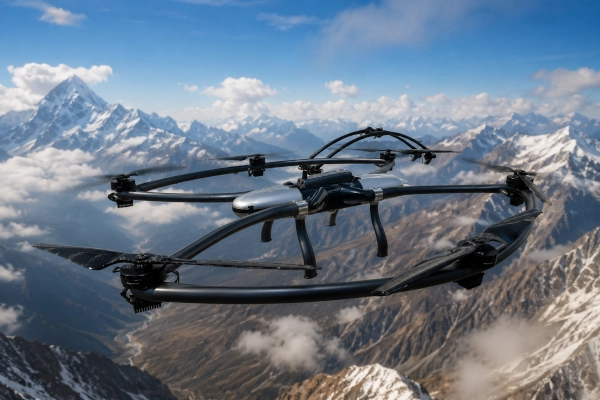
India’s rapidly expanding private drone industry is moving into a category that was once dominated almost entirely by imported platforms, and Noida-based Raphe mPhibr is positioning itself among the companies attempting that transition.
Specialist defence reports indicate that Raphe has developed a new MALE unmanned aircraft with an approximate maximum weight in the 1.5-tonne class and a wingspan of around 15 metres. At the centre of the programme is a reported 250 kW indigenous internal-combustion engine, corresponding to approximately 335 horsepower.
Raphe has not yet publicly released a comprehensive technical specification sheet for the aircraft or the 250 kW engine. However, the company has independently confirmed its work on indigenous UAV propulsion and says it designs and manufactures core aircraft technologies in India.
The new aircraft is particularly significant because Raphe is among roughly ten Indian companies that submitted bids for the Ministry of Defence programme to acquire 87 Medium-Altitude Long-Endurance UAVs, with the Indian Air Force leading the procurement. The bidding window closed on June 16, 2026.
A 335 HP Engine Could Be Raphe’s Most Important Technology
India’s UAV industry has made considerable progress in airframes, composites, autopilots, communications and payload integration. High-performance aviation engines, however, remain one of the most difficult areas to indigenise.
Raphe appears to have identified that problem several years ago.
Company CEO Vivek Mishra explained in a June 2025 interview that Raphe needed an internal-combustion engine for one of its long-endurance UAV programmes but could not find an existing product that met its requirements for weight, cost and performance.
Instead of adapting the aircraft around an imported engine, Raphe decided to design and manufacture the propulsion system itself.
Mishra said the company’s objective was to reduce weight and size while increasing performance and optimising the engine specifically for unmanned aircraft requirements.
Raphe’s own technology portfolio also lists indigenous two-stroke engine development, including the use of metal additive manufacturing. The company says it conducts extensive aerodynamics, composites, electronics, flight-control, navigation and propulsion work internally rather than relying exclusively on externally supplied subsystems.
The reported 250 kW engine therefore appears to represent a substantial scaling-up of an engineering capability Raphe has been developing for several years.
From Small UAV Engines to MALE-Class Propulsion
There is already independent evidence that Raphe has developed unusually lightweight internal-combustion engines for unmanned aircraft.
Dassault Systèmes, whose 3DEXPERIENCE engineering platform is used by Raphe, has documented the company’s development of a 4 kW two-stroke engine weighing around 600 grams. That project demonstrated Raphe’s ability to optimise propulsion systems specifically for UAV applications rather than simply modifying engines developed for unrelated uses.
Scaling propulsion from a few kilowatts to a reported 250 kW represents a very different engineering challenge.
A MALE aircraft must sustain long-duration flight while carrying sensors, communications equipment, fuel and potentially weapons. The engine has to provide sufficient power at altitude while remaining reliable during sorties that can last many hours.
The propulsion system must also operate efficiently across different flight profiles and environmental conditions.
For that reason, an indigenous engine could influence far more than the aircraft’s headline performance. It can affect endurance, payload capacity, operating altitude, maintenance requirements and the ability to modify the aircraft over its service life.
Raphe Joins a ₹30,000-Crore Contest
The aircraft is being developed against the backdrop of one of India’s largest UAV acquisition programmes.
Around ten Indian public and private companies submitted bids by the June 16 deadline for the programme to acquire 87 MALE-class unmanned aircraft. Confirmed participants include Hindustan Aeronautics Limited, Tata Advanced Systems, Larsen & Toubro, Adani Defence Systems, Solar Defence and Aerospace and Raphe mPhibr, among others.
The project is valued at more than ₹30,000 crore.
Rather than simply buying complete UAVs from an overseas manufacturer, the programme has been structured to establish a substantial domestic manufacturing ecosystem.
Earlier reports on the acquisition indicated that the eventual order is expected to be divided between two suppliers in a 64:36 ratio, allowing India to establish two separate UAV production lines. This arrangement could also provide greater capacity for future orders and exports while reducing dependence on a single production source.
The competition is therefore about considerably more than delivering 87 aircraft.
The successful bidders could become the foundation of India’s future industrial capability in the large military UAV sector.
More Than 60 Percent Indigenous Content Expected
Indigenisation forms a central part of the programme.
Reports on the procurement have indicated that the aircraft will require more than 60 percent indigenous content, with substantial parts of the aerostructure, aircraft systems and other components manufactured in India.
The requirement is especially important when examining Raphe’s approach.
A UAV may be assembled in India while still depending heavily on imported propulsion, electro-optical sensors, satellite communications equipment or flight-control systems. Such dependencies can become significant during prolonged conflict, when replacement components and foreign supply chains may face disruption.
Raphe’s strategy of developing propulsion, composites, electronics, software and other technologies internally could therefore become an important part of its bid.
The company says its wider manufacturing infrastructure includes additive manufacturing, printed circuit board assembly, machining and composite production.
That vertical integration could allow Raphe to control a larger proportion of the aircraft’s design and manufacturing process within India.
The IAF Wants Far More Than a Surveillance Drone
The 87-UAV requirement is not limited to conventional reconnaissance.
Defence officials have indicated that the aircraft will perform intelligence, surveillance and reconnaissance missions while also possessing strike capability. Plans have also been reported for integration with indigenous weapons.
Earlier reporting on the programme indicated requirements for endurance exceeding 30 hours and operating altitude above 35,000 feet, although the final detailed technical parameters remain part of the procurement process and have not been publicly released in full.
Such capability would allow the aircraft to remain over operational areas for prolonged periods, monitoring borders and collecting imagery or electronic intelligence before transmitting information to command networks.
An armed configuration would extend that role further by allowing the UAV to engage selected targets after detection and identification.
For India, this has clear relevance across both continental and maritime theatres.
Long borders with Pakistan and China create persistent ISR requirements, while the Indian Ocean produces an equally demanding need for long-range surveillance.
An Indigenous Engine Changes the Equation
For Raphe’s aircraft, the propulsion system could become one of the most important differentiators.
Imported engines can create certification, licensing, export-control and supply-chain constraints. They can also make future modifications dependent on foreign manufacturers.
Domestic control over an engine potentially gives aircraft designers greater freedom to alter cooling systems, electrical generation, fuel capacity and airframe characteristics as requirements evolve.
It can also simplify future variants.
A successful propulsion programme could eventually support aircraft beyond the initial MALE platform, especially if Raphe develops an engine family covering different power classes.
However, several questions remain unanswered publicly about the reported 335 hp powerplant. Raphe has not released details concerning its displacement, dry weight, fuel type, turbocharging system, altitude power retention, specific fuel consumption or certification status.
Until those figures are formally disclosed, comparisons with established foreign UAV engines would be premature.
What can be established is that Raphe already possesses an active indigenous internal-combustion engine development programme and has publicly explained the strategic reasoning behind bringing UAV propulsion in-house.
India’s Private UAV Industry Moves Into a New Weight Class
Raphe is best known for smaller unmanned platforms developed for surveillance, logistics and military missions.
The move into a 1.5-tonne-class MALE aircraft represents a considerable expansion in scale.
Large unmanned aircraft require advanced flight controls, redundant systems, secure communications, high-capacity electrical architecture, sophisticated ground-control stations and far more demanding airworthiness engineering than small tactical drones.
Their manufacturing requirements also change dramatically.
Large composite wings and fuselage structures require different tooling, quality-control processes and structural testing. Recent imagery reported in August 2026 has indicated that Raphe is progressing work on large composite structures associated with its MALE programme, suggesting that development has moved beyond a purely conceptual aircraft configuration.
Raphe has simultaneously expanded its manufacturing capacity. The company raised $100 million in 2025, bringing its total funding at that stage to approximately $145 million, with the investment directed partly towards expanding aircraft design and manufacturing capabilities.
A Potential Breakthrough for Indian UAV Propulsion
The significance of Raphe’s new MALE programme extends beyond the outcome of the 87-aircraft tender.
India has long sought greater domestic control over the critical technologies that determine the performance of military aircraft. UAV propulsion is increasingly part of that requirement.
A domestically designed engine in the 335 hp class, successfully demonstrates the required reliability and high-altitude performance, would represent an important addition to India’s unmanned aviation technology base.
It would also illustrate a broader change taking place within the country’s defence industry.
Indian private companies are no longer limiting themselves to assembling drones from imported motors, autopilots and airframes. Several are beginning to develop the difficult technologies underneath the aircraft — propulsion, flight computers, composites, navigation systems, sensors and manufacturing processes.
Raphe mPhibr’s entry into the 87-UAV competition is one of the clearest examples of that transition.
Whether its 1.5-tonne MALE aircraft eventually secures part of the ₹30,000-crore programme will depend on how it performs against a formidable field of competitors. But the development of an indigenous high-power UAV engine could prove important regardless of the final tender result.
For India’s emerging military drone ecosystem, controlling the technology that keeps an unmanned aircraft in the air for hours at a time may ultimately be as important as building the aircraft itself.
You may also like
-
Indian Army Special Forces Depart for Indonesia for Exercise Garuda Shakti 2026
-
India to Train 600 Nigerian Army Soldiers in Specialised Jungle and Mountain Warfare
-
ICAR Scientists Develop Indigenous Protective Gloves for Cotton Farmers, Sign Commercial Manufacturing Agreement
-
India Moves Towards Five-Year Assured Orders for Defence Startups Under New Procurement Reforms
-
BHEL–Coal India Joint Venture Begins Construction of ₹25,016 Crore Indigenous Coal Gasification Project in Odisha
