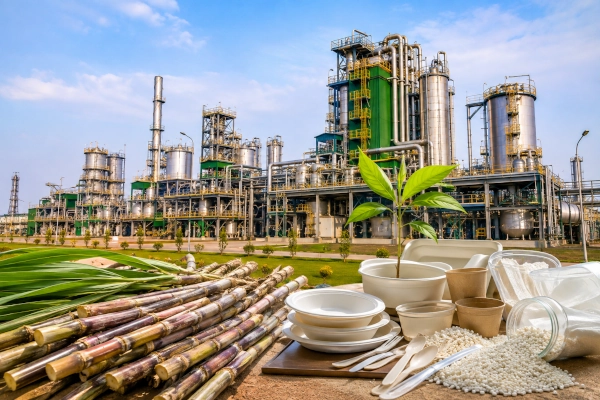
India is moving closer to commissioning its first industrial-scale Polylactic Acid (PLA) biopolymer manufacturing plant, with Balrampur Chini Mills Limited making rapid progress on the ₹3,080-crore facility at Kumbhi in Uttar Pradesh’s Lakhimpur Kheri district.
The project represents one of India’s largest investments in bio-based materials and will convert sugarcane-derived feedstock into PLA, a renewable material that can replace conventional petroleum-based plastics across several applications.
Balrampur Chini Mills’ latest Q1 FY27 investor presentation says construction remains largely on schedule and the company expects the plant to begin operations during the second half of FY 2026-27. An earlier official project schedule had targeted October 2026 for commissioning.
₹3,080-Crore Green Manufacturing Project
The project’s estimated gross capital expenditure has now reached approximately ₹3,080 crore. Balrampur Chini Mills originally announced the project with a lower investment estimate, but the company has subsequently revised its expenditure as the facility moved deeper into construction.
The company plans to finance around ₹1,650 crore through debt, while approximately ₹1,430 crore will come from equity and internal accruals. It has also raised ₹450 crore through equity shares, partly to finance the increase in project cost.
The plant’s planned production capacity has also increased. Balrampur Chini Mills initially envisaged a 75,000-tonne-per-year facility but has now optimised the project for 80,000 tonnes of PLA annually.
At full capacity, the company estimates that the PLA business could generate around ₹2,000 crore in annual revenue.
Construction Enters Advanced Stage
The latest company data shows that work at the Kumbhi site has entered an advanced phase.
As of July 31, 2026, Balrampur Chini Mills had spent approximately ₹2,180 crore on the project. Civil erection was around 92% complete, while equipment erection had reached approximately 68%.
The company also reported that about 92% of domestically sourced equipment was ready, with the remaining equipment progressing according to schedule. Model reviews had reached 94% completion.
More than 3,000 people were working at the project site on an average basis, highlighting the scale of construction underway ahead of commissioning.
From Sugarcane to Bioplastic
PLA is a bio-based polymer that can be produced using renewable agricultural feedstocks rather than fossil-derived raw materials.
Balrampur Chini Mills is particularly well positioned for such production because of its established sugar operations in Uttar Pradesh. The company plans to integrate the new facility with its existing sugar manufacturing ecosystem, allowing sugarcane-derived material to become the starting point for PLA production.
The company describes the project as India’s first industrial-scale biopolymer plant and has positioned the investment as part of its strategy to extract greater value from sugarcane while diversifying beyond conventional sugar, ethanol and power businesses.
PLA can be processed into products such as bottles, food-service items, straws, packaging films, carry bags, garbage bags and 3D-printing materials. Depending on its formulation and disposal environment, PLA can provide a bio-based alternative to several conventional plastic products.
Global Technology Partners Join the Project
Balrampur Chini Mills has brought several international engineering and technology companies into the project.
Switzerland’s Sulzer is providing technology for important stages of PLA production, including lactide synthesis, purification and polymerisation. Austria’s Alpine Engineering is associated with the upstream production process, while Jacobs has been engaged for engineering related to utilities, civil infrastructure and integration between different parts of the facility.
The combination of international process technology with domestic manufacturing infrastructure is intended to establish an Indian production base capable of operating at globally relevant scale.
Uttar Pradesh Builds a Bioplastics Ecosystem
The Kumbhi project has also become closely linked with Uttar Pradesh’s broader attempt to establish a domestic bioplastics industry.
The state introduced the Uttar Pradesh Bio-Plastic Industry Policy 2024, providing incentives for large investments in bioplastic manufacturing. These include eligible capital subsidy, interest subvention, SGST reimbursement, electricity-duty relief and stamp-duty benefits.
Invest UP has subsequently issued Balrampur Chini Mills a Letter of Comfort confirming the project’s eligibility for incentives, subject to the commencement of commercial production and fulfilment of stipulated conditions.
Chief Minister Yogi Adityanath laid the foundation stone for the Kumbhi facility on February 22, 2025. The company described the project at the time as India’s first PLA biopolymer manufacturing facility and one of the largest investments in its history.
Preparing the Market Before Production Begins
Balrampur Chini Mills is simultaneously building demand for its biopolymer products under the Balrampur Bioyug brand.
By July 2026, the company said it was engaging with more than 100 customers through direct and hybrid channels and had successfully completed more than 25 product trials. Development work covers bottles, cutlery, films, bags, straws and other PLA-based applications.
The company has also secured its first institutional order from the Lucknow Cantonment Board, covering compostable garbage bags, 300-ml PLA bottles, 3D-printed compostable pens and PLA folders.
This commercial groundwork means the Kumbhi facility is being developed alongside an emerging domestic market rather than waiting for production to begin before applications are identified.
A New Industrial Use for India’s Sugarcane
The project could give India’s sugar economy an important new downstream opportunity.
Sugarcane already supports sugar production, ethanol, electricity generation from bagasse and several other value-added products. Industrial-scale PLA production would add another manufacturing chain in which an agricultural crop becomes a feedstock for advanced materials.
For a major sugar-producing state such as Uttar Pradesh, the development could create links between agriculture, biotechnology, chemical processing and sustainable packaging.
With construction now well advanced and commissioning targeted for the second half of FY27, the Kumbhi project is approaching the point at which India could begin producing PLA biopolymers domestically at industrial scale rather than depending primarily on imported material.
When having successfully commissioned as planned, the facility would mark an important expansion of India’s bio-manufacturing capabilities and establish sugarcane as a feedstock not only for food and fuel, but also for the next generation of renewable materials.
References
- Balrampur Chini Mills Limited — Q1 FY27 Investor Presentation, August 11, 2026.
Details on PLA project investment, construction progress, production capacity, commissioning schedule, customer trials and financing. - Balrampur Chini Mills Limited — PLA Manufacturing – Upcoming Venture / Balrampur Bioyug.
Official company information on the PLA biopolymer project, applications, technology and integration with the sugarcane value chain. - Balrampur Chini Mills Limited — Official Press Release on PLA Project and Technology Partnerships, March 2024.
Information on technology partnerships involving Sulzer, Alpine Engineering and Jacobs. - Balrampur Chini Mills Limited — Foundation Stone Ceremony for India’s First Industrial-Scale PLA Biopolymer Plant, February 22, 2025.
Official company communication on the Kumbhi project in Lakhimpur Kheri, Uttar Pradesh. - Government of Uttar Pradesh / Invest UP — Uttar Pradesh Bio-Plastic Industry Policy 2024.
Official policy framework covering incentives and support for bioplastic manufacturing projects in the state.
You may also like
-
Petronet LNG Plans ₹1,200 Crore Joint Venture for Ten Compressed Biogas Plants Across India
-
India Seeks South Korean Shipbuilding Partnerships as Sarbananda Sonowal Begins Four-Day Visit to Busan
-
Koraput Kalajeera Rice of Odisha: The GI-Tagged Aromatic Heritage of India’s Ancient Rice-Growing Region
-
ICAR Scientists Develop Indigenous Protective Gloves for Cotton Farmers, Sign Commercial Manufacturing Agreement
-
India Moves Towards Five-Year Assured Orders for Defence Startups Under New Procurement Reforms
