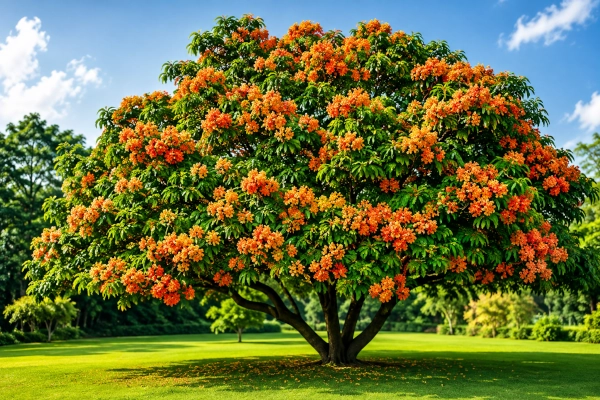
Few medicinal trees are as closely associated with women’s health in Ayurveda as Ashoka.
Known botanically as Saraca asoca, the true Ashoka is an evergreen tree celebrated for its clusters of brilliant orange, scarlet and crimson flowers. Its Sanskrit name carries an equally beautiful meaning. A-shoka literally conveys the idea of being “without sorrow” or “free from grief.”
Ayurveda values Ashoka primarily for its stem bark. Classical traditions use it especially in conditions associated with excessive menstrual bleeding, uterine disorders and disturbances of Rakta and Pitta. It also appears in traditional management of diarrhoea, burning sensations, certain urinary disorders and excessive bodily discharge. An Ayurvedic teaching resource lists Ashoka under the Kashaya Skandha and describes it as particularly important in Rakta Pradara.
Ashoka is also the principal herb that gives the famous Ayurvedic preparation Ashokarishta its name.
Modern research has identified tannins, flavonoids, catechins and several other phytochemicals in the tree. Researchers have investigated its reproductive, antioxidant, anti-inflammatory and other biological effects. However, much of this evidence remains experimental, and many traditional claims still require stronger human clinical studies.
Botanical Identity
Sanskrit name: Ashoka — अशोक
Common names: Ashoka, Asoka, True Ashoka, Sita Ashoka
Botanical name: Saraca asoca (Roxb.) W.J.de Wilde
Family: Fabaceae
Traditional family classification: Caesalpiniaceae / Caesalpinioideae
Genus: Saraca
Plant type: Evergreen tree
Principal Ayurvedic part: Stem bark
Other traditionally used parts: Flowers, seeds and roots
Royal Botanic Gardens, Kew recognises Saraca asoca as an accepted species. Its native range extends through parts of the Indian subcontinent towards Myanmar and Sri Lanka.
Older Ayurvedic and pharmacognostic literature often places Ashoka under Caesalpiniaceae. Modern botanical classification includes it within the larger Fabaceae, or legume family.
How to Identify the True Ashoka Tree
The genuine Ashoka is a graceful evergreen tree with a dense crown.
Young leaves often emerge in striking shades of copper, reddish brown or crimson. They gradually turn green as they mature.
The leaves are compound and usually contain several pairs of elongated leaflets. The tree’s flowers form dense clusters directly around the branches.
These flowers are among Ashoka’s most distinctive features.
They begin in yellow-orange or orange shades and gradually deepen toward vermilion and red. Ayurvedic botanical descriptions note that the flowers are fragrant and occur in dense clusters.
The fruits develop as flattened pods containing several seeds.
An Important Warning: True Ashoka and False Ashoka Are Different Trees
Ashoka is one of the most frequently confused medicinal trees in India.
The tall, narrow ornamental tree commonly planted along roads, compounds and institutional buildings is often called Ashoka tree. It was traditionally known botanically as Polyalthia longifolia.
Modern taxonomy recognises that tree as Monoon longifolium. Kew lists Polyalthia longifolia as a synonym of Monoon longifolium.
It is not the same species as Saraca asoca.
This distinction becomes particularly important in Ayurveda because the bark is used medicinally. An Ayurvedic pharmacognostic source specifically lists Polyalthia longifolia among plants reported as substitutes or adulterants of genuine Ashoka bark.
Medicinal Ashoka should therefore come from an authenticated source.
Ashoka in Ayurveda
Ayurveda gives Ashoka a special place among medicines acting upon Rakta Dhatu and the female reproductive system.
A Dravyaguna resource from Shri Dhanwantry Ayurvedic College describes Ashoka under the Kashaya Skandha of Charaka and the Rodhradi group in Sushruta and Vagbhata traditions.
Its strongest Ayurvedic character comes from the combination of Kashaya and Tikta Rasa, cooling potency and drying qualities.
Ayurvedic Properties of Ashoka
| Ayurvedic Parameter | Traditional Description |
|---|---|
| Rasa — Taste | Kashaya, Tikta — Astringent and bitter |
| Guna — Qualities | Laghu, Ruksha — Light and dry |
| Virya — Potency | Sheeta — Cooling |
| Vipaka — Post-digestive effect | Katu — Pungent |
| Dosha action | Primarily associated with reducing aggravated Pitta and Kapha |
| Important traditional actions | Grahi, Rakta-stambhana-related action, Pitta-shamana and uterine support |
| Principal traditional focus | Rakta Pradara and disorders of the female reproductive system |
These properties are documented in contemporary Ayurvedic teaching material based on traditional Dravyaguna literature.
Kashaya Rasa — The Key to Understanding Ashoka
Ashoka’s dominant taste is Kashaya, or astringent.
Astringent substances create a drying and contracting sensation. Ayurveda traditionally uses this quality when excessive moisture, discharge or bleeding is present.
This helps explain why Ashoka became important in conditions involving:
Rakta Pradara, or excessive uterine bleeding; excessive menstrual flow; certain vaginal discharges; diarrhoeal conditions; bleeding disorders; and disorders where Pitta and Rakta are aggravated.
Its Sheeta Virya, or cooling potency, further supports its traditional use where heat, burning and excessive Pitta accompany these conditions.
Ashoka and Rakta Pradara
The best-known Ayurvedic application of Ashoka is in Rakta Pradara.
The term broadly describes abnormal or excessive uterine bleeding within Ayurvedic medicine.
Traditional texts and later Ayurvedic practice employ Ashoka bark in formulations intended to control excessive bleeding and support uterine health. The Ayurvedic source cited above describes Ashoka as especially associated with Rakta Pradara and identifies the uterus as one of its principal therapeutic areas.
This association has made Ashoka one of Ayurveda’s most recognised herbs for women’s reproductive health.
However, heavy or irregular menstrual bleeding should never automatically be assumed to be a simple imbalance.
Fibroids, adenomyosis, endometriosis, thyroid disease, pregnancy-related complications, bleeding disorders and other medical conditions can cause abnormal bleeding.
Persistent or heavy bleeding requires proper medical evaluation.
Ashoka and Menstrual Health
Ayurvedic practitioners traditionally use Ashoka-based formulations where menstruation involves excessive bleeding, Pitta aggravation or uterine discomfort.
Its role is particularly associated with Raktapradara and related gynaecological conditions. Traditional descriptions also mention dysmenorrhoea and excessive uterine discharge among its applications.
Modern laboratory research has attempted to investigate the biological basis of these traditional uses.
Studies of Saraca asoca have reported bioactive compounds with potential effects on reproductive tissues. One experimental study investigated a standardised flower extract for estrogenic activity in animal models.
Such results remain preclinical evidence.
They should not be interpreted as proof that Ashoka can correct hormonal disorders or replace treatment prescribed by a gynaecologist.
Ashoka and the Uterus
Ashoka is often described in modern Ayurvedic literature as a uterine-supporting herb.
Traditional Dravyaguna descriptions associate it with strengthening and supporting uterine function while reducing excessive discharge and bleeding.
This traditional focus explains why Ashoka frequently appears in Ayurvedic formulations intended for women’s reproductive health.
However, the phrase “uterine tonic” should be understood in its traditional Ayurvedic context.
It does not mean that Ashoka is appropriate for every uterine disorder or every woman.
The cause of symptoms must first be understood.
Ashokarishta — The Famous Formulation Named After Ashoka
One of Ayurveda’s best-known fermented formulations is Ashokarishta.
As its name indicates, Ashoka is its principal medicinal ingredient.
Traditional practice uses Ashokarishta primarily in the context of women’s reproductive health and menstrual disorders. Ayurvedic teaching material lists Ashokarishta and Ashokaghrita among important formulations containing Ashoka.
Ashokarishta is an Arishta, meaning it is produced through a controlled fermentation process.
It is therefore very different from simply boiling Ashoka bark at home.
Classical formulations combine several ingredients in specific proportions. Their preparation, dose and suitability depend on the individual.
A small clinical study published in the Journal of Ayurveda and Integrative Medicine evaluated a combination containing Ashokarishta, Ashwagandha Churna and Praval Pishti in women with menopausal symptoms. Because several medicines were used together, the study cannot establish the independent effect of Ashokarishta or Ashoka alone.
Ashoka and Excessive Vaginal Discharge
Traditional Ayurvedic literature also associates Ashoka with Shveta Pradara, a term commonly used for excessive whitish vaginal discharge.
Its Kashaya Rasa and Ruksha Guna provide the traditional rationale.
Astringent and drying medicines are used when excessive Kleda, or pathological moisture, is involved.
However, vaginal discharge can also result from infections, hormonal changes, sexually transmitted infections or cervical disease.
Persistent discharge associated with smell, pain, itching, fever or bleeding requires medical assessment.
Ashoka and Pitta
Ashoka is traditionally considered especially useful when Pitta and Rakta are disturbed together.
Its cooling potency makes this relationship easy to understand within Ayurvedic theory.
Pitta is associated with heat and transformation. When excessively aggravated, Ayurvedic descriptions associate it with burning sensations, inflammation and certain forms of bleeding.
Ashoka’s Sheeta Virya is traditionally used to counter this excess heat. Its Kashaya Rasa adds a contracting and drying action.
This combination forms the foundation of many of Ashoka’s classical uses.
Ashoka and Kapha
Ashoka’s bitter and astringent tastes, combined with its dry quality, also help reduce excessive Kapha and Kleda.
This becomes relevant when symptoms involve heaviness, excessive secretions or abnormal discharge.
Its action is therefore not limited to Pitta alone.
Ayurvedic descriptions generally place Ashoka among medicines capable of reducing Pitta and Kapha when appropriately indicated.
Ashoka and Vata
Ashoka’s dry and astringent nature requires more care when Vata is already strongly aggravated.
Excessive use of drying medicines may increase dryness or disturb Vata in susceptible people.
This illustrates an important Ayurvedic principle.
A medicine cannot be judged merely by asking whether it is “good” for a particular disease.
The person’s constitution, Dosha state, digestive strength, age and accompanying symptoms all influence the choice of treatment.
Traditional Use in Diarrhoeal Disorders
Ashoka’s strong astringency also explains its traditional use in Atisara and Grahani-related conditions involving loose stools.
Ayurvedic descriptions identify Ashoka as Grahi, meaning it has an absorbing or binding quality. Traditional sources therefore include diarrhoeal and dysenteric conditions among its applications.
This does not mean every episode of diarrhoea should be treated with Ashoka.
Diarrhoea caused by infection, food poisoning or inflammatory disease may require very different treatment.
Maintaining hydration remains particularly important.
Ashoka in Bleeding Conditions
The relationship between Ashoka and Rakta extends beyond menstruation.
Traditional practice also associates its astringent parts with other conditions involving excessive bleeding.
The flowers, bark and related preparations have been described in Ayurvedic literature in the context of haemostatic applications.
Unexplained bleeding, however, can indicate serious disease.
Ashoka should never be used to conceal symptoms that require diagnosis.
Ashoka and Burning Sensations
Ashoka’s Sheeta Virya explains its traditional use where burning sensations accompany aggravated Pitta.
Ayurvedic descriptions include Daha, or burning, among its indications.
Cooling Ayurvedic herbs are selected according to the complete clinical pattern rather than temperature sensation alone.
Persistent unexplained burning should therefore be investigated medically.
Flowers of Ashoka
The flowers are responsible for much of Ashoka’s extraordinary beauty.
Unlike many flowers that grow at the ends of delicate twigs, Ashoka produces dense clusters around its branches.
Their colour transforms as the flowers mature.
Yellow-orange blossoms deepen into orange, scarlet and vermilion shades. Ayurvedic botanical descriptions also note their fragrance.
The flowers have traditional medicinal uses of their own and have also attracted modern research interest.
An experimental study examined Saraca asoca flower extract for estrogenic activity. The study was conducted in animal models, so the findings cannot be directly translated into treatment recommendations for humans.
Bark — The Most Important Medicinal Part
The stem bark remains the most widely recognised medicinal part of Ashoka.
Its astringency is one reason it features so prominently in women’s health formulations.
The bark contains numerous phytochemical constituents, including catechins, flavonoids and related polyphenolic substances.
Research comparing different plant parts has detected catechin-related compounds and investigated their antimicrobial activity.
Because the bark is harvested directly from the trunk and branches, medicinal demand creates an important conservation challenge.
Removing excessive bark can severely injure a tree.
Seeds and Roots
Ayurvedic sources also recognise the seeds and roots as medicinal parts, although they are less famous than the bark.
Traditional descriptions include seed preparations in particular urinary conditions.
Modern researchers have also investigated Ashoka seeds.
Experimental studies have examined their phytochemistry and pharmacological activity, including antipyretic effects in animal models.
Again, these findings do not establish a clinically proven human treatment.
Important Phytochemicals in Ashoka
Modern phytochemical research has identified numerous compounds within Saraca asoca.
These include:
- Catechins
- Epicatechin-related compounds
- Procyanidins
- Flavonoids
- Quercetin-related compounds
- Kaempferol-related compounds
- Anthocyanin pigments
- Tannins
- Sterols
- Other phenolic compounds
Ayurvedic botanical teaching resources also list compounds including apigenin derivatives, kaempferol, quercetin, epicatechol, leucocyanidin, procyanidin derivatives and beta-sitosterol.
These constituents help researchers investigate possible mechanisms behind Ashoka’s traditional uses.
However, the presence of a bioactive compound does not by itself prove therapeutic effectiveness.
Antioxidant Research
Polyphenols and flavonoids present in Ashoka have generated considerable interest because many demonstrate antioxidant activity under experimental conditions.
A comprehensive scientific review published in 2023 summarised pharmacological studies involving different parts of Saraca asoca and highlighted the plant as a potential source of therapeutically interesting compounds. It also called for further research and stronger conservation measures.
Antioxidant activity measured in the laboratory should not be interpreted as evidence that Ashoka can prevent every disease associated with oxidative stress.
Human physiology is much more complex than a laboratory antioxidant assay.
Anti-inflammatory Research
Researchers have also investigated Ashoka extracts for potential anti-inflammatory effects.
These findings fit broadly with some traditional applications involving pain, inflammation and Pitta-related disorders.
However, much of this evidence comes from laboratory and animal studies rather than large controlled clinical trials. The 2023 comprehensive review of Saraca asoca similarly notes broad pharmacological potential while emphasising the need for further research.
Ashoka should therefore not replace established treatment for inflammatory disease.
Antimicrobial Research
Extracts from different parts of Ashoka have shown antimicrobial activity in laboratory investigations.
One study analysed catechins across several organs of Saraca asoca and examined their relationship with antimicrobial activity.
Such studies can help researchers identify useful chemical compounds.
They do not mean that raw bark powder can safely replace antibiotics or antifungal medicines.
Laboratory inhibition of microorganisms is only an early stage in drug research.
Research into Female Reproductive Health
The strongest traditional reputation of Ashoka continues to centre on the female reproductive system.
Modern researchers have therefore examined bark and flower extracts for their influence on reproductive tissues and hormonal pathways. Experimental work includes studies of estrogenic activity and other reproductive effects.
This area requires particular caution.
Hormonal activity can be therapeutically useful in some situations and inappropriate in others.
Women with endometriosis, fibroids, fertility concerns, hormone-sensitive disease or unexplained bleeding should not self-medicate with concentrated Ashoka preparations.
What Modern Science Can and Cannot Say
Research on Ashoka is promising, but it is important to distinguish traditional use, experimental evidence and proven clinical treatment.
Ayurveda has a long tradition of using Ashoka, particularly for Rakta Pradara and women’s reproductive health.
Modern research has identified numerous bioactive compounds and several potentially useful biological effects.
Yet much of the pharmacological evidence still comes from cell studies and animal experiments.
High-quality human trials using botanically authenticated, standardised Saraca asoca preparations remain comparatively limited.
This does not invalidate the traditional use.
It simply defines what modern science has established so far.
Ashoka in Indian Cultural Tradition
Ashoka’s significance reaches far beyond medicine.
The tree appears repeatedly in Indian literature, art and sacred tradition.
Its name itself connects the tree with the removal of Shoka, or sorrow.
The flowering Ashoka became associated with beauty, fertility, love and feminine grace in Sanskrit literary traditions.
Perhaps its best-known appearance is in the Ramayana.
Sita is traditionally described as being held in Ashoka Vatika in Lanka. The flowering Ashoka therefore became intimately connected with one of the most remembered episodes of the epic.
Across centuries, Indian temple sculpture and literature also incorporated the Ashoka into imagery associated with women, fertility and spring.
Its strong association with feminine life in Indian culture creates an interesting parallel with its equally prominent place in Ayurvedic women’s medicine.
Ashoka and Ayurveda’s View of Women’s Health
Ayurveda does not treat menstruation merely as a monthly inconvenience.
It considers healthy menstrual function an important reflection of the state of Rasa, Rakta, Agni, Doshas and reproductive tissues.
Ashoka became important within that framework because of its cooling, astringent and Pitta-balancing properties.
Its role is therefore much more specific than the modern marketing expression “women’s herb.”
Ayurveda uses Ashoka when the qualities of the plant correspond to the qualities of the disorder.
That distinction is essential.
Conservation Is Part of the Medicine
Ashoka’s medicinal popularity has also created pressure on natural populations because the bark is the most commercially important part.
Unlike harvesting fruits or flowers, removing bark can directly damage the trunk.
Modern reviews of Saraca asoca specifically discuss demand, supply-chain concerns and the need for conservation strategies.
The National Medicinal Plants Board also includes Saraca asoca among medicinal plants relevant to India’s medicinal-plant cultivation and conservation programmes.
Cultivation therefore becomes important for both Ayurvedic medicine and biodiversity protection.
Medicinal demand should encourage the planting of genuine Ashoka trees rather than uncontrolled extraction from wild populations.
Why Botanical Authentication Matters
The high demand for Ashoka bark creates another problem: substitution.
Several other tree barks can enter the supply chain.
An Ayurvedic pharmacognostic source specifically notes adulteration or substitution involving plants including Polyalthia longifolia, Shorea robusta, Bauhinia variegata and Cynometra travancorica.
For ordinary consumers, these barks can be very difficult to distinguish.
This is why authenticated raw material and reputable Ayurvedic manufacturers are important.
The elegant column-shaped ornamental “Ashoka” growing beside a road should never automatically be assumed to be medicinal Saraca asoca.
A Tree Where Medicine and Culture Meet
Ashoka presents a remarkable meeting point between Ayurveda, botany and Indian cultural memory.
Its fiery clusters of flowers represent beauty and spring.
Its Sanskrit name expresses freedom from sorrow.
Its place in the Ramayana connects it with Sita and Ashoka Vatika.
Its bark, meanwhile, became one of Ayurveda’s important medicines for Rakta Pradara and selected disorders of women’s reproductive health.
Modern research has begun examining the phytochemistry and biological activity behind this tradition. Catechins, flavonoids and other compounds provide several promising directions for further study. Yet clinical evidence remains far less extensive than the centuries of traditional use.
Ashoka therefore deserves a balanced understanding.
It should not be reduced to a decorative tree, nor should every traditional claim be presented as scientifically proven.
It is a major Ayurvedic medicinal species whose traditional knowledge deserves careful preservation, rigorous scientific investigation and responsible conservation.
In that sense, Ashoka truly reflects the broader wisdom of Ayurveda: the medicine, the tree and the ecosystem that sustains it cannot be separated from one another.
References
Royal Botanic Gardens, Kew — Plants of the World Online: Saraca asoca is recognised as an accepted species within Fabaceae, with its native distribution extending across the Indian subcontinent towards Myanmar and Sri Lanka.
Shri Dhanwantry Ayurvedic College & Hospital — Dravyaguna Vigyan: Ayurvedic properties, classical classification, traditional indications, plant parts and important formulations of Ashoka.
PubMed — Comprehensive Review of Saraca asoca: Review of the plant’s traditional uses, phytochemistry, pharmacological research, supply-chain issues and conservation requirements.
Kew Science — Monoon longifolium: Modern botanical identity of the tree formerly called Polyalthia longifolia, demonstrating that the commonly planted ornamental “Ashoka” is botanically distinct from Saraca asoca.
Shirolkar et al.: Investigation of catechin distribution and antimicrobial activity in different organs of Saraca asoca.
Swar et al.: Experimental study examining the estrogenic potential of a standardised Saraca asoca flower extract.
Journal of Ayurveda and Integrative Medicine: Clinical investigation of a multi-component Ayurvedic regimen containing Ashokarishta in menopausal syndrome.
Health Disclaimer
This article is intended for educational and informational purposes only. Traditional Ayurvedic descriptions should not be interpreted as medical advice or as proof that Ashoka can treat a particular medical condition.
Ashoka is especially associated with menstrual and uterine disorders, but abnormal vaginal bleeding can have many causes. Heavy bleeding, bleeding between periods, bleeding during pregnancy or bleeding after menopause requires prompt medical evaluation.
Pregnant women should not self-medicate with Ashoka or Ashokarishta. Women who are breastfeeding, undergoing fertility treatment, taking hormonal medicines or living with hormone-sensitive conditions should consult an appropriately qualified healthcare professional before medicinal use.
People taking regular medicines should also seek professional advice before using concentrated Ashoka extracts or classical formulations.
Do not harvest bark directly from roadside or unidentified trees. The commonly planted ornamental tree called “Ashoka” may actually be Monoon longifolium and is botanically different from medicinal Saraca asoca.
Ayurvedic treatment should be individualised according to the person’s constitution, Dosha state, symptoms, age and medical history. Proper Ayurvedic care should complement appropriate medical diagnosis rather than delay or replace necessary treatment.
You may also like
-
Ayurveda on Cold Foods and Iced Drinks: Why Food Temperature Matters for Digestion
-
Serum Institute of India-Manufactured Ebola Vaccine Enters Clinical Trial in Uganda
-
Ayurveda and Hydration: How Much Water Should We Really Drink?
-
Warm Water in Ayurveda: When and Why It Is Recommended
-
Women Make Up 43% of India’s Ayush Workforce as Sector Supports 17.6 Lakh Livelihoods
