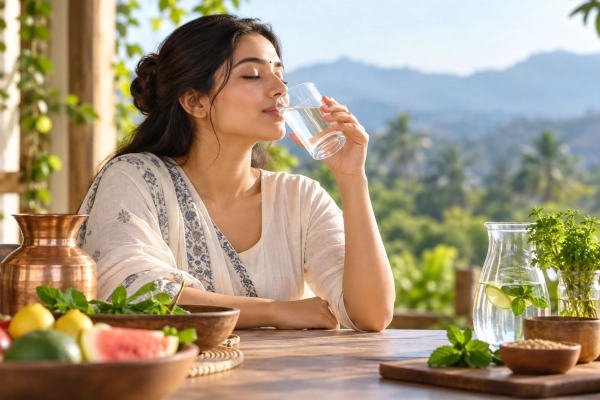
Water is essential for life, but drinking more water does not automatically mean better health. While modern wellness advice often recommends consuming a fixed number of glasses daily, Ayurveda takes a more individualised approach. It considers thirst, digestive capacity, seasonal conditions, physical activity and the body’s changing requirements when determining how much water a person should drink.
Classical Ayurvedic texts discuss water under Jala Varga, examining its qualities, temperature, quantity and relationship with digestion. Rather than prescribing an identical daily intake for everyone, Ayurveda emphasises drinking according to the body’s needs while maintaining the balance of agni, the digestive and metabolic principle.
This approach raises an important question: Should we drink water according to a fixed daily target, or should we pay greater attention to thirst, digestion and individual circumstances?
Ayurveda Does Not Prescribe the Same Water Intake for Everyone
Ayurveda recognises that water requirements vary between individuals. A person performing strenuous physical work in hot weather generally needs more water than someone resting indoors during winter. Similarly, age, dietary habits, physical constitution and health conditions influence the body’s fluid requirements.
The Ashtanga Hridaya, particularly the Drava Dravya Vijnaniya chapter of the Sutrasthana, discusses the appropriate use of water in relation to digestion, seasons and bodily conditions. The classical guidance cautions against excessive consumption without considering digestive capacity and individual needs.
This principle differs from the popular belief that everyone must drink eight glasses or three litres of water daily. Ayurveda places greater emphasis on suitability than on achieving a predetermined quantity.
Modern nutritional science also recognises considerable variation in hydration requirements. Climate, sweating, physical exertion, food intake and health conditions all influence how much fluid a person needs.
Thirst Is an Important Signal in Ayurveda
In Ayurveda, trishna, or thirst, is recognised as a physiological signal that deserves attention. The sensation indicates the body’s need for fluids and forms an important part of maintaining internal balance.
Suppressing natural thirst is discouraged in classical Ayurvedic guidance. Just as Ayurveda advises against unnecessarily suppressing hunger, urination and other natural bodily urges, it considers prolonged neglect of thirst undesirable.
However, thirst is not the only indicator of hydration. Older adults may experience a reduced sensation of thirst, while children and people engaged in strenuous outdoor activity may require more frequent access to water.
A practical approach combines awareness of thirst with attention to weather, physical exertion and the body’s general condition. Drinking regularly throughout the day is particularly important in hot climates, where fluid losses through sweating can increase considerably.
How Much Water Should We Drink Daily?
Ayurveda does not establish a universal daily quantity expressed in litres. Its central recommendation is to adjust water consumption according to individual requirements rather than drink excessive amounts simply to meet a target.
Modern health recommendations provide useful reference points. The European-style public health guidance used by the UK’s National Health Service generally recommends around six to eight cups or glasses of fluid daily for most adults, with greater quantities needed in certain circumstances.
The US National Academies of Sciences, Engineering, and Medicine established adequate total daily water intakes of approximately 3.7 litres for adult men and 2.7 litres for adult women. Importantly, these figures include water obtained from food and all beverages, not just plain drinking water. They are population-level reference values rather than compulsory individual targets.
Food contributes meaningfully to hydration. Fruits, vegetables, milk, soups and other moisture-rich preparations supply water throughout the day. Consequently, someone eating a diet rich in fresh fruits and cooked vegetables may obtain more water from food than a person consuming predominantly dry foods.
For most healthy adults, maintaining comfortable thirst levels, drinking regularly and observing urine colour can provide practical guidance. Pale-yellow urine generally suggests adequate hydration, although medicines, supplements and certain medical conditions can affect its appearance.
Ayurveda’s View on Drinking Water During Meals
The relationship between drinking water and eating occupies an important place in classical Ayurvedic dietary guidance.
The Ashtanga Hridaya describes different traditional effects associated with consuming water before, during and after meals. Its teaching generally favours moderate water consumption during meals, while cautioning against drinking excessive quantities without considering digestive capacity.
The Sushruta Samhita also discusses the timing of liquids in relation to food. In its traditional framework, drinking during a meal is associated with maintaining bodily balance, while drinking before or after eating is described as having different effects on nourishment.
These descriptions reflect classical Ayurvedic concepts and should not be interpreted as scientifically established methods of controlling body weight.
From a practical standpoint, taking small sips of water during meals can help moisten food and make swallowing more comfortable. There is no convincing scientific evidence that drinking ordinary amounts of water with meals significantly dilutes digestive juices or damages digestion.
The sensible approach is to drink according to comfort, avoiding both unnecessary restriction and excessive consumption that produces uncomfortable fullness.
Warm Water or Cold Water: What Does Ayurveda Recommend?
Ayurveda distinguishes between ushna jala, or warm water, and sheeta jala, or cool water. Classical texts describe their different qualities and recommend selecting water according to bodily condition, climate and digestive requirements.
Warm water traditionally receives preference in circumstances associated with heaviness, sluggish digestion and cold weather. Ayurveda regards it as suitable for people who find warm beverages more comfortable, particularly after certain meals.
Cool water is traditionally associated with relieving heat and thirst. During hot weather or after physical exertion, appropriately cool drinking water can be refreshing and help replace fluids lost through sweating.
Modern evidence does not establish that warm water is universally superior for digestion or that cold water extinguishes digestive activity. The body regulates its internal temperature, and ordinary drinking-water temperatures do not switch digestive enzymes on or off.
For daily hydration, clean, safe drinking water at a comfortable temperature is more important than whether it is warm or cool. Extremely hot water should be avoided because it can injure the mouth and oesophagus.
How Seasons Influence Water Requirements
Ayurveda places considerable emphasis on ritucharya, the adjustment of daily habits according to seasonal changes. Water consumption forms part of this seasonal adaptation.
During grishma ritu, the summer season, increased environmental heat and sweating can raise the body’s fluid requirements. Ayurveda’s seasonal approach recognises the importance of maintaining hydration while avoiding excessive exposure to heat.
During cooler weather, sweating generally decreases, and some people naturally experience less thirst. However, reduced thirst does not mean that the body no longer requires adequate fluids. Water remains essential for circulation, temperature regulation, kidney function and normal metabolism.
India’s varied climatic conditions make seasonal awareness particularly relevant. A person working outdoors during summer in Rajasthan may require substantially more water than someone performing sedentary work in a temperature-controlled environment.
The appropriate quantity therefore changes with temperature, humidity, physical exertion and individual sweating patterns. People exercising or working for prolonged periods in extreme heat may also need to replace electrolytes, not merely water.
Water Intake and the Three Doshas
Ayurveda interprets individual physiological tendencies through the framework of vata, pitta and kapha. These doshas provide a traditional explanation of differences in bodily constitution and functional balance.
People described as having predominant vata characteristics are traditionally associated with qualities such as dryness and irregularity. Ayurvedic practitioners may therefore emphasise regular fluid intake and suitable dietary moisture.
Individuals with predominant pitta characteristics are associated with heat and may find cool or room-temperature water more comfortable, particularly during warm weather.
Those described as having predominant kapha characteristics are traditionally associated with heaviness and moisture. Ayurvedic dietary guidance may favour warm beverages and discourage unnecessary excessive drinking.
These distinctions belong to Ayurveda’s traditional explanatory system. They should not replace objective assessment of hydration requirements or medical advice. Regardless of dosha classification, everyone must replace sufficient fluids to maintain normal physiological function.
Why Drinking Excessive Water Is Not Always Beneficial
Ayurveda cautions against excessive consumption that disregards the body’s digestive and physiological capacity. The broader principle is that even essential substances should be consumed in appropriate quantities.
Modern medicine similarly recognises that consuming extremely large quantities of water, particularly over a short period, can be harmful. Excessive water intake may dilute blood sodium levels, producing a condition known as hyponatraemia.
In severe cases, hyponatraemia can cause headache, nausea, confusion, seizures and potentially life-threatening complications. The risk is particularly relevant during prolonged endurance exercise when people consume water far beyond their fluid losses.
Drinking additional water does not continuously improve kidney function, accelerate metabolism or remove toxins more efficiently once normal hydration needs have been met. Healthy kidneys regulate water and electrolyte balance, but their capacity to eliminate excess water is not unlimited.
People with kidney disease, heart failure or conditions requiring fluid restriction must follow individual medical guidance. Traditional recommendations to reduce water intake should never be applied automatically to illnesses such as diarrhoea, where dehydration can be dangerous.
Hydration Also Depends on What We Eat
Ayurveda treats food and water as interconnected components of nourishment. A meal containing sufficient moisture contributes to hydration while supporting comfortable eating and digestion.
Traditional Indian diets contain several naturally hydrating preparations. Buttermilk, appropriately prepared soups, thin dals, vegetable dishes and freshly prepared rice gruels can contribute to daily fluid intake.
Seasonal fruits and vegetables also provide substantial amounts of water. Watermelon, cucumber, muskmelon, oranges and other moisture-rich foods are particularly useful during warmer months.
These foods offer additional nutritional benefits through vitamins, minerals and dietary fibre. However, they should complement rather than completely replace drinking water.
Ayurveda’s emphasis on seasonal foods and appropriate meal composition provides a useful framework for recognising that hydration involves the entire diet, not simply the number of glasses consumed.
Recognising When the Body Needs More Water
The body provides several signals when fluid intake becomes insufficient. Thirst is the most familiar, but dry mouth, reduced urine output, darker urine, tiredness and dizziness may also indicate dehydration.
Mild dehydration can affect concentration, physical performance and general comfort. More significant fluid losses may occur during fever, vomiting, diarrhoea, intense exercise or prolonged exposure to heat.
These situations require particular attention because ordinary drinking habits may not adequately replace lost fluids. During diarrhoea, especially in children and older adults, oral rehydration solution can help replace both water and essential electrolytes.
Persistent vomiting, confusion, fainting, very low urine output or inability to keep fluids down requires prompt medical evaluation.
Traditional Ayurvedic awareness of bodily signals can complement modern hydration practices, provided symptoms suggesting significant dehydration receive appropriate medical attention.
Developing a Balanced Daily Hydration Routine
A practical hydration routine need not involve constantly measuring every glass of water. For most healthy adults, it begins with paying attention to thirst and making safe drinking water readily available throughout the day.
Drinking some water after waking can be a comfortable way to begin the morning, particularly after several hours without fluids. However, there is no medical requirement to consume a large quantity immediately upon rising.
During meals, water can be consumed in moderate amounts according to comfort. Between meals, fluid intake should reflect thirst, physical activity and environmental conditions rather than rigid restrictions.
Outdoor workers, athletes, pregnant women, breastfeeding mothers and people living in hot environments often need additional fluids. Older adults may benefit from regular drinking routines because their thirst response can become less reliable.
The objective is neither to minimise water intake nor to force excessive consumption. It is to maintain sufficient hydration consistently while responding appropriately to changing circumstances.
Ayurveda’s Central Lesson: Drink According to Need, Not Habit Alone
Ayurveda’s approach to hydration reflects its broader philosophy of moderation, seasonal adaptation and attentiveness to the body’s natural requirements. Classical guidance treats water as an essential part of nourishment while recognising that its appropriate quantity varies across individuals and circumstances.
Modern nutritional science supports the principle that hydration requirements are not identical for everyone. Although contemporary medicine uses measurable fluid recommendations, it also recognises the importance of climate, activity, diet, age and health conditions.
The practical lesson is straightforward: drink enough water to remain comfortably hydrated, increase intake when fluid losses rise, and avoid forcing excessive quantities simply to satisfy a numerical target.
By combining Ayurveda’s emphasis on individual awareness with modern understanding of hydration, water consumption can become a balanced, natural part of daily living rather than another rigid health ritual.
References
- Vagbhata – Ashtanga Hridaya, Sutrasthana, Chapter 5, Drava Dravya Vijnaniya Adhyaya. Classical discussion of water, its properties, seasonal suitability and consumption in relation to meals.
https://ayurveda-online.net/admin/php/astang/view_astanga_en.php?id=1&row=163 - Sushruta Samhita, Sutrasthana, Chapter 46, Annapana Vidhi Adhyaya. Classical Ayurvedic discussion of food, beverages and their appropriate consumption.
https://www.ayanaayurveda.com/learn/classical-texts/sushruta-samhita/sutrasthanam/annapanavidhyadhyayah/ - National Academies of Sciences, Engineering, and Medicine – Dietary Reference Intakes for Water, Potassium, Sodium, Chloride, and Sulfate. Scientific reference values for total daily water intake.
https://www.nationalacademies.org/read/10925/chapter/6 - National Health Service, United Kingdom – Water, Drinks and Hydration. Guidance on daily fluid requirements, food sources of water and hydration.
https://www.nhs.uk/live-well/eat-well/food-guidelines-and-food-labels/water-drinks-nutrition/ - Guy’s and St Thomas’ NHS Foundation Trust – Keeping Hydrated. Practical guidance on fluid intake and recognising dehydration.
https://www.guysandstthomas.nhs.uk/health-information/keeping-hydrated
You may also like
-
Warm Water in Ayurveda: When and Why It Is Recommended
-
Women Make Up 43% of India’s Ayush Workforce as Sector Supports 17.6 Lakh Livelihoods
-
Sunfox Technologies Raises $7 Million to Take India-Built Spandan ECG Platform Global
-
Ayurveda on Fasting: When Restraint Supports Digestion
-
Zydus and MSN Launch First Generic Riociguat in US Pulmonary Hypertension Market
