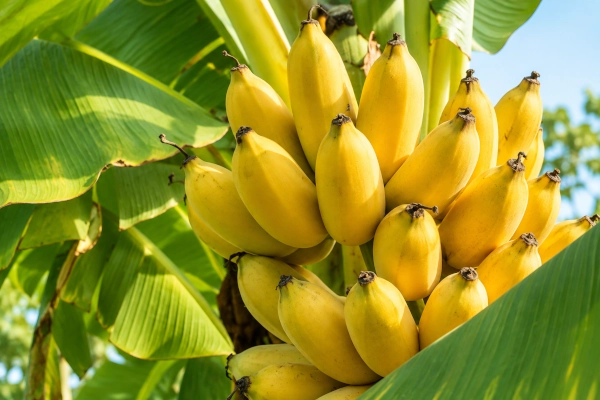
Botanical Name: Musa paradisiaca L.
Sanskrit Name: Kadali
Common Names: Banana, Plantain
Family: Musaceae
Hindi: Kela
Malayalam: Vazha, Kadali
Tamil: Vazhai
Kannada: Bale
Telugu: Arati
Parts Traditionally Used: Ripe fruit, unripe fruit, flower, pseudostem, rhizome and leaves
Few plants are woven into Indian life as completely as Kadali, the banana.
It is food, medicine and an important household plant. The ripe fruit provides nourishment, while the raw fruit forms part of traditional cooking. The flower and tender inner pseudostem are eaten as vegetables in several parts of India. Ayurveda also uses different parts of Kadali for distinctly different purposes.
Ayurvedic literature identifies Kadali with Musa paradisiaca. Modern botanical taxonomy usually writes the cultivated plantain complex as Musa × paradisiaca L., recognising it as a hybrid associated with Musa acuminata and Musa balbisiana. Royal Botanic Gardens, Kew currently accepts Musa × paradisiaca as a hybrid within the Musaceae family.
The distinction is important because “banana” does not refer to one nutritionally identical fruit. Hundreds of cultivars exist, ranging from sweet dessert bananas to starch-rich cooking plantains.
Ayurveda recognised another equally important distinction centuries ago: ripe Kadali and unripe Kadali do not behave in exactly the same way in the body.
Kadali in Classical Ayurveda
Kadali appears in Ayurvedic Nighantus under several names, including Kadali, Varana, Mocha and Ambusara.
Bhavaprakasha places Kadali within its discussion of fruits and describes the fruit as sweet, cooling, heavy and unctuous. The classical description of the ripe fruit further emphasises its nourishing and strengthening qualities. Ayurvedic teaching sources based on the Bhavaprakasha Nighantu classify Kadali under the Amradi Phala Varga and record its Madhura Rasa, Guru Guna, Sheeta Virya and Madhura Vipaka.
This makes Kadali a good example of how Ayurveda evaluates ordinary foods as carefully as medicinal herbs.
Food itself can become therapeutic when its qualities match the needs of the individual.
Ayurvedic Profile of Ripe Kadali
| Ayurvedic Property | Ripe Banana |
|---|---|
| Rasa — Taste | Madhura — sweet |
| Guna — Qualities | Guru, Snigdha — heavy and unctuous |
| Virya — Potency | Sheeta — cooling |
| Vipaka — Post-digestive effect | Madhura — sweet |
| Dosha Action | Generally pacifies Vata and Pitta; may increase Kapha when taken excessively |
| Important Actions | Brimhana, Balya, Vrishya, Dahahara and nourishing |
Classical descriptions are especially favourable towards the properly ripened fruit. Bhavaprakasha describes it as sweet, cooling, nourishing and supportive of body tissues. It is also traditionally associated with relieving excessive hunger, thirst and burning sensations.
The Guru and Snigdha qualities explain why ripe banana can feel satisfying and substantial despite being a fruit.
Ripe and Raw Banana Are Ayurvedically Different
One of the most useful lessons from Kadali is that ripeness changes both food chemistry and Ayurvedic action.
A ripe banana contains more readily available sugars and has a softer texture. An unripe banana contains considerably more starch, including resistant starch.
Ayurveda likewise distinguishes the actions of raw and mature fruit.
The ripe fruit is predominantly Madhura, Guru, Snigdha and Brimhana. It is therefore viewed as nourishing and tissue-building.
Raw banana is more astringent and starchy. It is traditionally used in cooked preparations and may have a more Grahi, or binding, action.
Modern research supports the idea that ripening substantially changes banana carbohydrates. Unripe banana products can contain appreciable resistant starch, which behaves differently from rapidly digestible starch in the gastrointestinal tract. A clinical study using unripe banana flour, for example, described the flour as containing a high proportion of resistant starch.
Thus, a green plantain curry and a fully ripe sweet banana should not be considered physiologically identical foods.
Brimhana — The Nourishing Nature of Kadali
Brimhana is an important Ayurvedic concept describing substances that nourish and help build body tissues.
Ripe Kadali fits this category naturally.
Its Madhura Rasa, Madhura Vipaka, Snigdha Guna and substantial carbohydrate content make it suited to situations where nourishment and energy are required. Classical Ayurvedic descriptions explicitly associate ripe Kadali with Brimhana.
Modern nutritional guidance similarly recognises banana as a relatively starch-rich fruit capable of contributing useful dietary energy. India’s National Institute of Nutrition notes that fruits such as banana contain significant starch and can contribute more energy than many lower-calorie fruits.
This does not make banana a complete meal.
It does make it an efficient and convenient source of carbohydrate within a balanced diet.
Balya — Supporting Strength
Kadali is traditionally regarded as Balya, meaning supportive of strength.
In Ayurveda, Bala does not refer only to muscular strength. It includes the body’s capacity to maintain function, nourishment and resilience.
A properly ripe banana provides carbohydrate in an easily consumed form and is therefore widely suited to people who need additional dietary energy.
Its soft texture also makes it convenient when chewing or appetite is temporarily reduced.
However, a person recovering from illness should still receive adequate protein, fats, micronutrients and other foods rather than depending heavily on bananas alone.
Kadali and Pitta
The Sheeta Virya, or cooling potency, of ripe Kadali makes it traditionally relevant where excess heat and Pitta are considered prominent.
Classical descriptions associate Kadali with reducing Daha, or burning sensations, and with pacifying Pitta-related disturbances.
Its cooling action also helps explain the traditional use of the ripe fruit in conditions involving thirst and internal heat.
This is an Ayurvedic interpretation and should not be confused with treating fever, dehydration or inflammatory disease without appropriate medical care.
Kadali and Vata
The Madhura Rasa and Snigdha quality of ripe banana generally work against excessive dryness and lightness associated with aggravated Vata.
For this reason, ripe Kadali can be nourishing for Vata-dominant individuals when digestion is strong enough to process it.
However, its Guru quality means quantity still matters.
A person with weak Agni may experience heaviness, bloating or discomfort after eating too much banana, especially alongside other heavy foods.
Ayurveda therefore considers not merely whether a food is “healthy,” but whether the individual’s digestion can handle it.
Why Kadali Can Increase Kapha
Sweetness, heaviness, cooling potency and unctuousness are all qualities that can increase Kapha when consumed excessively.
This explains the classical description of Kadali as Kaphakara under certain circumstances.
A ripe banana may therefore feel excessively heavy for a person with pronounced Kapha, sluggish digestion or a tendency towards mucus and congestion.
This does not mean every person with Kapha traits must avoid bananas.
Ayurveda considers portion, season, digestive strength, preparation and the rest of the meal.
Kadali and Agni
Banana illustrates why Ayurveda pays close attention to Agni, the digestive and metabolic capacity of the individual.
Ripe Kadali is nutritious, but it is also Guru.
When Agni is strong, the fruit may provide satisfying nourishment. When digestion is weak, the same fruit may produce heaviness or discomfort.
This is one reason Ayurveda generally discourages the idea that a particular food must be good for everyone simply because it contains useful nutrients.
The qualities of the food and the condition of the person must be considered together.
The Banana Flower
The large purple-red inflorescence of the banana plant contains rows of developing flowers beneath protective bracts.
Banana flower has long been eaten as a vegetable in southern and eastern India. In Ayurvedic practice, it is also valued separately from the fruit.
Modern researchers have investigated extracts of the flowers and bracts of Musa × paradisiaca for metabolic effects. Experimental work has demonstrated antidiabetic activity in laboratory models, although this remains preclinical evidence and does not establish banana flower as a treatment for human diabetes.
The flower also contains fibre and several classes of phytochemicals.
As a food, it can form part of a varied diet.
As a concentrated medicinal extract, it should be treated differently.
Banana Flower and Women’s Traditional Diets
Banana flower has an especially prominent place in several traditional Indian food cultures.
Ayurvedic and regional practices have used it in diets associated with women’s health, particularly where an astringent food was considered useful.
However, traditional use should not be converted into claims that banana flower can independently treat excessive menstrual bleeding, hormonal disorders or diabetes.
Heavy menstrual bleeding can result from fibroids, endocrine disorders, pregnancy-related problems, clotting abnormalities and other conditions.
Persistent or unusually heavy bleeding therefore requires medical assessment.
The Inner Banana Pseudostem
What is commonly called the banana “stem” is largely a pseudostem formed from tightly packed leaf sheaths.
The tender central portion is widely cooked as a vegetable.
Its crisp, fibrous texture makes it quite different nutritionally from the ripe fruit. Traditional food systems often use it when a lighter and more fibrous preparation is desired.
Ayurvedic sources also describe the stem or stalk among the useful parts of Kadali. Teaching material based on classical traditions records fruit, stem and flower among its principal parts.
Claims that banana stem “dissolves kidney stones” or automatically “cleans the kidneys” should be treated cautiously.
Kidney stones differ greatly in chemical composition and cause. A food cannot be assumed to dissolve them simply because it traditionally supports urination.
Kadali and the Digestive System
Bananas can affect digestion differently depending on ripeness.
Ripe fruit contains soluble and insoluble carbohydrate fractions and becomes progressively sweeter as starches are converted during ripening.
Green banana retains substantially more resistant starch.
Dietary fibre generally slows absorption, contributes to stool bulk and supports satiety. India’s National Institute of Nutrition notes that fibre-rich foods can delay carbohydrate and fat absorption and support healthy bowel function.
A randomised controlled study involving healthy women also investigated banana consumption and the intestinal microbiota. The study found changes suggesting potential prebiotic effects, although the findings do not justify treating banana as a therapy for gastrointestinal disease.
Resistant Starch in Green Banana
Resistant starch escapes digestion in the small intestine to a greater extent than ordinary rapidly digestible starch.
It can then reach the large intestine, where intestinal microorganisms may ferment it.
This has made green banana flour an increasingly studied functional food.
A clinical study in patients with chronic kidney disease evaluated unripe banana flour containing substantial resistant starch for its effects on gut-derived metabolites.
These findings are scientifically interesting, but green banana flour should not automatically be treated as a medicinal supplement.
Its physiological effect can differ according to processing, cultivar, dose and the health of the individual.
Banana and the Stomach
Unripe plantain has a particularly interesting history in experimental gastric research.
Animal studies conducted over several decades found that dried unripe plantain preparations could increase gastric mucosal resistance and reduce experimental injury.
Researchers later isolated leucocyanidin, a flavonoid from unripe plantain, and reported protective activity against aspirin-induced gastric erosions in experimental models.
These studies provide a useful scientific lead.
They do not establish raw banana powder as a treatment for peptic ulcer disease in humans.
Ulcers can involve Helicobacter pylori, medicines such as NSAIDs and other causes that require appropriate diagnosis and treatment.
Banana and Blood Sugar
Bananas contain carbohydrate, so portion size matters for people managing diabetes.
Ripeness is also relevant. As a banana ripens, its carbohydrate profile changes and sweetness increases.
The American Diabetes Association emphasises that fruit contains carbohydrate and should be included within an individual’s carbohydrate plan rather than regarded as a “free” food.
This does not mean people with diabetes must avoid bananas.
It means the quantity should fit the person’s meal plan, glucose response and medication regimen.
Banana flower or green banana extracts should not be used to replace insulin or prescribed glucose-lowering medicines.
Potassium and Banana
Banana is popularly associated with potassium, an essential mineral involved in nerve, muscle and fluid-balance functions.
Indian dietary guidance recommends fruits and vegetables as important dietary sources of potassium and notes the significance of maintaining an appropriate sodium-to-potassium balance.
For most healthy people, obtaining potassium from whole foods forms part of normal nutrition.
However, more potassium is not always better.
People with impaired kidney function may be unable to remove potassium efficiently from the blood.
An Important Kidney Disease Precaution
People with advanced chronic kidney disease or kidney failure may need to limit high-potassium foods.
The US National Institute of Diabetes and Digestive and Kidney Diseases specifically includes bananas among foods that may need restriction when blood potassium is high.
Therefore, the common advice to “eat bananas for potassium” should not be applied indiscriminately.
Anyone with chronic kidney disease, dialysis requirements or a history of abnormal potassium levels should follow the dietary plan provided by their clinician or renal dietitian.
Banana and Blood Pressure
Fruits and vegetables that contribute potassium can form part of dietary patterns designed to support normal blood pressure.
The National Institute of Nutrition notes that potassium-rich fruits and vegetables are valuable within a diet that controls excessive sodium intake.
This should not be simplified into the claim that eating a banana treats hypertension.
Blood pressure depends on many factors, including body weight, sodium intake, physical activity, kidney function, genetics and medication.
Banana can be part of a healthy diet. It is not a substitute for prescribed antihypertensive treatment.
Kadali and Raktapitta
Classical Ayurvedic descriptions associate ripe Kadali with Pitta and Rakta-related conditions, particularly those characterised by heat and burning. The traditional description of the fruit includes Pitta-pacifying and cooling actions.
This is consistent with the Madhura Rasa, Snigdha quality and Sheeta Virya attributed to the ripe fruit.
The concept of Raktapitta is specific to Ayurveda and should not simply be translated as every modern bleeding disorder.
Unexpected bleeding always requires proper medical evaluation.
Vrishya — Traditional Reproductive Nourishment
Bhavaprakasha describes properly ripened Kadali as Vrishya, a term associated with reproductive nourishment and vitality.
Madhura Rasa, Madhura Vipaka and Brimhana action make the fruit consistent with Ayurveda’s broader category of nourishing foods.
However, describing a food as Vrishya does not mean it is a proven treatment for infertility, erectile dysfunction or hormonal disease.
Those conditions may have complex medical causes.
Banana Leaves
The large leaves of Kadali are among the most recognisable parts of the plant.
They are not usually eaten as a vegetable. Instead, they have long been used as natural surfaces for serving and preparing foods.
From an Ayurvedic perspective, the medicinal discussion focuses more strongly on the fruit, flower, pseudostem and rhizome.
The presence of Kadali across food, household and medicinal traditions nevertheless illustrates how completely useful plants were integrated into Indian daily life.
The Banana Plant Is Not Technically a Tree
Despite its tree-like appearance, banana is a large herbaceous plant.
Kew classifies Musa × paradisiaca as a herbaceous plant within the Musaceae family.
Its apparent trunk is a pseudostem created by overlapping leaf bases rather than woody tissue.
After a pseudostem flowers and fruits, that shoot naturally declines. New shoots arise from the underground system and continue the plant’s growth.
This unusual biology makes Kadali one of the world’s largest and most productive food-bearing herbs.
Kadali and Modern Nutrition
Modern nutrition and Ayurveda describe banana through different frameworks, but several observations complement each other.
Ayurveda recognises ripe Kadali as nourishing and Brimhana.
Modern nutrition identifies banana as a carbohydrate-rich fruit capable of supplying useful food energy. India’s National Institute of Nutrition specifically lists banana among starch-rich fruits that contribute meaningful calories.
Ayurveda distinguishes raw from ripe fruit.
Modern food science likewise shows that ripening substantially alters the balance between starch and sugars.
Ayurveda describes Kadali as Guru.
Modern experience also shows that portion size, ripeness and the rest of a meal influence how comfortably an individual digests it.
The two systems use different language, but both recognise that the same plant can behave differently according to its state and how it is consumed.
Can Banana Cause Allergy?
Banana allergy is uncommon compared with many major food allergies, but it does occur.
Banana can also participate in latex-fruit cross-reactivity. Research has identified shared allergenic proteins that can cause some people with natural-rubber latex allergy to react to banana.
Symptoms may range from itching or oral discomfort to more serious allergic reactions.
Anyone who has previously experienced swelling, difficulty breathing, widespread hives or other systemic symptoms after banana should seek medical advice rather than experimenting with further exposure.
When Kadali May Not Suit You
A ripe banana is an ordinary food for most healthy people, but Ayurveda does not regard even familiar foods as universally appropriate.
Its Guru, Snigdha, Madhura and Sheeta properties may feel excessive for people with pronounced Kapha, sluggish digestion or a tendency towards heaviness.
People managing diabetes need to account for its carbohydrate content.
People with advanced kidney disease may need to restrict banana because of potassium.
Those with banana or latex-associated allergy require additional caution.
Individual context matters more than simplistic labels such as “superfood.”
Food Is Not the Same as Herbal Medicine
Eating one ripe banana is very different from consuming concentrated banana flower extract, raw banana powder or a medicinal preparation made from the pseudostem or rhizome.
Traditional Ayurvedic treatment considers Prakriti, Vikriti, Agni, Dosha, disease stage, age, strength and accompanying medicines before selecting a preparation.
This distinction becomes especially important when a common food plant is also a medicinal plant.
Familiarity does not automatically make every concentrated preparation appropriate for unrestricted use.
Kadali — A Complete Plant in the Ayurvedic Household
Kadali demonstrates one of Ayurveda’s most enduring principles: medicine does not always begin in a pharmacy.
Sometimes it begins in the kitchen.
The ripe fruit nourishes. The green fruit offers a different starch profile. The flower becomes a vegetable. The inner pseudostem provides another food with very different texture and composition. Ayurveda then assigns medicinal significance to these different parts rather than treating the entire plant as one uniform substance.
Modern science is gradually exploring many of these distinctions.
Researchers have investigated resistant starch from green banana, the gastrointestinal effects of unripe plantain, banana-associated prebiotic activity and phytochemicals from the flower.
Yet the oldest lesson remains perhaps the most practical.
A ripe banana, a raw plantain, a banana flower and a banana pseudostem may come from the same plant, but they are not the same food and they do not produce identical effects.
Ayurveda understood this through Rasa, Guna, Virya, Vipaka and Karma.
Modern science approaches it through starch, sugars, fibre, phytochemicals and physiology.
Kadali stands comfortably in both worlds — an everyday food plant with an unusually rich medicinal tradition.
References
Bhavaprakasha Nighantu / Ayurvedic Kadali reference: Classical descriptions of Kadali, its fruit qualities and Ayurvedic energetics are reproduced by DAV Pharmacy with a link to the NIIMH e-Nighantu edition.
Royal Botanic Gardens, Kew — Plants of the World Online: Current botanical treatment of Musa × paradisiaca as an accepted hybrid within Musaceae.
National Institute of Nutrition, India — Dietary Guidelines for Indians: Nutritional role of fruits, fibre, starch-rich banana and dietary potassium.
PubMed-indexed research: Experimental studies have examined green banana resistant starch, unripe plantain and gastric mucosal protection, banana consumption and gut microbiota, and extracts from banana flowers and bracts.
National Institute of Diabetes and Digestive and Kidney Diseases: Guidance regarding potassium-rich foods such as banana in chronic kidney disease and dialysis.
Health Disclaimer
This article is intended for educational and informational purposes only. It is not medical advice and should not be used to diagnose, treat, cure or prevent any disease. Ordinary banana fruit is a commonly consumed food, but concentrated preparations made from banana flower, pseudostem, rhizome or unripe fruit may have different physiological effects. People with diabetes should account for the carbohydrate content of bananas within their meal plan. People with chronic kidney disease or abnormal potassium levels should seek professional dietary advice before increasing banana intake. Anyone with banana or latex-associated allergy should exercise caution. Pregnant or breastfeeding women, children and people taking long-term medicines should consult a qualified physician or registered Ayurvedic practitioner before using Kadali medicinally.
You may also like
-
Ayurveda and Mental Fatigue in the Digital Age: Ancient Wisdom for a Calm and Focused Mind
-
Bharat Biotech’s Nucelion and VeGen Bio Partner to Manufacture Advanced Dual-Target CAR-T Cancer Therapy in India
-
Ayurveda and Anger: How Emotional Excess Affects Physical and Mental Health
-
Ayurveda and Stress: Daily Practices for Mental Balance and Emotional Well-Being
-
Ayurveda and Bowel Routine: Why Regularity Matters for Digestive Health
