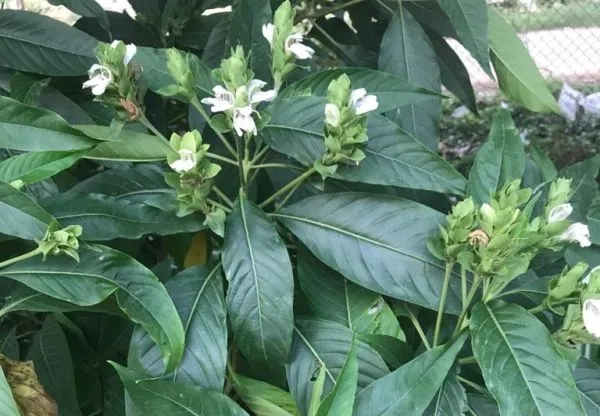
Among the medicinal shrubs that have remained part of Indian household medicine for generations, Vasa, better known as Vasaka, Adusa or Adulsa, occupies a particularly important position. Its intensely bitter leaves may appear unremarkable beside more aromatic household herbs such as Tulsi, but Ayurveda has long valued Vasa as an important medicine for the respiratory passages, especially where cough, accumulated Kapha, difficult expectoration and certain bleeding disorders are involved.
The accepted botanical name is Justicia adhatoda L., belonging to the family Acanthaceae. The older botanical name Adhatoda vasica Nees remains extremely common in Ayurvedic literature, pharmaceutical preparations and research publications. Kew’s Plants of the World Online currently accepts Justicia adhatoda as the botanical name and lists Adhatoda vasica among its synonyms.
India’s Ayurvedic Pharmacopoeia also recognises Vāsā leaf as an official Ayurvedic drug, while the Ministry of AYUSH’s e-CHARAK medicinal-plant database records Adusa both for its leaf and whole plant.
Identity of Vasa
| Particular | Description |
|---|---|
| Sanskrit name | Vāsā / Vāsaka |
| Botanical name | Justicia adhatoda L. |
| Important synonym | Adhatoda vasica Nees |
| Family | Acanthaceae |
| English name | Malabar Nut |
| Hindi | Adusa / Arusa |
| Malayalam | Aadalodakam / Aatalootakam |
| Tamil | Adathodai |
| Kannada | Adusoge |
| Marathi | Adulsa |
| Bengali | Basak |
| Principal medicinal part | Leaves |
| Other traditionally used parts | Root and flowers |
Regional names vary considerably across India, reflecting just how widely the plant has entered local systems of medicine. Modern taxonomic databases record vernacular names from Malayalam, Marathi, Kannada, Gujarati, Hindi, Tamil, Bengali, Punjabi and several other Indian languages.
The Plant and How to Identify It
Vasa is an evergreen or semi-evergreen perennial shrub that commonly grows several feet high and develops numerous branches. Its leaves occur opposite one another on the stem and are generally elongated, lance-shaped to elliptic, smooth and prominently veined. When crushed, the leaves possess a characteristic odour and an unmistakably bitter taste.
The flowers are among the easiest ways of recognising a mature Vasa plant. They are usually white, often marked with purple or reddish streaks, and occur in dense spikes surrounded by conspicuous green bracts. The fruit develops as a capsule.
The species is native across a broad belt extending from Afghanistan through the Indian subcontinent towards parts of Indo-China. Kew records it as native to India, Bangladesh, Nepal, Pakistan, Sri Lanka, the eastern and western Himalaya, Myanmar, Laos and Vietnam.
Because Vasa grows readily as a shrub and tolerates pruning well, it has also traditionally been planted as a hedge around homes and agricultural properties. Thus, for many Indian families, the medicine was historically available almost literally at the doorstep.
Vasa in Classical Ayurveda
Vasa is not merely a later folk remedy that entered Ayurvedic practice. References to the drug occur within the classical Ayurvedic textual tradition.
The Charaka Samhita database records Vasa under several names including Vrushaka, Vrushamula, Atarushaka, Simhasya, Bhishakmata and Vrusha. It records the plant in the Tikta Skandha, the group characterised by bitter taste, and also identifies references to Vasa in formulations and therapeutic procedures throughout the text.
Its enduring importance arises primarily from the combination of two characteristics that Ayurveda considers particularly valuable: Vasa can act upon Kapha accumulating in the respiratory passages, while its cooling and bitter-astringent nature also makes it traditionally important in disorders involving aggravated Pitta and Rakta.
Ayurvedic Properties — Rasa Panchaka
| Ayurvedic Principle | Property of Vasa |
| Rasa — Taste | Tikta — bitter; Kashaya — astringent |
| Guna — Qualities | Laghu — light; Ruksha — dry |
| Virya — Potency | Shita — cooling |
| Vipaka — Post-digestive effect | Katu — pungent |
| Dosha action | Primarily Kapha-Pitta shamaka |
These properties are consistently described in Ayurvedic teaching sources. Its Tikta and Kashaya rasa, combined with Laghu and Ruksha guna, help explain its traditional use where excessive Kapha and secretions are present, while its Shita Virya contributes to its association with Pitta-related heat and bleeding conditions.
Principal Ayurvedic Actions of Vasa
Kasahara — Supporting the Management of Cough
Perhaps no traditional use is more closely associated with Vasa than Kasa, or cough.
Ayurveda does not regard every cough as identical. The underlying Dosha, presence or absence of sputum, strength of the patient and chronicity of the disorder are all relevant. Vasa nevertheless became particularly important where Kapha obstructs the respiratory passages and mucus needs to be expelled.
This traditional reputation eventually led to Vasa becoming a common ingredient in Ayurvedic cough syrups, avalehas and respiratory preparations.
Shwasahara — Used in Difficult Breathing
Vasa is also traditionally associated with Shwasa, a broad Ayurvedic category encompassing disorders characterised by difficult or abnormal breathing.
This does not mean that Vasa should be considered a substitute for modern emergency treatment of asthma or acute breathlessness. Rather, classical Ayurveda incorporated it into therapeutic approaches for chronic respiratory conditions according to the patient’s Dosha and overall constitution.
Modern reviews likewise identify respiratory disorders as the most prominent historical application of Justicia adhatoda.
Kaphahara — Helping Clear Accumulated Phlegm
Its bitter, astringent, light and dry qualities make Vasa particularly suited, within Ayurvedic theory, to states of excessive Kapha.
When mucus becomes thick and difficult to expel, Vasa has traditionally been used to encourage its removal. This is why descriptions of Vasa frequently employ the modern pharmacological term expectorant, although this terminology should not be treated as identical to the classical Ayurvedic concept.
Raktapittahara — A Classical Herb in Bleeding Disorders
An equally interesting but sometimes overlooked aspect of Vasa is its traditional connection with Raktapitta, a classical Ayurvedic disorder involving pathological bleeding associated with aggravated Pitta and Rakta.
Its cooling Shita Virya, together with bitter and astringent tastes, explains why Ayurveda traditionally employed Vasa in certain bleeding conditions. Traditional sources consequently discuss it not only in connection with lungs and cough but also with haemorrhagic disorders. The Charaka-related Vasa database specifically lists Raktapitta among its therapeutic uses.
This traditional indication should not be interpreted as advice to treat unexplained bleeding at home. Coughing blood, gastrointestinal bleeding, recurrent nosebleeds or other unexplained bleeding require medical assessment.
Jvarahara — Traditional Use in Fever
Vasa also occurs traditionally in the management of Jwara, or fever, particularly where the presentation corresponds to the properties attributed to the herb.
As always, the classical concept of Jwara is broader than the modern measurement of elevated body temperature and includes systemic disturbance. Vasa therefore should not be presented as a generic modern antipyretic.
Svarya — Supporting the Voice and Throat
Traditional Dravyaguna sources describe Vasa as Svarya, indicating an association with the health and clarity of the voice. This complements its broader use in cough and disorders involving the throat and respiratory passages.
Vasa as a Household Medicine
Vasa became a household medicinal plant precisely because the leaves could be harvested fresh when needed. Traditional practice commonly utilised fresh leaf juice — Vasa Swarasa — or a decoction prepared from the leaves.
One widespread traditional approach combines carefully prepared Vasa with honey. However, this should be regarded as a traditional medicinal preparation rather than an ordinary drink or food.
Unlike Tulsi, ginger or coriander, Vasa is not primarily a culinary herb. Its intense bitterness and potent medicinal character mean that it is better treated as a medicine than incorporated casually into everyday cooking.
Ayurvedic teaching references commonly describe traditional adult quantities such as approximately 5–15 ml of fresh juice, 1–3 g of powder or 20–40 ml of decoction, but these are pharmacognostic reference ranges rather than personalised prescriptions. The appropriate preparation and quantity depend upon the patient’s age, constitution, disease and other medicines and should therefore be determined by a qualified practitioner.
Classical Ayurvedic Formulations Containing Vasa
Vasa’s importance is perhaps most clearly demonstrated by the formulations built around it. Among the best-known are:
- Vasavaleha — a classical semisolid preparation based upon fresh Vasa juice, traditionally combined with ingredients including Pippali, ghee, honey and sugar.
- Vasarishta / Vasakarishta — a fermented Ayurvedic formulation centred upon Vasa.
- Vasaghrita — a medicated ghee preparation involving Vasa.
- Vasa-Kantakari preparations — formulations combining Vasa with respiratory herbs such as Kantakari.
- Vasadya Ghrita and related classical combinations — used according to specific indications prescribed in Ayurvedic practice.
The Government of India’s CGHS Ayurvedic formulary includes Vasavaleha as well as Vasakasava/Vasakarishta, confirming their continued place within institutional Ayurvedic medicine.
The Ayurvedic Pharmacopoeia/Formulary describes classical Vasavaleha as being prepared from fresh Vasa leaf juice with sugar candy, cow’s ghee, Pippali and honey.
Modern Science and Vasa
Modern pharmacological interest in Vasa has concentrated particularly upon a group of quinazoline alkaloids found in the plant.
The best known is vasicine, accompanied by compounds such as vasicinone, vasicinol, anisotine and related alkaloids. These compounds have been investigated for respiratory, anti-inflammatory, antimicrobial and several other biological activities.
Laboratory and preclinical research provides a plausible pharmacological basis for at least some of Vasa’s longstanding reputation as a respiratory herb. Studies have investigated bronchodilatory, expectorant and related effects of extracts or isolated constituents.
However, there is an important distinction between demonstrating biological activity in laboratory experiments and proving clinical effectiveness in humans. A major modern review specifically notes that additional well-designed clinical investigation is needed for important proposed actions such as bronchodilatory and anti-asthmatic activity.
Thus, Vasa represents an interesting example where a very old empirical medicinal tradition and modern phytochemical research intersect, but where traditional reputation should not be exaggerated into claims that clinical science has completely established every Ayurvedic indication.
Vasicine — The Characteristic Alkaloid
Vasicine is one reason Vasa attracted early pharmacological attention.
It is a pyrroloquinazoline alkaloid concentrated particularly in the leaves. Vasicine and related constituents have been extensively investigated experimentally, and the plant’s phytochemistry is now substantially better documented than that of many lesser-known Ayurvedic herbs.
This chemical characterisation is also important for quality control. A properly authenticated medicinal leaf cannot simply be replaced by another bitter shrub because the identity and chemical profile of the raw drug are integral to the formulation.
An Important Precaution — Vasa and Pregnancy
Vasa deserves a stronger pregnancy warning than many common household herbs.
Scientific literature has reported uterotonic, oxytocic and abortifacient activity associated particularly with vasicine and Vasa preparations. A major toxicological review specifically examined these findings while evaluating the safety of Adhatoda vasica.
For this reason, pregnant women should not self-medicate with Vasa, concentrated Vasa juice, decoctions, powders or extracts. Use during pregnancy should occur only when specifically prescribed and supervised by an appropriately qualified medical professional familiar with the patient’s circumstances.
Similar caution is appropriate for infants, very young children, people taking multiple medicines and patients with serious chronic respiratory disease.
Persistent cough, severe wheezing, breathlessness, high fever, chest pain or blood in the sputum requires medical evaluation rather than prolonged treatment with household remedies.
Growing Vasa Around the Home
Vasa is well suited to the Indian climate and can grow into a dense perennial shrub. Once established, regular pruning encourages branching and provides a renewable supply of leaves.
The plant can be grown along boundaries and hedges where sufficient sunlight and reasonably drained soil are available. Because the medicinal leaf is the principal drug, plants grown for household medicinal use should not be exposed to pesticide sprays or contaminated roadside environments.
Leaves intended for medicinal preparation should be correctly identified, healthy and free from fungus, insect damage and chemical contamination.
Storage of Vasa Leaves
Fresh leaves are traditionally preferred when Swarasa, or fresh juice, is required. When leaves are to be dried, they should be cleaned, dried thoroughly away from excessive moisture and stored in an airtight container protected from humidity and direct sunlight.
Powdered herbs deteriorate more quickly than intact dried leaves because greater surface area is exposed to air and moisture. For medicinal preparations, therefore, properly authenticated material from a reliable Ayurvedic source is preferable to old, unidentified household powders.
Vasa in the Indian Tradition of Household Medicine
Vasa demonstrates an important characteristic of Ayurveda: a medicinal plant did not necessarily need to be exotic, expensive or imported to acquire great therapeutic importance.
A shrub growing beside the courtyard could become the raw material for sophisticated medicines described in classical formulations. Vasa moved effortlessly between these two worlds. It remained a village household remedy while simultaneously becoming an official pharmacopoeial Ayurvedic drug.
Historical writings on Indian materia medica specifically mention the leaves of Vasaka as an example of the medicinal utilisation of leaves in Indian medicine.
This continuity survives today. The Government of India’s Ayurvedic Pharmacopoeia maintains a formal monograph for Vasa leaf, while Vasa-based medicines continue to appear in institutional Ayurvedic formularies.
Ayurveda’s Bitter Guardian of the Lungs
Vasa lacks the fragrance of Tulsi, the warmth of ginger or the sweetness associated with many household remedies. Its defining personality is instead its intense bitterness, cooling nature and powerful medicinal reputation.
Ayurveda recognised this shrub particularly in the intertwined domains of Kasa, Shwasa, Kapha and Raktapitta. Generations of Indian practitioners subsequently incorporated its leaves into juices, decoctions, medicated ghees, fermented preparations and avalehas.
Modern research has identified vasicine and a substantial family of related alkaloids and has provided experimental support for several biological activities that may help explain why Vasa acquired such a strong reputation in respiratory medicine. At the same time, the evidence does not justify replacing prescribed asthma, pneumonia, tuberculosis or other respiratory treatment with the herb.
Vasa is therefore best understood neither as a miraculous cough cure nor merely as an old folk remedy. It is a major classical Ayurvedic medicinal plant whose traditional respiratory use has generated genuine modern pharmacological interest, while still requiring the care and respect appropriate to a biologically active medicine.
References
Ayurvedic Pharmacopoeia of India — Vāsā Leaf Monograph, Pharmacopoeia Commission for Indian Medicine & Homoeopathy, Ministry of AYUSH.
e-CHARAK Knowledge Resources, Ministry of AYUSH, Government of India — Adusa (Adhatoda vasica).
Plants of the World Online, Royal Botanic Gardens, Kew — Justicia adhatoda L., accepted botanical name and distribution.
Charaka Samhita Online — Vasa, classical names and textual references.
Claeson UP et al. Adhatoda vasica: a critical review of ethnopharmacological and toxicological data, Journal of Ethnopharmacology, 2000.
Wadhwani BD et al. Exploring the pharmacological and chemical aspects of pyrrolo-quinazoline derivatives in Adhatoda vasica, Heliyon, 2024.
CGHS Ayurvedic Formulary, Government of India — listing Vasavaleha and Vasakasava/Vasakarishta.
Health Disclaimer
This article describes Vasa from the perspectives of classical Ayurveda, traditional Indian medicine and contemporary scientific research. It is intended for educational purposes and is not a medical prescription. Respiratory illness can have infectious, allergic, cardiac and other serious causes. People with persistent cough or breathing difficulty should seek medical evaluation. Vasa should especially not be self-administered during pregnancy because of reported uterotonic and abortifacient activity associated with the plant and its alkaloids.
You may also like
-
Ayurveda on Cold Foods and Iced Drinks: Why Food Temperature Matters for Digestion
-
Serum Institute of India-Manufactured Ebola Vaccine Enters Clinical Trial in Uganda
-
Ayurveda and Hydration: How Much Water Should We Really Drink?
-
Warm Water in Ayurveda: When and Why It Is Recommended
-
Women Make Up 43% of India’s Ayush Workforce as Sector Supports 17.6 Lakh Livelihoods
