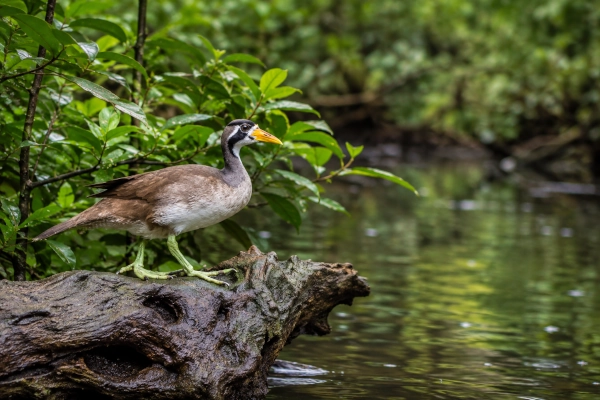
Among the most mysterious waterbirds ever recorded from India is the Masked Finfoot (Heliopais personatus), a secretive inhabitant of shaded rivers, swamp forests, mangroves and forest-fringed wetlands.
Historically, the species occurred across Northeast India and Bangladesh through Myanmar and mainland Southeast Asia to the Malay Peninsula and Sumatra. Its position in India today, however, is considerably more precarious than that description suggests. A major review of the species found that the only securely verified Indian records were specimens collected in Assam and Arunachal Pradesh during the early twentieth century, with no convincing modern evidence confirming a surviving Indian population.
The Masked Finfoot has since undergone catastrophic decline across much of Asia. It was upgraded to Critically Endangered in 2022, and the eastern Sundarbans of Bangladesh are now considered its most important surviving stronghold.
That makes this extraordinary bird not simply another rare species associated with Northeast India, but potentially one of India’s lost birds—one whose rediscovery would rank among the most significant ornithological events in the country.
Scientific Classification
Common name: Masked Finfoot
Scientific name: Heliopais personatus
Alternative name: Asian Finfoot
Family: Heliornithidae
Order: Gruiformes
Historic Indian range: Assam and Arunachal Pradesh
Habitat: Forest rivers, creeks, swamp forest, mangroves and secluded wetlands
Global conservation status: Critically Endangered
The species belongs to the tiny family Heliornithidae, which contains only three living finfoot or sungrebe species worldwide.
A Bird That Looks Like a Duck—but Is Not One
At first glance, a Masked Finfoot swimming through a forest creek can resemble a slender duck.
But it is not a duck.
Its elongated body, long neck and pointed bill combine characteristics reminiscent of rails, grebes and waterfowl. Taxonomically it belongs to the Gruiformes, the wider group that includes rails and cranes.
Adults measure approximately 52–55 centimetres in length.
The upperparts are largely grey-brown or brown, while the underparts are much paler. The bird’s most striking feature is the dark facial mask that gives the species its English name.
Its bill is conspicuously yellowish, and a white stripe runs around the dark facial area and down the side of the neck.
Yet perhaps the most extraordinary feature is hidden beneath the water.
The Extraordinary Green Lobed Feet
The Masked Finfoot does not have the broad webbed feet of a duck.
Instead, each toe possesses a series of individually expanded lobes, producing an unusual paddle-like structure.
The feet are strikingly green and allow the bird to swim efficiently while retaining considerably greater flexibility for walking and gripping branches than conventional webbed feet would provide.
This helps explain one of the finfoot’s unusual behaviours.
It is equally comfortable swimming along a secluded waterway and climbing onto partially submerged logs or low branches overhanging the water.
The name “finfoot” derives directly from this specialised foot structure.
Male and Female Can Be Distinguished
The sexes differ noticeably around the head and neck.
The male generally possesses a black throat and upper fore-neck, complementing the black facial mask.
The female retains the dark facial markings but usually has a whitish throat and fore-neck, surrounded by darker edging.
Eye colour can also differ between the sexes, with males generally having darker or brownish eyes and females showing more yellowish eyes.
These differences become particularly useful in the rare circumstances when observers obtain prolonged views of the bird.
A Creature of Shaded Forest Waterways
The Masked Finfoot is not primarily a bird of large, open lakes.
Its characteristic habitat consists of slow-moving rivers, streams and creeks surrounded by dense lowland forest, as well as swamp forest and mangrove channels.
It tends to favour quiet waterways with overhanging vegetation, submerged branches and relatively undisturbed banks.
This habitat preference helps explain why the species can remain undetected even where it survives.
A bird swimming quietly beneath dense vegetation along a forest river can disappear from view within seconds.
It also means that ordinary wetland protection may not be enough.
The Masked Finfoot depends upon the combination of water and intact forest surrounding that water.
Destroy the riverbank forest while leaving the river intact, and the ecosystem may no longer function as suitable finfoot habitat.
Northeast India Was Once Part of Its Range
Historic records establish that the species occurred in Northeast India.
The comprehensive 2020 review of Masked Finfoot records found that India’s securely documented material consisted of specimens collected in Assam and Arunachal Pradesh during the early twentieth century.
This places India firmly within the species’ historical distribution.
But the same review could find no convincing subsequent evidence establishing continued survival in the country.
That distinction is important.
The Masked Finfoot should not presently be described simply as a regular resident of Northeast Indian wetlands.
It is more accurate to describe Northeast India as part of its historic range, with its present status in the country uncertain and possibly extirpated.
Reports from Elsewhere in India Remain Unconfirmed
There have been occasional claims of Masked Finfoots from other parts of India.
These have included reports from the Indian Sundarbans, Andhra Pradesh and even Rajasthan.
However, the detailed review of the species found that these records lacked adequate photographic, specimen or descriptive evidence and concluded that they should be regarded as unconfirmed.
The Rajasthan report was particularly far outside the recognised range and was considered likely to involve misidentification.
This illustrates the difficulty of establishing the status of an extremely rare species.
When only a handful of birds may remain, a single convincing photograph can dramatically change scientific understanding—but unverified reports cannot safely be treated as proof.
The Global Population Collapsed
The Masked Finfoot once occupied a much broader range across South and Southeast Asia.
Its decline has been severe.
A major international assessment involving researchers associated with the University of Cambridge, BirdLife International, Wildlife Conservation Society and other organisations concluded that the global population might number no more than roughly 304 adult birds, considerably below earlier estimates.
Their analysis showed declines or disappearances across multiple former range countries and warned that the species was approaching extinction.
This work helped lead to the species being reassessed as Critically Endangered in 2022.
Bangladesh’s Sundarbans Become the Main Stronghold
Today, one of the most important surviving populations occurs in the eastern Sundarbans of Bangladesh.
Recent conservation projects estimate that this landscape may support approximately 40–80 breeding pairs, potentially representing a major proportion of the world’s remaining birds.
The Sundarbans provide exactly the kind of habitat the species requires.
Mangrove-lined channels create enormous networks of secluded waterways, while overhanging branches and dense vegetation provide cover.
Breeding has been documented there, making the area particularly significant for the bird’s survival. The Oriental Bird Club has published dedicated observations of Masked Finfoot breeding in the Bangladesh Sundarbans.
BirdLife International now treats the Masked Finfoot as one of the flagship threatened species of conservation efforts along the East Asian-Australasian Flyway.
Why Is the Masked Finfoot Disappearing?
The decline appears to result from several pressures acting simultaneously.
Forested wetlands across its Asian range have been cleared, fragmented or converted for agriculture, settlements, roads and other development.
Riverbanks have been disturbed.
Mangroves and swamp forests have disappeared.
Waterways have experienced increasing human activity.
Hunting, trapping and collection of eggs have also been identified as threats in parts of the range.
For a widespread waterbird, destruction of one wetland may be survivable.
For a species whose total population may now number only a few hundred individuals, the loss of even one productive breeding area can become globally significant.
Secretive Behaviour Makes Conservation Harder
The Masked Finfoot presents another difficulty for researchers—it is exceptionally difficult to survey.
It tends to remain close to vegetation, frequently swimming in shaded channels and avoiding exposed open water.
Its low density further reduces the likelihood of encounters.
Consequently, absence of sightings does not automatically prove absence of birds.
This uncertainty is especially relevant to Northeast India.
Large areas of potentially suitable forest and wetland habitat remain difficult to survey comprehensively.
The possibility that an overlooked population survives cannot be entirely dismissed, but there is presently no strong evidence proving that one does.
Could the Masked Finfoot Still Survive in India?
That is perhaps the most intriguing question surrounding the species.
Recent conservation sources describe it as apparently extirpated from India, reflecting the lack of confirmed modern records.
Yet “extirpated” means locally disappeared rather than globally extinct.
The species continues to survive elsewhere.
And Northeast India still contains extensive riverine and forest landscapes.
Targeted searches in historically suitable habitats of Assam and Arunachal Pradesh could therefore be valuable, particularly using modern survey methods such as remote cameras and systematic searches along secluded forest waterways.
A confirmed living Masked Finfoot in India would represent far more than another bird sighting.
It would demonstrate that a species believed lost from the country had survived unnoticed for generations.
Protecting Forested Wetlands Protects Far More Than One Bird
The Masked Finfoot also demonstrates why wetland conservation cannot be separated from forest conservation.
Traditional conservation categories often distinguish terrestrial forests from aquatic wetlands.
Species such as Heliopais personatus ignore that boundary entirely.
Their ecosystem is the forested wetland itself—the river, the banks, the submerged branches, the surrounding canopy and the invertebrate and vertebrate life supported by all of them.
Protecting only the water without the forest is inadequate.
Protecting only the forest while allowing waterways to become polluted or heavily disturbed is equally inadequate.
The entire ecological system must survive.
One of Asia’s Most Evolutionarily Distinct Waterbirds
The species carries another level of conservation importance because finfoots represent an unusually small and distinctive evolutionary lineage.
Only three living species make up the Heliornithidae worldwide.
Losing the Masked Finfoot would therefore mean losing considerably more evolutionary uniqueness than the disappearance of one species within a large, species-rich bird family.
Its strange lobed green feet, secretive swimming behaviour and unusual relationship with forest waterways represent an evolutionary solution developed by very few birds.
Once gone, that lineage cannot be recreated.
A Bird India Should Search for Again
The Masked Finfoot occupies an unusual place in Indian ornithology.
Unlike the Forest Owlet, which was dramatically rediscovered after more than a century without confirmed records, the Masked Finfoot has not yet received its Indian rediscovery.
The historical evidence is clear: it once occurred in Assam and Arunachal Pradesh.
The modern evidence is equally sobering: despite decades of increased birdwatching and ornithological activity, no confirmed surviving Indian population has emerged.
That makes the species both a conservation tragedy and an unfinished mystery.
Somewhere within the remaining forest rivers and wetlands of Northeast India, there may still be habitat capable of supporting it.
Whether the bird itself remains is another question.
For now, the Masked Finfoot stands as one of the most haunting members of India’s avifaunal history—a Critically Endangered waterbird once recorded from the forests of Assam and Arunachal Pradesh, now surviving principally beyond India’s borders and waiting, perhaps, for one more confirmed sighting from the land it once inhabited.
You may also like
-
Chhattisgarh Plans Innovative Tree Surgery to Save Over 500 Damaged Trees in Udanti Sitanadi Tiger Reserve
-
Kerala’s Peechi Wildlife Survey Records 395 Species, Adds 36 New Entries to Biodiversity Checklists
-
Tiger Returns to Maharashtra’s Beed Forests After Nearly 100 Years, Highlights Importance of Wildlife Corridors
-
Himachal Pradesh Achieves Major Success in Rare Cheer Pheasant Conservation
-
Blackbucks to Return to Chhattisgarh’s Gomarda Wildlife Sanctuary After Five Decades
