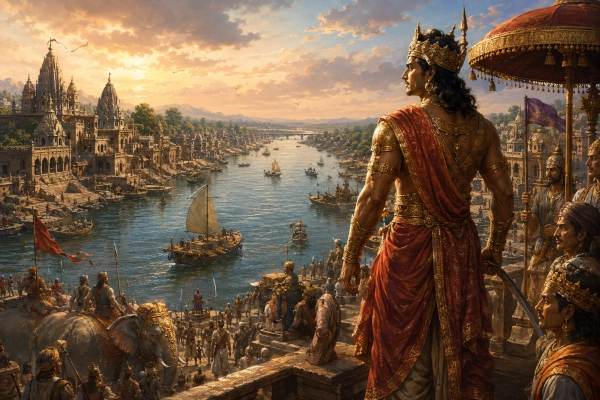
Among the eastern kingdoms that appear repeatedly in the Mahabharata, Anga occupies a particularly memorable place because of its association with Karna. The kingdom lay in the eastern Gangetic region and is generally identified with Bhagalpur and adjoining parts of eastern Bihar, extending toward areas that are now in Jharkhand. Its best-known capital was Champa, associated with the modern Bhagalpur region. The Bhagalpur district administration itself identifies ancient Bhagalpur with the kingdom of Anga and preserves the tradition that Champa became its capital.
In the Mahabharata, however, Anga is far more than merely Karna’s territorial title. His installation as its king becomes one of the defining moments of the epic. It is the moment when Duryodhana transforms Karna from an unknown challenger at the Hastinapura tournament into a crowned monarch, establishing a political and personal friendship that survives until Karna’s death at Kurukshetra.
Anga consequently stands at the intersection of geography, royal legitimacy, friendship, warfare and one of the Mahabharata’s most tragic personal stories.
Anga at a Glance
| Feature | Description |
|---|---|
| Ancient Kingdom | Anga |
| Principal Capital | Champa |
| Earlier name associated with capital | Malini |
| Modern Core Region | Bhagalpur and adjoining eastern Bihar |
| Broader Cultural Geography | Parts of present Bihar and adjoining Jharkhand |
| Country Today | India |
| Most Famous Mahabharata Ruler | Karna |
| How Karna Became King | Installed by Duryodhana at the Hastinapura tournament |
| Principal Political Alignment | Kaurava |
| Major Rival | Arjuna |
| Major Ally | Duryodhana |
| Magadha Connection | Karna later fought Jarasandha and gained additional territory |
| Kurukshetra Role | Anga troops fought principally on the Kaurava side |
| Modern Cultural Centre | Bhagalpur |
| Important Ancient Site | Champapur / Nathnagar |
The Geography of Ancient Anga
Ancient Anga occupied an important position in the eastern Gangetic plain. Its core territory is most strongly associated with the Bhagalpur region of modern Bihar, while its influence appears to have extended into adjoining territories toward present-day Jharkhand. The modern district administration of Bhagalpur directly identifies the region with ancient Anga and notes that the kingdom appears in both the Ramayana and Mahabharata traditions.
The Ganga formed one of the defining geographical features of the region. Modern Bhagalpur still lies alongside the river, surrounded by fertile plains that connect Bihar with Bengal and the eastern regions beyond. Bihar Tourism describes Bhagalpur as lying beside the Ganga amid fertile agricultural country, illustrating the strategic advantages that would have made this region important from antiquity onward.
In broad modern terms, Anga may therefore be represented approximately as:
Bhagalpur – Champapur – Banka – Munger fringe – adjoining areas toward the Jharkhand border
The precise boundaries necessarily remain approximate because ancient kingdoms did not possess fixed borders corresponding to modern districts or states.
Champa: The Capital of Anga
The principal city associated with Anga was Champa.
Bhagalpur’s official historical account preserves a tradition that an earlier capital was called Malini, and that it was subsequently known as Champa after a ruler named Champa. The same account identifies Anga as one of the important ancient eastern kingdoms.
The Mahabharata itself also connects Karna with both Anga and Champa.
In the Shanti Parva, Narada recounts a battle between Karna and Jarasandha. After Karna proved his extraordinary strength, Jarasandha abandoned hostility and established friendship with him. The text states that Jarasandha gave Karna the town of Malini and that Karna thereafter ruled Champa as well.
This suggests that Karna’s political position expanded beyond the territory he initially received from Duryodhana.
Anga became the core of his royal power, while Champa emerged as the great urban centre associated with his rule.
Champapur and Modern Bhagalpur
A surviving cultural memory of Champa is visible in Champapur, now associated with Nathnagar near Bhagalpur.
Bhagalpur district authorities identify the present Champapur area as an ancient and historically important settlement. Today it is particularly famous for the Jain Siddha Kshetra associated with the Tirthankara Vasupujya.
While the archaeological and textual geography of ancient Champa cannot simply be reduced to a single modern neighbourhood, the persistence of the name in the Bhagalpur landscape is significant.
For our modern geographical series:
Ancient Champa → Bhagalpur–Champapur region of Bihar
is the most useful broad identification.
Anga Before Karna
Anga had a history long before Karna.
The official history of Bhagalpur preserves epic and Puranic traditions in which the eastern kingdom was associated with the descendants of Anu and eventually with a ruler named Anga. It also remembers Lomapada, a ruler connected in tradition with King Dasharatha of Ayodhya.
Anga therefore belonged to an already old political and cultural geography when Karna was crowned.
Karna did not create Anga.
Rather, Duryodhana placed him on the throne of an existing and recognised kingdom.
That point is important because it explains the political significance of what happened during the great martial exhibition at Hastinapura.
Karna Appears at the Hastinapura Tournament
One of the defining scenes of the Adi Parva occurs when the Kuru princes publicly demonstrate the martial skills taught to them by Drona.
Arjuna dazzles the spectators with his mastery of weapons.
Then Karna enters.
He challenges Arjuna and demonstrates that he can perform many of the same feats.
The confrontation immediately becomes politically explosive.
Kripa asks Karna to declare his lineage, because according to the rules governing the duel, a prince such as Arjuna should fight another ruler or warrior of recognised royal standing.
Karna cannot provide the pedigree being demanded.
His challenge appears about to collapse.
Then Duryodhana intervenes.
Duryodhana Makes Karna King of Anga
Duryodhana’s solution is immediate and dramatic.
If Karna requires kingship before Arjuna will fight him, Duryodhana declares that he will make him a king.
The Mahabharata describes Karna being seated upon a golden seat and formally installed as king of Anga, with Brahmanas performing the rites, the royal umbrella raised above him and ceremonial fans waved around him.
In one stroke, Duryodhana removes the objection to Karna’s status.
The scene is one of the most consequential political acts in the entire early Mahabharata.
Karna is no longer merely an unknown warrior.
He is now:
Angaraja — King of Anga.
The Gift That Created an Unbreakable Alliance
After his coronation, Karna asks Duryodhana what he can possibly give in return for such an extraordinary gift.
Duryodhana asks only for his friendship.
Karna accepts.
The two embrace.
This exchange becomes the foundation of Karna’s lifelong loyalty.
The political calculation was clear.
Duryodhana had found perhaps the only warrior capable of rivalling Arjuna.
By giving Karna a kingdom, he simultaneously elevated him socially, bound him personally and gained one of the greatest champions of his cause.
For Karna, the gift had even greater emotional significance.
At the moment when his birth and status were being used to humiliate him, Duryodhana publicly recognised his ability and gave him royal dignity.
This is why Anga becomes inseparable from the relationship between the two men.
Anga Gave Karna Political Legitimacy
The coronation of Karna was not merely ceremonial.
Kingship gave Karna an independent territorial base.
From that point onward the epic repeatedly calls him the ruler of Anga.
During the Rajasuya assembly, Shishupala refers to Karna as ruler of the territories of Anga and Vanga, demonstrating that his authority had expanded significantly by that stage of the narrative.
The transformation was therefore remarkable.
Karna first appears at Hastinapura as a warrior whose ancestry is publicly questioned.
He later stands among the great kings of Bharat.
Anga is the political bridge between those two identities.
Karna and Jarasandha
Karna’s connection with neighbouring Magadha adds another fascinating dimension to Anga’s history.
The Shanti Parva recounts that Jarasandha, king of Magadha, challenged Karna after hearing about his military reputation.
The two first fought with weapons.
When their weapons were exhausted or broken, they continued in hand-to-hand combat.
Karna eventually gained such an advantage that Jarasandha ended the struggle and chose friendship instead.
The episode is especially significant because Jarasandha was one of the most formidable rulers in the Mahabharata.
A warrior capable of forcing Jarasandha to abandon hostility possessed extraordinary prestige.
Jarasandha Gives Karna Malini
Following their reconciliation, Jarasandha granted Karna Malini.
The Mahabharata then notes that Karna, who had previously been ruler of Anga, began ruling over Champa also.
The exact relationship among Anga, Malini and Champa is expressed somewhat differently in different textual and later geographical traditions. Bhagalpur’s official history preserves the tradition that the capital originally known as Malini later came to be called Champa.
What matters for the epic narrative is that Karna’s position grew.
He did not remain a ceremonial monarch dependent entirely upon Duryodhana.
He became a recognised regional ruler whose military prowess could command the respect even of Jarasandha.
Anga Between Magadha and the Eastern Kingdoms
Geographically, Anga occupied an important position.
To its west lay Magadha.
To its east were territories leading toward Vanga and the lower Gangetic world.
To the south lay uplands that connected the Gangetic plain with the regions now divided between Bihar and Jharkhand.
This location made Anga a natural eastern corridor.
Its political history also demonstrates the competition between eastern kingdoms. The Bhagalpur district history preserves later traditions in which Anga and Magadha fought repeatedly before Magadha ultimately absorbed Anga during the age associated with Bimbisara.
That occurred in a much later historical context and should not be confused with the Mahabharata narrative.
Yet it illustrates why the Anga-Magadha frontier was strategically important for centuries.
Bhima and Anga
The Mahabharata also remembers Bhima as having campaigned through the eastern kingdoms.
In the Udyoga Parva, Bhima is praised as the warrior who had previously defeated peoples including Kasi, Anga, Magadha and Kalinga.
This places Anga within the eastern sphere over which Pandava military power had at some stage been asserted.
The Mahabharata’s political geography was fluid.
A ruler could accept tribute or submit during a digvijaya without permanently becoming a loyal ally.
Karna remained inseparably tied to Duryodhana despite the broader Pandava campaigns in eastern Bharat.
Anga at Yudhishthira’s Rajasuya
Karna’s status as a major eastern ruler is visible during Yudhishthira’s Rajasuya.
When Shishupala disputes the decision to honour Krishna, he points to other powerful rulers who, in his opinion, were equally or more worthy of praise.
Among them he specifically names Karna, ruler of Anga and Vanga, and recalls Karna’s remarkable encounter with Jarasandha.
The reference reveals how far Karna had risen.
The warrior who once needed Duryodhana to give him royal status is now invoked in a gathering of kings as one of the great rulers of Bharat.
Anga Joins the Kaurava War Effort
When the Kurukshetra War began, Karna’s political loyalty naturally placed Anga within the Kaurava sphere.
The epic repeatedly mentions Anga warriors and elephant forces fighting alongside the Kaurava coalition.
In the Drona Parva, the ruler of the Angas attacks Bhima while mounted upon an elephant. Bhima kills both the elephant and the ruler, after which the Anga divisions break and retreat.
This demonstrates that the Anga contingent at Kurukshetra was not restricted merely to Karna’s personal followers.
The kingdom fielded identifiable military formations.
The Elephant Warriors of Anga
One particularly striking feature of Anga’s battlefield presence is its association with elephants.
During Arjuna’s advance in the Drona Parva, the epic describes thousands of trained elephant-riders from Anga surrounding him. Arjuna responds with the Gandiva and destroys large numbers of the advancing force.
Another Karna Parva passage lists Angas among the eastern peoples fighting with large elephant contingents alongside Vangas, Pundras, Magadhas and Kalingas.
This fits the broader military character assigned by the Mahabharata to many eastern kingdoms.
Elephants were among their most formidable battlefield assets.
Karna: Anga’s Most Famous King
No ruler is more completely associated with Anga in popular memory than Karna.
His identity as Angaraja survives independently of almost every other political detail of the kingdom.
Yet Karna’s kingship carries a tragic irony.
Duryodhana’s gift provides him with the royal status that society initially denied him.
But that very gift also binds him to Duryodhana’s political fortunes.
Even when Krishna later reveals Karna’s true birth as the eldest son of Kunti and offers him an entirely different future, Karna refuses to abandon the friend who had stood beside him when others rejected him.
Anga therefore represents both Karna’s elevation and his bond of obligation.
Karna’s Death and the End of an Epic Relationship
Karna eventually assumes supreme military responsibility for the Kaurava cause after the deaths of Bhishma and Drona.
His long-awaited confrontation with Arjuna comes during the Karna Parva.
Karna is ultimately killed by Arjuna, ending the life of the warrior who had first emerged publicly as Arjuna’s rival at the Hastinapura tournament.
The Shanti Parva later looks back upon his life and again describes him through his connections with Anga, Champa, Jarasandha and Duryodhana.
Thus the kingdom remains part of Karna’s story from his political birth to his post-war remembrance.
Anga on the Modern Map
For our modern geography series, the best broad representation is:
Anga → Bhagalpur and adjoining eastern Bihar → extending toward parts of present Jharkhand → India
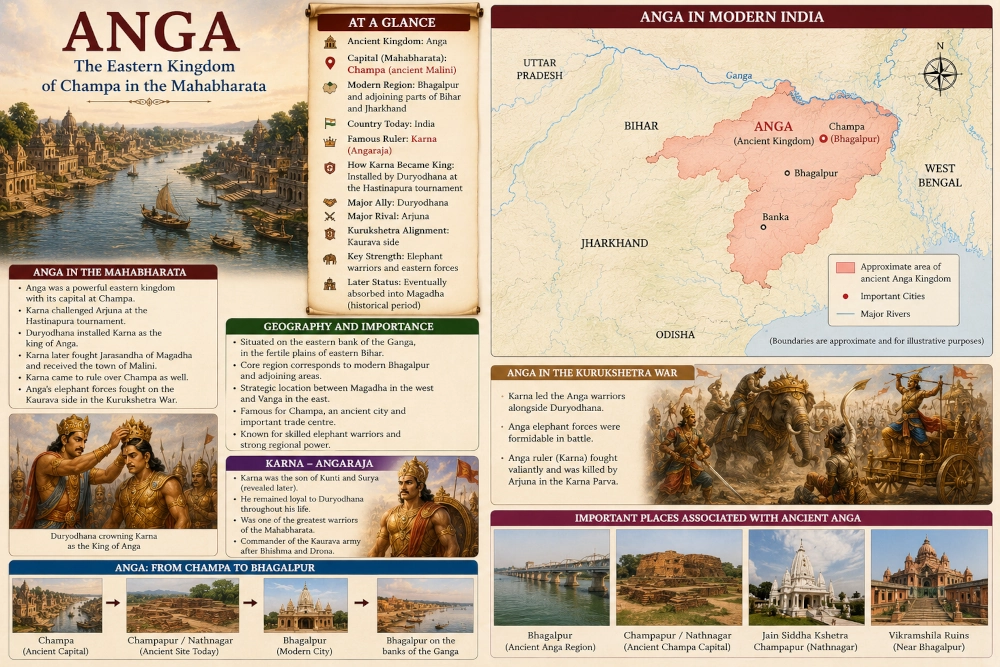
Modern Identification
| Ancient Geography | Modern Geography |
|---|---|
| Anga | Eastern Bihar and adjoining Jharkhand |
| Core Region | Bhagalpur |
| Capital | Champa |
| Modern Champa association | Champapur / Nathnagar near Bhagalpur |
| Important adjoining areas | Banka and regions toward the Jharkhand frontier |
| Major River | Ganga |
| Modern State primarily associated | Bihar |
| Country | India |
The ancient kingdom should be shown as an approximate cultural-political region, not as an exact modern administrative boundary.
Anga Beyond the Mahabharata
Anga survived in Indian historical memory long after the epic period.
Buddhist and Jain literature later counted Anga among the important kingdoms of northern India. Bihar’s official historical account notes that Anga was one of the Mahajanapadas associated with the region before it was eventually absorbed into the expanding Magadhan state.
Champa itself continued to remain important.
The Bhagalpur district administration notes traditions connecting Champa with later political and religious developments, while modern Champapur remains a major Jain sacred centre.
Centuries later, the broader Bhagalpur region would also become home to Vikramshila, one of the celebrated centres of Buddhist learning founded during the Pala period.
These later developments should not be projected backward into the Mahabharata era, but they demonstrate the extraordinary continuity of eastern Bihar as a major cultural landscape.
Anga’s Place in the Mahabharata
Anga’s importance in the Mahabharata can ultimately be understood through one man.
Karna.
Duryodhana’s decision to make him king of Anga transforms the entire course of the epic.
Without that coronation, Karna might have remained an extraordinary but politically isolated warrior.
With it, he gains royal legitimacy, territory and status.
Duryodhana gains the friend and champion who will remain loyal to him even when the cost becomes death.
The coronation therefore accomplishes three things simultaneously:
it creates Angaraja Karna, establishes one of the strongest friendships in the epic, and gives the Kaurava cause its greatest rival to Arjuna.
Karna later expands his prestige through his encounter with Jarasandha, becomes recognised as ruler over Anga and Champa, and stands among the great kings assembled during Yudhishthira’s Rajasuya.
When the Kurukshetra War begins, the warriors and elephants of Anga fight alongside the Kauravas, while Karna himself ultimately takes command of Duryodhana’s army.
Today the political kingdom has vanished, but its geography remains identifiable.
Bhagalpur still stands beside the Ganga. Champapur preserves the ancient name. And across Indian cultural memory, Karna remains Angaraja — the King of Anga.
References
Mahabharata — Adi Parva, Sambhava Parva
Karna challenges Arjuna at the Hastinapura tournament and Duryodhana immediately installs him as king of Anga.
Mahabharata — Sabha Parva
Karna is described as ruler of Anga and Vanga and his combat with Jarasandha is recalled during the Rajasuya assembly.
Mahabharata — Shanti Parva
Narada recounts Karna’s duel with Jarasandha and his subsequent acquisition of Malini and authority over Champa.
Mahabharata — Udyoga Parva
Bhima is remembered as having defeated Anga among other eastern kingdoms.
Mahabharata — Drona Parva
Anga rulers, troops and large elephant formations participate in the Kurukshetra War on the Kaurava side.
Bhagalpur District Administration, Government of Bihar
Identifies the Bhagalpur region with ancient Anga and preserves traditions concerning Malini, Champa and the later history of the kingdom.
Bhagalpur District Administration — Champapur
Documents modern Champapur near Nathnagar as an ancient religious and historical centre.
You may also like
-
Kapisa: The Ancient Kingdom North of Kabul at the Gateway of the Hindu Kush
-
Lampaka: The Mountain Kingdom of Laghman on the Kabul River Frontier
-
Navaratri and Ayurveda: The Nine Divine Medicinal Plants Associated with Navadurga
-
Bahlika: The Ancient Bactrian Realm of Balkh in the Mahabharata
-
Kamboja: The Horse-Breeding Frontier Kingdom of the Hindu Kush in the Mahabharata
