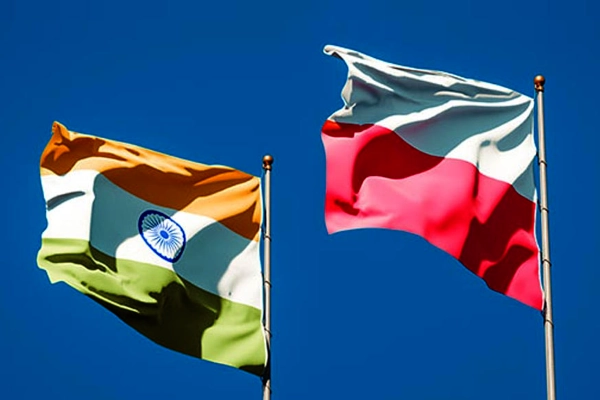
India and Poland have announced a series of initiatives to strengthen their strategic partnership, including a target to double bilateral trade by 2030, establish a Defence Industry Dialogue and expand cooperation in emerging technologies, critical minerals and infrastructure.
The announcements followed discussions between Prime Minister Narendra Modi and Polish Prime Minister Donald Tusk during the latter’s official visit to India from October 21 to 23, 2026. Tusk was accompanied by a high-level delegation comprising approximately 100 leading business executives and industry representatives, reflecting the growing economic importance of bilateral relations.
The two leaders reviewed progress under the India–Poland Strategic Partnership, established during Modi’s visit to Warsaw in August 2024. They reaffirmed their commitment to implementing the bilateral Action Plan for 2024–2028 while identifying additional opportunities in industrial development, defence, research and international connectivity.
India and Poland Set Target to Double Bilateral Trade by 2030
One of the principal outcomes of the discussions was the agreement to target a doubling of bilateral trade by 2030. Both governments recognised the complementary strengths of their economies and encouraged greater investment, industrial partnerships and business exchanges.
Prime Minister Modi invited Polish companies to expand their manufacturing and business operations in India by taking advantage of the country’s growing industrial ecosystem, skilled workforce and domestic market. Poland, meanwhile, highlighted its position as an important gateway for Indian businesses seeking access to Central and Eastern Europe and the wider European Union.
The leaders welcomed the India–Poland Business Forum held during the visit and encouraged companies to explore opportunities in industrial machinery, defence equipment, pharmaceuticals, infrastructure, mining, critical minerals, energy and information technology.
Both countries also agreed to resume activities under their bilateral agricultural working group to facilitate greater agricultural cooperation and trade.
New Defence Industry Dialogue to Promote Joint Manufacturing
Defence cooperation emerged as another important component of the discussions, with India and Poland agreeing to establish a dedicated Defence Industry Dialogue to strengthen engagement between their defence manufacturing sectors.
The proposed mechanism will encourage direct cooperation between Indian and Polish defence companies, focusing on commercially viable partnerships, technology collaboration and opportunities for joint development and production.
Both leaders welcomed the outcomes of the eighth meeting of the India–Poland Joint Working Group on Defence, held in Warsaw in September 2026. They also supported continued exchanges between their respective defence establishments and closer interaction between military technology companies.
The discussions further covered cybersecurity, defence innovation and critical technologies. Both sides emphasised the importance of concluding an agreement governing the mutual protection and exchange of classified information to support future security cooperation.
The Defence Industry Dialogue provides an additional institutional channel for Indian manufacturers seeking technological partnerships and opportunities within Europe’s defence industrial ecosystem.
Cooperation in Artificial Intelligence, Semiconductors and Quantum Technologies
India and Poland agreed to encourage collaborative research in artificial intelligence, semiconductors and quantum technologies while strengthening connections between their startup ecosystems.
Both governments recognised the growing importance of advanced technologies in industrial productivity, economic development and public services. They supported closer collaboration between enterprises, universities, research institutions and technology companies.
Semiconductor cooperation received particular attention, reflecting the importance of electronics manufacturing and resilient technology supply chains to both economies.
The proposed collaboration will complement wider India–European Union initiatives in digital technologies, research and industrial innovation.
Critical Minerals, Rare Earth Refining and Battery Recycling
The two countries identified opportunities for cooperation in critical minerals, geological exploration, mining and advanced materials processing.
Particular attention was given to the circular economy, including battery recycling and rare earth mineral refining. These sectors have become increasingly important for electric mobility, renewable energy systems, electronics and advanced industrial manufacturing.
India and Poland are also negotiating a memorandum of understanding covering cooperation in geology, mining and critical minerals.
The proposed collaboration could support India’s efforts to develop domestic mineral-processing capabilities while creating opportunities for industrial partnerships involving specialised Polish technologies and expertise.
Poland Joins India’s Coalition for Disaster Resilient Infrastructure
Poland announced its decision to join the Coalition for Disaster Resilient Infrastructure (CDRI), an international initiative launched by India to promote infrastructure capable of withstanding natural disasters and climate-related risks.
India welcomed Poland’s participation and also invited the European country to join the International Solar Alliance and the Global Biofuels Alliance.
Both leaders emphasised the importance of clean energy, sustainable technologies and climate-resilient development. They recognised the need to strengthen domestic energy capabilities while improving industrial competitiveness and reducing exposure to disruptions in global energy markets.
Poland’s participation in CDRI expands the initiative’s international engagement and creates additional opportunities for cooperation in infrastructure resilience and disaster management.
Direct Flights, Shipping and Maritime Connectivity
India and Poland agreed to explore opportunities for strengthening direct air connectivity between the two countries.
The leaders encouraged their respective civil aviation authorities to conduct discussions on potential direct flight services. Improved air connectivity would support tourism, business travel, educational exchanges and commercial engagement.
Both countries also identified shipping, port cooperation and maritime security as areas for closer collaboration.
The discussions highlighted the importance of secure and diversified international supply chains, including the potential role of the India–Middle East–Europe Economic Corridor in improving connectivity between Indian and European markets.
The two sides additionally agreed to develop scientific cooperation in polar affairs, opening another area for institutional and research partnerships.
India and Poland Agree to Strengthen Counter-Terrorism Cooperation
Prime Ministers Modi and Tusk reaffirmed their opposition to terrorism in all its forms, including cross-border terrorism, and agreed to establish a dialogue on counter-terrorism.
The leaders strongly condemned the terrorist attack in Pahalgam, Jammu and Kashmir, on April 22, 2025. They called for coordinated international action against terrorist organisations, their financing networks and infrastructure supporting terrorist activities.
Both countries reiterated the importance of implementing United Nations counter-terrorism measures and supported the early adoption of the Comprehensive Convention on International Terrorism.
The proposed dialogue will provide a framework for closer bilateral engagement on shared security concerns.
Poland Reaffirms Support for India’s UN Security Council Aspirations
Poland reiterated its support for India’s membership of a reformed and expanded United Nations Security Council.
Warsaw also reaffirmed its support for India’s candidature for a non-permanent seat on the Security Council for the 2028–2029 term.
Both leaders called for structural reforms to improve the effectiveness and representation of the United Nations, including expansion of the Security Council in its permanent and non-permanent categories.
The discussions also addressed developments in Ukraine, international law, maritime security and the importance of maintaining peace and stability in the Indo-Pacific.
India invited Poland to join the Indo-Pacific Oceans Initiative, while both countries reaffirmed their interest in strengthening cooperation through the Visegrad Group–India framework.
Education, Cultural Exchanges and Historical Connections
India and Poland agreed to deepen cooperation in higher education, scientific research, cultural exchanges and tourism.
The leaders welcomed the ICCR Chair of Indian Studies at Jagiellonian University in Kraków and acknowledged Poland’s longstanding academic interest in Sanskrit and Indology.
Both sides encouraged greater collaboration between universities, including student exchanges, faculty mobility and joint research programmes.
The discussions also highlighted the historical ties established during the Second World War, when India provided refuge to thousands of Polish women and children.
The leaders acknowledged the continuing importance of the Jam Saheb Memorial Youth Exchange Programme and welcomed the completion of its second edition in October 2026.
They also recalled Poland’s assistance in facilitating the evacuation of more than 2,000 Indian students stranded in Ukraine during Operation Ganga.
India–Poland Strategic Partnership Enters a New Phase
The October 2026 discussions build upon the Strategic Partnership established in August 2024 and the bilateral Action Plan for 2024–2028.
The latest announcements place greater emphasis on measurable economic objectives, industrial cooperation and institutional engagement. The target of doubling bilateral trade by 2030 provides a clear economic goal, while the proposed Defence Industry Dialogue establishes a framework for closer manufacturing and technology partnerships.
Cooperation in semiconductors, artificial intelligence, critical minerals, infrastructure and clean energy further broadens the relationship beyond conventional diplomatic and commercial exchanges.
With growing engagement between businesses, research institutions and government agencies, India and Poland are strengthening the foundations of a diversified partnership connecting India’s expanding economy with the industrial and technological capabilities of Central Europe.
References
- Press Information Bureau, Government of India — List of Outcomes: Official Visit of Prime Minister of Poland to India, October 22, 2026.
- Press Information Bureau, Government of India — India–Poland Joint Statement, October 22, 2026, Release ID: 2326568.
- Ministry of External Affairs, Government of India — India–Poland Strategic Partnership and Action Plan 2024–2028.
You may also like
-
Russia Ratifies Temporary Employment Agreement with India, Expanding Opportunities for Skilled Workers
-
Indian Navy’s First Training Squadron Arrives in Maldives, Strengthening Maritime Defence Cooperation
-
India and Uzbekistan Strengthen Counter-Terrorism Cooperation, Focus on Terror Financing and Regional Security
-
India Calls for Legally Binding International Treaty to Prevent Weaponisation of Outer Space
-
India and New Zealand Strengthen Trade Ties with Electronic Origin Data Exchange Agreement Under FTA
