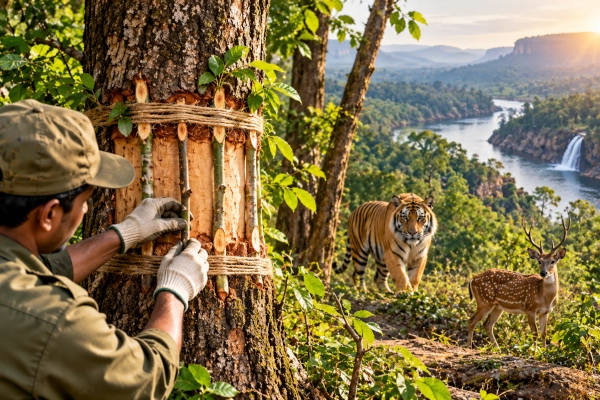
The Chhattisgarh Forest Department is preparing an innovative conservation initiative to save more than 500 trees damaged by deliberate bark removal inside the Udanti Sitanadi Tiger Reserve. The proposed intervention involves a specialised technique known as bridge grafting, which can help restore the flow of nutrients through damaged tree trunks and potentially prevent the death of affected trees.
The conservation effort focuses on Karka village within the tiger reserve, where forest officials have identified extensive damage to mature trees. A recent departmental inspection recorded approximately 2,500 trees affected by girdling, a destructive practice that involves removing a ring of bark from a tree to interrupt its nutrient supply.
The Forest Department has identified more than 500 recently damaged trees that could benefit from timely treatment. Specialist assistance is being sought to assess their condition and determine suitable restoration methods.
The initiative represents an unusual approach to forest conservation, where scientific horticultural techniques will be used to preserve existing mature trees rather than relying exclusively on replacement planting.
Forest Survey Identifies 2,500 Damaged Trees in Tiger Reserve
The Udanti Sitanadi Tiger Reserve extends across parts of Chhattisgarh’s Gariaband and Dhamtari districts and forms an important component of the state’s protected forest network.
During inspections conducted between September 22 and October 10, 2026, forest officials identified approximately 2,500 girdled trees in the Karka area. The affected species primarily include Sal (Shorea robusta), Bija (Pterocarpus marsupium) and Tendu (Diospyros melanoxylon).
Many of these trees have suffered damage over an extended period, while more than 500 appear to have been girdled recently. Forest authorities believe the freshly damaged trees offer better prospects for recovery because some of their living tissues may remain capable of supporting restoration.
Udanti Sitanadi Tiger Reserve Deputy Director Varun Kumar Jain has highlighted the importance of preventing further forest degradation while attempting to restore trees that remain alive.
The department’s approach combines field assessments, technological monitoring and specialised treatment to improve the prospects of forest regeneration.
What Is Girdling and How Does It Kill Trees?
Girdling is the removal of a continuous band of bark from around a tree trunk. Although the damage may initially appear superficial, it can interfere with essential physiological processes.
Tree bark contains the phloem, a specialised tissue responsible for transporting sugars and other organic nutrients from leaves to growing tissues and roots.
When girdling removes the phloem around the entire circumference of a trunk, this downward transport is interrupted. The roots gradually lose access to the nutrients required for respiration, growth and maintenance.
The affected tree may continue producing leaves for some time because water can still move upward through the xylem, provided that tissue remains intact. However, the prolonged interruption of nutrient transport can eventually weaken the root system and cause the tree to die.
The severity of girdling depends on the extent of tissue removal, the tree species, its age and its physiological condition.
Freshly damaged trees may retain enough living tissue to support treatment. Older injuries that have already caused extensive root decline are considerably more difficult to reverse.
Bridge Grafting Could Restore Nutrient Transport in Damaged Trees
The Forest Department is considering bridge grafting as a possible method of saving recently girdled trees.
Bridge grafting is a horticultural technique traditionally used to repair trees whose bark has been severely damaged by animals, mechanical injuries or other causes.
The procedure involves placing suitable living shoots or scions across the damaged section of the trunk. These are joined to healthy tissues above and below the wound, creating a biological connection that can eventually restore the movement of nutrients.
The grafted material must establish a living connection with the tree’s cambium, the layer of actively dividing cells responsible for producing new vascular tissues.
When the grafts establish successfully, they can provide alternative pathways for nutrient transport across the damaged region.
The treatment requires considerable technical precision because graft compatibility, cambial alignment, moisture conditions and the physiological condition of the tree influence the outcome.
Bridge grafting does not guarantee survival, particularly when the roots have already suffered severe damage. However, it provides an opportunity to preserve trees that might otherwise deteriorate following extensive girdling.
Conservation Expert Vijay Nishanth to Assist Forest Restoration
The Forest Department is seeking assistance from conservationist Vijay Nishanth, known for his work in tree preservation through the Project Vruksha Foundation.
Often referred to as the Tree Doctor, Nishanth is expected to assess the affected trees and recommend suitable methods for restoring damaged tissues.
His proposed visit will involve examining the condition of recently girdled trees, identifying those with realistic recovery prospects and advising forest personnel on appropriate treatment procedures.
Bridge grafting is among the techniques under consideration, alongside other forms of specialised tree care.
The involvement of an experienced conservation practitioner will also provide opportunities for forest personnel to improve their understanding of tree restoration techniques.
Developing local expertise could help reserve authorities undertake similar interventions in other parts of the protected forest where girdling or mechanical injuries threaten mature trees.
Earlier Tree Restoration Attempt Recorded Limited Success
Udanti Sitanadi Tiger Reserve authorities previously attempted bridge grafting on girdled trees in the Taurenga Range during 2022.
According to Deputy Director Varun Kumar Jain, the earlier intervention achieved a success rate of approximately 10 per cent.
The department has also used a treatment involving the application of cow dung and soil to damaged portions of tree trunks, followed by wrapping the affected areas with gunny bags.
Such traditional protective measures are intended to cover exposed tissues, although their effectiveness depends on the nature of the injury and the tree’s condition.
Forest officials have observed that treatment before the monsoon can offer favourable conditions for tissue growth and recovery.
The limited success of earlier interventions has encouraged the department to seek specialised technical assistance and evaluate more effective treatment procedures.
The latest initiative will therefore provide an opportunity to improve practical restoration methods while building upon experience gained from previous attempts.
Satellite Imagery and Drone Surveys Reveal Forest Degradation
The conservation initiative follows wider investigations into forest degradation within the Karka area.
Forest authorities have used Differential Global Positioning System (DGPS) technology, drone surveys and historical satellite imagery to examine changes in forest cover.
Images obtained through the Indian Space Research Organisation’s satellite systems provided information about the area’s earlier vegetation cover, while recent surveys helped identify damaged and cleared forest sections.
The combination of satellite observations and ground inspections allows forest managers to compare changes over time and identify locations requiring conservation intervention.
Such technologies are increasingly important in protected-area management because they enable authorities to monitor extensive and difficult-to-access forest landscapes.
For Udanti Sitanadi Tiger Reserve, remote sensing can support the identification of damaged vegetation, assessment of habitat changes and planning of restoration activities.
The use of geospatial technology alongside specialised tree treatment demonstrates how modern scientific tools can complement conventional forest management practices.
Forest Encroachment Raises Concerns About Habitat Protection
Forest authorities suspect that deliberate girdling in the Karka area is connected with attempts to clear forest vegetation for cultivation.
Officials have reported extensive damage to mature trees and expressed concern that newly girdled trees indicate continuing pressure on the protected landscape.
The Forest Department is pursuing measures to prevent further damage while examining the circumstances surrounding the affected areas.
Forest protection in such landscapes requires careful coordination among conservation authorities, local communities and government agencies responsible for land administration.
Maintaining healthy forest cover is important for protecting wildlife habitats, preventing soil erosion and preserving ecological processes.
The department’s immediate priority is to prevent the loss of recently damaged trees while strengthening protection of the surrounding forest.
Restoring injured trees and preventing additional girdling are complementary elements of a broader conservation strategy.
Protecting the Mahanadi River’s Forest Catchment
The conservation initiative has importance beyond the survival of individual trees because Udanti Sitanadi Tiger Reserve forms part of the wider forested landscape associated with the Mahanadi River system.
The reserve includes areas linked to the upper catchments of rivers that contribute to the Mahanadi basin.
Healthy forests support watershed functions by protecting soil, influencing water infiltration and reducing surface erosion.
Mature trees also contribute to the stability of forest ecosystems through their extensive root systems, vegetation cover and interactions with surrounding plant communities.
The loss of large numbers of trees can affect habitat quality and contribute to environmental degradation, particularly where forest clearance exposes soil to intense seasonal rainfall.
Preserving existing mature trees can therefore support both biodiversity conservation and the ecological stability of the river catchment.
The restoration programme aims to retain valuable forest vegetation while reducing the need for replacement planting in areas where damaged trees can still recover.
Indigenous Knowledge and Scientific Restoration to Work Together
Forest officials are also exploring the contribution of traditional ecological knowledge to the restoration effort.
Communities living in and around forest landscapes often possess practical knowledge of local tree species, seasonal growth patterns and traditional methods of caring for damaged vegetation.
Such knowledge can complement scientific approaches by providing insights into local ecological conditions and species-specific characteristics.
The Forest Department intends to combine technical guidance with available local experience to improve the treatment of affected trees.
This approach recognises that successful forest restoration depends on more than the application of a single technique. Species characteristics, weather conditions, soil moisture and the extent of injury all influence recovery.
Combining specialised horticultural procedures with local ecological understanding can help develop restoration practices suited to the conditions of the tiger reserve.
Tree Surgery Offers a New Approach to Forest Conservation
Conventional forest restoration frequently concentrates on planting saplings to replace lost vegetation. While afforestation and natural regeneration remain important, preserving mature trees offers distinct ecological advantages.
Large trees already possess developed root systems, extensive canopies and established relationships with surrounding organisms.
They provide nesting sites, food resources, shelter and microhabitats for numerous forest species. Mature trees also store substantial quantities of carbon accumulated over decades of growth.
Replacing a mature tree with a sapling cannot immediately reproduce these ecological functions.
Specialised interventions such as bridge grafting offer another conservation option by attempting to preserve existing trees that remain physiologically capable of recovery.
The method requires careful assessment and sustained monitoring, but successful treatment can retain important elements of the forest ecosystem.
For conservation authorities managing protected areas, developing practical techniques for saving injured mature trees could complement existing approaches to habitat restoration.
Udanti Sitanadi Initiative Could Support Wider Forest Restoration Efforts
The Chhattisgarh Forest Department’s plan to treat more than 500 recently girdled trees represents an important attempt to apply specialised biological restoration techniques within a protected forest landscape.
The initiative combines field surveys, satellite monitoring, technical expertise and local ecological knowledge to address a problem that threatens mature forest vegetation.
The involvement of conservation specialists will help authorities assess individual trees and improve treatment methods based on their condition and capacity for recovery.
Experience gained from the programme could contribute to better restoration practices in other forest areas affected by deliberate bark removal, wildlife damage or mechanical injuries.
The effort also reinforces the importance of protecting existing forest resources alongside conventional afforestation programmes.
By attempting to save mature Sal, Bija and Tendu trees within Udanti Sitanadi Tiger Reserve, Chhattisgarh is exploring an approach that places greater emphasis on preserving living forest assets and strengthening long-term ecosystem resilience.
The initiative provides an opportunity to combine traditional conservation knowledge with modern horticultural science while advancing the protection of India’s forests and biodiversity.
References
1. The Indian Express — October 21, 2026
Chhattisgarh Seeks Expert Help for ‘Surgery’ to Save Over 500 Damaged Trees.
Reports the Forest Department’s proposed tree restoration programme, expert involvement and earlier bridge-grafting efforts.
https://indianexpress.com/article/india/chhattisgarh-seeks-expert-help-for-surgery-to-save-over-500-damaged-trees-10930043
2. Deccan Chronicle — October 18, 2026
Chhattisgarh Tiger Reserve Launches Tree Restoration Drive to Revive Mahanadi Catchment.
Includes statements attributed to Udanti Sitanadi Tiger Reserve Deputy Director Varun Kumar Jain concerning tree damage, restoration techniques and conservation measures.
https://www.deccanchronicle.com/amp/nation/in-a-first-cgarh-reserve-origin-landscape-of-mahanadi-river-set-to-launch-specialized-conservation-initiative-to-restore-girdled-trees-reports-1996997
3. The Indian Express — October 2026
Chhattisgarh Tiger Reserve Finds 2,500 Trees Girdled; Satellite Images Show Scale.
Reports the Forest Department’s investigation into tree girdling, damage assessment and use of remote sensing.
https://indianexpress.com/article/india/chhattisgarh-udanti-sitanadi-tiger-reserve-tree-girdling-encroachment-10905019
4. Udanti Sitanadi Tiger Reserve — Chhattisgarh Forest Department
Official information on the protected area and its conservation administration.
Home
You may also like
-
Kerala’s Peechi Wildlife Survey Records 395 Species, Adds 36 New Entries to Biodiversity Checklists
-
Tiger Returns to Maharashtra’s Beed Forests After Nearly 100 Years, Highlights Importance of Wildlife Corridors
-
Himachal Pradesh Achieves Major Success in Rare Cheer Pheasant Conservation
-
Blackbucks to Return to Chhattisgarh’s Gomarda Wildlife Sanctuary After Five Decades
-
Asiatic Lions Return to Barda Wildlife Sanctuary After 144 Years as Scientific Study Confirms Habitat’s Conservation Potential
