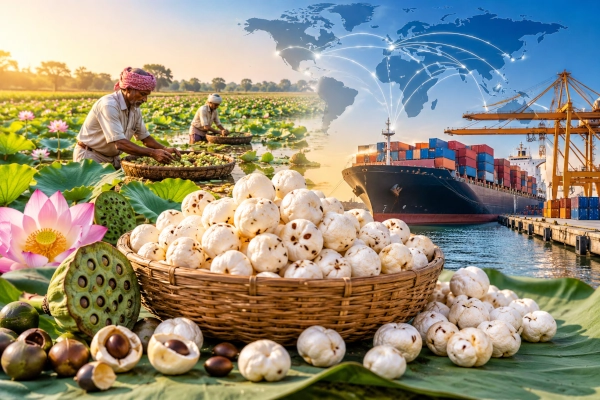
India’s traditional makhana industry is emerging as an important contributor to agricultural exports, with the country exporting 7,264.89 metric tonnes of makhana and related products worth ₹192.96 crore during FY2025–26. According to the Ministry of Agriculture and Farmers Welfare, rising international demand for nutritious, plant-based foods is creating new opportunities for Indian farmers, food-processing enterprises and agricultural exporters.
Bihar remains the centre of India’s makhana industry, with its GI-tagged Mithila Makhana gaining recognition in domestic and international markets. The state accounts for nearly three-fourths of India’s production and approximately 80–85% of global makhana supply. Government initiatives, improved cultivation technologies and the growing participation of food-processing startups are helping transform this traditional aquatic crop into an increasingly valuable agricultural commodity.
The establishment of the National Makhana Board and the approval of a ₹476.03 crore development scheme have provided additional institutional support for improving cultivation, processing, branding and exports. These initiatives aim to strengthen the entire makhana value chain while creating greater economic opportunities for farmers and rural enterprises.
India’s Makhana Exports Reach 7,264.89 Metric Tonnes
India exported 7,264.89 metric tonnes of makhana products during FY2025–26, generating export earnings of ₹192.96 crore. The figures were published in an official government assessment of the makhana sector released on 19 August 2026.
The United States, Canada and the United Arab Emirates account for a substantial share of India’s makhana exports. According to the government’s assessment, the United States represents approximately 40% of the export market, followed by Canada with 20% and the UAE with 17%.
Together, these three destinations account for approximately 77% of India’s makhana exports. Other important markets include the United Kingdom, Germany, Australia and Nepal.
The government has also identified differences in export prices across international destinations. Premium markets such as Germany and Australia offer higher unit-price realisations, creating opportunities for Indian exporters to expand their presence in specialised food and health-conscious consumer segments.
The growing international demand reflects makhana’s increasing acceptance as a plant-based snack that can be marketed in several forms, including roasted, flavoured and ready-to-eat products.
Bihar Remains India’s Leading Makhana-Producing State
India is the world’s largest producer of makhana, scientifically known as Euryale ferox. The crop is cultivated primarily in Bihar, West Bengal and Assam, with Bihar accounting for the largest share of national production.
According to the Second Advance Estimates for 2025–26, India’s makhana production is estimated at 80,590 metric tonnes, compared with 63,910 metric tonnes in 2024–25. Bihar alone is estimated to produce approximately 60,000 metric tonnes during 2025–26.
Makhana cultivation is particularly concentrated in northern Bihar, especially the Mithila, Kosi and Seemanchal regions. Major producing districts include Darbhanga, Madhubani, Purnia, Katihar, Saharsa, Supaul, Araria, Madhepura and Sitamarhi.
The crop grows in shallow ponds, wetlands and other water bodies. Traditional cultivation requires considerable skill, particularly during seed collection and processing.
Farmers harvest the seeds from aquatic plants before cleaning, drying, roasting and popping them to produce the familiar white makhana consumed as a snack.
The concentration of cultivation and traditional processing knowledge in northern Bihar has made the region central to India’s makhana economy.
Mithila Makhana Receives Geographical Indication Protection
Mithila Makhana received its Geographical Indication registration on 16 August 2022, recognising the product’s geographical origin, traditional production practices and established reputation.
The GI registration provides legal recognition to makhana associated with the specified geographical region of Bihar. It also creates opportunities for producers to distinguish authentic regional products from those originating elsewhere.
Geographical Indication protection is particularly valuable for agricultural commodities whose commercial reputation is closely connected with traditional cultivation methods and regional expertise.
For Mithila Makhana, the registration strengthens its identity as a distinctive agricultural product of Bihar and provides a foundation for improved branding, marketing and market recognition.
As demand for makhana expands internationally, GI-based branding can help authorised producers communicate the product’s geographical identity and traditional heritage to consumers.
GI Details at a Glance
| Particular | Details |
|---|---|
| GI Product | Mithila Makhana |
| State | Bihar |
| Product Category | Agricultural |
| GI Class | 29 |
| Application Number | 696 |
| Filing Date | 14 August 2020 |
| GI Journal Number | 153 |
| Journal Publication Date | 13 April 2022 |
| Certificate Number | 421 |
| Certificate Date | 16 August 2022 |
| Registered Applicant | Mithilanchal Makhana Utpadak Sangh |
| Registered Geographical Area | Bihar, as specified in the GI registration |
| Registration Valid Until | 13 August 2030 |
| Registering Authority | Geographical Indications Registry, Government of India |
The registration details are available in the official Geographical Indications Registry maintained by Intellectual Property India.
National Makhana Board Established to Strengthen the Industry
Recognising the economic potential of makhana cultivation and processing, the Government of India announced the establishment of the National Makhana Board in the Union Budget 2025–26.
The Board was constituted on 14 September 2025 and formally launched in Bihar by Prime Minister Narendra Modi on 15 September 2025.
Its principal objective is to promote makhana production, productivity, processing, value addition, marketing and exports.
The Board functions under the administrative control of the Department of Agriculture and Farmers Welfare. It is responsible for coordinating development activities involving state governments, research institutions, farmers and other stakeholders.
During its first meeting on 12 December 2025, the Board reviewed Annual Action Plans submitted by states and research institutions. The discussions focused on quality seed production, improved cultivation practices, farmer training, processing infrastructure, branding and export readiness.
The Board also emphasised the importance of developing modern facilities for grading, drying, popping and packaging makhana.
These activities are expected to support a more organised and technologically advanced makhana industry while strengthening the participation of farmers and rural processing enterprises.
Government Approves ₹476.03 Crore Makhana Development Scheme
The Union Government has approved a Central Sector Scheme for the Development of Makhana with a total outlay of ₹476.03 crore for the period from 2025–26 to 2030–31.
The scheme covers several important areas of the makhana value chain, including research and innovation, quality seed production, farmer training, improved cultivation methods, post-harvest management, processing and marketing.
It also provides support for value addition, branding, export promotion and quality control.
The government approved ₹30 crore for FY2025–26 and ₹90 crore for FY2026–27 under the programme.
The initiative seeks to address challenges associated with traditional makhana cultivation, particularly its labour-intensive harvesting and processing methods.
Improved cultivation technologies and modern processing equipment can help farmers increase productivity, improve product quality and strengthen their participation in organised markets.
The programme also encourages Farmer-Producer Organisations to participate in production, processing and marketing activities, helping small farmers benefit from collective operations and improved market access.
Improved Cultivation Technologies Increase Makhana Productivity
Research institutions are playing an important role in modernising makhana cultivation.
The ICAR-National Research Centre for Makhana, located in Darbhanga, has been developing improved varieties, cultivation techniques and processing technologies to increase productivity and reduce production difficulties.
Improved varieties such as Swarna Vaidehi and Sabour Makhana-1 have contributed to the development of more productive cultivation systems.
Research efforts also include field-based makhana cultivation, improved water management and integrated farming practices.
According to the Ministry of Agriculture and Farmers Welfare, the Central Sector Scheme supported the expansion of makhana cultivation across an additional 1,010 hectares during 2025–26. Another 73 hectares were covered under seed production activities.
The programme also supported 89 frontline demonstrations to introduce improved production technologies.
A total of 8,159 farmers benefited from the scheme during FY2025–26, reflecting the government’s emphasis on expanding access to technical knowledge and improved agricultural practices.
Food-Processing Startups Expand Makhana’s Commercial Potential
The expanding makhana market is attracting food-processing companies, agricultural startups and organised snack manufacturers.
Traditionally consumed as a roasted snack or used in regional dishes, makhana is increasingly being marketed in value-added formats. These include flavoured snacks, ready-to-eat products, makhana flour and packaged health-food offerings.
The Ministry of Agriculture and Farmers Welfare has identified the growing participation of startups and Farmer-Producer Organisations as an important factor supporting the industry’s development.
Value addition creates opportunities for enterprises to move beyond the sale of raw agricultural produce and participate in processing, packaging, branding and retail distribution.
Modern processing technologies can also improve product consistency and reduce the physical effort required during traditional roasting and popping operations.
The National Research Centre for Makhana has developed equipment such as seed washers, seed graders, primary roasting machines, popping machines and popped makhana graders.
Several technologies have been licensed to manufacturers for commercial use, supporting the development of more efficient processing operations.
These improvements can help establish stronger links between farmers, processing enterprises and domestic and international markets.
Separate Trade Classification Improves Makhana Export Monitoring
India introduced separate Harmonised System of Nomenclature classifications for makhana products in 2025, improving the identification of these commodities in international trade records.
Previously, makhana exports were classified under broader product categories, making it difficult to identify product-specific trade volumes and values.
The Directorate General of Foreign Trade introduced distinct classifications for popped makhana and other makhana products to address this limitation.
The change improves the availability of trade statistics and enables more accurate monitoring of export performance.
Product-specific classifications can also support policymakers, exporters and industry organisations in evaluating international demand and identifying potential markets.
The availability of more detailed trade data is particularly important as India’s makhana industry expands beyond traditional export destinations.
Growing Demand for Nutritious and Plant-Based Foods
Makhana’s increasing popularity is closely associated with growing consumer interest in nutritious snacks and plant-based food products.
The government describes makhana as a nutrient-rich food containing carbohydrates, protein, dietary fibre and minerals such as magnesium, potassium, phosphorus and iron.
Its naturally low fat content and versatility have contributed to its growing use in packaged snack products.
The product can be consumed in roasted form, incorporated into traditional preparations or processed into flour and other food ingredients.
This versatility allows makhana-based products to serve different consumer preferences across domestic and international markets.
Rising demand has also encouraged investment in improved packaging, product development and premium branding.
As organised food companies expand their makhana offerings, the crop is gaining importance beyond its traditional agricultural regions.
Strengthening Farmer Incomes Through Agricultural Value Addition
The expansion of India’s makhana industry presents opportunities to increase the economic value generated from traditional agricultural activities.
Improved production methods can help farmers increase output, while better grading and processing facilities can enhance product quality.
Farmer-Producer Organisations can support small growers by facilitating collective procurement, processing, marketing and access to larger buyers.
The development of regional processing enterprises can also create employment opportunities in cleaning, roasting, popping, sorting, packaging and distribution.
Government initiatives under the National Makhana Board aim to strengthen these activities through coordinated investments in cultivation, research, infrastructure and market development.
The GI recognition of Mithila Makhana adds another dimension by providing a distinct geographical identity that producers can use in authorised branding and marketing.
Together, these measures are intended to strengthen the connection between traditional cultivation and modern food-processing industries.
Mithila Makhana Emerges as a Recognised Indian Agricultural Export
India’s export of 7,264.89 metric tonnes of makhana products during FY2025–26 demonstrates the growing international reach of a crop closely associated with Bihar’s agricultural heritage.
With its GI-tagged Mithila Makhana, established cultivation expertise and expanding processing industry, Bihar occupies a central position in this development.
The National Makhana Board, the ₹476.03 crore development programme and continued agricultural research are providing support for improving productivity, quality and market access.
As farmers, Farmer-Producer Organisations and food-processing enterprises adopt improved technologies and expand value-added production, makhana is becoming an increasingly important part of India’s agricultural export portfolio.
The transformation of Mithila Makhana from a traditional regional food into an internationally marketed agricultural product reflects the growing potential of India’s distinctive, GI-protected agricultural heritage.
References
1. Ministry of Agriculture and Farmers Welfare – India’s Makhana Sector: Traditional Crop to Global Superfood
Press Information Bureau, 19 August 2026.
Official government assessment covering production, exports, major international markets, improved cultivation technologies, value addition and the National Makhana Board.
https://www.pib.gov.in/PressNoteDetails.aspx?ModuleId=3&NoteId=159603
2. Ministry of Agriculture and Farmers Welfare – Establishment of National Makhana Board
Press Information Bureau, 12 August 2026.
Lok Sabha reply confirming the National Makhana Board’s establishment, state-wise production information, major producing districts and institutional support.
https://www.pib.gov.in/PressReleasePage.aspx?PRID=2298038
3. Ministry of Agriculture and Farmers Welfare – National Makhana Board Holds First Meeting
Press Information Bureau, 12 December 2025.
Official announcement detailing the ₹476.03 crore Central Sector Scheme, research programmes, quality seed production, processing infrastructure and export promotion initiatives.
https://www.pib.gov.in/PressReleasePage.aspx?PRID=2203165
4. Geographical Indications Registry – Mithila Makhana
Intellectual Property India, Government of India.
Official GI registration record containing the application number, filing date, applicant details, geographical area, classification, certificate number and registration validity.
https://search.ipindia.gov.in/GIRPublicSearch/Application/Details/696
5. Agricultural and Processed Food Products Export Development Authority (APEDA) – Makhana Sector Report
Ministry of Commerce and Industry, Government of India.
Official sector research covering makhana production, processing, export potential and industry development.
https://apeda.gov.in/sites/default/files/study_reports/Makhana_Report_English.pdf
You may also like
-
NHPC Announces Commercial Operation of Fifth 250 MW Unit at Subansiri Lower Hydroelectric Project
-
India and New Zealand Strengthen Trade Ties with Electronic Origin Data Exchange Agreement Under FTA
-
India Hosts Agrivoltaics World Conference 2026, Unveils Plans for Major Solar Farming Expansion Under PM-KUSUM
-
Piyush Goyal to Visit Germany and Netherlands with 100 Indian Businesses and Startups to Strengthen Trade and Investment
-
Marcha Rice of Bihar: The GI-Tagged Aromatic Heritage of West Champaran
