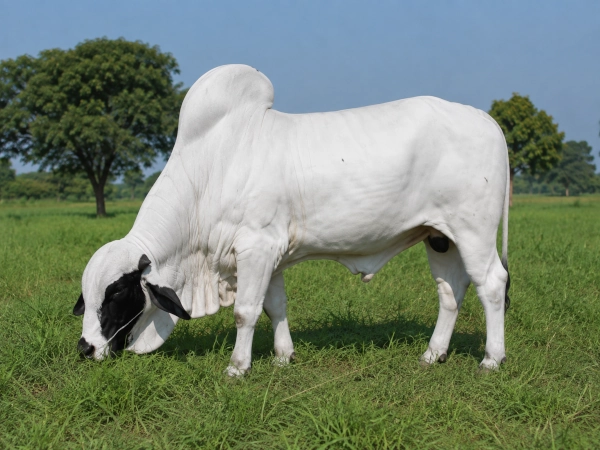
Among the indigenous cattle breeds of the Deccan, the Deoni occupies an important place as a genuinely dual-purpose animal—combining useful milk production in the cow with the strength and body structure required for heavy agricultural work in the bullock.
The breed is principally associated with the Marathwada region of Maharashtra and adjoining northern Karnataka, particularly the wider belt around Latur and Bidar. ICAR’s National Bureau of Animal Genetic Resources officially identifies Maharashtra and Karnataka as the home tract of Deoni cattle.
For generations, this combination of milk and muscle made the Deoni particularly valuable to farmers of the Deccan plateau. A household maintaining Deoni cattle could obtain milk from its cows while raising males capable of ploughing the heavy agricultural soils of the region.
The breed therefore reflects an older Indian farming system in which cattle were expected to perform several economic functions simultaneously rather than being selected solely for maximum milk production.
A Breed of the Marathwada–Karnataka Borderlands
The Deoni is particularly associated with Latur district and neighbouring parts of Maharashtra, along with Bidar and adjoining areas of northern Karnataka.
Research published by ICAR describes Deoni as one of the better-known dual-purpose cattle breeds of southern and western India, with major populations in Latur in southeastern Maharashtra and Bidar in northern Karnataka.
The breed’s distribution reflects geography rather than modern political boundaries.
For centuries, communities across the Deccan moved animals, traded breeding stock and cultivated similar agricultural landscapes extending across what are today Maharashtra, Karnataka and Telangana.
Older livestock literature consequently also records Deoni cattle in adjoining parts of the former Andhra Pradesh region. Tamil Nadu Agricultural University’s breed documentation describes the population as occurring in Marathwada, neighbouring Karnataka and areas further east.
The breed itself takes its name from Deoni, in present-day Latur district of Maharashtra, which became strongly associated with its breeding and development.
Black and White: The Distinctive Deoni Appearance
One of the most striking features of Deoni cattle is their characteristic white-and-black colouring.
Unlike uniformly white breeds such as many Hariana or Tharparkar animals, Deoni cattle frequently possess irregular black patches over a predominantly white body.
The breed is medium-sized, strongly built and unmistakably adapted for dual-purpose use.
Its broad frame and substantial body distinguish it from lighter indigenous dairy types.
The head is proportionate, the ears are moderately large, and the horns are generally short to medium in length. Like other Indian Bos indicus cattle, the breed possesses a prominent hump and developed dewlap.
The overall impression is of an animal that combines dairy characteristics with sufficient skeletal and muscular development for field work.
That body structure was particularly important in the black cotton soils encountered across parts of the Deccan, where ploughing could require considerable draught power.
Deoni Actually Occurs in Three Traditional Types
An especially interesting characteristic of the breed is that traditional Deoni cattle are recognised in three principal colour varieties or strains.
ICAR research identifies these as Wannera, Balankya and Shevera.
Wannera
The Wannera type is predominantly white but possesses characteristic black colouring along the sides of the face.
This facial pigmentation gives the animal a distinctive appearance while the remainder of the body may remain largely white.
Balankya
The Balankya strain is the lightest in colour.
Animals are generally clear or predominantly white, with little of the extensive black spotting seen in other Deoni types.
Shevera
The Shevera type displays perhaps the appearance most commonly associated with Deoni cattle—a white body carrying irregular black patches.
The three varieties demonstrate that an indigenous breed does not necessarily have one rigid colour pattern. Farmer selection over generations can preserve several recognisable forms within the same genetic population.
Modern research continues to recognise all three strains as Deoni cattle.
The Deoni Cow: A Useful Indigenous Milker
Deoni is formally regarded as a milk-and-draught breed. NDDB lists its principal utilities as both dairy production and draught work.
Milk performance varies considerably according to the herd, genetics, feeding conditions and management.
Traditional breed descriptions report lactation yields ranging roughly from 636 to 1,230 kg under different production conditions.
However, results from scientifically managed herds demonstrate substantially better potential.
A study of Deoni cows maintained at the ICAR-National Dairy Research Institute’s Southern Regional Station in Bengaluru between 2002 and 2019 recorded an overall average lactation yield of approximately 997 kg, with the first five or more lactations together producing an average lifetime yield of more than 5,090 kg.
The same research found considerable variation between animals, indicating significant scope for genetic selection.
That is important for the future of the breed.
Deoni should not necessarily be judged by the performance of an average village animal maintained under limited feeding. Its productive potential depends heavily upon identifying genetically superior cows and bulls and propagating those lines systematically.
Some Deoni Herds Show Higher Daily Production
Field studies also demonstrate how management and genetics influence performance.
An ICAR study examining six indigenous cattle breeds maintained by farmers in Karnataka found Deoni to have the highest average daily milk productivity among the breeds studied, at about 3.85 litres per animal per day.
That does not make Deoni a specialised high-output dairy breed comparable with animals bred exclusively for maximum milk volume.
Its significance lies elsewhere.
The breed provides useful quantities of milk while maintaining the body structure, environmental adaptation and working ability traditionally required from a Deccan farm animal.
This balance is precisely what defines a dual-purpose breed.
The Deoni Bullock: Built for Heavy Cultivation
Historically, the great second strength of the Deoni was the working ability of its males.
Agricultural breed descriptions specifically identify Deoni bullocks as suitable for heavy cultivation.
This characteristic was especially valuable in parts of Maharashtra and Karnataka where farmers cultivated deep black soils.
Such soils can become heavy and difficult to work after rainfall. Pulling a traditional plough through them demanded animals with substantial body strength and endurance.
A good Deoni bullock therefore represented far more than an unwanted male calf.
It was an agricultural machine.
Pairs could plough fields, haul agricultural produce, pull carts and perform numerous other tasks around the farm.
Before widespread mechanisation, the economic value of these working animals could be considerable.
Why Dual-Purpose Cattle Made Sense to Indian Farmers
The Deoni illustrates the logic behind many traditional Indian cattle breeds.
A modern specialised dairy operation tends to evaluate cattle principally according to milk production.
The traditional Indian mixed farm worked differently.
The cow produced milk.
The bullock cultivated the land.
Dung fertilised the soil.
Crop residues returned to the cattle as fodder.
Young stock provided future breeding animals or draught power.
The entire system operated as an interconnected agricultural cycle.
Under such circumstances, selecting cattle solely for maximum milk production would not necessarily have been economically optimal.
Farmers instead maintained animals capable of performing several functions reliably under local climatic and feeding conditions.
Deoni cattle were shaped within precisely this system.
Adapted to a Drought-Prone Landscape
Another characteristic of the breed deserves particular attention: its association with drought-prone Marathwada.
An ICAR review describes Deoni as an important cattle breed maintained in one of India’s major drought-affected regions and specifically highlights its potential value as a drought-resistant indigenous genetic resource.
Marathwada experiences highly variable rainfall and periodic water and fodder shortages.
Cattle populations maintained there historically had to cope with fluctuating feed resources, high temperatures and difficult seasonal conditions.
This does not mean Deoni cattle can remain highly productive without proper feeding or water.
No dairy animal can.
Rather, generations of adaptation have made the breed valuable within production systems where environmental conditions are less predictable than those encountered in intensive temperate dairying.
Researchers have consequently suggested further investigation into Deoni genetics associated with heat stress and disease resistance.
Such traits may become increasingly important as Indian livestock production confronts higher temperatures and climatic variability.
Mechanisation Changed the Breed’s Economic Role
Like Hariana, Tharparkar, Kankrej and several other Indian dual-purpose breeds, the Deoni was profoundly affected by agricultural mechanisation.
For generations, producing a strong male calf added value to the farmer’s herd.
The arrival of tractors changed that equation.
Machines gradually displaced bullocks from ploughing, while trucks and tractors replaced cattle carts for rural transport.
The economic value of the draught animal consequently declined.
That left the cow’s milk production carrying an increasingly large share of the breed’s economic justification.
This transition has placed pressure on many dual-purpose indigenous breeds because farmers naturally compare them with specialised dairy animals capable of producing larger volumes of milk.
The challenge is therefore to increase Deoni dairy productivity without destroying the breed through indiscriminate replacement or crossbreeding.
Scientific Selection Can Produce Better Deoni Cattle
Modern breeding technologies offer a way forward.
Rather than replacing the breed, superior animals within the Deoni population can be identified through systematic performance recording.
Milk yield, lactation length, calving interval, disease resistance, fertility and other traits can all be measured and used in selection.
The long-term ICAR-NDRI study of Deoni cows found, for example, that second-lactation milk yield was strongly associated with lifetime milk production, suggesting it could serve as a useful indicator when selecting superior females.
This kind of research represents a major change from purely visual livestock selection.
A farmer may see two animals that look almost identical, yet their genetic potential for milk production can be very different.
Performance recording allows breeding programmes to identify these differences.
Over multiple generations, such selection can gradually increase average productivity while preserving the traits that make the Deoni a Deoni.
Preserving Genetic Diversity Within the Breed
Conservation is particularly important because indigenous cattle populations can suffer genetic erosion when the number of good breeding bulls declines.
ICAR researchers examining Deoni have previously raised concern about shortages of superior breeding males and increasing homozygosity within parts of the population.
Maintaining a sufficiently broad genetic base is crucial.
Simply breeding repeatedly from a small number of animals can eventually concentrate undesirable traits along with desirable ones.
Effective conservation therefore requires a large enough population, identification of unrelated breeding lines, good-quality semen and careful genetic monitoring.
It also requires retaining the different Deoni strains rather than allowing one colour type to replace the others merely because it becomes fashionable.
Wannera, Balankya and Shevera collectively form part of the breed’s heritage and genetic diversity.
Deoni Genetics Are Being Preserved in India’s Gene Banks
Modern conservation now extends beyond maintaining live herds.
ICAR’s National Livestock Gene Bank has cryopreserved semen from Deoni bulls along with genetic material from numerous other indigenous cattle breeds.
This frozen germplasm provides an important long-term insurance policy.
Even if a particular breeding line becomes rare in the field, preserved semen can potentially allow those genetics to be reintroduced into future populations.
ICAR-NBAGR has gone a step further by cryopreserving Deoni somatic cells in its national somatic-cell repository.
Somatic-cell preservation retains the complete diploid genome of individual animals and provides material for future genomic research and potentially advanced reproductive technologies.
Thus a cattle breed once maintained entirely through village breeding systems is now also preserved through modern biotechnology.
Deoni Has Value Beyond Milk Yield Alone
The future value of Deoni cattle should not be reduced to one number on a milk-recording sheet.
Milk productivity certainly matters because farmers must earn an income from maintaining animals.
But indigenous breeds also contain combinations of traits that may become increasingly valuable over time.
These can include adaptation to local feed resources, ability to function in tropical climates, reproductive characteristics, disease resilience and tolerance of environmental stress.
Once such genetic traits disappear, recreating them is extraordinarily difficult.
A breed represents centuries of accumulated biological selection.
The Deoni therefore constitutes not merely an animal population but an agricultural genetic resource.
A Breed Connecting Maharashtra and Karnataka
There is also a cultural dimension to the Deoni.
The breed belongs naturally to a region extending across modern state boundaries.
Its history links the agricultural communities of Marathwada in Maharashtra with northern Karnataka and the wider Deccan plateau.
The animals were shaped not in laboratories but in farmers’ fields—selected repeatedly according to which cows produced useful milk, which bullocks worked effectively and which animals survived difficult local conditions.
This makes the breed a living record of agricultural knowledge accumulated over generations.
Its characteristic black-and-white coat is therefore more than an aesthetic feature.
Behind that appearance lies a cattle population built for the realities of Deccan farming.
From Working Bullock to Climate-Resilient Genetic Resource
The traditional role of Deoni cattle is changing.
The breed will probably never again depend primarily upon large numbers of bullocks pulling ploughs through Maharashtra’s fields.
But that does not make it obsolete.
Its future can increasingly lie in improved indigenous dairying, scientific selective breeding, conservation of native genetics and livestock systems adapted to India’s tropical environment.
The challenge is to combine modern technology with the qualities already present within the breed.
Performance recording can identify superior cows.
Artificial insemination can spread the genetics of outstanding bulls.
Genomic tools can help understand economically important traits.
Cryopreservation can protect genetic diversity.
Better nutrition and veterinary care can allow animals to express their productive potential.
The objective should not be to transform the Deoni into something unrecognisable.
It should be to produce healthier, more productive and genetically stronger Deoni cattle.
A Cattle Breed Created for the Complete Farm
The enduring significance of the Deoni ultimately lies in the balance embodied by the breed.
Its cows provided milk.
Its bullocks supplied power.
Its dung fertilised the soil.
Its ability to cope with a difficult environment allowed farming families to maintain livestock in a region periodically affected by drought.
This was not accidental breeding. It was the result of generations of practical selection.
Modern agriculture has altered the economic importance of some of those traits, but it has not erased their genetic value.
Today, Deoni cattle represent both the agricultural heritage of Maharashtra and Karnataka and a valuable indigenous resource for India’s future livestock economy.
In an age increasingly concerned with climate resilience, sustainable farming and preservation of native animal genetics, the strong black-and-white cattle of the Deccan may have much more to offer than their traditional role suggests.
You may also like
-
India Expands Global Big Cat Conservation as International Big Cat Alliance Opens New Headquarters
-
Satpura Tiger Reserve’s Barasingha Population Crosses 300 as Madhya Pradesh Plans New Wildlife Corridors
-
Karnataka’s Tiger Population Could Cross 700 as New Census Builds on Official Count of 563
-
Project Cheetah Expands as Veerangana Durgavati Tiger Reserve Becomes Madhya Pradesh’s Third Cheetah Habitat
-
Kashmir Markhor Population Rises to 227 as Kazinag Conservation Efforts Show Results
