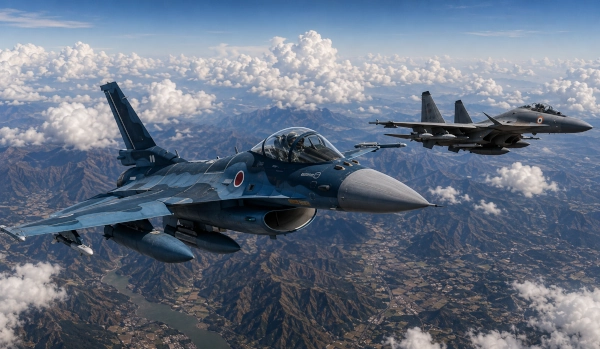
Japan is preparing for what could become a landmark moment in India-Japan defence cooperation, with the Japan Air Self-Defense Force expected to deploy its Mitsubishi F-2 multirole fighters to India for joint air-combat training later in August 2026. If the deployment proceeds as currently reported, it would mark the first time Japanese fighter aircraft actually land and operate from Indian soil, adding a new operational dimension to a defence partnership that has steadily expanded across the Indo-Pacific.
Current reports indicate that Japan plans to send the F-2 fighters to India towards the latter part of August 2026. Japanese Defence Minister Shinjiro Koizumi is expected to begin a visit to India and Australia from around August 17, and the proposed deployment is expected to form part of discussions with Defence Minister Rajnath Singh. The most reasonable exercise window at present is therefore the second half or final week of August 2026, although neither the Indian Air Force nor Japan’s Ministry of Defense has yet publicly released definitive exercise dates. Reporting on August 8 said Tokyo was planning to deploy the aircraft to India “by the end of this month” for joint air training.
The precise Indian airbase has also not yet been officially announced. Jodhpur Air Force Station in Rajasthan is presently one plausible venue, particularly because Jodhpur had been selected to receive Japanese F-2 fighters during Exercise Tarang Shakti in 2024 and already has the infrastructure and experience required to host large international fighter detachments. That should, however, be treated only as an informed possibility rather than a confirmed venue. The IAF could select another operational airbase depending on the training objectives of the bilateral exercise.
This clarification is particularly important because the history of the F-2 and India has often been reported incorrectly. Japan had indeed planned to send its F-2 fighters to India in 2024 for the second phase of Exercise Tarang Shakti at Jodhpur. The Japan Air Self-Defense Force formally announced on August 16, 2024 that F-2 aircraft from its 7th Air Wing would participate in the Indian exercise, and the fighters subsequently began their journey towards India.
The Japanese aircraft even reached Paya Lebar Air Base in Singapore on August 27, 2024, which was intended to be an intermediate stop before the fighters continued towards Rajasthan. Contemporary reporting consequently described their journey as the first Japanese fighter deployment to India.
But the F-2s never completed that journey.
Japan’s Air Self-Defense Force later confirmed that the planned deployment had to be abandoned. Three F-2 fighters intended for Tarang Shakti were unable to proceed from Singapore to India because of a combination of persistent bad weather associated with cyclonic activity over the Bay of Bengal and a technical problem affecting the accompanying KC-767 aerial-refuelling aircraft. Japan’s Air Self-Defense Force chief disclosed in September 2024 that the fighters had therefore failed to reach India. Had the deployment succeeded, it would have been the first visit of Japanese fighter aircraft to the country.
That failed mission makes the proposed 2026 deployment considerably more significant than it initially appears. Rather than being the second visit of Japanese F-2s, the forthcoming exercise could finally accomplish what Japan attempted two years earlier: put JASDF fighters on an Indian airbase and conduct combat training directly from Indian soil.
India and Japan are nevertheless far from strangers when it comes to fighter operations. Their first dedicated bilateral fighter exercise, Veer Guardian 2023, was conducted in Japan from January 16 to 26, 2023. The Indian Air Force sent four Su-30MKI fighters, supported by C-17 transport aircraft and an IL-78 aerial refueller, while Japan fielded four F-2s and four F-15 fighters. The exercise included complex air-combat missions and gave both air forces an opportunity to train against aircraft and tactical philosophies very different from their own.
The next logical step was for Japan to bring its fighters to India. That was supposed to happen during Tarang Shakti 2024. The weather and tanker malfunction prevented it. The 2026 deployment therefore represents a continuation of a process that began with Indian fighters travelling to Japan and is now likely to result in Japanese fighters operating from India.
The Mitsubishi F-2 itself makes the exercise particularly interesting. Although its appearance clearly reflects its origins in the American F-16 programme, the F-2 is substantially more than an F-16 produced under licence. Japan and the United States jointly developed the aircraft around Japanese operational requirements, with Mitsubishi Heavy Industries playing the central industrial role. The F-2 uses a larger wing, extensive composite materials, Japanese avionics and an electronically scanned radar architecture that made Japan one of the earliest countries to operationally field an AESA radar on a fighter.
Japan developed the aircraft with particular emphasis on air defence and maritime strike, missions shaped by the country’s island geography and enormous maritime approaches. The F-2 can employ Japanese anti-ship missiles and forms an important component of the JASDF’s conventional combat force alongside the F-15J and increasingly the F-35.
For the Indian Air Force, training against the F-2 provides exposure to a fighter that represents a very different operational philosophy from the Su-30MKI. The Indian aircraft is a large, twin-engine, long-endurance heavyweight fighter with enormous weapon-carrying capacity and exceptional manoeuvrability. The F-2 is a smaller single-engine fighter intended to function within Japan’s highly networked air-defence structure, where airborne warning aircraft, ground-based sensors, electronic warfare and datalinks play an increasingly important role.
Exercises involving these aircraft therefore have value far beyond traditional visual-range dogfighting. Modern fighter warfare increasingly depends upon which force can detect, classify and engage the opponent first while denying the adversary the same information. Radar employment, electronic countermeasures, datalink tactics, airborne early-warning integration and beyond-visual-range engagements may consequently be considerably more valuable than spectacular close-range manoeuvring.
India also brings something unique to the relationship. The IAF operates one of the world’s most varied fighter fleets, combining Russian Su-30MKIs and MiG-29s, French Rafales and Mirage 2000s, Anglo-French Jaguars and indigenous LCA Tejas aircraft. Japanese pilots normally operate within an overwhelmingly American-derived technological ecosystem built around F-15s, F-2s and F-35s. India therefore provides access to platforms, sensors and tactical approaches that JASDF pilots would rarely encounter in their routine training environment.
For Indian pilots, Japan offers the reverse opportunity. The JASDF operates within one of the world’s most sophisticated integrated air-defence environments, backed by extensive ground radar coverage, airborne warning aircraft and close networking with United States forces operating in the western Pacific. Experience gained through training with Japan can expose Indian personnel to different methods of conducting networked air warfare and large-scale air defence.
The timing is also strategically important. India and Japan are expanding defence cooperation far beyond occasional military exercises. Their armed forces conduct naval, land and air engagements, while both governments are simultaneously attempting to deepen defence-industrial and technology cooperation. Japan views India as an increasingly important security partner stretching across the Indian Ocean and Indo-Pacific, while New Delhi sees Tokyo as a technologically sophisticated partner that can contribute to India’s defence modernisation without requiring India to enter a formal military alliance.
The Northeast and eastern Indian theatre inevitably add another strategic dimension to the relationship because of their proximity to China and Southeast Asia, although there is currently no reliable official confirmation that the F-2 exercise itself will take place in Northeast India. Any claim naming an Assam or eastern-sector base at this stage should therefore be treated cautiously unless the IAF or JASDF subsequently confirms it.
If Jodhpur is eventually selected, there would be a certain historical symmetry. The same airbase that was waiting for Japanese fighters during Tarang Shakti 2024 could finally receive them two years later. Jodhpur also offers extensive airspace and established infrastructure for multinational fighter training, making it an entirely logical candidate. Nevertheless, until the exercise notification is released, Jodhpur should be described as a probable or possible venue, not as the confirmed venue.
The most likely timeline is clearer. Japan’s current plans point towards the second half of August 2026, probably after or around Defence Minister Koizumi’s India visit beginning around August 17, with current reporting placing the deployment before the end of August.
China has already taken notice. Chinese state-linked commentary has portrayed the prospective deployment as evidence of growing military coordination between Tokyo and New Delhi. Such commentary reflects Beijing’s strategic interpretation rather than the officially stated purpose of India-Japan defence cooperation, but the attention itself demonstrates how closely military exchanges between the two Asian powers are now being watched.
The significance of the exercise should therefore not be reduced to the novelty of an unfamiliar Japanese fighter appearing at an Indian airbase. Repeated exercises generate operational familiarity. Pilots learn one another’s terminology and tactical methods. Ground crews learn how to support foreign aircraft. Controllers learn how different formations respond to rapidly changing combat situations. Mission planners learn how another air force thinks.
Those relationships cannot be improvised during a crisis. They have to be built progressively during peacetime.
Veer Guardian 2023 began that process at fighter level when Indian Su-30MKIs flew to Japan and trained with Japanese F-2s and F-15s. Japan attempted to reciprocate in 2024, but weather and an aerial-refuelling problem prevented the F-2s from completing their journey from Singapore to Jodhpur.
The proposed August 2026 deployment therefore represents unfinished business.
If the F-2s land in India this time, it will not merely be another international fighter exercise.
It will mark the first successful deployment of Japanese combat aircraft to Indian soil, completing a military exchange attempted two years earlier and opening the door to a more regular cycle of bilateral fighter training between the Indian Air Force and Japan Air Self-Defense Force.
The deeper story is not simply that Japanese F-2s are coming to India.
It is that two of Asia’s most important air forces are moving steadily from diplomatic defence cooperation towards practical combat interoperability in the skies of the Indo-Pacific.
You may also like
-
Exercise Tarang Shakti 2026 Concludes in Jodhpur, Showcasing India’s Air Power, Indigenous Defence Technology
-
US Double Standards in Foreign Policy: 16 Recent Cases Involving India, Russia, China and Global Trade
-
Indian Navy Vice Chief Inspects Japan’s Mogami-Class Stealth Frigate as India-Japan Shipbuilding Cooperation Expands
-
Philippine Marine Wargames Reportedly Show BrahMos Can Penetrate Chinese Destroyer Air Defences
-
Safran Signs 18 Agreements with Indian Aerospace Suppliers, Expanding Make in India Manufacturing Partnerships
