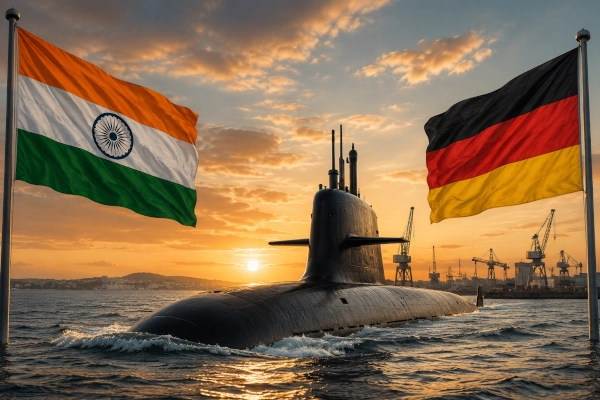
One of India’s most important naval modernisation programmes is approaching a decisive stage, with India and Germany moving towards finalising the long-awaited Project 75(I) programme for six next-generation conventional submarines.
The proposed agreement brings together India’s state-owned Mazagon Dock Shipbuilders Limited (MDL) and German submarine specialist ThyssenKrupp Marine Systems (TKMS). The six submarines are planned to be constructed in India, substantially expanding domestic expertise in designing, integrating and manufacturing advanced underwater platforms.
German Ambassador to India Philipp Ackermann said recently that the agreement could be concluded soon, with reports placing its current value at around €8 billion, or more than ₹90,000 crore. Earlier Indian reporting placed the acquisition cost closer to ₹70,000 crore, reflecting differences in estimates as negotiations, equipment packages and escalation have progressed.
Project 75(I): Much More Than Six Submarines
Project 75(I), or P-75I, was conceived not simply as an overseas purchase but as an attempt to establish a substantially deeper submarine-building capability inside India.
The Ministry of Defence originally issued the formal Request for Proposal in 2021 for six conventionally powered submarines equipped with fuel-cell Air Independent Propulsion.
The requirement includes advanced torpedoes, missiles, modern sensors, countermeasure systems, shore support, training and engineering support.
Under the emerging arrangement, MDL will be the principal Indian shipbuilder, while TKMS will supply German submarine technology, engineering support, important components and the AIP system.
TKMS confirmed in September 2025 that formal contract negotiations had begun and that the two companies had already completed work under their Concept Design Agreement. The German company also submitted binding offers covering engineering services, submarine components, AIP and combat-system solutions.
Based on Germany’s Type 214 Family
The Indian submarine is expected to be based on an advanced derivative of the German Type 214, one of TKMS’s established export submarine families.
TKMS itself identifies its next-generation 214NG as an advanced AIP-equipped export design and specifically links its cooperation with Mazagon Dock to India’s P-75I programme.
The final Indian configuration, however, will not simply be an off-the-shelf Type 214.
The submarine is expected to be adapted around Indian Navy requirements, with substantial construction, integration and localisation taking place in India.
That distinction is important.
India is not merely seeking six completed German submarines delivered from Kiel. The objective is to build the boats in Mumbai, develop Indian industrial capability and absorb technologies that can contribute to future submarine programmes.
Fuel-Cell AIP Is the Centrepiece
The defining capability of Project 75(I) is Air Independent Propulsion, or AIP.
A conventional diesel-electric submarine normally uses batteries while submerged. Eventually those batteries must be recharged by operating diesel generators, requiring the submarine to surface or raise a snorkel.
That creates vulnerability.
Radar, electro-optical systems, aircraft, satellites and anti-submarine forces can potentially detect a snorkeling submarine.
AIP dramatically extends the amount of time a conventional submarine can remain underwater without operating its diesel engines.
TKMS has decades of experience with fuel-cell-based AIP, and the Indian requirement specifically sought a proven fuel-cell system.
For the Indian Navy, this would provide a major increase in submerged endurance compared with traditional diesel-electric operations.
Why AIP Matters in the Indian Ocean
The Indian Ocean presents enormous operating distances.
An Indian submarine may be required to patrol approaches to the Arabian Sea, Bay of Bengal, Andaman Sea or strategically important sea lanes extending towards Southeast Asia.
Stealth becomes the submarine’s greatest protection.
The longer a boat can remain underwater without exposing a snorkel, the harder it becomes for an adversary to establish its position.
An AIP-equipped conventional submarine could therefore spend extended periods quietly waiting near choke points, monitoring naval movements or positioning itself for anti-surface and anti-submarine operations.
Unlike nuclear submarines, conventional AIP submarines can also be exceptionally quiet at low speeds, making them formidable platforms in confined waters and littoral environments.
Modern Weapons and Sensors
The Ministry of Defence’s original P-75I requirement called for submarines equipped with advanced torpedoes, modern missiles and state-of-the-art countermeasures.
The precise final Indian weapons configuration has not been publicly disclosed.
That is worth stressing because numerous reports have speculated about particular Indian missiles, vertical-launch systems and future weapons. Until the final configuration is officially disclosed, such details should not be treated as confirmed.
What is clear is that the Navy expects P-75I to perform the major missions required of a modern attack submarine:
anti-submarine warfare, anti-surface warfare, surveillance, intelligence gathering, sea denial and special operations.
Its combat system will have to integrate the submarine’s sonar, weapons, navigation equipment and electronic sensors into a single tactical picture.
A Major Technology-Transfer Programme
The industrial element could ultimately prove almost as important as the submarines themselves.
TKMS has publicly described P-75I as a programme supporting domestic naval capability and international technology transfer.
Submarine construction involves some of the most demanding engineering found anywhere in defence manufacturing.
India would gain further experience in areas such as:
- pressure-hull fabrication,
- submarine systems integration,
- hydrodynamic design,
- propulsion integration,
- acoustic management,
- combat-system installation,
- quality control,
- specialised underwater engineering.
MDL already possesses substantial experience from constructing the Kalvari-class Scorpene submarines in India.
P-75I could allow that expertise to progress into another generation of submarine technology rather than letting the industrial infrastructure built around the Kalvari programme become underutilised.
India and Germany Already Have Submarine History
The partnership would also revive an old connection.
India’s Shishumar-class submarines originated from the German HDW Type 209 design. Two were built in Germany while subsequent boats were constructed at Mazagon Dock in Mumbai.
TKMS is the successor to the German submarine-building industrial lineage behind those boats.
Project 75(I) would therefore reconnect the Indian Navy and MDL with German submarine technology after several decades — but at a considerably more advanced technological level.
Why India Needs the Boats
The programme comes at an important moment for the Indian Navy.
India’s conventional submarine fleet includes the modern Kalvari-class boats together with older Russian-origin Sindhughosh-class and German-origin Shishumar-class submarines.
Several of those older platforms will inevitably approach retirement as P-75I progresses.
At the same time, underwater competition in the Indian Ocean is intensifying.
China operates one of the world’s largest submarine fleets and continues to expand both its nuclear and conventional underwater forces. Chinese naval vessels have also operated increasingly frequently across the wider Indian Ocean.
Pakistan, meanwhile, is modernising its own submarine force with Chinese assistance.
India therefore needs both numerical strength and technological improvement below the surface.
Six highly capable AIP submarines will not by themselves solve every long-term fleet requirement, but they would form an important part of a much larger submarine-modernisation strategy.
P-75I and Project 76
The longer-term significance of the German partnership becomes clearer when viewed alongside Project 76, India’s planned indigenous next-generation conventional submarine.
Project 75(I) can help sustain domestic submarine production while India simultaneously develops the engineering and industrial ecosystem necessary for increasingly indigenous designs.
That progression is critical.
India has already demonstrated considerable success in designing nuclear-powered ballistic-missile submarines under the Arihant programme. Developing an independently designed modern conventional attack submarine is the next major industrial challenge.
Knowledge accumulated through Kalvari construction, P-75I and indigenous programmes can gradually reduce dependence on foreign submarine designs.
An Indo-German Strategic Partnership Beneath the Waves
For Germany, the deal would represent one of its largest defence-industrial partnerships with India and a major international success for TKMS.
For India, the attraction extends beyond access to a proven submarine design.
Germany possesses expertise in precisely the area India urgently requires: highly stealthy conventional submarines with mature fuel-cell AIP technology.
The programme therefore provides a convergence between India’s need for advanced underwater capability and Germany’s technological strength.
The proposed agreement also comes as defence relations between New Delhi and Berlin have broadened considerably, with both governments increasingly viewing industrial cooperation as an important element of their strategic relationship.
The Deal Is Close — But Not Signed Yet
Reports in late July quoted German Ambassador Philipp Ackermann saying that he expected the P-75I agreement to be signed soon, potentially as early as August 2026.
The programme has already passed through extensive technical and commercial negotiations. India’s Finance Ministry was reported in May to have cleared a proposal valued at around ₹70,000 crore, leaving the programme to proceed through the remaining high-level approval process.
However, until the Government of India formally announces Cabinet approval and contract signature, the programme should still be described as nearing conclusion rather than a completed ₹90,000-crore purchase.
That distinction matters in a defence procurement programme that has already taken years to reach this stage.
A Critical Step in Rebuilding India’s Underwater Strength
Project 75(I) is ultimately about more than acquiring six submarines.
It is about maintaining a continuous submarine-building capability inside India.
It is about introducing proven fuel-cell AIP into the Navy’s conventional submarine force.
It is about transferring manufacturing and engineering knowledge to Indian industry.
And it is about preparing the industrial foundation from which increasingly indigenous submarines can eventually emerge.
If the India-Germany agreement is concluded in the coming weeks, six German-derived submarines built at Mazagon Dock could become the bridge between today’s Kalvari-class fleet and India’s future generation of domestically designed underwater warships.
References
Ministry of Defence / PIB — Project 75(I) RFP: Six AIP-equipped conventional submarines with modern weapons, sensors and countermeasures under the Strategic Partnership model.
TKMS — September 11, 2025: Official confirmation that TKMS and Mazagon Dock entered contract negotiations for six German-designed P-75I submarines and completed the Concept Design Agreement.
TKMS corporate presentation: Identifies the 214NG as its advanced AIP export submarine and specifically links MDL cooperation to India’s P-75I programme.
Economic Times — July 30, 2026: German Ambassador Philipp Ackermann says the roughly €8-billion/₹90,000-crore agreement could be signed soon.
Hindustan Times — May 29, 2026: Reports Finance Ministry clearance for the submarine proposal and movement towards final CCS consideration.
You may also like
-
Exercise Tarang Shakti 2026 Concludes in Jodhpur, Showcasing India’s Air Power, Indigenous Defence Technology
-
Indian Navy Vice Chief Inspects Japan’s Mogami-Class Stealth Frigate as India-Japan Shipbuilding Cooperation Expands
-
Philippine Marine Wargames Reportedly Show BrahMos Can Penetrate Chinese Destroyer Air Defences
-
Safran Signs 18 Agreements with Indian Aerospace Suppliers, Expanding Make in India Manufacturing Partnerships
-
Indian Army’s Vajra Corps Certifies First Batch of Drone Operators, Strengthens Battlefield Surveillance
